1. The Jewel Box Approach — Small but Completely Magnificent
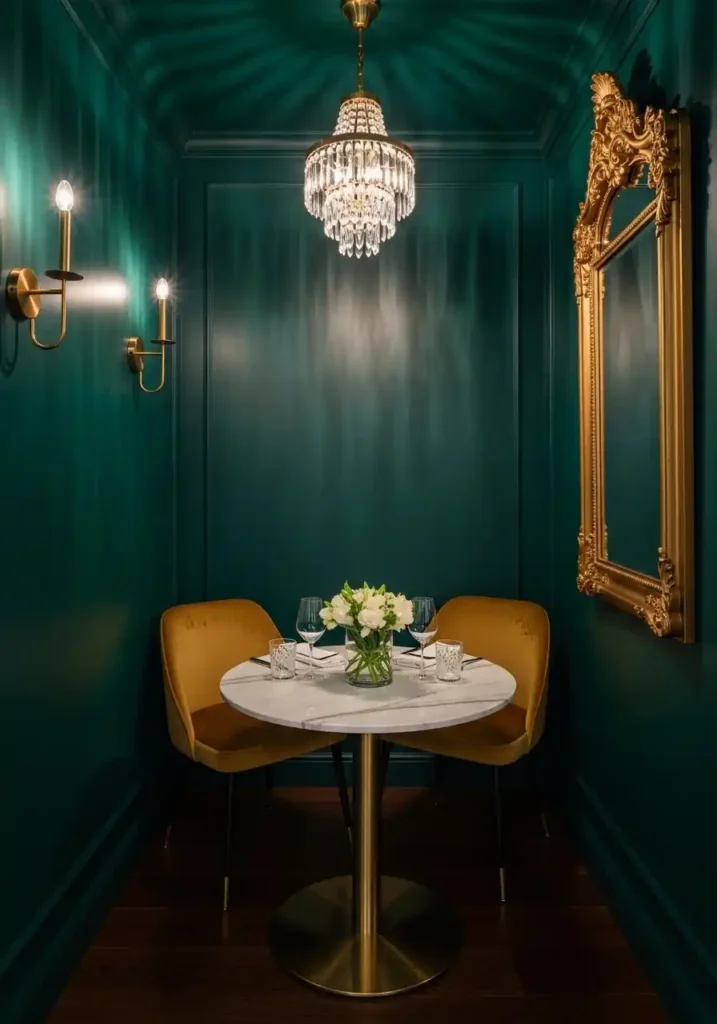
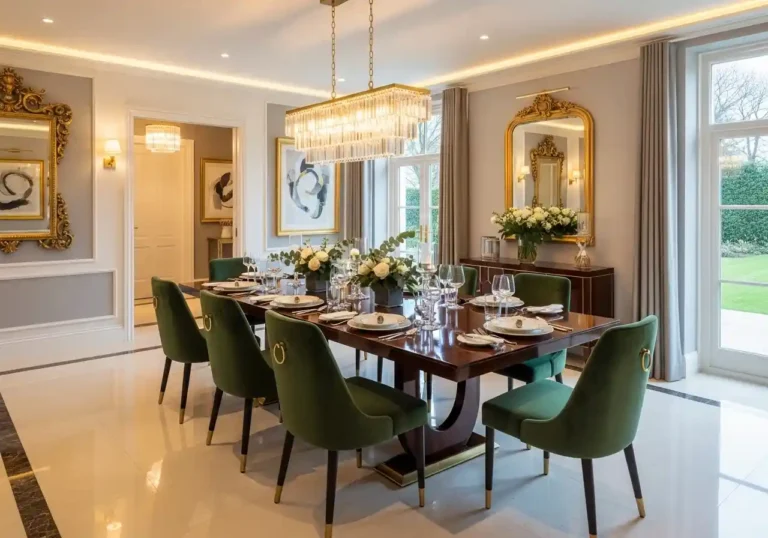
The jewel box approach to a tiny dining room is the design philosophy that flips the entire small-space conversation completely on its head — because instead of trying to make the Tiny Dining Room Ideas feel bigger than it is, it leans fully, joyfully, and unapologetically into the room’s smallness and treats it as the room’s greatest asset rather than its defining limitation. A tiny room that has been deliberately, richly, completely decorated from floor to ceiling in opulent materials, deep colors, and genuine luxury finishes doesn’t feel small — it feels intimate, exclusive, and extraordinarily special in exactly the way that a tiny private dining room in the world’s finest restaurants always feels.
The jewel box approach requires a specific kind of design courage — the willingness to commit completely to richness and depth without the safety net of pale walls and neutral furniture that most small-space decorating advice defaults to — and the results consistently reward that courage with a room of such concentrated, atmospheric magnificence that everyone who experiences it immediately understands why the room’s tiny size is not a compromise but a genuine, irreplaceable quality. Deep emerald walls. A small marble table. A crystal chandelier. An ornate gilt mirror. Every surface finished to perfection. This is the tiny dining room that nobody ever wants to leave.
2. Floating Everything for Maximum Floor Visibility
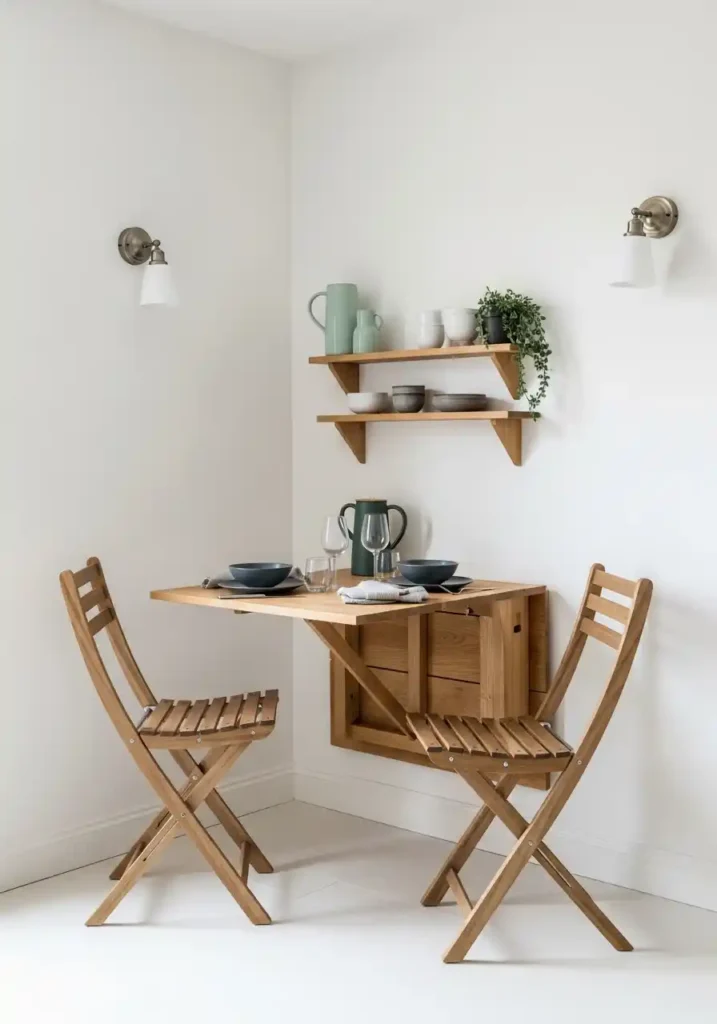
Floating everything in a tiny dining room — mounting the table to the wall, hanging the chairs on hooks, installing the storage as floating shelves, and putting all lighting on wall sconces — is the radical spatial approach that eliminates the primary visual and physical factor that makes tiny rooms feel cramped: furniture legs on the floor. When the floor of a tiny dining room is completely and entirely clear of every furniture leg, every furniture base, and every object that isn’t a human foot, the room achieves a state of spatial openness that feels genuinely extraordinary given its actual square footage. The uninterrupted floor plane creates a visual spaciousness that reads as twice the actual room size.
The practical magic of a fully floating tiny dining room is that the space performs multiple functions with complete flexibility — because a wall-mounted drop-leaf table that folds flat against the wall when not in use and two folding chairs that hang on wall hooks when not deployed create a room that is simultaneously a proper dining room when meals require it and a completely open, multi-purpose space when they don’t. This dual-function quality is the tiny dining room’s greatest possible achievement — a room that is dining room, yoga space, children’s play area, home office, and reading room all within the same footprint, shifting between roles in under sixty seconds without any furniture moving across the floor.
3. Bold Black Walls for Unexpected Drama
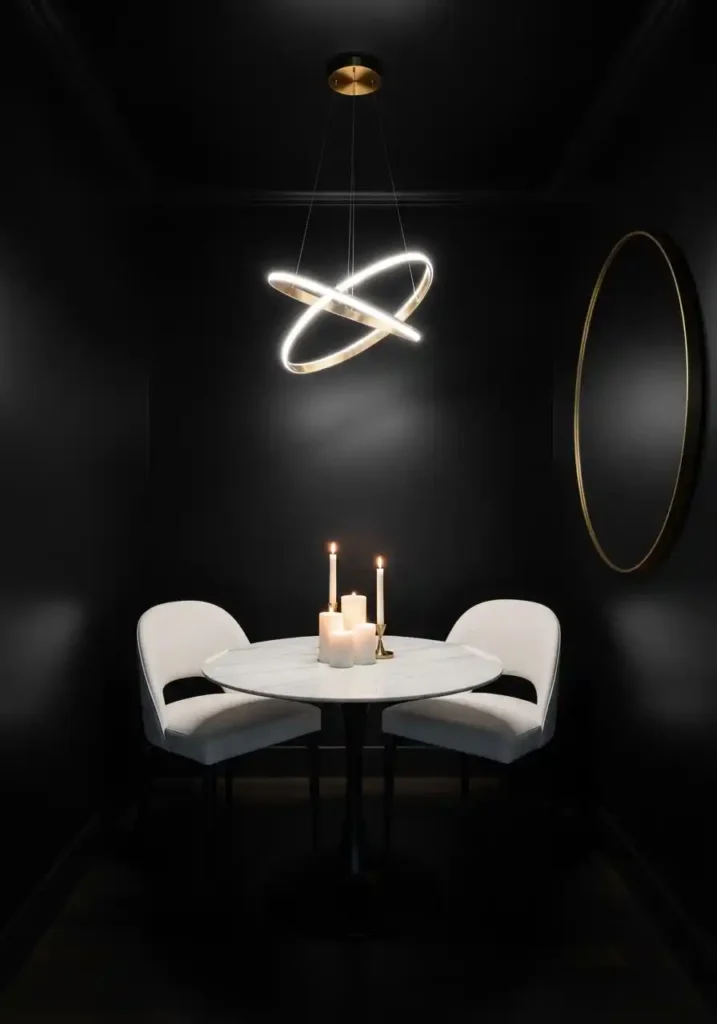
Bold black walls in a tiny dining room is the design decision that stops every interior design conversation cold — because the instinctive response is that black walls in a tiny room must be catastrophically claustrophobic, and the actual experience of a beautifully executed black tiny dining room is so completely opposite to that expectation that the transformation is genuinely shocking in the best possible way. Matte black walls absorb light and create a visual depth that makes the boundaries of a tiny room seem to recede into darkness rather than to press in close, and that quality of apparent depth makes the room feel more spatially interesting and more atmospherically generous than pale walls in the same footprint.
The specific genius of black walls in a tiny dining room is the way they make every other element in the space glow with an intensity and a beauty that those same elements could never achieve against a pale backdrop. A white marble table against black walls looks like a photograph of a white marble table — every vein, every tonal variation, every polished edge rendered with extraordinary clarity and visual presence. A brushed gold pendant against a black ceiling doesn’t just hang there — it radiates warm amber light that fills the dark room with a quality of warm intimacy that makes every meal feel like the most special one you’ve ever shared. Black walls don’t shrink the tiny dining room — they transform it into the most atmospheric room in the house.
4. A Bistro Table and Two Chairs for Pure Parisian Charm
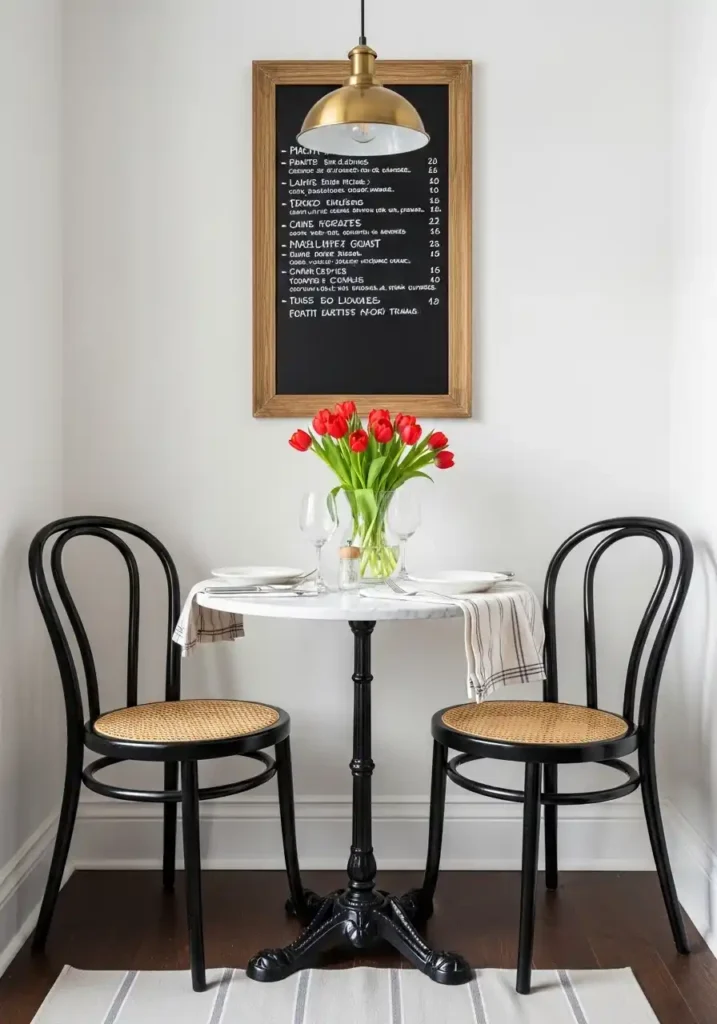
A bistro table and two beautiful chairs in a tiny dining space is the approach that stops apologizing for the room’s limited size and instead celebrates it as the defining quality of one of the world’s most beloved and most romanticized dining formats — the intimate Parisian café corner where two people share a meal in such close, warm proximity that every conversation feels private, every glance feels meaningful, and every shared bottle of wine feels like the beginning of something wonderful. The tiny dining room styled as a bistro corner is not making a virtue of necessity — it is recognizing that some of the most pleasurable dining experiences in the world happen at tables for two, and designing the room to celebrate that truth.
The Parisian bistro aesthetic achieves its magic through a combination of classic, enduring furniture forms — the marble-topped table on black iron legs, the rattan-seated café chair — with details of such romantic charm and such casual elegance that the entire corner feels like it was transported directly from the streets of Montmartre into your home. A small chalkboard on the wall behind the table with a handwritten menu or a daily quote. Fresh flowers in a simple vase. A striped linen tablecloth. A brass pendant above casting warm, flattering light. These details cost almost nothing and transform a tiny dining corner into the most charming, most frequently used, and most deeply loved spot in the entire home.
5. Mirrored Wall That Creates an Infinite Dining Room
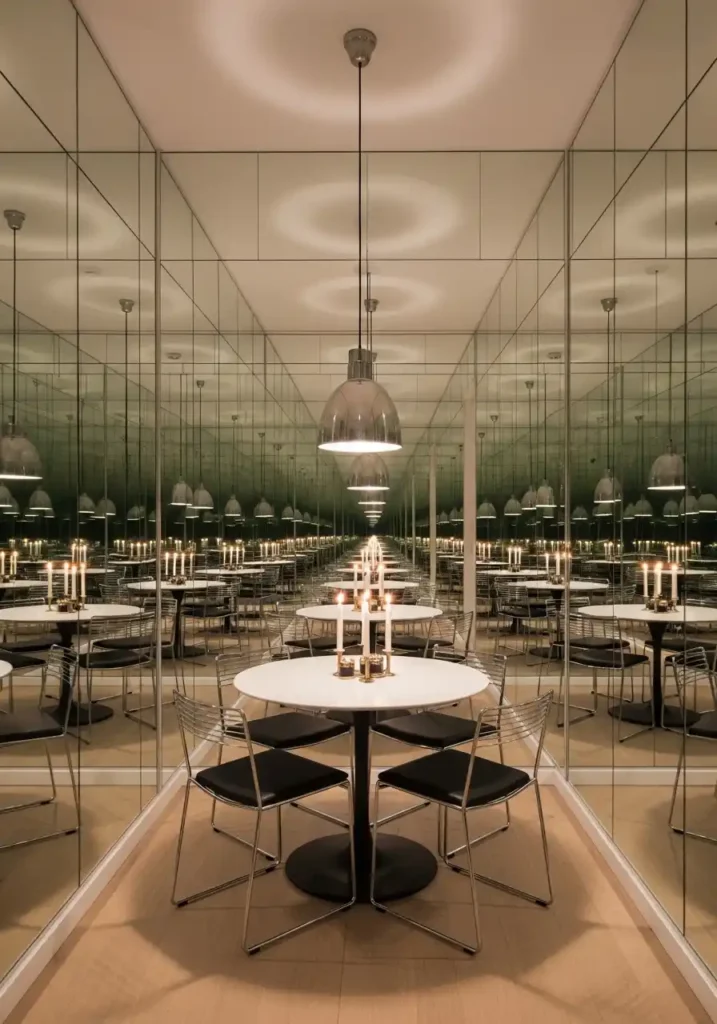
A full wall of floor-to-ceiling mirror in a tiny dining room is the spatial transformation that produces the most dramatic, most immediately convincing, and most genuinely extraordinary improvement in apparent room size of any single decorating intervention — not because it adds visual interest or creates a focal point but because it literally doubles the room. The reflected dining table, the reflected chairs, the reflected pendant light, and the reflected view through the opposite window all combine to create an apparent dining room of twice the actual square footage, and the human eye and brain accept this reflected space as genuinely real in a way that is both fascinating and completely convincing.
The practical installation of a full mirrored wall in a tiny dining room is most beautifully achieved with large-format mirror panels rather than small, grid-like mirror tiles — because large panels create the most seamless, the most convincing, and the most genuinely window-like reflection that makes the mirrored wall feel like a genuine opening into another space rather than a decorated surface applied to a flat wall. The mirrored wall is most effective when positioned on the wall that the dining table most directly faces, so that seated diners look into the full reflection of themselves, their companions, the table, and the room — creating a dining experience that feels simultaneously intimate and expansive, private and endlessly deep.
6. Hanging Pendant as the Room’s Only Decoration Needed
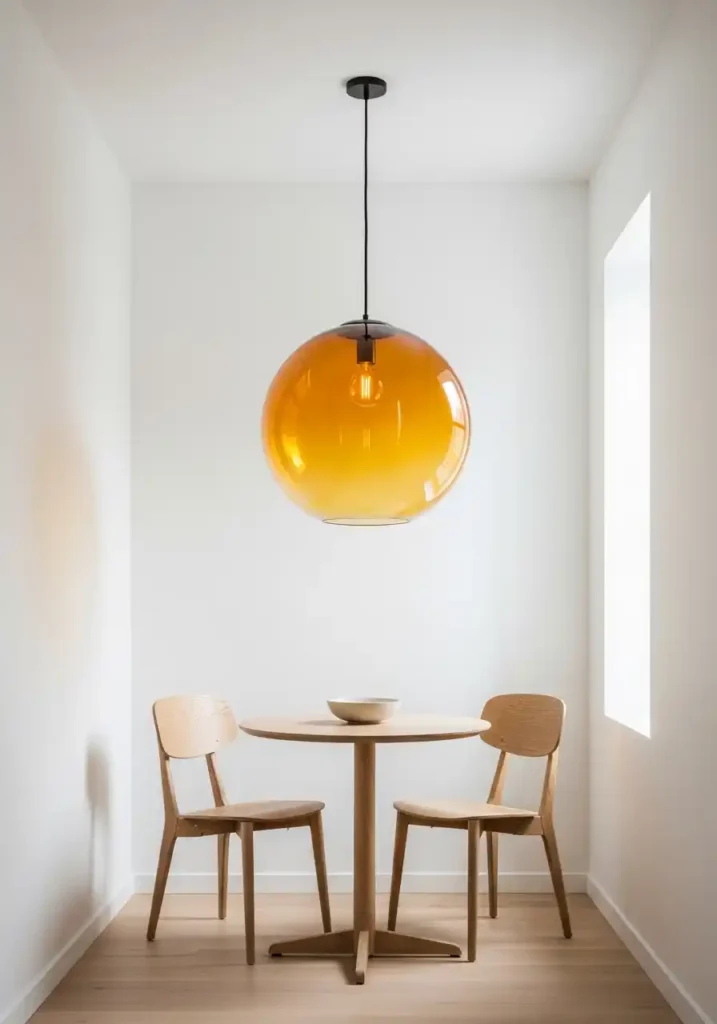
There is a specific type of design confidence that expresses itself through radical simplicity — the decision to choose one element of genuine, extraordinary beauty and allow it to be the complete and sole design statement of a tiny dining room, trusting that one perfect thing is infinitely more powerful and more impressive than many ordinary things competing for attention in a limited space. A spectacular pendant light in a tiny dining room is the single element most capable of carrying this complete design responsibility — because it hangs from the ceiling, it doesn’t consume floor space, it provides functional illumination while serving as the room’s entire decorative identity, and when it is genuinely magnificent, it makes the room genuinely magnificent simply by being present within it.
The handblown glass pendant — particularly in warm amber, deep cobalt, or rich forest green — is the specific pendant type that transforms a tiny dining room most completely and most beautifully through sheer material presence. Handblown glass has an organic irregularity, a warmth, and a quality of translucent depth that mass-produced glass or any other pendant material cannot replicate — and when that glass glows from within with a warm light source, it becomes the most beautiful object in the room by an enormous margin. Hang it low — closer to the table than feels immediately comfortable — so it fills the vertical space above the dining table with maximum presence and maximum warm light. Everything else in the room can be perfectly simple, perfectly minimal, and perfectly fine.
7. Banquette Corner Built for Two with Maximum Storage
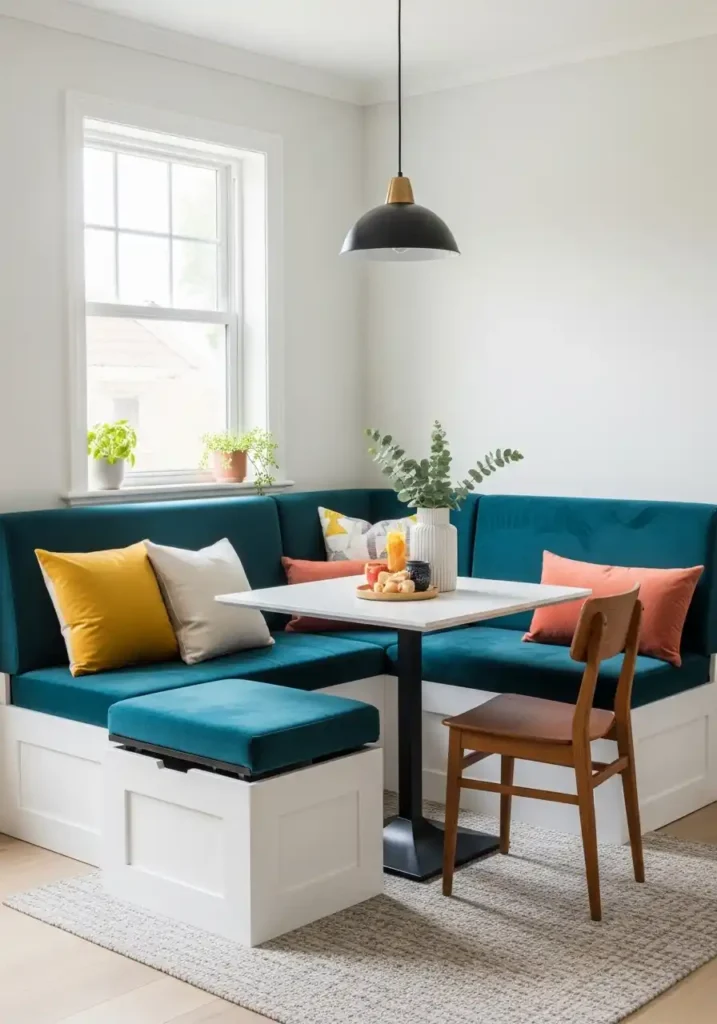
A custom L-shaped banquette built into the corner of a tiny dining room is the spatial transformation that makes the most complete and most comprehensive use of the room’s available square footage of any furniture arrangement possible — because it places the seating directly against two walls simultaneously, eliminating chair-pullout clearance requirements on both banquette sides, tucks the storage beneath the seat cushions rather than into separate furniture pieces that would consume additional floor area, and creates a dining arrangement of such intimate coziness that the tiny room’s limited size stops feeling like a constraint and starts feeling like the specific quality that makes the corner so warm, so enclosed, and so perfectly right for the act of sharing a meal in close, comfortable proximity.
The storage capacity beneath a corner banquette in a tiny dining room is genuinely significant and genuinely liberating — because lift-up seat cushions on both arms of the L-shape provide two large, deep storage compartments that can accommodate an extraordinary quantity of dining room essentials that tiny rooms otherwise have no dedicated place to store. Table linens, seasonal tableware, napkins, placemats, children’s craft supplies, board games, and any number of other household items can disappear beneath the banquette cushions, keeping the tiny dining room’s limited surface and floor areas completely clear of the clutter that makes small spaces feel overwhelmed and claustrophobic. The banquette corner is a tiny dining room design working at its most intelligent and its most beautiful simultaneously.
8. Monochromatic Terracotta for Warmth and Cohesion
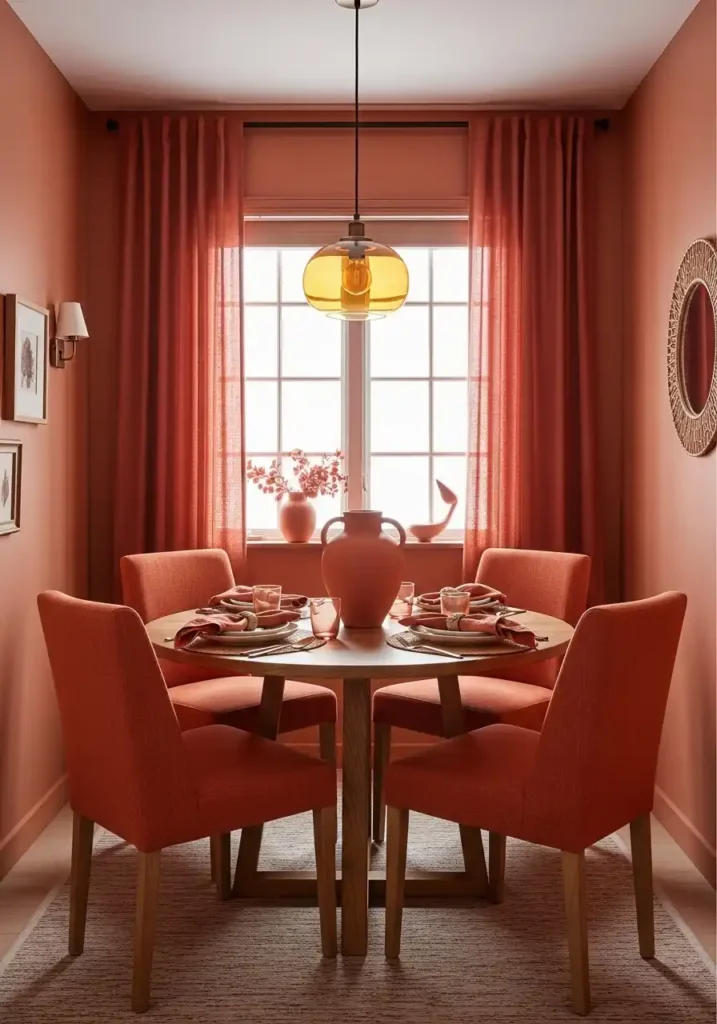
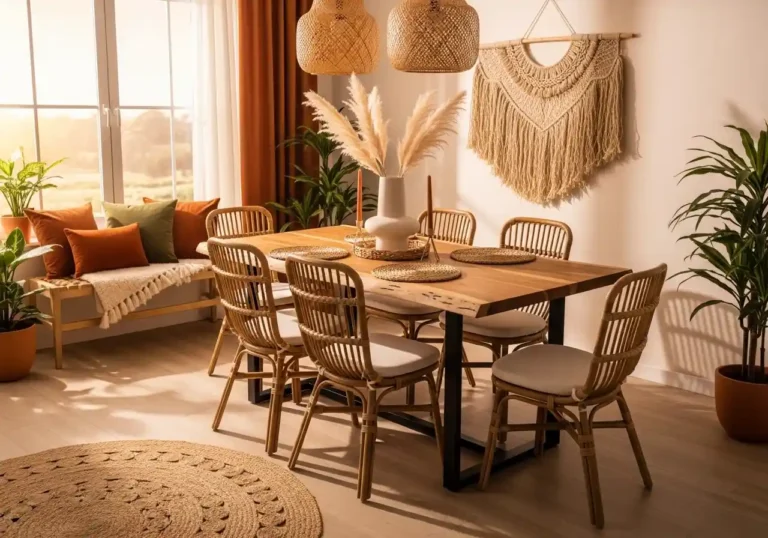
Monochromatic terracotta in a tiny dining room is the color approach that simultaneously solves the two fundamental design challenges of compact dining spaces — making the room feel visually larger through tonal continuity while making it feel genuinely, deeply warm and inviting through the specific quality of terracotta’s rich, earthy, sun-baked tone. When the walls, the furniture, the textiles, and the accessories all exist within the same warm orange-brown color family, the eye travels seamlessly from surface to surface without encountering the visual interruptions and boundaries that make rooms feel compartmentalized and small. The tiny room reads as a single, continuous, beautifully colored environment rather than a collection of separate elements competing for space.
Terracotta is the specific monochromatic color that works most magnificently in a tiny dining room context because of its extraordinary range of beautiful tonal expression within a single color family — from the palest dusty peach through warm clay to the richest, deepest burned sienna — and the variation available within this family provides all the visual interest and all the tonal depth that a fully monochromatic room needs to feel rich and multi-layered rather than flat and monotonous. Layer terracotta limewash walls against terracotta upholstered chairs against a warm wood table in terracotta tones against terracotta ceramic accessories, and the tiny dining room becomes a room of such concentrated, earthy, organic warmth and beauty that it feels like the most nourishing possible environment for sharing food and conversation.
9. Vertical Shiplap for Rustic Height and Character
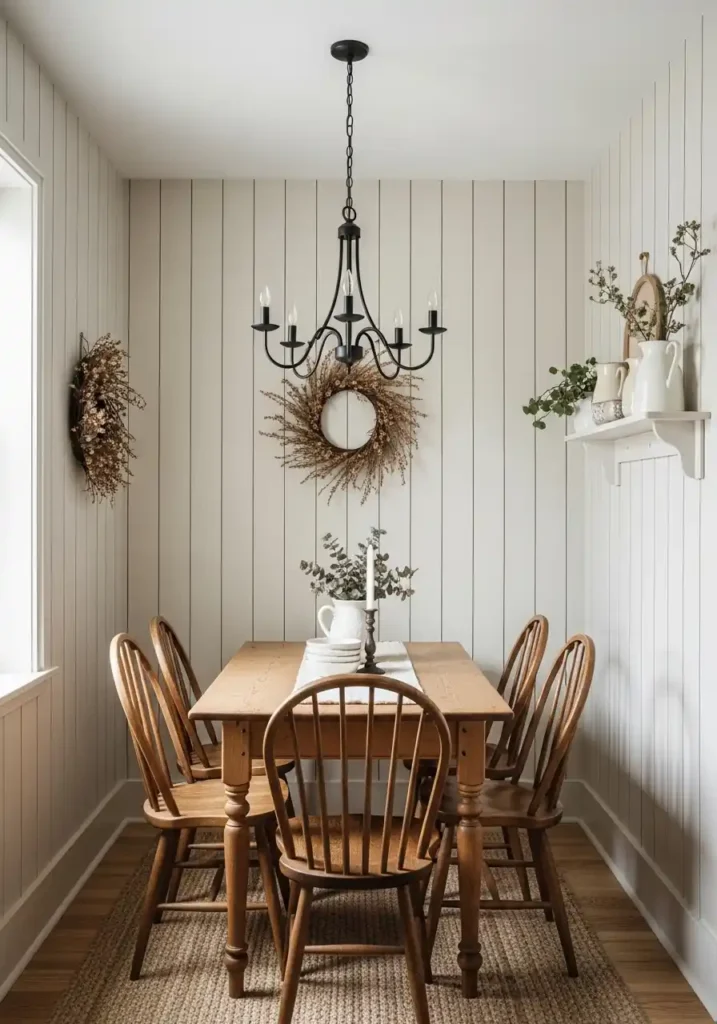
Vertical shiplap paneling in a tiny dining room is the wall treatment that earns its installation effort many times over by delivering simultaneously the strong upward visual emphasis that makes the ceiling feel higher, the organic texture and shadow play that makes flat walls feel architecturally rich and interesting, and the warm, characterful farmhouse personality that makes the tiny room feel like a space of genuine historical warmth and charm rather than a merely compact modern dining room. The vertical boards create a rhythm of shadow and highlight that runs from floor to ceiling on every wall, drawing the eye continuously upward and creating a sense of the room extending vertically in a way that horizontally paneled rooms, however beautiful, cannot achieve.
Painting vertical shiplap in a tiny dining room in a soft, warm white — not a blue-white or a cold stark white but a white with genuine cream and warmth in its undertones — creates the ideal combination of spatial lightness and material character. The white reflects and amplifies the natural and artificial light in the room while the shadows between the vertical boards create the texture and depth that prevent the all-white treatment from feeling flat and clinical. A simple black wrought iron chandelier above the farmhouse table and Windsor chairs completes a room of such effortless, unpretentious, genuinely charming character that it makes every meal within it feel like a Sunday lunch at the most beloved farmhouse in the countryside.
10. A Smoked Glass Table for Mysterious Elegance
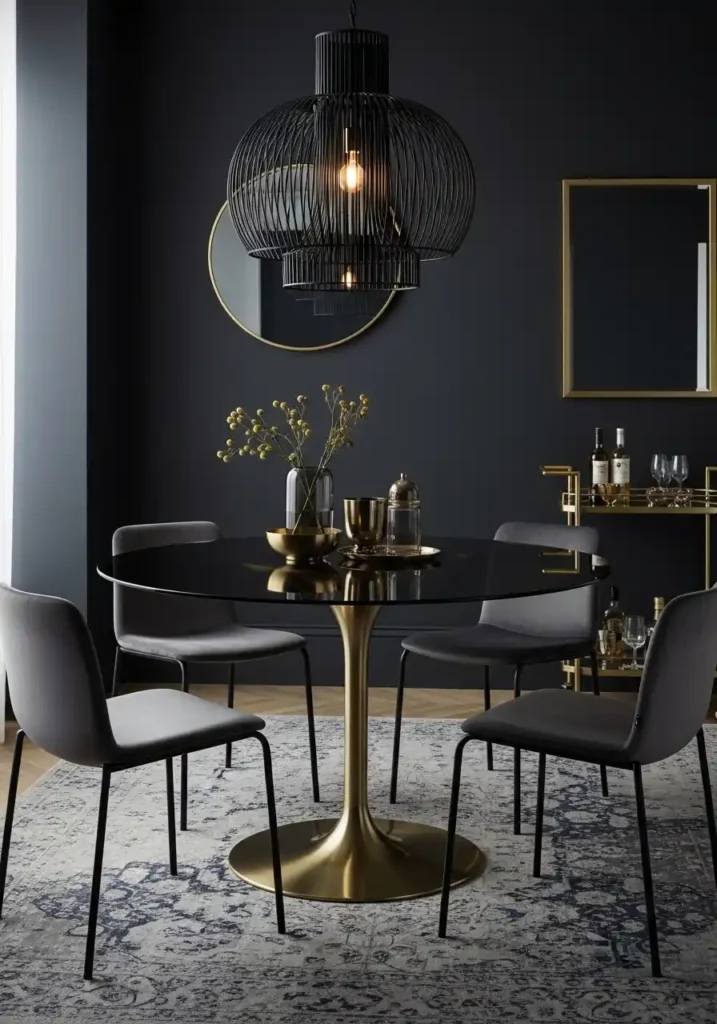
A smoked glass dining table in a tiny room occupies a fascinating middle ground between the full transparency of clear glass and the complete opacity of solid material — it is partially visible, partially mysterious, partially there and partially not, and that quality of visual ambiguity makes it one of the most intriguing and most sophisticated furniture choices available for a tiny dining room that wants to make a strong aesthetic statement without the clinical clarity of clear acrylic or the visual heaviness of solid wood or stone. The smoky tint of the glass creates a moody, slightly mysterious quality that suits dark, atmospheric tiny dining rooms particularly beautifully.
The smoked glass table pairs most magnificently with dark walls and warm metallic accents — because the combination of the semi-transparent smoke-tinted glass, the deep dark walls, and the warm amber glow of brass fixtures creates a tiny dining room of such concentrated, layered atmospheric richness that the room feels like a very private, very special venue rather than simply a compact home dining space. The partial transparency of the smoked glass allows the warm-toned rug beneath it to be partially glimpsed through the table surface, adding another layer of visual depth and mystery to the composition. This is the tiny dining room that makes guests lean forward across the table and speak in slightly lowered voices, not because the room demands it but because its atmosphere makes that intimacy feel completely natural and right.
11. Slim Bar Cart as a Tiny Dining Room’s Hardest Worker
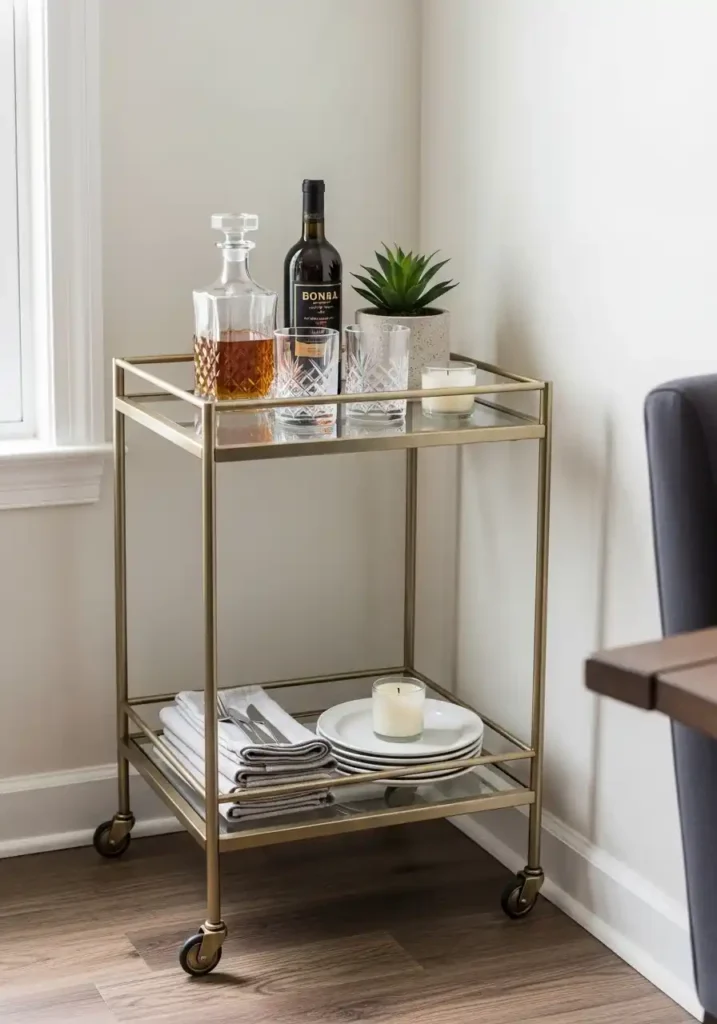
A slim bar cart in a tiny dining room is the furniture piece with the most impressive ratio of function delivered to floor space consumed of anything available in the contemporary furniture market — because a well-chosen bar cart on its small, wheeled footprint provides a serving surface, a drinks station, a display platform, and supplementary storage all simultaneously, while remaining slim enough to tuck into a corner or against a wall without meaningfully encroaching on the tiny room’s precious circulation space. The wheels allow it to be pulled out when serving is needed and pushed back when the floor space is required, making it the most flexible and the most accommodating furniture piece the tiny dining room contains.
The bar cart’s stylistic contribution to a tiny dining room goes well beyond its practical versatility — because a beautifully chosen and beautifully styled bar cart is one of the most visually attractive furniture pieces available, its combination of metallic frame, glassware, decanters, and styled accessories creating a vignette of such warm, celebratory elegance that it makes the tiny dining room feel genuinely more festive and more socially generous than its square footage might otherwise suggest. Choose a cart in brushed gold, matte black, or polished chrome depending on your room’s metallic palette, and style it with the same editorial care and the same attention to beauty and proportion that you would bring to any curated shelf or sideboard display.
12. Washi Tape Geometric Floor Pattern for Zero-Cost Drama
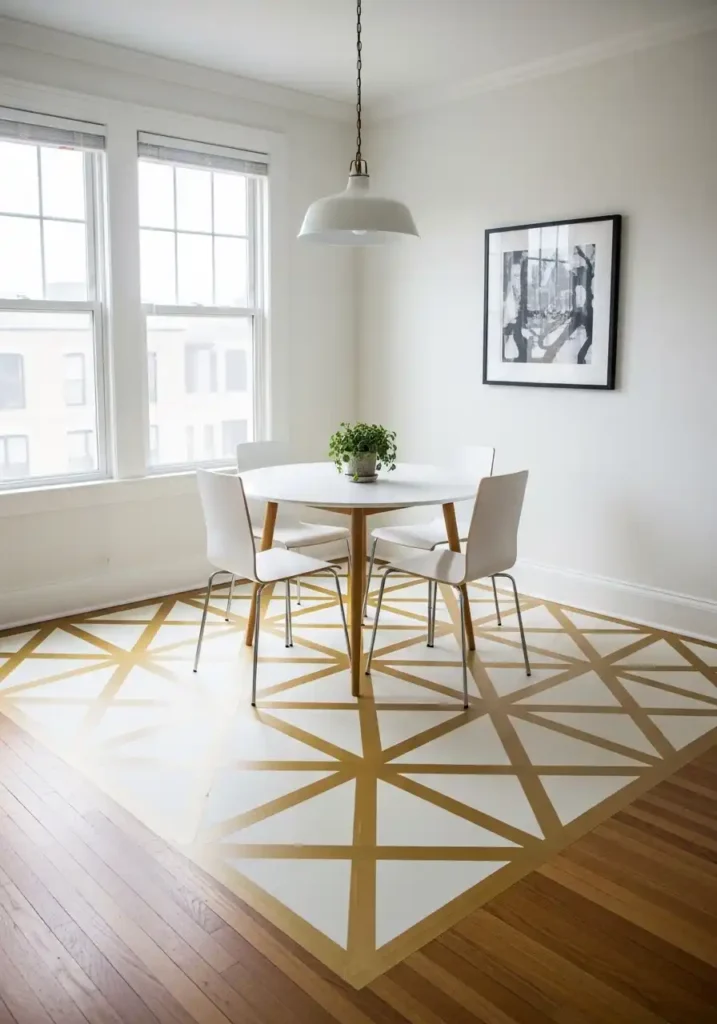
Washi tape geometric floor patterns in a tiny dining room are the zero-cost, zero-commitment, zero-permanence design intervention that delivers the most surprisingly dramatic and most genuinely impressive visual transformation relative to its investment of any decorating idea in this entire guide — because a bold geometric pattern on a plain wooden or painted floor creates the impression of a custom stenciled or inlaid floor treatment that looks like it cost significant money and required professional installation, while actually being achievable in an afternoon with a roll of wide tape, a ruler, and a pencil. The visual impact on the tiny room is immediate, powerful, and completely reversible if your taste changes next season.
The geometric pattern that works most beautifully and most spatially effectively in a tiny dining room floor is one that uses a relatively large repeat — wide diamond shapes, bold chevrons, or generous hexagons — rather than a small, intricate pattern that becomes visually busy and overwhelming in a compact space. Gold washi tape on warm wood creates an extraordinarily beautiful and luxurious-looking floor treatment that photographs like a genuine metallic inlay. White tape on a dark floor creates a graphic, contemporary impact. Black tape on a pale floor creates a crisp, architectural precision. Whatever color and pattern you choose, center the geometric design on the dining table so the pattern frames and anchors the dining zone with a confidence and a visual authority that makes the tiny room feel deliberately, beautifully designed.
13. Hanging Plants That Use Vertical Space Brilliantly
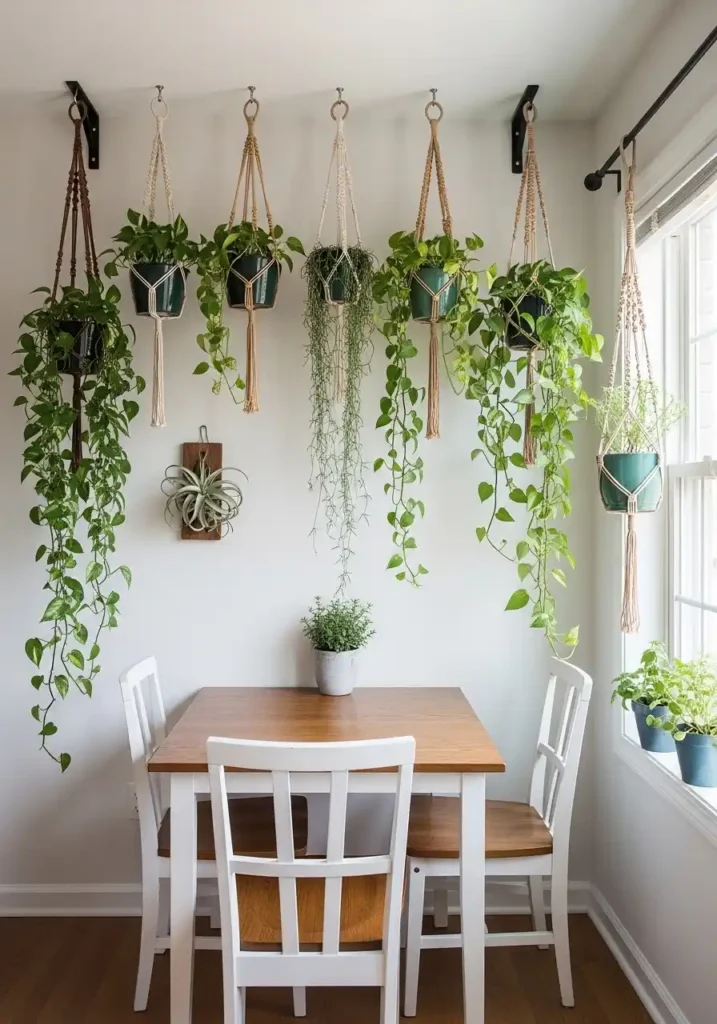
Hanging plants in a tiny dining room is the vertical space utilization strategy that adds the most organic warmth, the most living richness, and the most genuinely extraordinary atmosphere of any element that can be introduced to the room’s upper zone without consuming a single square centimeter of the precious floor area below. The ceiling and the upper wall space of a tiny dining room are almost always completely unused territory — blank planes that make the room feel top-heavy with empty space at the same time as the floor feels overcrowded with furniture — and hanging plants suspended at varying heights from the ceiling transform that unused vertical zone into the room’s most alive, most beautiful, and most atmospherically generative territory.
The specific hanging plant choices that work most beautifully in a tiny dining room are the trailing varieties that grow cascading tendrils and leaves downward from their hanging position, filling the vertical space with graceful, organic green movement that flat-growing or upright plants cannot provide. Trailing pothos with its heart-shaped leaves in deep green or variegated gold and green is the most forgiving, most beautiful, and most rapidly growing choice for dining room hanging positions. A string of pearls cascading from a small ceramic pot creates a sculptural, jewel-like quality that is genuinely extraordinary in pendant light. The trailing string of hearts with its tiny patterned leaves and trailing wire-like stems creates a delicate, intricate vertical texture that makes the tiny room feel like the most enchanting indoor garden imaginable.
14. An Arched Doorway Detail That Adds Architectural Soul
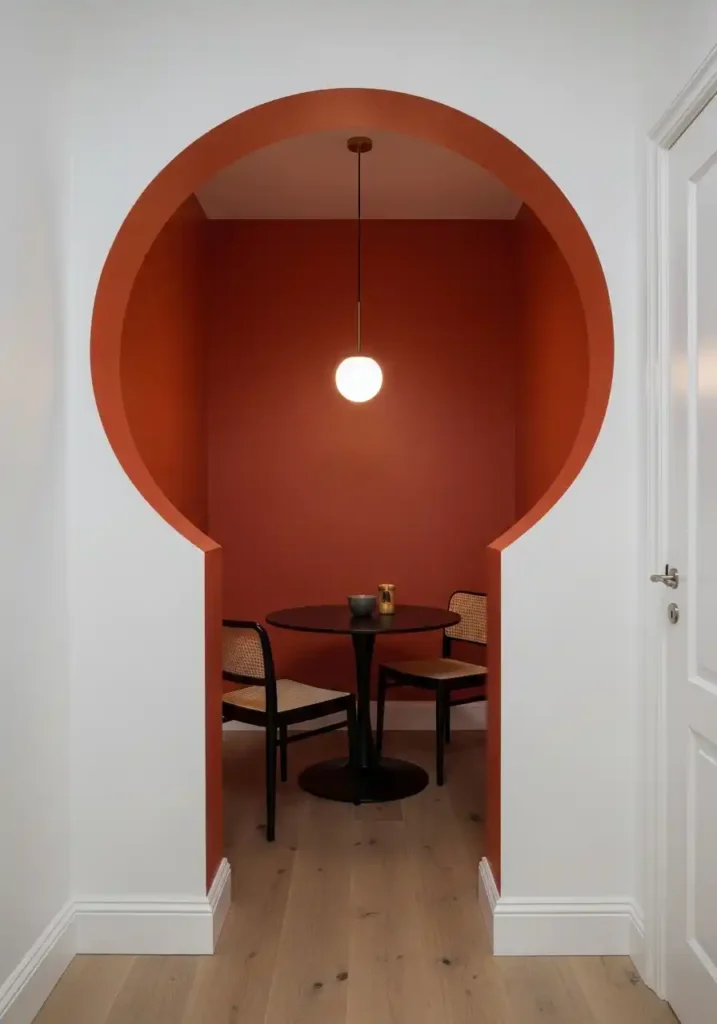
An arched doorway leading into a tiny dining room is the architectural detail that transforms the experience of entering the room from a simple functional transition — walking through a rectangular opening from one space to another — into something genuinely ceremonial, genuinely special, and genuinely beautiful that communicates clearly and immediately to every arriving guest that the space they are entering is a room that has been considered, loved, and designed with genuine intention and genuine care. The arch frames the dining room like a painting in a gallery, creating a moment of visual anticipation before entry that makes the tiny room feel more significant, more important, and more worthy of full, appreciative attention than a plain rectangular doorway ever could.
Creating an arched doorway in an existing rectangular door opening is a relatively modest construction project — a curved timber or plasterboard infill at the top of the opening, finished in plaster or timber cladding and painted — that delivers an architectural impact completely disproportionate to the modest cost and effort of its installation. Painting the arch reveal — the curved interior surface of the doorway itself — in a deeper, richer color than the surrounding walls draws the eye into the curve and makes the arch feel three-dimensional and genuinely architectural rather than flat and decorative. Viewed from the hallway, the arch frames the tiny dining room like the most beautiful painting in the house, making even the most compact and simply furnished space look like a room of genuine importance and genuine soul.
15. A Chandelier That Punches Way Above Its Weight Class
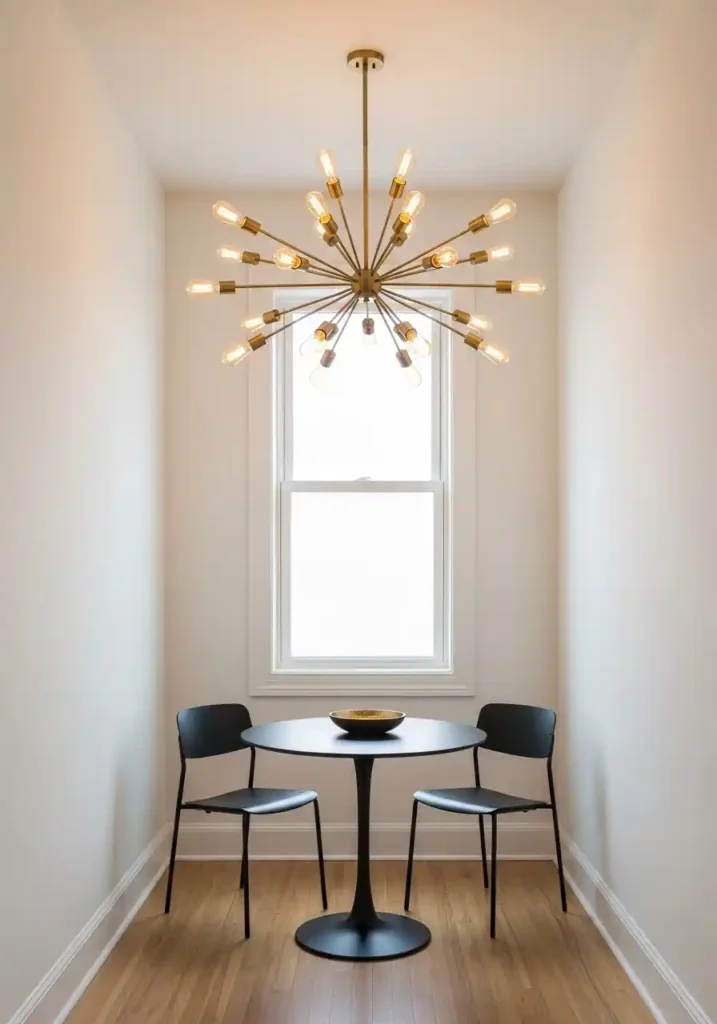
A chandelier that is deliberately, dramatically, almost outrageously oversized for the tiny dining room it occupies is the design decision that makes the most confident possible statement about the philosophy behind the room’s decoration — that scale is not a constraint to be observed but a convention to be deliberately subverted in the service of creating something visually extraordinary, genuinely memorable, and completely, unmistakably intentional. When a chandelier is chosen that spreads nearly wall to wall across the ceiling of a tiny dining room, the contrast between the magnificent, room-filling fixture and the compact simplicity of the table and chairs below creates a visual drama and a design tension that is absolutely electric.
The specific chandelier types that create the most spectacular oversized effect in a tiny dining room are those whose form extends horizontally as well as vertically — the sputnik chandelier with its multiple extending arms, the linear chandelier with its elongated horizontal span, and the branch chandelier with its organic, spreading form. A sputnik chandelier in brushed brass with twelve arms and amber Edison bulbs extended to fill the ceiling of a tiny dining room creates a composition of such unexpected, gleeful, completely confident visual drama that it makes the tiny room the most talked-about, most photographed, and most consistently admired space in the entire home. The tiny table beneath it needs to be simple — because the chandelier is already saying everything that needs to be said.
16. Patterned Wallpaper Ceiling for the Ultimate Fifth Wall
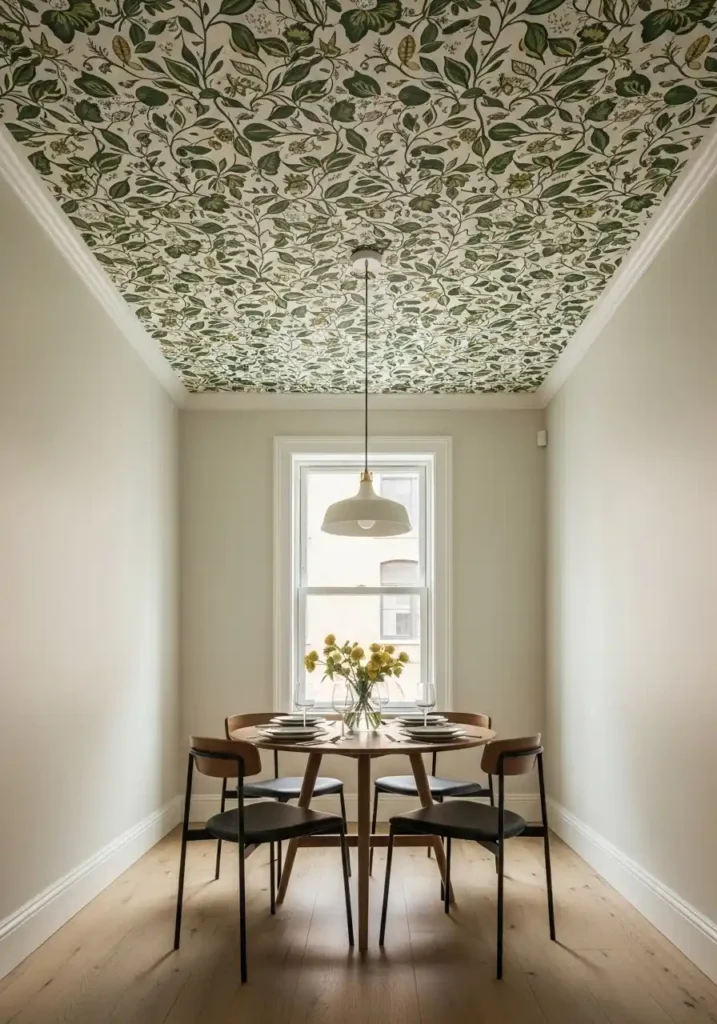
Wallpapering the ceiling of a tiny dining room while leaving the walls in a calm, plain tone is the design move that creates the most surprising and most completely delightful spatial experience available in a compact dining space — because it puts the bold pattern exactly where the eye goes when you look up from your plate during a meal, turning every moment of the dining experience into an encounter with genuine beauty and genuine visual richness. The wallpapered ceiling adds all the personality, character, and decorative impact of a boldly wallpapered room without reducing the room’s perceived size or creating the enclosed, busy feeling that wallpaper on all four walls of a tiny room can sometimes produce.
The wallpaper pattern that creates the most magnificent effect on a tiny dining room ceiling is one that is genuinely rich in color, genuinely bold in scale, and genuinely beautiful when viewed from the unusual angle of looking directly up at it from a seated position. A lush botanical print in deep forest greens and warm golds creates the feeling of dining beneath a canopy of tropical plants — an experience of extraordinary organic richness and genuine wonder. A dark floral in deep navy with cream and pink flowers creates a moody, opulent overhead that makes candlelit dinners feel spectacularly atmospheric. A geometric Art Deco pattern in deep teal and brass creates a ceiling of architectural graphic impact that makes the tiny room feel like a privately owned Art Deco supper club.
17. The Murphy Bed Wall That Hides a Complete Dining Room
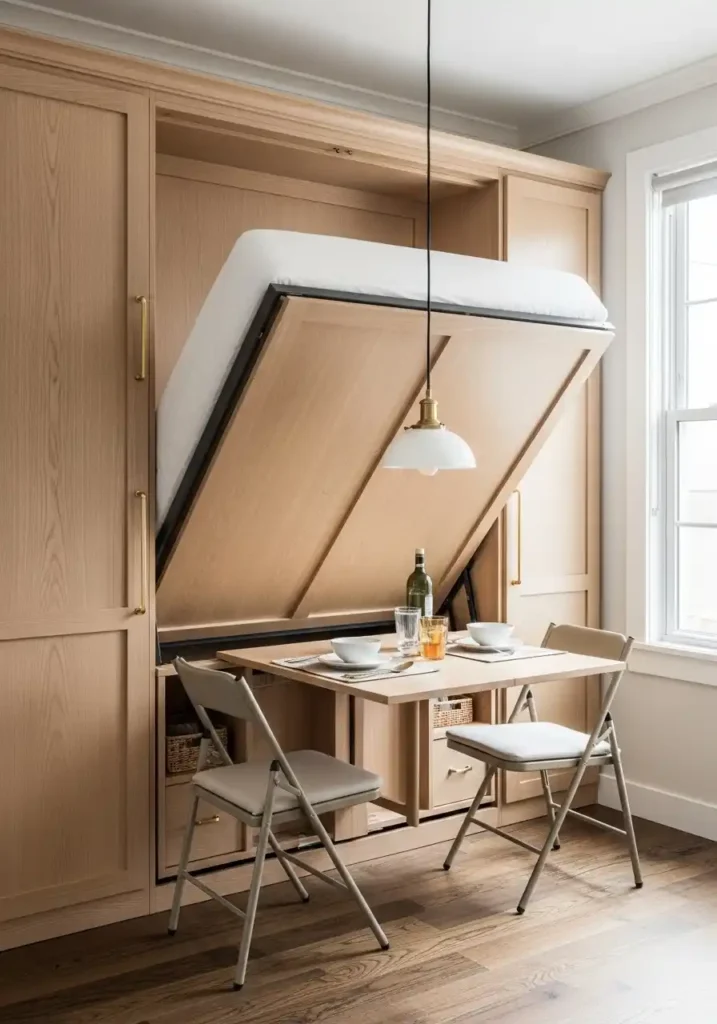
The Murphy bed wall unit that integrates a complete fold-down dining table and fold-out chairs into its face panel is the tiny space solution at its most completely brilliant — a piece of furniture architecture that allows a single room to be a bedroom, a living room, and a complete dining room in sequential rotation throughout the day, each function claiming the full available floor space of the room when it is needed and disappearing entirely into the wall when it is not. The dining table folds out from the wall panel in a single motion, the chairs unfold from their recessed positions in the same panel, and a complete dining arrangement for two to four people appears in under a minute where thirty seconds earlier there was only wall.
The design quality of a Murphy bed wall unit that incorporates dining functionality matters enormously in a tiny space where the unit will always be the dominant visual element of the room regardless of which function is currently deployed — and investing in a unit that is genuinely beautiful in its closed, wall-presenting mode is as important as ensuring its deployed furniture functions are well-designed and comfortable. A unit in warm white oak with brass hardware, clean contemporary lines, and carefully considered proportions looks like a piece of bespoke cabinetry in its closed mode — adding genuine architectural quality and warmth to the room’s walls rather than announcing itself as a concealed practical solution. The brass pendant light mounted above the dining table position completes the composition with a detail of considered elegance.
18. Dramatic Drapery From Ceiling to Floor on Every Wall
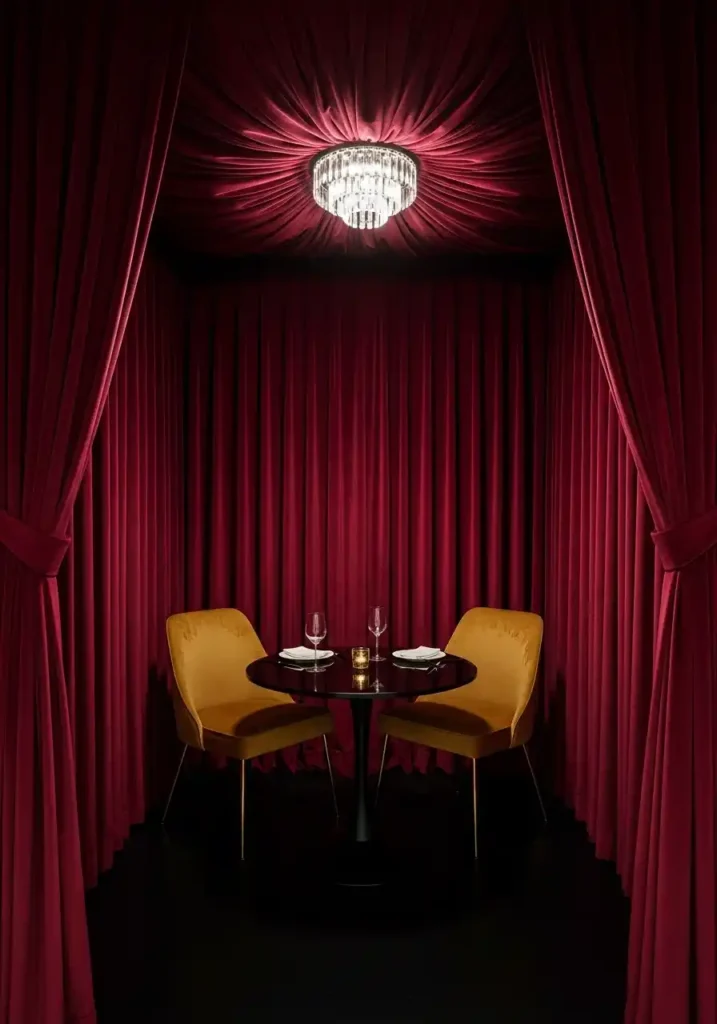
Floor-to-ceiling drapery on all four walls of a tiny dining room is the theatrical transformation that converts a compact, ordinary dining space into something so completely, so extravagantly, so unapologetically extraordinary that describing it as a decorating decision feels inadequate — it is more accurately described as a complete environmental installation, a decision to replace the room’s hard architectural surfaces with soft, enveloping fabric that creates an atmosphere of warmth, enclosure, and opulent intimacy unlike anything that paint, wallpaper, or paneling could achieve. This is the tiny dining room that feels like the interior of a very private, very luxurious tent — enclosed on all sides in rich fabric, warm with candlelight, magnificent in its sensory completeness.
The practical execution of wall-to-ceiling drapery in a tiny dining room is straightforward — ceiling-mounted curtain tracks running around the full perimeter of the room, long curtain panels in a beautiful, substantial fabric hung from each track — and the transformation it creates is so complete and so immediate that the before and after versions of the room feel like entirely different spaces rather than the same room decorated differently. Deep burgundy velvet creates the most spectacular, most opulent, most atmospheric result. Rich forest green creates a more botanical, more outdoor-inspired enclosure. Deep navy creates a moody, midnight intimacy. Whatever color and fabric you choose, the wall-to-wall drapery transforms the tiny dining room from a spatial limitation into a spatial experience — and that transformation is worth every yard of beautiful fabric it requires.
19. A Pegboard Dining Wall That Does Absolutely Everything
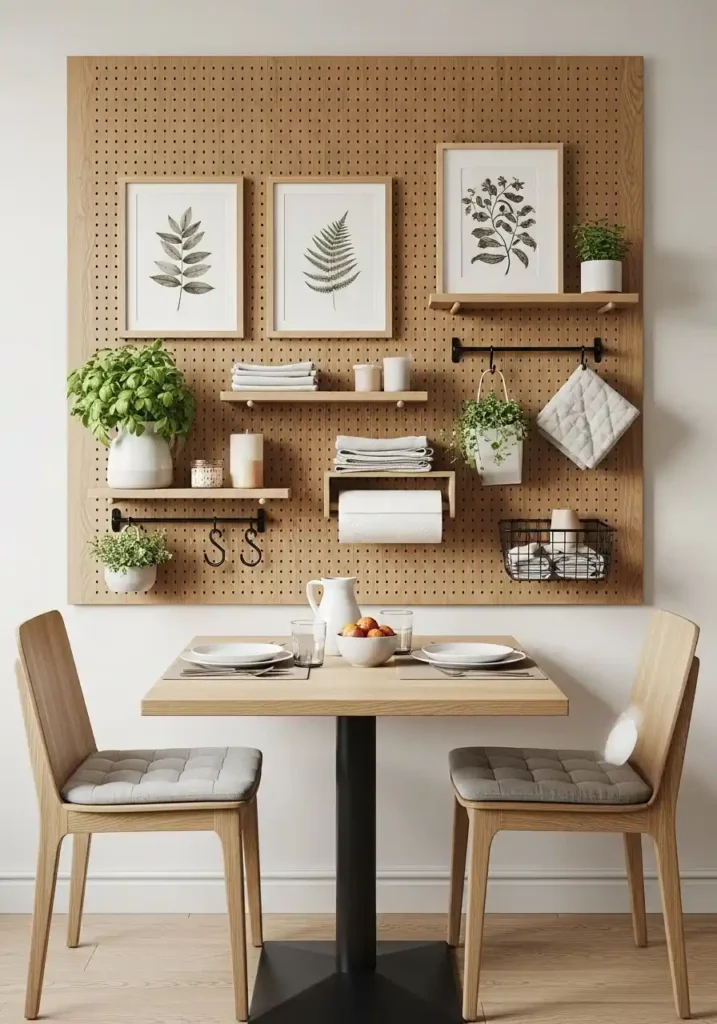
A full-wall pegboard in a tiny dining room is the organizational and decorative solution that approaches the problem of tiny dining room storage and display from a completely different angle than any other approach — not by hiding storage behind closed doors, not by stacking objects on shelves of fixed position, but by creating a completely flexible, completely customizable wall system that can hold anything, display anything, and be reconfigured in minutes as the room’s needs and the decorator’s taste evolve over time. A pegboard wall is a tiny dining room’s most democratic and most responsive surface — it accommodates whatever you need it to accommodate without argument, without limitation, and without any additional installation work beyond the initial mounting.
A pegboard panel in beautiful natural oak rather than the utilitarian painted wood or white MDF that most people associate with pegboard systems transforms this practical tool into a genuine design feature that adds warmth, material character, and a considered quality to the tiny dining room wall. Oak pegboard looks like a beautifully crafted architectural wall feature rather than an organizational system installed out of spatial necessity — and the objects displayed on it, when chosen and arranged with genuine care, create a curated wall composition of real beauty and real personality. Artwork, plants, ceramics, dining accessories, and storage baskets coexist on the oak pegboard in a composition that is simultaneously the tiny room’s most practical wall and its most visually interesting and most personally expressive one.
20. A Tiny Dining Room Dedicated to One Extraordinary Material
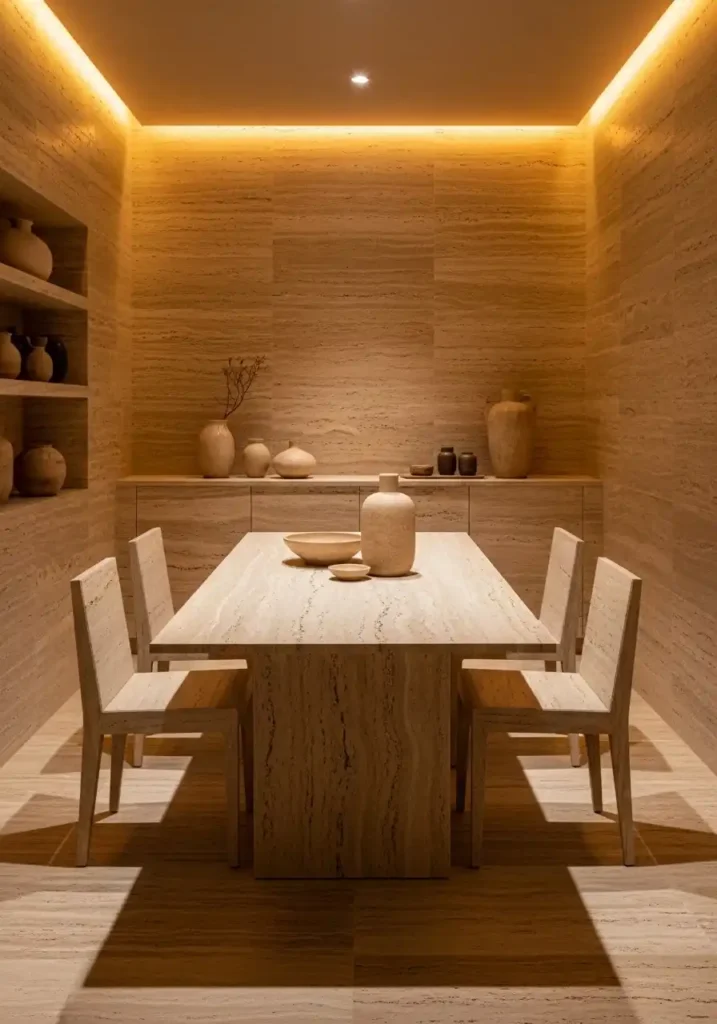
A tiny dining room decorated around a single extraordinary material — where walls, floor, table, and accessories all share the same material identity or material family — achieves a quality of complete material cohesion that transforms a space of limited square footage into a room of genuine architectural magnitude and genuine material beauty. The single-material approach removes every visual distraction and every competing decorative interest, leaving only the extraordinary inherent beauty of the chosen material to carry the entire aesthetic weight of the space — and when the material chosen is genuinely extraordinary, that single material is more than sufficient to create a room of breathtaking beauty.
Natural travertine is the most magnificently beautiful material to dedicate a tiny dining room to — because its warm cream and honey tones, its distinctive linear veining, its characteristic fossils and organic inclusions, and its quality of warm, geological depth create a surface of such rich visual complexity and such genuine natural magnificence that it never becomes boring or insufficient regardless of how many surfaces it covers simultaneously. A travertine table, travertine floor, travertine-toned plaster walls, and travertine-colored ceramic accessories create a tiny dining room of such complete material harmony and such warm, luminous, geological beauty that the tiny room becomes the most extraordinary material experience in the entire home — a private geological gallery where every meal is eaten in the company of ancient natural beauty.
21. String Lights That Transform a Tiny Room After Dark
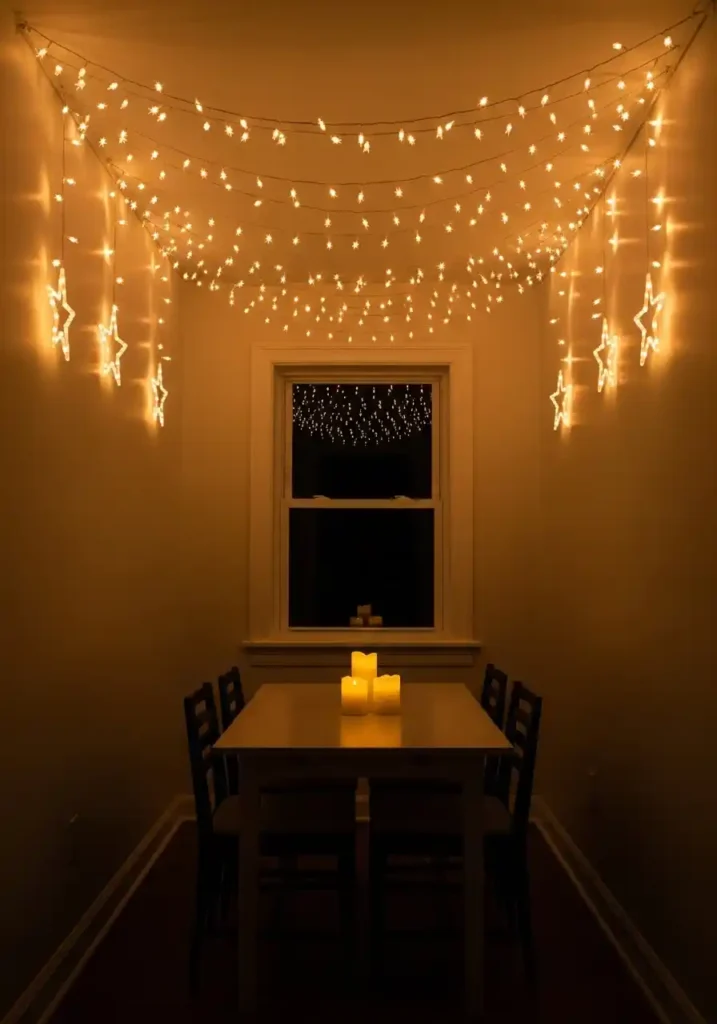
String lights draped in generous scallops across the ceiling of a tiny dining room create the most romantic, most enchanting, and most completely transformative evening atmosphere available to any space that needs to feel magical rather than merely decorated after the sun goes down — and the installation is so simple, the cost so modest, and the result so genuinely extraordinary that it is difficult to understand why every tiny dining room ceiling doesn’t already have them. A canopy of warm white string lights above a dining table creates the specific, beautiful sensation of eating beneath a night sky of warm stars — private, intimate, slightly otherworldly, and completely, overwhelmingly lovely.
The specific string light type that creates the most beautiful ceiling canopy in a tiny dining room is the warm white micro-LED string — not the cool blue-white LEDs that create a cold, clinical light but the warm amber micro-LEDs that mimic candleflame in their color temperature and create the warmest, most flattering, most romantically beautiful light possible. Drape them in dense, overlapping scallops from wall to wall rather than in sparse, widely spaced lines, so the ceiling appears to be completely covered in a continuous warm glow rather than decorated with individual lines of light. Supplement the string light canopy with pillar candles on the table and the tiny dining room achieves an evening atmosphere of such intimate beauty that every meal within it feels like the most special dinner of the year.
22. The Complete Tiny Dining Room — Every Element a Perfect Choice
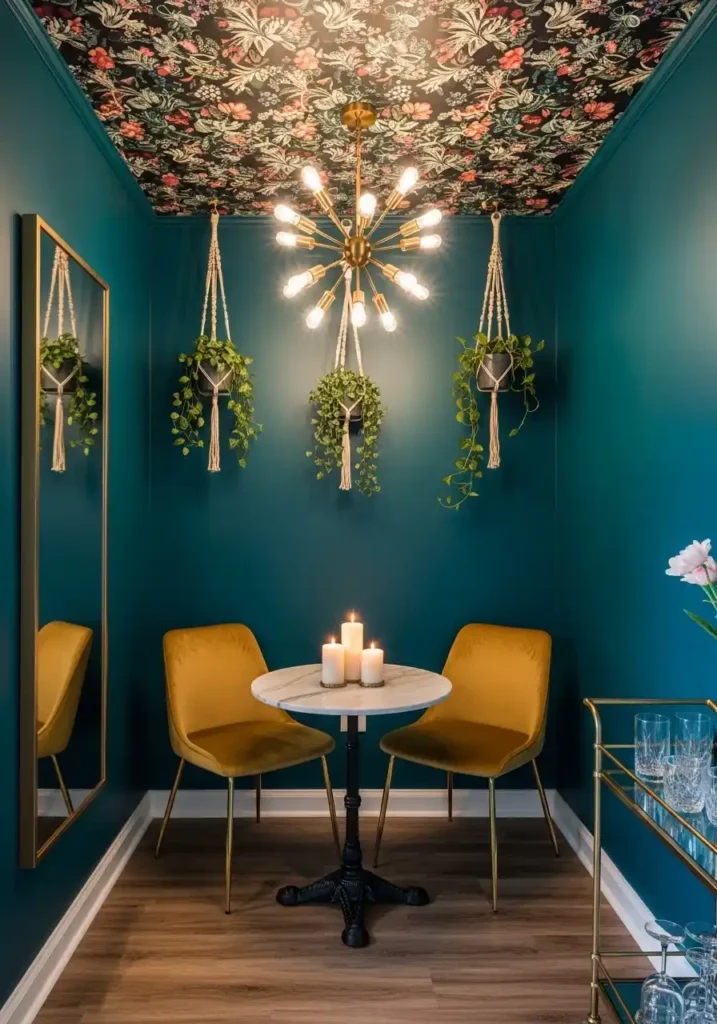
The perfect tiny dining room — the one that makes every person who experiences it immediately understand that small and magnificent are not contradictions but complements, that limitation and beauty are not opposites but partners, and that the most extraordinary dining experiences do not require grand, generous square footage but only genuine design intelligence, genuine aesthetic courage, and a genuine, passionate commitment to making every single element of the space as beautiful and as considered as it is possible to make it — is the room that this guide has been building toward with every single idea it has shared.
The invitation that this guide leaves you with is the most exciting one in all of interior design: the invitation to see your tiny dining room not as a spatial problem requiring a spatial solution but as a creative opportunity requiring a creative vision. Every idea here — the jewel-box richness, the floating furniture, the dramatic chandelier, the patterned ceiling, the moody black walls, the bistro charm — is a proven, beautiful, completely achievable path to a tiny dining room of genuine magnificence. Choose the ideas that speak most powerfully to your aesthetic soul, commit to them completely and without apology, and create the tiny dining room that proves once and for all that the most stylish rooms in the world are not always the largest ones.
Conclusion:
Designing a small dining space doesn’t mean sacrificing style or functionality. With the right approach, even the tiniest dining room can feel open, inviting, and beautifully organized. From smart storage solutions and multifunctional furniture to strategic lighting and creative décor, these tiny dining room ideas prove that limited space can still deliver maximum impact.
By choosing space-saving furniture, using light colors, incorporating mirrors, and embracing vertical storage, you can transform a compact area into a stylish and practical dining spot. Whether you prefer a modern, minimalist look or a cozy, rustic vibe, the key is to make thoughtful design choices that enhance both aesthetics and usability.
Ultimately, the best small dining room design ideas are the ones that reflect your personal style while making the most of every square inch. With these inspiring tips, you can create a dining space that feels bigger, brighter, and perfect for everyday meals or intimate gatherings.