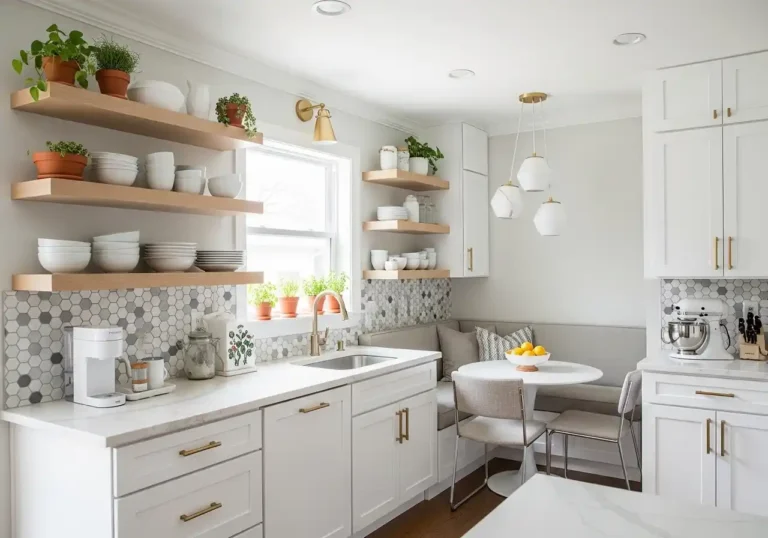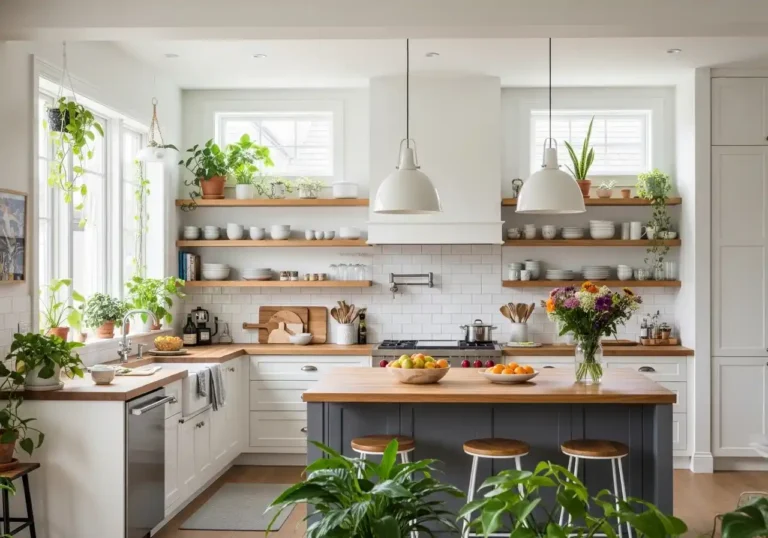
1. The Small Kitchen with Ceiling-Height Cabinets That Maximizes Every Inch
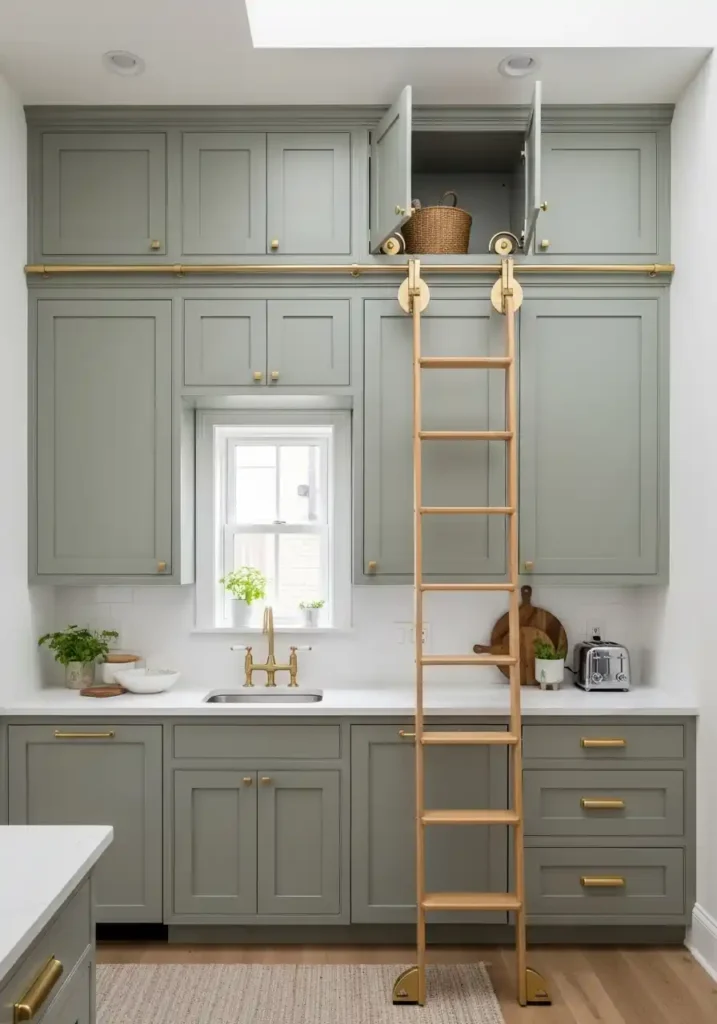
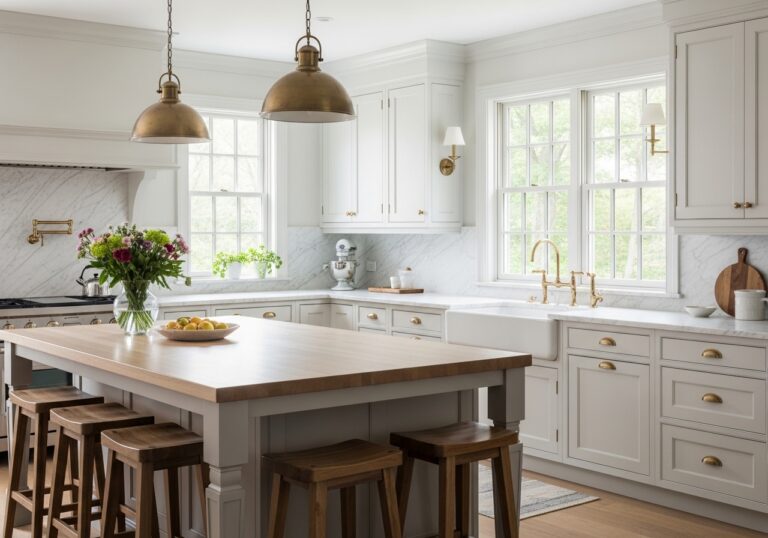
Ceiling-height cabinets in a Small Kitchen Design Inspirations are the most powerful and the most permanently effective space maximization strategy available — because they capture the single most consistently wasted volume in any compact kitchen: the dead space between the tops of standard-height upper cabinets and the ceiling above, which in most small kitchens sits empty and unused while the kitchen below struggles with insufficient storage. Floor-to-ceiling cabinetry converts this wasted vertical dimension into genuine, organized, beautifully accessible storage, transforming the small kitchen’s storage capacity with a completeness and a permanence that no other intervention can match.
The rolling library ladder on a brass ceiling-mounted track is the practical and aesthetic device that transforms ceiling-height small kitchen cabinets from a beautiful but partially inaccessible storage installation into a completely functional, completely delightful kitchen feature of genuine character and extraordinary charm. The library ladder solves the height-access problem with such warmth, such elegance, and such complete reference to the beautiful private libraries of genuinely well-appointed homes that it makes the small kitchen feel not constrained by its compact dimensions but enriched by the brilliant organizational intelligence that those dimensions have inspired. The ladder is the detail that makes the small kitchen’s most practical decision its most beautiful one.
2. The Small Kitchen with a Fold-Down Dining Table for Dual Function
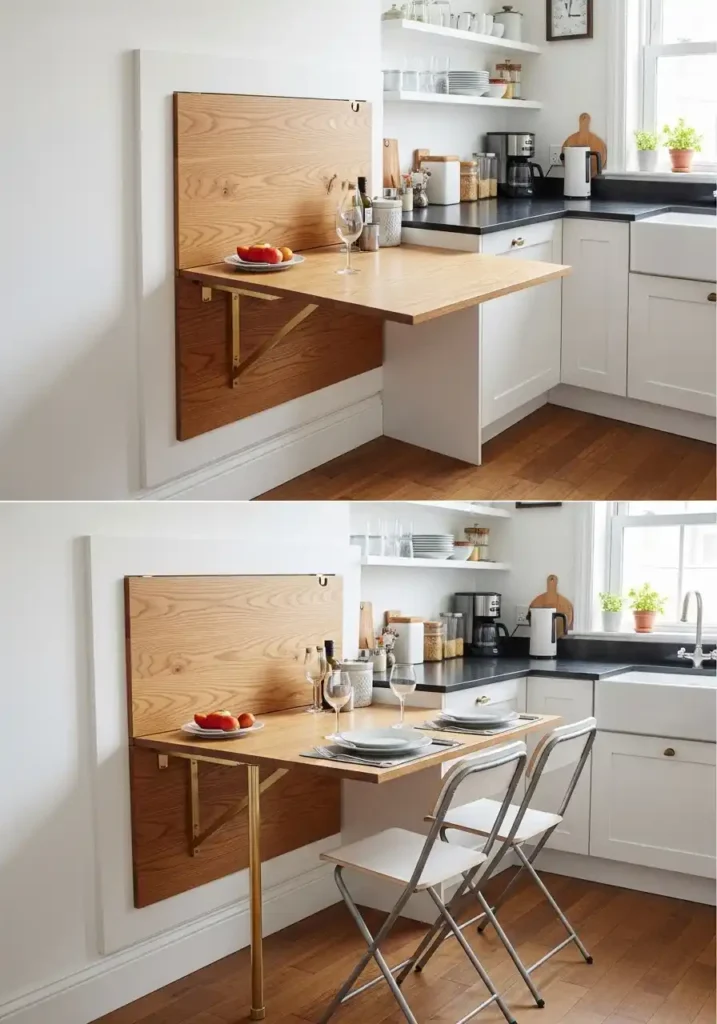
A fold-down dining table mounted on the kitchen wall is the dual-function solution that most brilliantly and most completely solves the small kitchen’s most persistent spatial challenge — the need to accommodate casual dining within a footprint that cannot permanently dedicate floor area to a fixed dining table and dining chairs without compromising the kitchen’s cooking function. The fold-down table provides a full, properly sized, properly supported dining surface when deployed and returns completely to the wall plane when not needed, occupying zero floor space and zero visual space in the kitchen’s daily environment between mealtimes.
The design and material quality of a fold-down kitchen dining table matters enormously in a small kitchen where every visible element is always prominent — because the fold-down table in its closed, wall-mounted position is permanently visible as part of the kitchen’s wall composition and must be as beautiful in that closed state as it is functional in its open one. A fold-down panel in solid oak with a beautiful natural grain finish reads as a deliberate, designed wall feature rather than a makeshift addition, and the slim brass support legs that deploy to hold the extended table are as beautifully made as the table surface itself. The fold-down dining table is the small kitchen’s most brilliantly resolved space-saving idea.
3. The Small Kitchen with Light Reflective Surfaces for Perceived Space
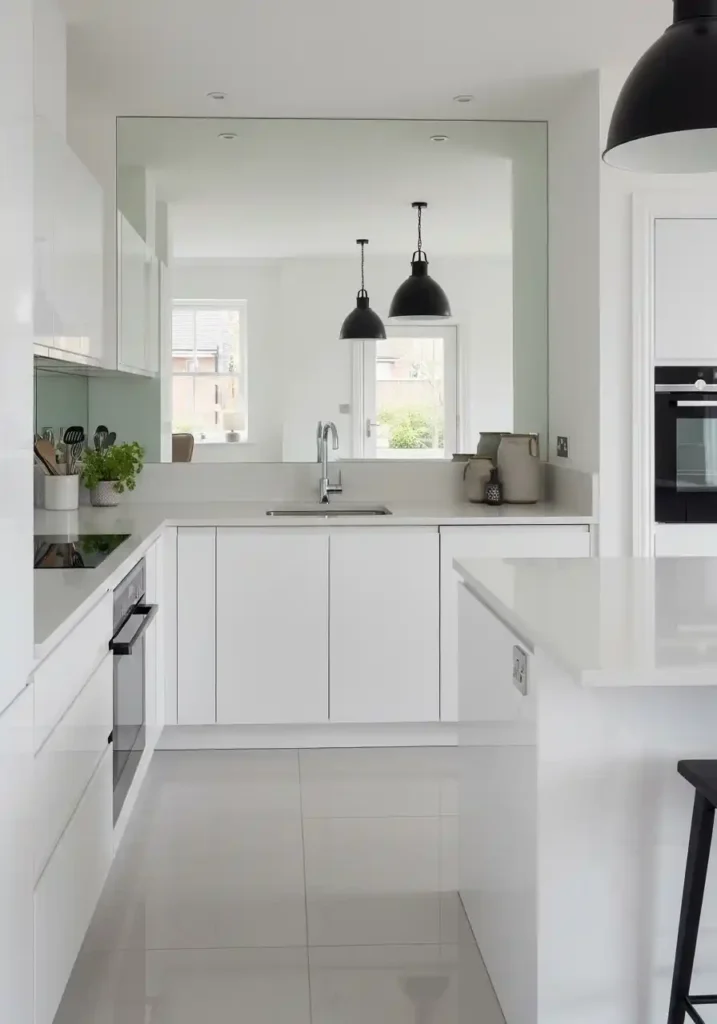
Light-reflective surfaces in a small kitchen are the spatial transformation strategy that delivers the most significant and the most convincingly perceived improvement in the kitchen’s apparent size without any structural change, any layout modification, or any increase in the kitchen’s actual physical dimensions. Mirror backsplashes, high-gloss cabinet fronts, polished countertops, and semi-polished floor tiles each individually contribute to the kitchen’s perceived spaciousness through their specific light-reflecting properties, and their combined presence in a single small kitchen creates a cumulative spatial expansion effect of such complete and convincing magnitude that the kitchen appears genuinely, substantially larger than it actually is.
The mirrored backsplash is the single most dramatically effective light-reflective surface addition available in a small kitchen — because a large, continuous mirror panel behind the counter and backsplash area reflects the entire kitchen — its pendant light, its opposite wall, its window view — back into the space with such complete spatial depth and such convincing spatial clarity that the kitchen appears to extend equally far in both directions from the counter, creating the impression of a kitchen of twice the actual width and twice the actual depth. The reflection is immediate, complete, and genuinely convincing, making the mirrored backsplash the small kitchen’s single most powerful spatial expansion tool.
4. The Small Kitchen with a Peninsula Instead of an Island
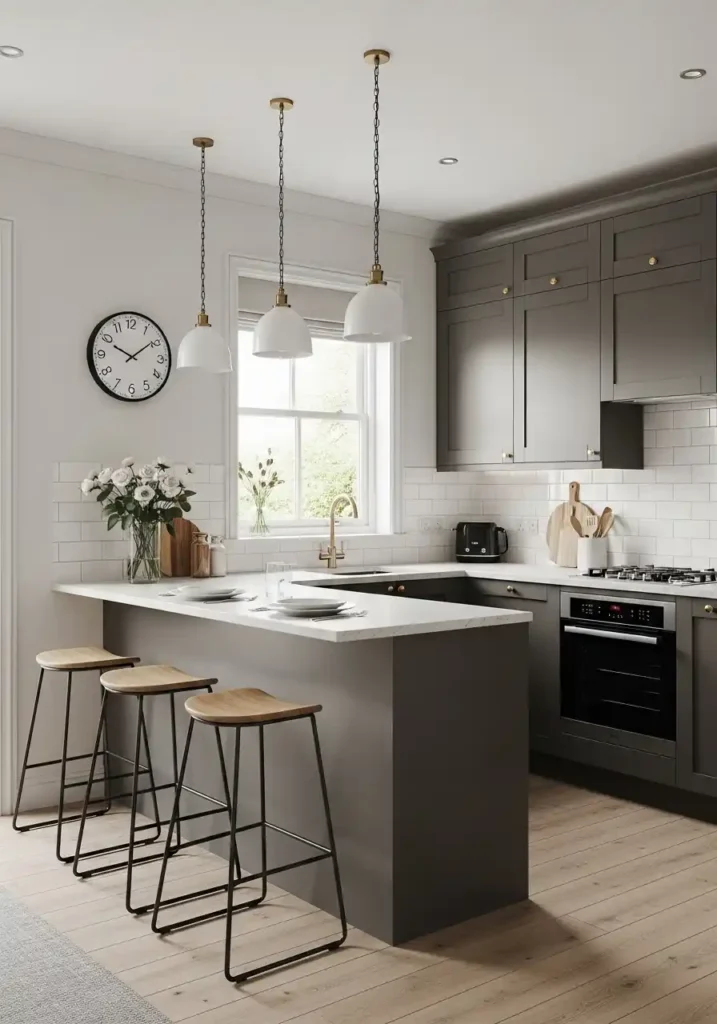
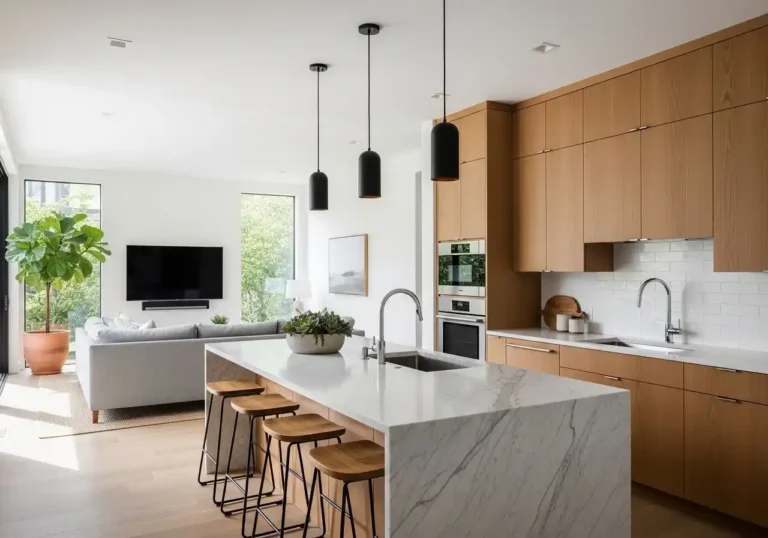
A peninsula connected to the main kitchen cabinet run is the alternative to a freestanding island that delivers virtually identical functional benefits — additional counter space, casual dining, and a social gathering point between kitchen and living area — while requiring significantly less kitchen floor area and significantly less circulation clearance, making it the ideal island-equivalent for small kitchens where a freestanding island would make movement through the kitchen impractically restricted. The peninsula’s connection to the main counter on one end means it requires clearance on only three sides rather than four, reducing its effective floor footprint by a genuinely significant margin.
The peninsula’s dual function — providing a kitchen-side preparation surface extension for the cook and a living-room-side casual dining bar for seated guests — creates the small kitchen’s most socially generous and most practically intelligent furniture piece, because it simultaneously solves the most important functional challenge of the compact cooking space and the most important social challenge of the open-plan small home: the desire for the cook to remain part of the social life of the home during cooking rather than being isolated in a separate, enclosed kitchen. Three slim counter stools on the living room side of the peninsula transform every cooking session into a genuinely social, genuinely connected experience.
5. The Small Kitchen with Open Shelving Replacing Upper Cabinets
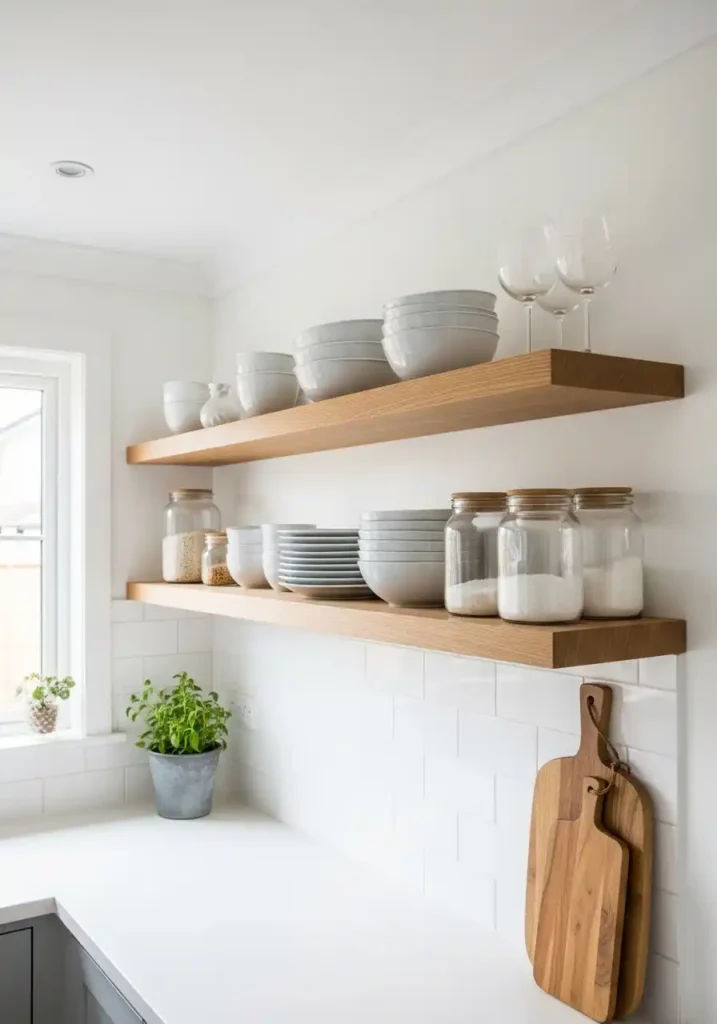
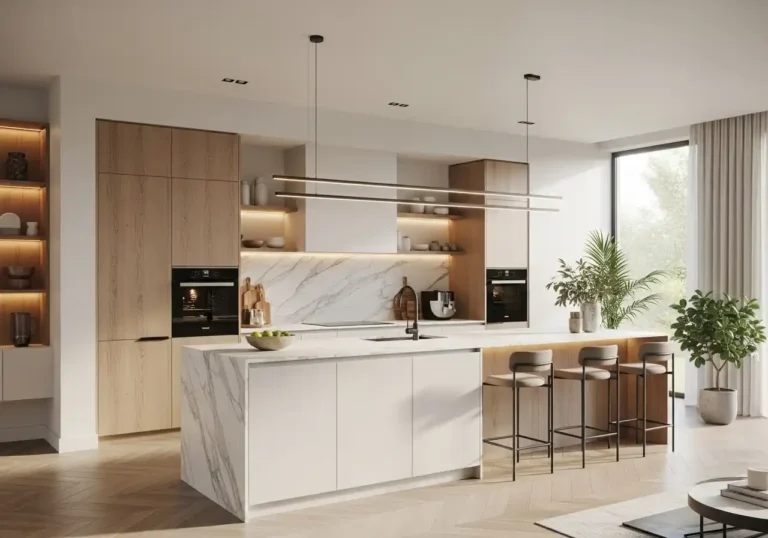
Replacing closed upper cabinets with open floating shelves in a small kitchen is the single renovation decision that delivers the most immediate and the most completely convincing improvement in the kitchen’s perceived spaciousness — because closed upper cabinet doors create a solid wall of visual mass that the eye reads as a heavy, space-consuming barrier, while open shelves allow the wall behind them to be seen around and between every displayed object, maintaining the kitchen’s sense of visual openness and spatial breathing room that no closed cabinet door, however beautifully finished, can replicate. The small kitchen with open shelves always feels more generous and more open.
The practical reality of open kitchen shelving in a small space — that everything stored is always visible and must therefore always be beautifully organized and thoughtfully curated — is not a disadvantage but the design discipline that produces the most consistently beautiful small kitchens of all. When every plate, every glass, every jar, and every kitchen essential must earn its visible place on an open shelf, the small kitchen naturally accumulates only objects of genuine beauty and genuine daily use, eliminating the forgotten accumulation of rarely-used items that closed cabinets tend to hide over years of convenient concealment. The result is a small kitchen that is simultaneously more beautiful, more organized, and more genuinely efficient.
6. The Small Kitchen with Vertical Storage Solutions for Every Wall
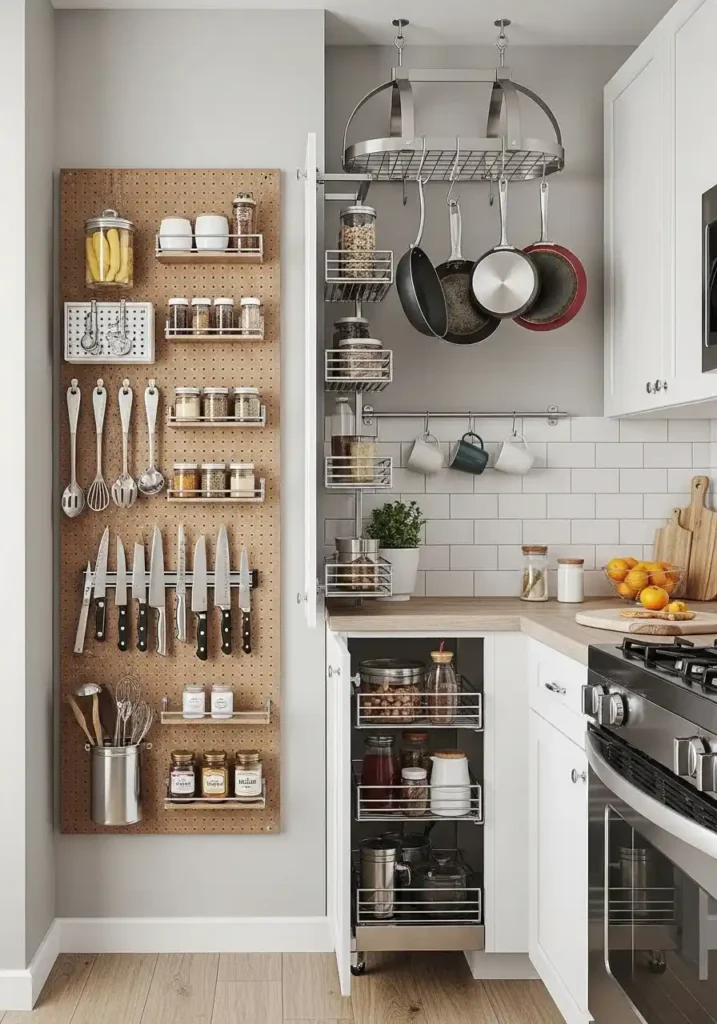
Vertical storage solutions that utilize every available wall surface in a small kitchen transform the relationship between the kitchen’s limited floor area and its abundant storage needs by shifting the storage strategy from horizontal expansion — which the small kitchen cannot afford — to vertical multiplication, which costs nothing and can be implemented on every wall surface from floor to ceiling. A pegboard panel, a pot rack, a magnetic knife strip, mug hooks beneath the upper cabinets, and a slim pull-out pantry in a narrow gap together create a storage system of such comprehensive vertical utilization that the small kitchen’s total storage capacity approaches that of a much larger kitchen.
The pegboard panel is the vertical storage solution with the greatest flexibility, the greatest organizational intelligence, and the greatest daily adaptability available for a small kitchen wall — because its modular hook and shelf system can be infinitely reconfigured as the kitchen’s storage needs evolve over time, accommodating every size and every category of kitchen tool with equal ease and equal organizational clarity. A pegboard styled with genuine care — utensils grouped by function, spice jars aligned by label, hooks arranged by the size of what they hold — creates a kitchen wall of such genuine organizational beauty that it functions simultaneously as the small kitchen’s most practical storage surface and its most visually characterful design feature.
7. The Small Kitchen with a Bold Backsplash as the Star
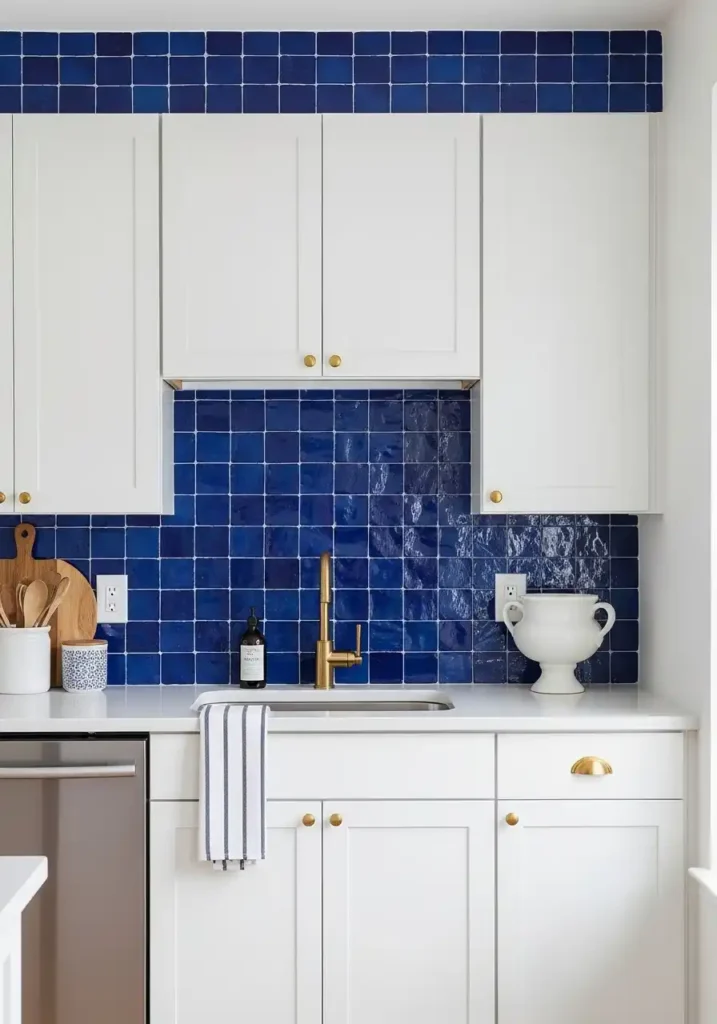
A bold backsplash is the small kitchen design decision that most brilliantly redirects the eye from the kitchen’s spatial limitations to the kitchen’s most concentrated and most beautifully specified design moment — because a backsplash of genuine visual drama and genuine material beauty creates such a compelling focal point of color, texture, and craftsmanship that every person who enters the kitchen looks immediately and instinctively at the backsplash rather than mentally measuring the kitchen’s dimensions. The bold backsplash doesn’t make a small kitchen feel larger — it makes its size feel irrelevant by providing something far more interesting and far more beautiful to look at.
Handmade zellige tiles in a rich, saturated color are the backsplash choice that creates the most dramatically beautiful and the most immediately transformative result in a small kitchen — because Zellige’s irregular, hand-pressed surface creates a wall of such organic material richness and such genuinely artisanal depth of color variation that it elevates the entire kitchen to a level of visual sophistication that no manufactured tile alternative can approach, regardless of its price or its pattern. The cobalt zellige that shimmers differently in morning light than in evening artificial light, that rewards every glance with a new depth of color and a new quality of handmade surface variation, makes the small kitchen’s backsplash wall the most beautiful square meter in the entire home.
8. The Small Kitchen with Smart Corner Solutions
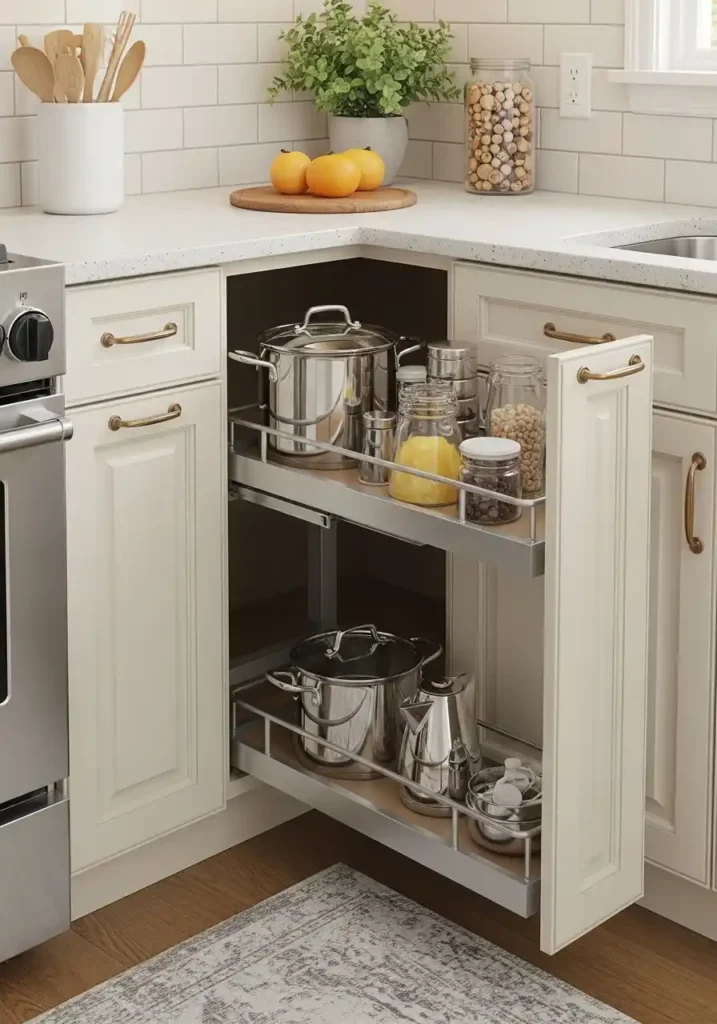
Smart corner solutions in a small kitchen are the storage interventions that most dramatically change the ratio between the kitchen’s apparent storage capacity and its actual usable storage capacity — because the conventional corner cabinet, with its deep, angular interior inaccessible to human arms of normal length, represents a genuinely significant volume of wasted space in every small kitchen that contains one, and an engineered corner solution that makes every inch of that volume genuinely, easily, and immediately accessible effectively adds a meaningful quantity of real storage to the small kitchen without adding a single new cabinet or a single additional inch of floor area.
The magic corner pull-out is the corner storage mechanism that converts the corner cabinet most completely and most practically from the kitchen’s most frustrating wasted space into one of its most generously organized and most easily accessible storage locations — because its two full-width shelves, extending completely out of the corner and beyond the cabinet opening when deployed, make every item stored in the cabinet’s full depth as visible and as accessible as an item on a conventional open shelf. The magic corner’s smooth, well-engineered movement makes daily deployment and return effortless, and its full extension provides the complete access that no fixed shelf, no lazy susan, and no other corner storage mechanism can match for genuine, comprehensive corner cabinet utilization.
9. The Small Kitchen with a Galley Layout Perfected
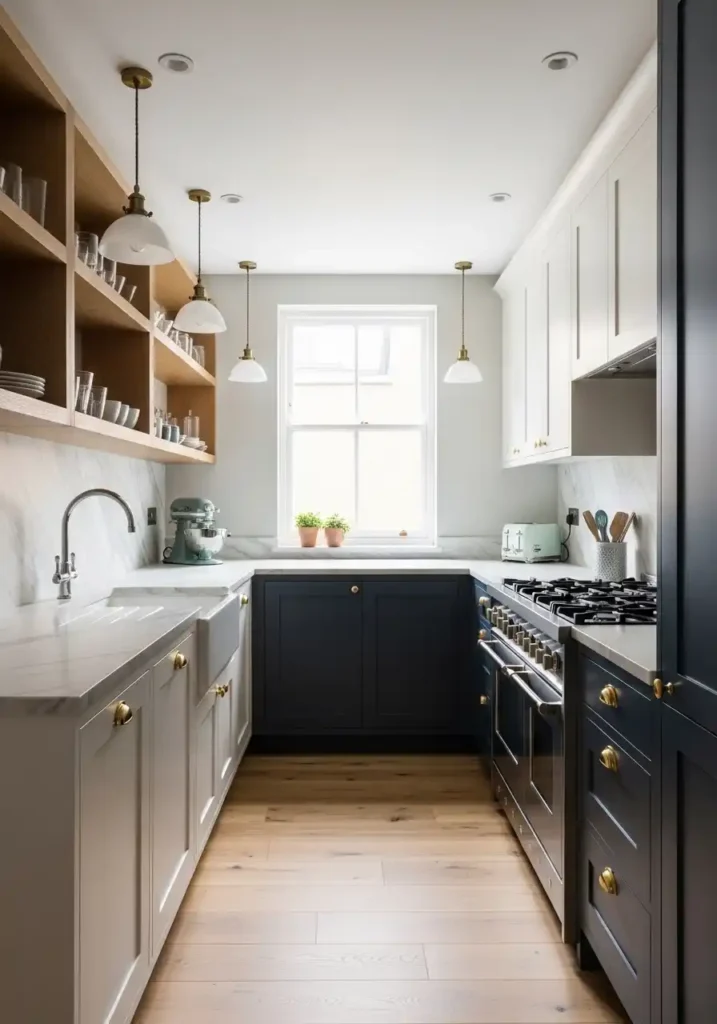
The galley kitchen layout is the small kitchen configuration that provides the highest ratio of usable counter and storage space to total floor area of any layout available — making it the most spatially efficient and the most functionally excellent format for compact cooking spaces where maximizing every inch of counter length and cabinet volume is the primary design priority. The galley’s two parallel runs of counter and cabinetry create an ergonomically optimal cooking environment where every kitchen function — sink, stove, refrigerator, preparation surface, and storage — is within a single step or turn of the working cook, eliminating the wasted movement that less efficient layouts introduce.
The corridor width between the two parallel galley runs is the kitchen’s single most critical dimensional decision — because a corridor that is too narrow makes movement through the kitchen uncomfortable and makes simultaneous two-person cooking physically impossible, while a corridor that is generously proportioned at 110 centimeters creates a galley of such comfortable, spacious working ease that the kitchen’s compactness becomes a genuine organizational virtue rather than a spatial compromise. A window or glass door at the far end of the galley corridor is the natural light provision that transforms the galley from a potentially tunnel-like space into a bright, naturally illuminated kitchen of genuine spatial quality and genuine daily pleasure.
10. The Small Kitchen with Two-Tone Cabinets for Visual Depth
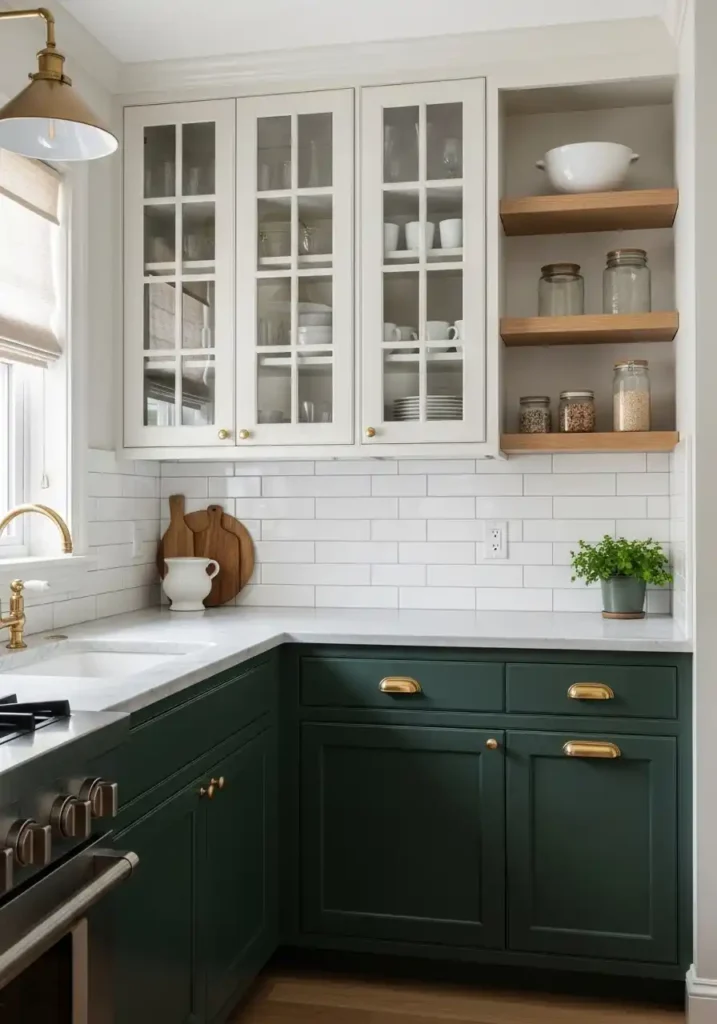
Two-tone cabinets in a small kitchen deliver the most significant visual transformation of any cabinet treatment available — not by making the kitchen larger but by making it dramatically more interesting, more designed, and more genuinely beautiful than a single-color cabinet scheme could achieve in the same compact footprint. The lower cabinets in a deeper, richer tone visually ground the kitchen and create a strong base of color that anchors the design with confidence, while the upper cabinets in a lighter tone keep the wall plane above the counter feeling open, bright, and airy. Together, the two tones create a visual layering and a sense of designed intention that makes the small kitchen feel genuinely, sophisticatedly resolved.
The specific color pairing that consistently creates the most beautiful and the most spatially successful two-tone small kitchen is a deep, saturated lower cabinet color combined with a clean, warm upper cabinet tone — forest green with warm white, deep navy with soft cream, charcoal with pale sage, or rich burgundy with ivory. The contrast between the tones creates a visual horizon line at counter level that the eye reads as a zone transition, making each zone feel more purposeful and more spatially defined. Brass hardware on both tones ties the two halves together with a warm metallic thread that makes the entire composition feel unified, considered, and completely beautiful.
11. The Small Kitchen with a Compact Island on Casters
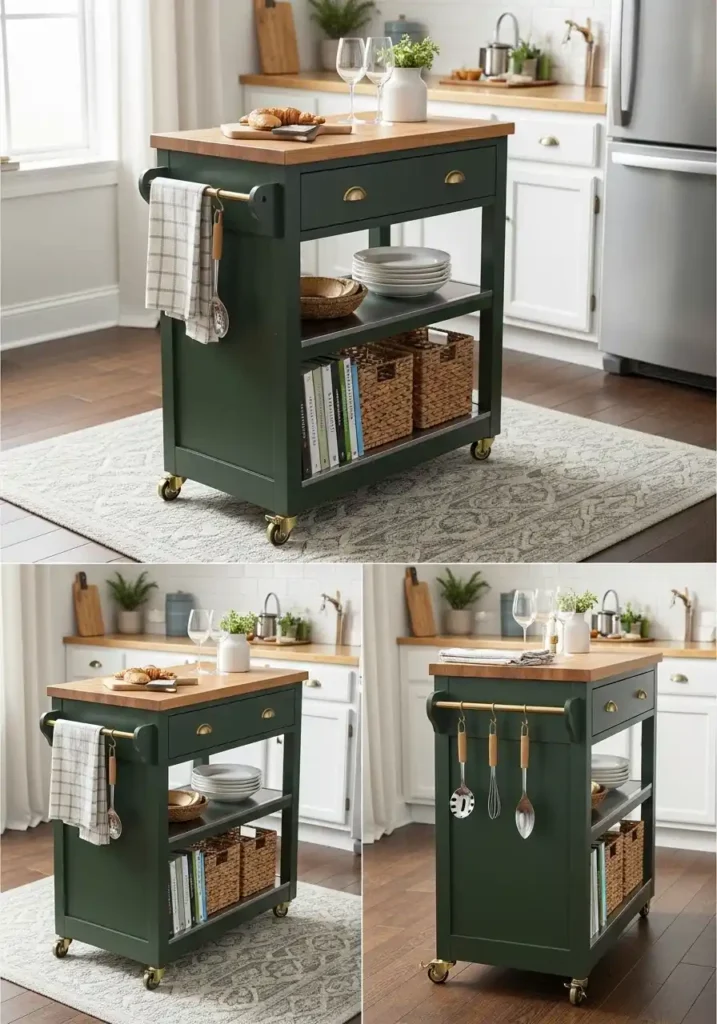
A compact rolling island on quality brass casters is the small kitchen’s most versatile, most liberating, and most brilliantly space-efficient furniture investment — because it delivers all the counter space, storage, and preparation surface benefits of a fixed island while adding a flexibility that the small kitchen desperately needs and that a fixed installation can never provide. Roll it to the center for meal preparation. Push it against the wall for a dinner party. Position it beside the stove for a cooking marathon. The rolling island serves the kitchen’s constantly changing spatial needs with equal ease and equal efficiency in every configuration.
The design of a rolling kitchen island in a small kitchen should be approached with genuine aesthetic ambition — because despite its mobility, the rolling island is always a prominent, always-visible element of the small kitchen and always contributing to or detracting from the kitchen’s overall design quality. A beautifully painted base in a rich, unexpected color — forest green, midnight navy, or warm terracotta — with a warm butcher block or marble top creates an island of genuine visual character and genuine material impact that makes the small kitchen feel more designed and more considered. Hooks on the sides for hanging utensils and open shelves beneath for cookbooks add the practical layers that make the island genuinely hardworking.
12. The Small Kitchen with a Mirror Ceiling for Double Height Illusion
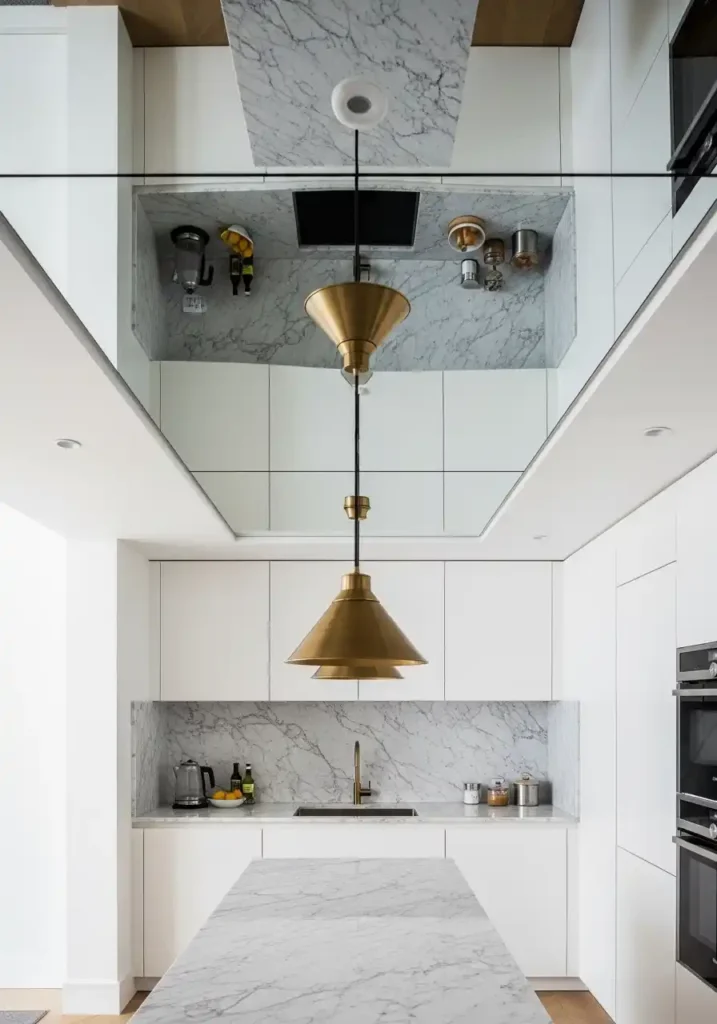
A mirror-finish ceiling panel above the kitchen’s central counter and island area is the spatial transformation that most powerfully and most completely creates the impression of greater ceiling height in a small kitchen — because a ceiling mirror reflects the kitchen’s pendant lights, its countertop, and its full vertical dimension back downward, creating a reflected image that effectively doubles the apparent height of the space in the most visually compelling and the most immediately convincing way available. The small kitchen that feels uncomfortably low-ceilinged becomes a space of surprising, reflected vertical generosity with a ceiling mirror of appropriate scale and quality.
The reflected pendant lights in a mirror ceiling create the small kitchen’s most dramatically beautiful and most unexpectedly gorgeous lighting effect — because a pendant light that hangs from a mirror ceiling appears to be reflected both above and below its actual position, creating a doubled, vertically symmetrical lighting composition of such complete, beautiful visual impact that the small kitchen’s pendant installation appears twice as generous and twice as spectacular as it would without the reflection. The warm amber of a brass pendant reflected in a mirror ceiling creates a composition of warm, doubled metallic beauty that is genuinely extraordinary in its effect on the kitchen’s perceived spatial quality and atmospheric warmth.
13. The Small Kitchen with Color-Blocked Zones for Smart Organization
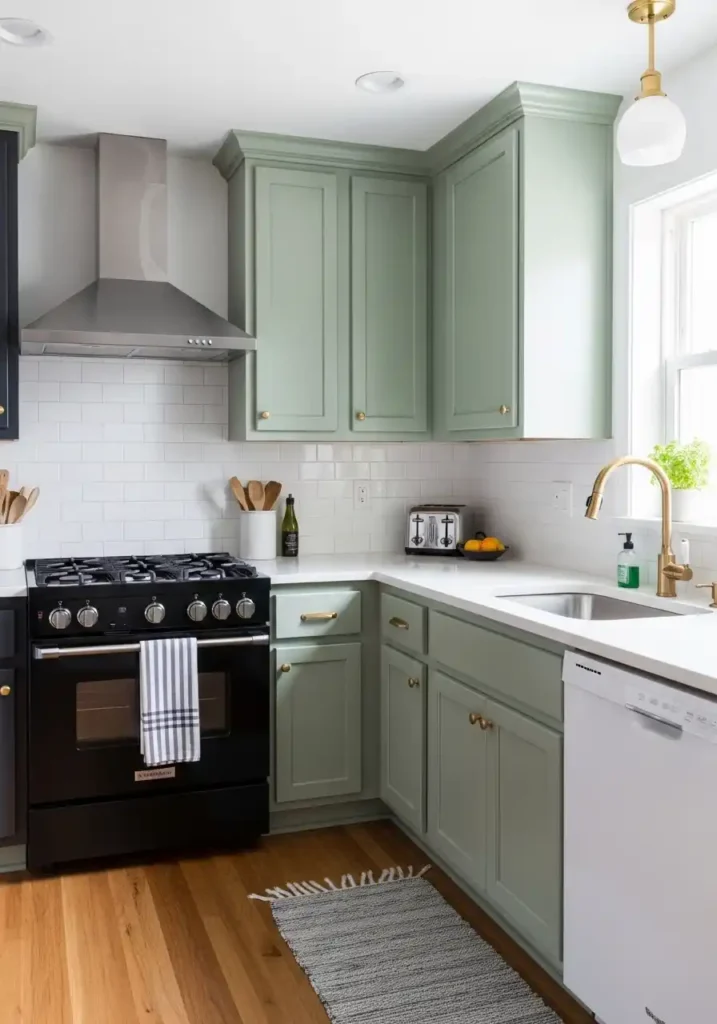
Color blocking different functional zones within a small kitchen is the spatial organization strategy that most intelligently converts a visual design tool into a functional organizational system — using color not merely as decoration but as a visual coding language that makes the kitchen’s three primary functional zones — cooking, preparation, and cleaning — immediately legible to every person who uses the kitchen, creating a quality of spatial clarity and operational efficiency that a single-color kitchen, however beautifully specified, simply cannot provide. The color-coded small kitchen is simultaneously more beautiful and more functionally intelligent.
The continuous white quartz countertop that flows uninterrupted through all three color zones is the unifying element that prevents the color-blocked small kitchen from feeling fragmented or visually chaotic — because the continuous countertop creates a strong, unbroken horizontal line of visual unity that ties the three distinct color zones together into a single, coherent kitchen composition despite their individual color differences. The countertop says that all three zones belong to the same kitchen even as their colors distinguish their specific functions, creating a visual organization of such complete, intelligent clarity that navigating the small kitchen’s workflow becomes as intuitive and as natural as reading a well-designed map.
14. The Small Kitchen with a Built-In Breakfast Nook
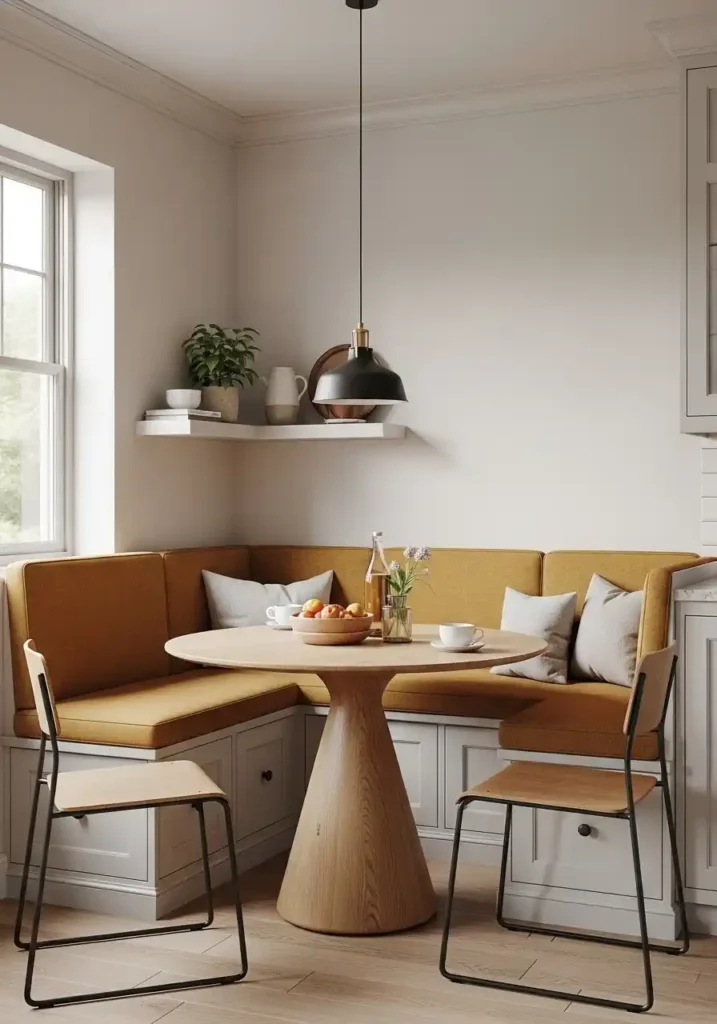
A built-in breakfast nook integrated directly into the small kitchen’s corner is the casual dining addition that creates the most genuine, the most warmly domestic, and the most spatially efficient dining destination available within a compact kitchen footprint — because the fixed bench seat requires zero chair-pullout clearance on its wall sides, making the nook’s floor footprint dramatically smaller than the equivalent number of freestanding chairs around a freestanding table would demand in the same corner. The nook creates a complete dining destination for four within a floor area that a conventional dining set of equivalent seating capacity would find barely adequate.
The storage compartment beneath the built-in bench cushion is the detail that transforms the breakfast nook from a beautiful casual seating solution into one of the small kitchen’s most practically intelligent furniture pieces — providing concealed storage for table linens, placemats, candles, and kitchen extras within the same footprint as the seating itself, contributing significant hidden storage capacity to the compact kitchen without any visible storage addition. The drawer or lift-up seat storage beneath the nook bench converts what would otherwise be dead structural space beneath the seat into organized, accessible, completely concealed storage of genuine practical value to a small kitchen always in need of additional storage options.
15. The Small Kitchen with Handleless Cabinets for Clean Lines
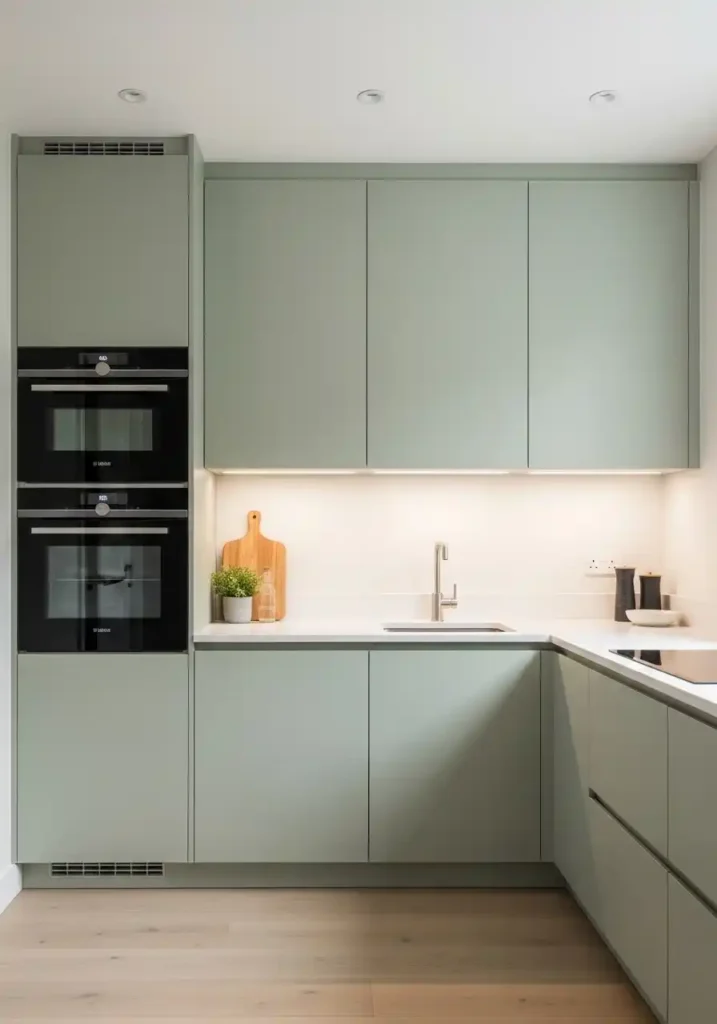
Handleless cabinets in a small kitchen are the design decision that creates the cleanest, the most visually uninterrupted, and the most genuinely spacious-feeling kitchen appearance available — because the elimination of all hardware from the cabinet fronts removes the rows of handles and knobs that add visual noise and visual complexity to kitchen walls and replaces them with smooth, continuous, uninterrupted planes of cabinet material that the eye reads as calm, visually receding surfaces rather than busy, detailed, spatially advancing ones. In a small kitchen where visual calm and visual simplicity directly contribute to the perceived spaciousness of the compact space, the handleless cabinet is the single most effective design decision.
The push-to-open mechanism that replaces conventional handles on a handleless small kitchen cabinet must be reliable, smooth, and consistently positive in its daily operation — because a handleless cabinet whose opening mechanism requires excessive force or operates inconsistently becomes a daily frustration that completely undermines the kitchen’s practical livability regardless of how beautiful its clean surface appearance may be. A properly specified push-to-open mechanism opens smoothly, positively, and consistently with a single light touch and closes with a gentle, satisfying, quality-communicating click that makes the handleless kitchen a genuine daily pleasure to use rather than merely a beautiful kitchen to look at.
16. The Small Kitchen with Under-Cabinet Lighting for Space and Atmosphere
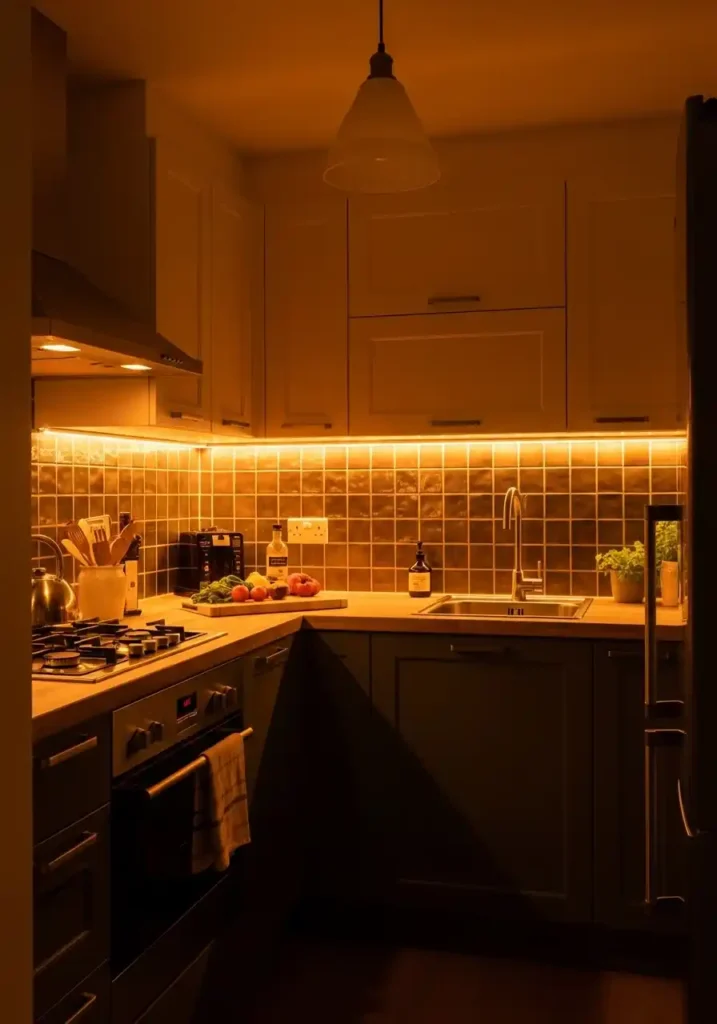
Under-cabinet LED lighting in a small kitchen is the installation upgrade with the most dramatically disproportionate impact on both the kitchen’s daily practical quality and its daily atmospheric beauty for the smallest installation effort and the most modest budget of any kitchen improvement available. Warm LED strips mounted beneath the upper cabinets transform both the quality of the kitchen’s task lighting — illuminating the countertop directly and evenly without the shadows that overhead lighting creates — and the atmospheric quality of the kitchen’s evening character, turning a compact room lit by a single overhead light into a space of warm, layered, beautifully multi-sourced illumination that feels genuinely extraordinary despite the kitchen’s modest dimensions.
The color temperature of the LED strips is the technical specification that most determines the quality of the under-cabinet lighting’s atmospheric contribution — and warm white LEDs at 2700 Kelvin create the most beautiful, most flattering, and most genuinely atmospheric kitchen lighting effect available, casting a warm amber glow across the counter and backsplash that makes food look more beautiful, makes the kitchen feel more welcoming and more intimate, and creates a quality of warm, directed light that transforms the small kitchen’s evening character completely. The 2700 Kelvin warm white creates light that feels like candlelight rather than fluorescent illumination — the specific atmospheric quality that makes a small kitchen genuinely beautiful after dark.
17. The Small Kitchen with Maximized Natural Light
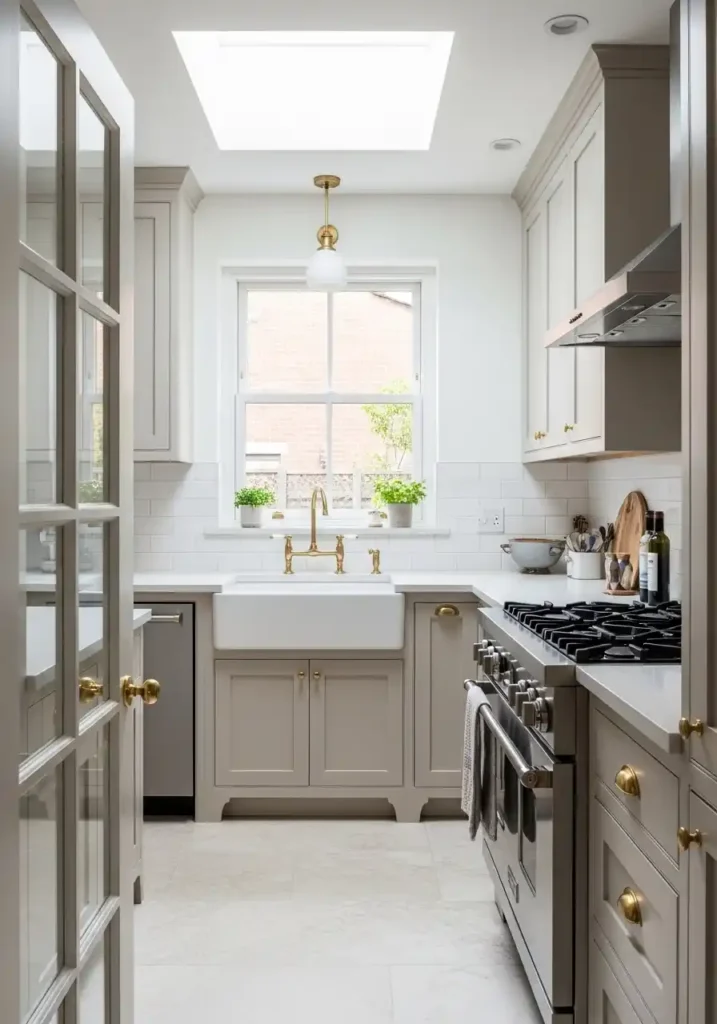
Maximizing natural light in a small kitchen is the spatial strategy that most genuinely and most fundamentally improves the quality of the compact cooking environment — because natural light makes small kitchens feel more spacious, more welcoming, and more genuinely beautiful than any artificial light source can replicate with the same completeness and the same daily-renewed freshness. A small kitchen with generous natural light feels significantly more generous in its spatial quality than the same kitchen with inadequate natural light, because natural light creates a quality of brightness, openness, and visual connection to the world beyond the kitchen walls that makes the compact space feel less contained and less enclosed.
A skylight above the small kitchen’s preparation area is the natural light addition with the most dramatic and the most consistent impact on the compact kitchen’s daily spatial quality — because overhead natural light delivered directly onto the kitchen’s primary working surface creates the most practically beneficial and the most beautifully atmospheric natural light provision available, illuminating the countertop without shadows, making food colors appear vivid and beautiful, and creating a direct, unmediated connection between the kitchen’s most active working position and the natural world above. A skylight in a small kitchen makes even the most compact cooking space feel connected to the sky, the light, and the generous natural world beyond its walls.
18. The Small Kitchen with a Statement Pendant That Elevates Everything
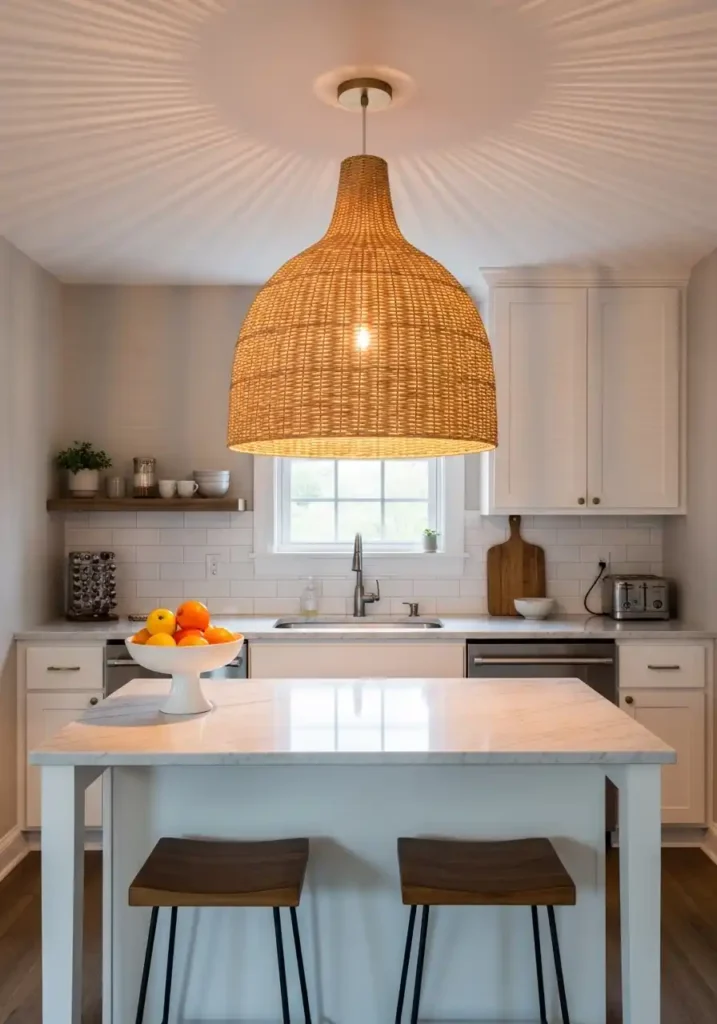
A statement pendant light of genuine beauty and genuine scale above a small kitchen counter or island is the installation that most dramatically and most immediately elevates the compact kitchen’s design quality — because a beautifully chosen pendant that is slightly larger in scale than conventional small kitchen lighting creates a visual focal point of such confident, generous presence that it reframes the kitchen’s spatial narrative entirely: the small kitchen stops being a compact room with a light fitting and becomes a beautifully designed space with a spectacular lighting statement. The statement pendant makes the small kitchen feel intentionally, beautifully small rather than inadvertently, apologetically compact.
The oversized rattan pendant is the specific light fitting that creates the most beautifully warm and the most completely atmospheric statement in a small kitchen — because rattan’s natural fiber construction creates the most organic, most warm, and most completely inviting pendant form available, casting a specific quality of warm, dappled light through its woven structure that no glass or metal alternative can replicate with the same quality of organic, filtered warmth. The rattan pendant’s scale, which appears generously large against the small kitchen’s dimensions, paradoxically makes the kitchen feel more spatially generous rather than more cramped — the large pendant drawing the eye upward and making the vertical dimension above the counter feel abundant and architecturally significant.
19. The Small Kitchen with Integrated Appliances for Clean Visual Flow
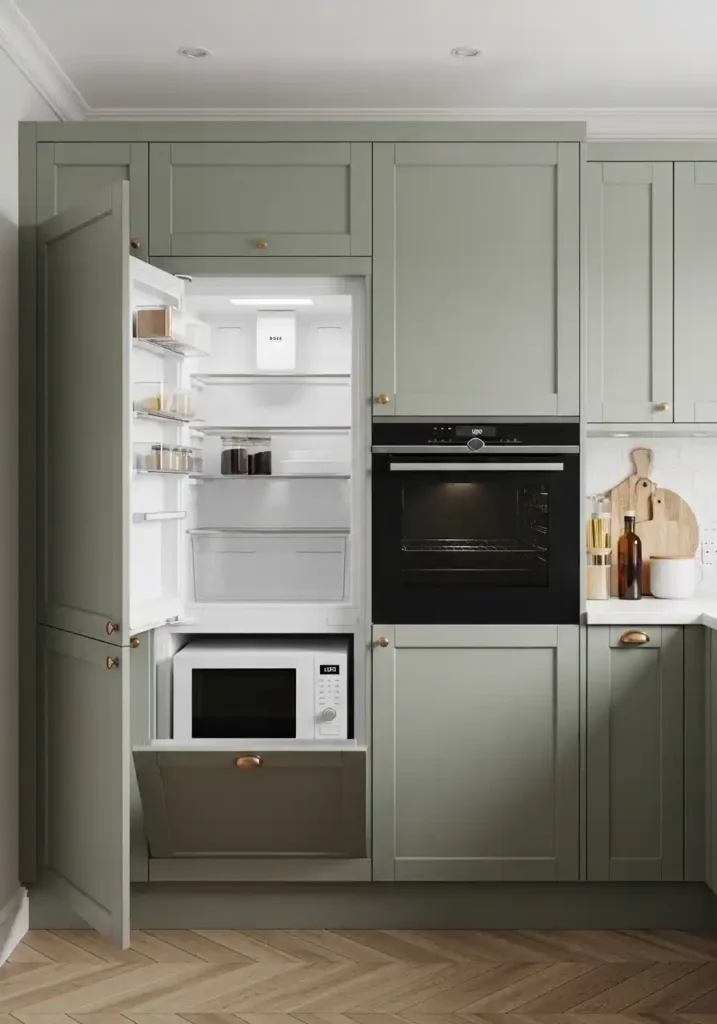
Fully integrated appliances in a small kitchen are not merely a design preference but the most practically transformative space maximization available — because in a small kitchen that is permanently, visually open to the daily life of the home, the large, visually dominant appliances that a kitchen must accommodate — the refrigerator, the dishwasher, the oven, the microwave — are among the most spatially aggressive and most visually disruptive elements in any compact cooking space, and concealing every one of them behind matching cabinet panels creates a visual calm and a spatial clarity of such complete, immediate, dramatic impact that the same small kitchen appears genuinely, significantly larger simply through the removal of these appliances from the room’s visual field.
The integrated refrigerator is the single appliance whose concealment delivers the most dramatic visual transformation of the small kitchen’s appearance — because a full-height refrigerator in its standard stainless steel or white finish is typically the kitchen’s largest and most visually dominant appliance, always prominent in the small kitchen’s limited visual field and always either contributing positively to the kitchen’s aesthetic quality or competing with it. An integrated refrigerator behind a full-height panel in the same finish as the surrounding cabinetry disappears completely into the cabinet run, removing the refrigerator’s entire visual mass from the small kitchen’s spatial composition and creating a kitchen of such complete, resolved visual unity that the fridge’s location becomes a charming small mystery to every new visitor.
20. The Small Kitchen with a Dedicated Spice and Pantry Wall
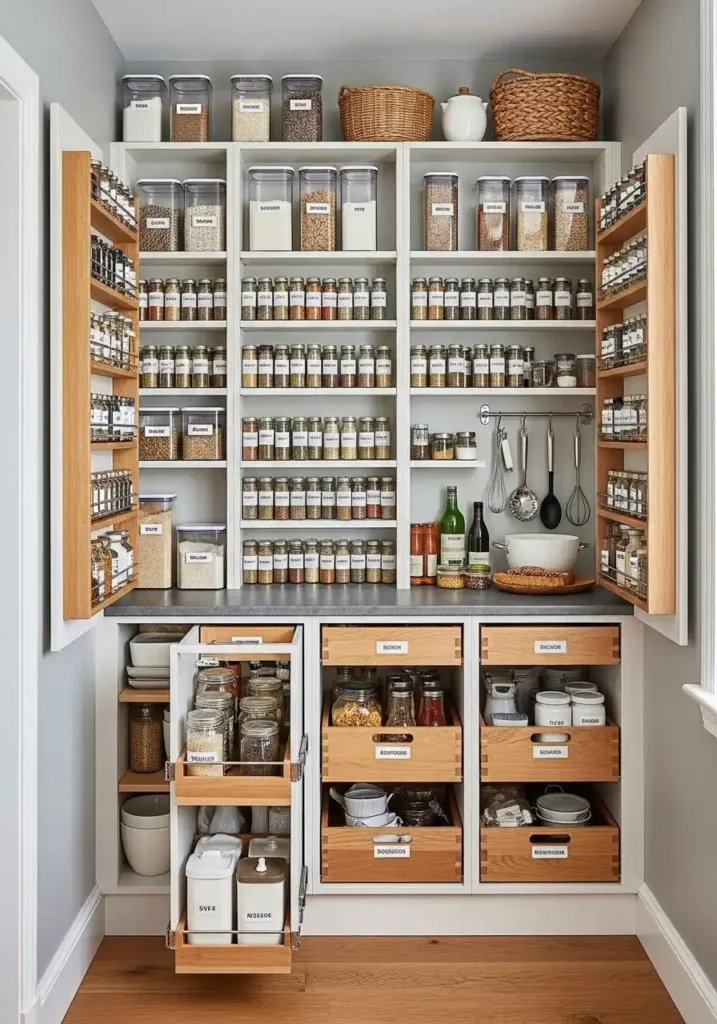
A dedicated spice and pantry wall in a small kitchen is the organizational investment that most completely and most permanently transforms the daily cooking experience — because a kitchen where every spice is immediately visible, immediately accessible, and immediately identifiable by its clearly labeled uniform container creates a quality of cooking ease and cooking flow that a kitchen with poorly organized, hard-to-access spice storage cannot approach, regardless of the beauty of its cabinet finishes or the quality of its appliances. The organized pantry wall makes cooking simultaneously more efficient and more genuinely pleasurable at every single meal.
Uniform glass spice jars with consistent labels are the pantry wall element that creates the most immediately beautiful and the most continuously satisfying visual organization in the small kitchen’s dedicated food storage system — because glass containers with matching labels transform what would otherwise be a chaotic collection of mismatched commercial packaging in varied colors, varied sizes, and varied label designs into a cohesive, beautiful, professionally organized display of kitchen ingredients that communicates genuine care and genuine organizational intelligence at a glance. The transition from commercial packaging to uniform glass jars requires an afternoon of decanting and labeling and produces a pantry wall of such extraordinary, organized beauty that it becomes one of the small kitchen’s most admired and most frequently photographed design features.
21. The Small Kitchen with a Clever Breakfast Bar Window Ledge
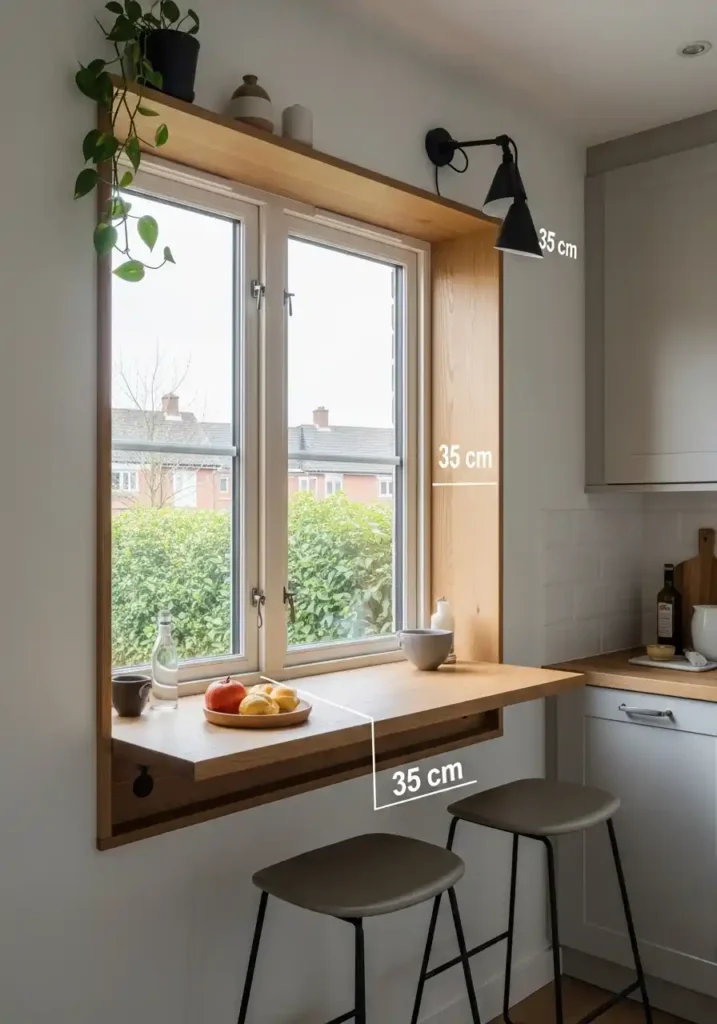
A window ledge extended and reinforced to serve as a breakfast bar is the small kitchen’s most brilliantly creative and most spatially efficient casual dining solution — because it converts an existing architectural feature, the window ledge, into a fully functional dining surface of appropriate depth and appropriate height without any additional floor area requirement, any structural modification beyond the ledge reinforcement and extension, or any disruption to the kitchen’s layout or workflow. The window breakfast bar is literally created from nothing — from the existing space of the window recess — making it the small kitchen’s most spatially democratic and most creatively intelligent dining addition.
The natural light flooding the breakfast bar from the window above it creates the most pleasant and the most naturally beautiful casual dining position in the small kitchen — because eating breakfast, drinking morning coffee, or enjoying a casual lunch at a window with natural light and a view of the outside world is a genuinely superior dining experience to eating at an interior position without the same quality of natural light and external visual connection. The window breakfast bar creates a casual dining destination of such completely natural, completely effortless beauty that it becomes the most sought-after and the most consistently used dining position in the home, making it the small kitchen’s most genuinely, daily life-improving spatial solution.
22. The Complete Small Kitchen — Every Space-Maximizing Inspiration in Perfect Harmony
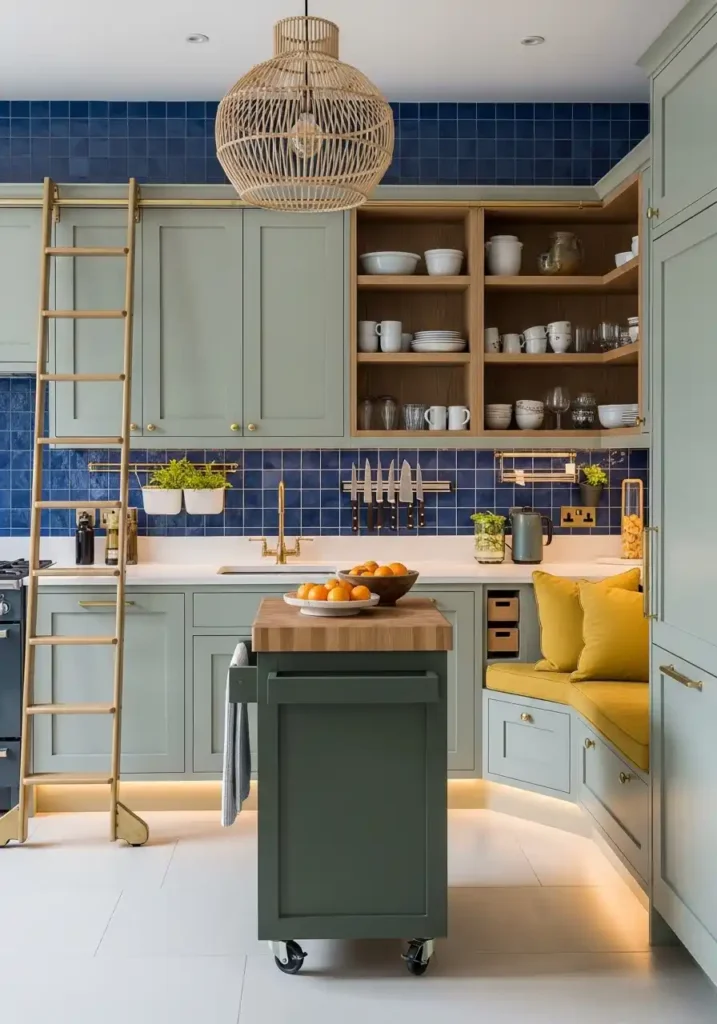
The perfectly maximized small kitchen — the one that makes every experienced kitchen designer stop in genuine admiration, that makes visitors ask how such a compact space manages to contain everything so beautifully and so effortlessly, and that makes its owner genuinely, deeply grateful for the intelligence and the creativity invested in its organization — is the accumulated, harmonious, completely resolved result of multiple complementary space-maximizing inspirations working together in complete, reinforcing concert rather than any single solution working in proud but partial isolation. The ceiling-height cabinets that capture every inch of vertical storage. The rolling island that adapts to every spatial need. The open shelves that make the wall feel open and alive. The handleless cabinets that create visual calm. Each inspiration amplifies every other.
The most important and the most genuinely liberating understanding this guide offers is that small kitchen design is not the lesser alternative to large kitchen design but a distinct, specific, and genuinely creative design challenge that rewards intelligent engagement with greater beauty, greater organizational sophistication, and greater daily satisfaction than any large kitchen that was simply filled with more of everything without the discipline and the creativity that limited space demands and inspires. Your small kitchen is not a compromise awaiting a future renovation — it is an opportunity for the most brilliant, the most creative, and the most personally satisfying kitchen design available. These twenty-two inspirations are the proof.
Conclusion:
A well-designed small kitchen isn’t about limitations—it’s about smart choices that enhance both functionality and style. By incorporating space-saving layouts, clever storage solutions, and multi-purpose elements, you can transform even the most compact kitchen into an efficient and visually appealing space. From utilizing vertical storage to choosing light color palettes and innovative cabinetry, each design idea plays a vital role in maximizing every inch.
Ultimately, the key to a successful small kitchen design lies in thoughtful planning and creativity. Whether you prefer a modern, minimalist look or a cozy, traditional feel, these inspirations prove that size doesn’t define potential. With the right approach, your small kitchen can become a highly functional, stylish, and comfortable hub of your home.