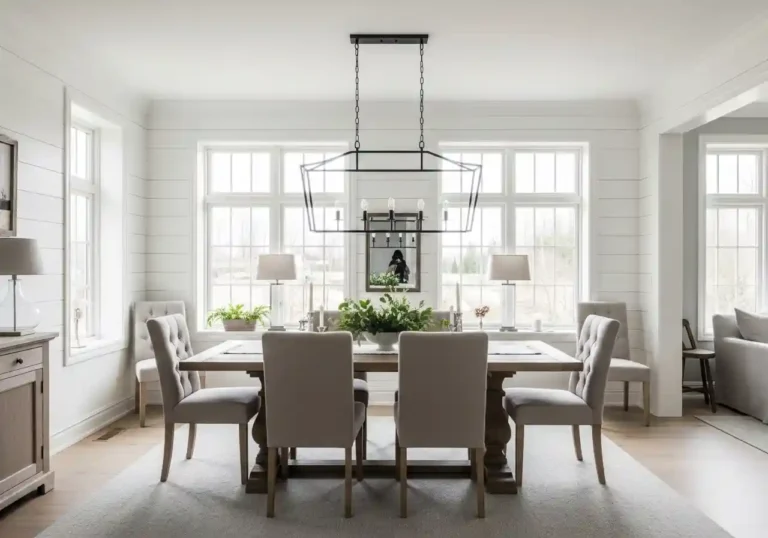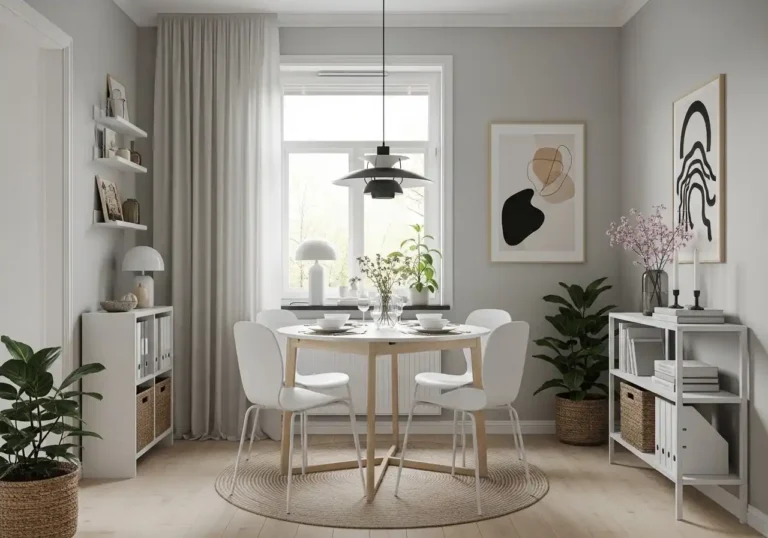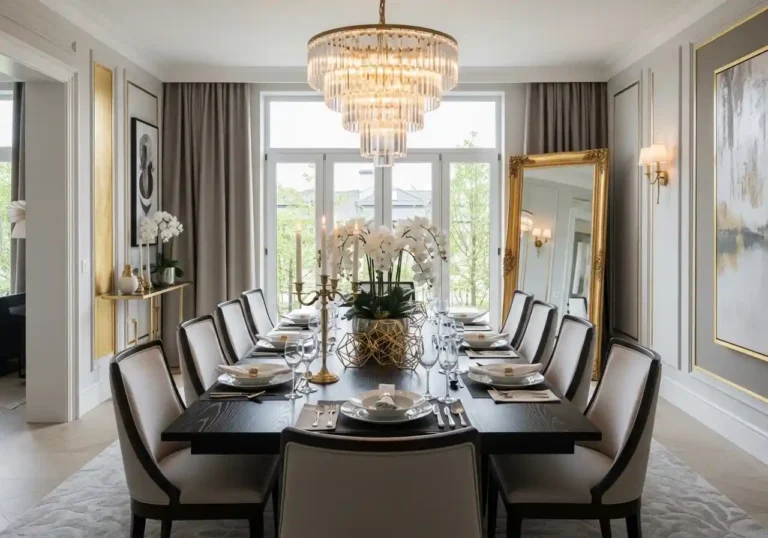
1. Round Table — The Small Dining Room’s Best Friend
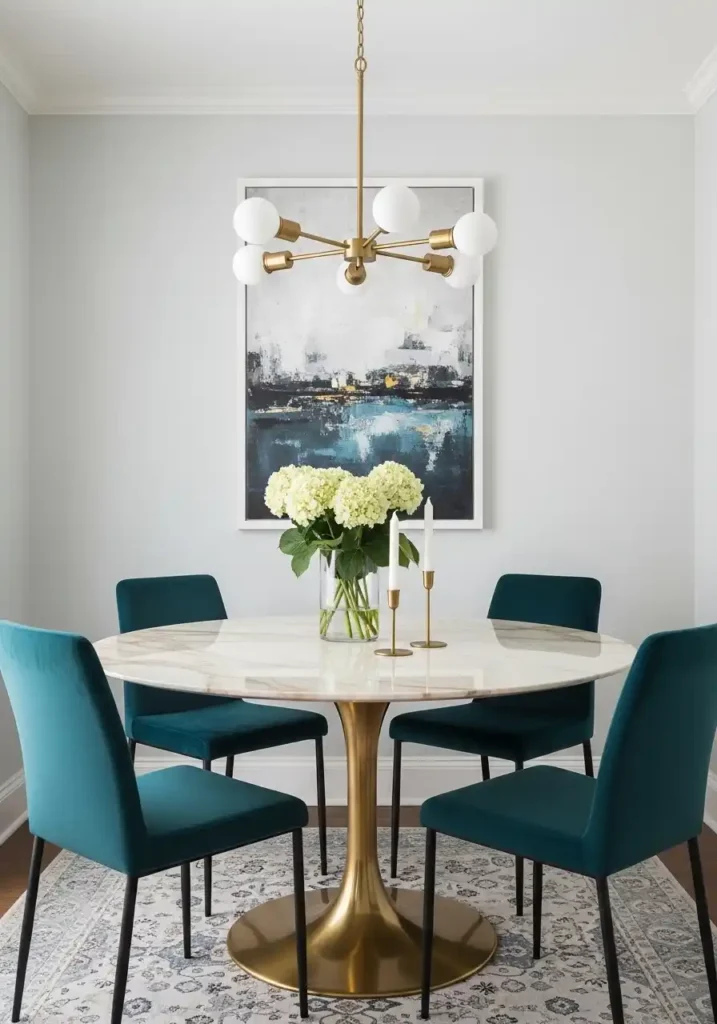
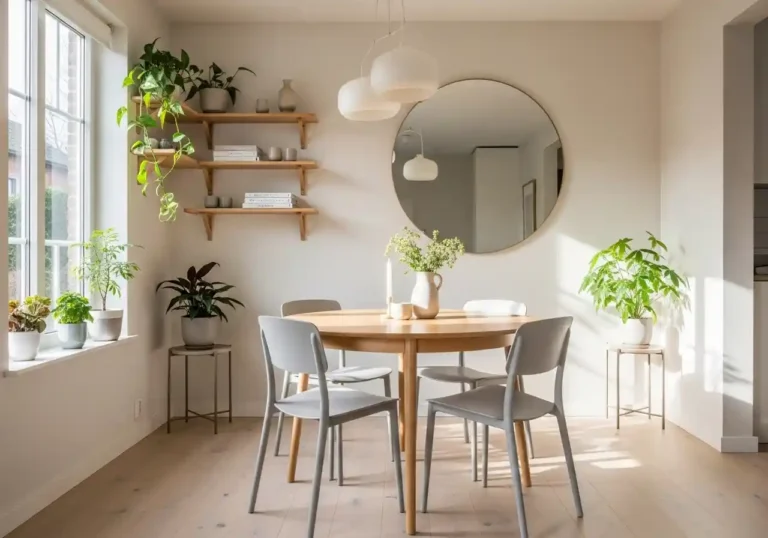
If there is one single furniture decision that will transform your Small Dining Room Ideas more dramatically, more immediately, and more completely than any other change you could possibly make, it is switching to a round dining table — and if you’re currently navigating around the sharp corners of a rectangular table in a tight space, you already know exactly why. Round tables have no corners to catch your hips, no ends that jut into circulation pathways, and no sides that feel uncomfortably close to the wall. They invite everyone at the table into a naturally democratic, face-to-face conversation that rectangular tables simply cannot facilitate with the same warmth and ease.
The pedestal base is the specific round table design that unlocks the most seating flexibility in a small dining room — because without legs at the corners, chairs can be positioned at any point around the circumference, allowing you to squeeze in an extra seat when guests arrive without any leg getting in anyone’s way. A marble top on a brass pedestal base brings genuine luxury and visual lightness simultaneously, making the table feel like a design statement rather than a spatial compromise. In a small dining room, a round table isn’t the second-best option — it is genuinely, undeniably the best option, full stop.
2. Dark Walls That Make a Small Space Feel Intentionally Intimate
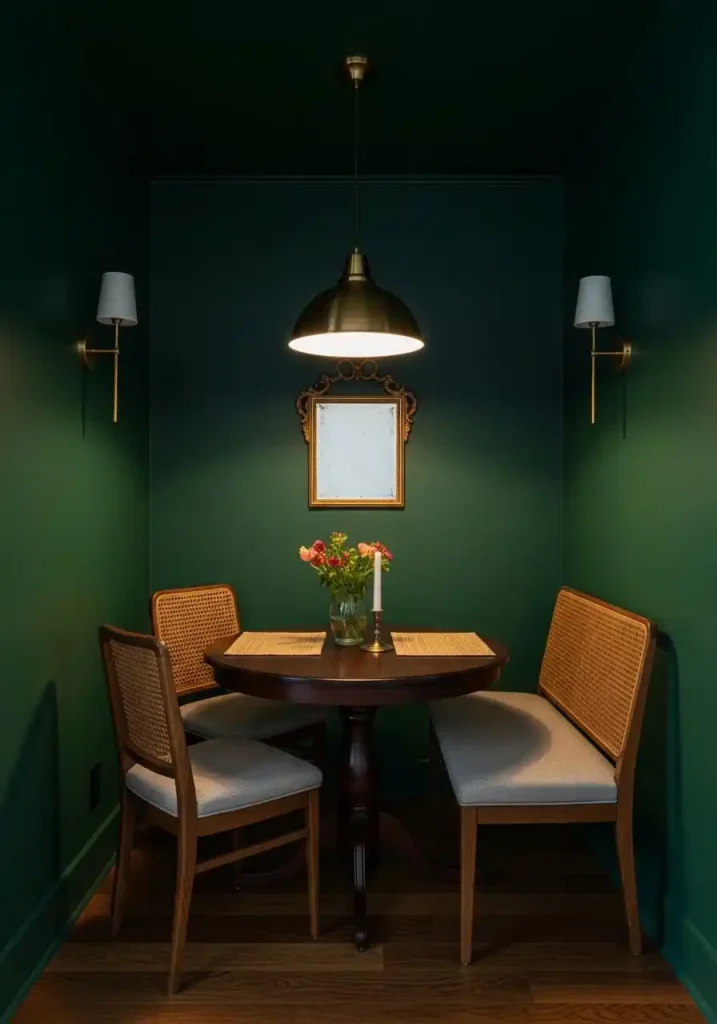
Here is the counterintuitive small dining room truth that interior designers have been sharing with skeptical clients for years, with consistently spectacular results: dark walls do not make a small dining room feel smaller — they make it feel intentionally intimate, deliberately cozy, and genuinely more beautiful than the same room painted white could ever be. A small dining room painted in a rich, deep tone stops looking like a room that isn’t big enough for something grander and starts looking like a room that was specifically, purposefully designed to be this size, this warm, and this atmospherically perfect for the shared pleasure of a meal.
The jewel-box effect — that sensation of being enclosed within a richly finished, beautifully considered space — is most powerfully achieved in small rooms precisely because of their limited size. Deep forest green, midnight navy, rich burgundy, or moody charcoal on all four walls and the ceiling of a small dining room creates a complete envelope of color that makes candlelight and pendant light glow with extraordinary warmth against the dark surfaces. Every face at the table looks beautiful. Every meal feels like an occasion. And every guest who walks into that small, dark, magnificently atmospheric room feels the same thing: that this is the most beautiful dining room they’ve ever sat in.
3. Wall-Mounted Drop-Leaf Table for the Tiniest Dining Spaces
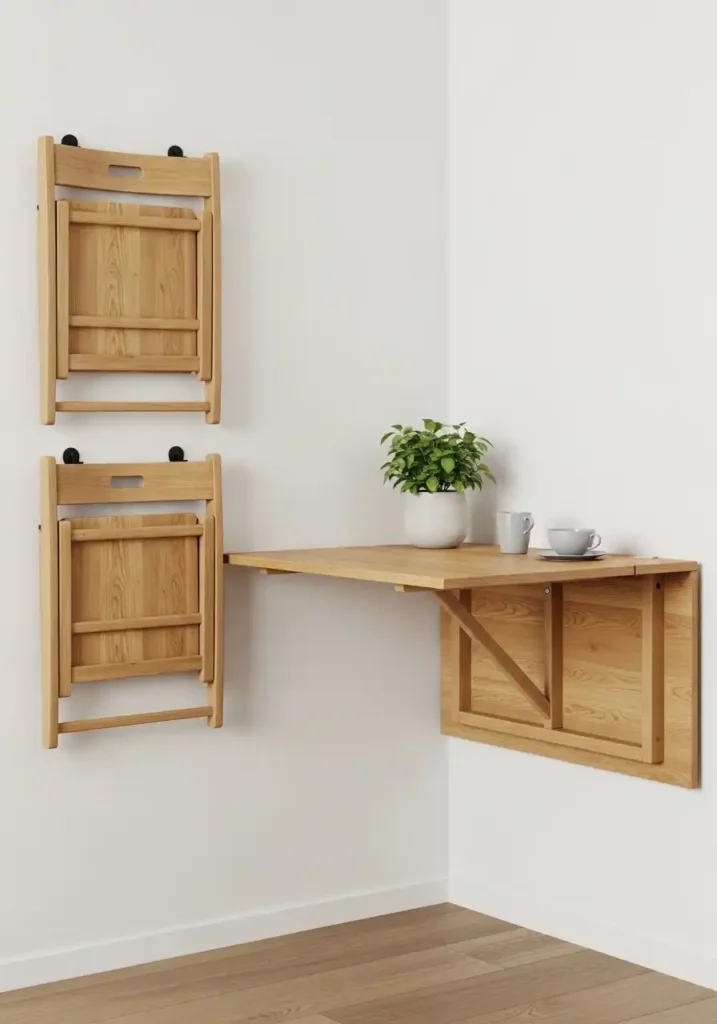
The wall-mounted drop-leaf table is the small dining room solution for spaces where “small” is genuinely extreme — where the room is so compact that a permanently positioned dining table, however petite, would consume floor space that the room cannot afford to surrender on a full-time basis. When the table is folded up against the wall, the space is completely free — available for yoga, for children’s play, for any activity that needs floor space and gets it back entirely the moment the meal is over. When it folds down, a proper, beautiful dining surface appears in seconds, complete and ready for use, as though it was always waiting patiently inside the wall.
The design quality of a wall-mounted drop-leaf table matters enormously in a small dining space where it is never truly out of sight — even folded closed, it is always a visible element of the room, always contributing to or detracting from the space’s overall aesthetic. Choose a table in solid oak, walnut, or painted wood with proper brass or black steel hardware, so that the folded position reads as a deliberate, beautiful wall feature rather than stored equipment. A small plant, a candle, and a framed print positioned above the folded table transforms the wall into a styled vignette that looks intentional and lovely on ordinary evenings when no one is dining.
4. Banquette Seating Along the Wall for Maximum Space Efficiency
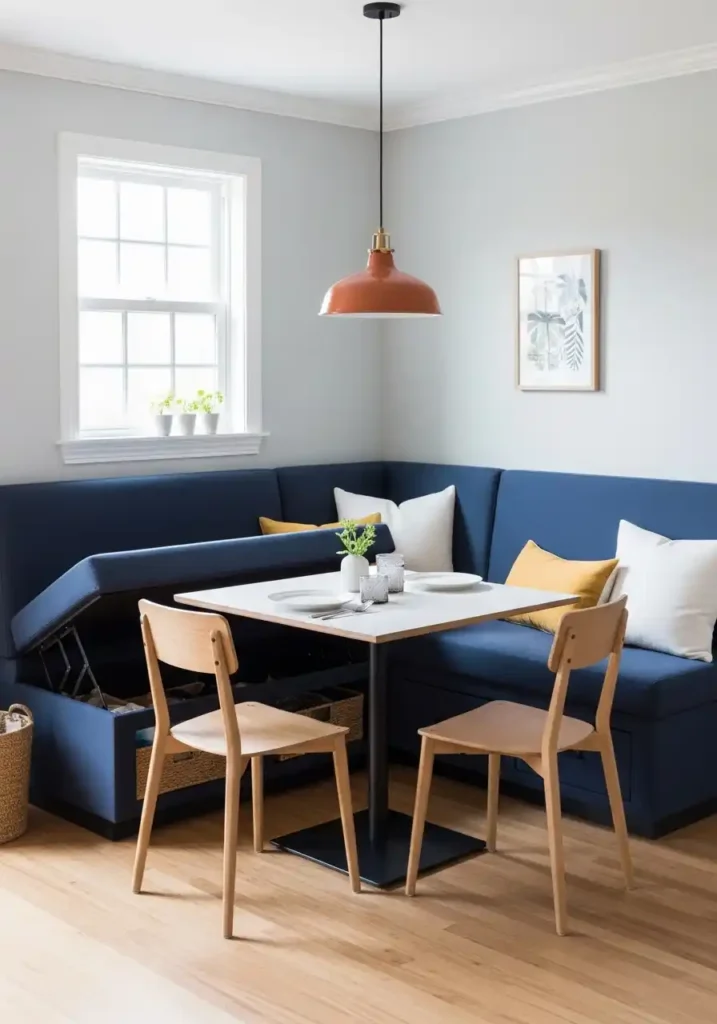
Banquette seating — the built-in or custom upholstered bench seating that runs along one or two walls of a dining area — is the small dining room’s single most space-efficient seating solution, and once you understand the geometry of why, you’ll immediately see why every space-constrained dining room should seriously consider it. A banquette requires zero clearance space behind the diner — because the diner slides in from the open side and the wall is right there behind them. That eliminated chair-pullout clearance, which typically requires eighteen to twenty-four inches per side, can represent the difference between a dining arrangement that works in a small room and one that simply doesn’t fit.
An L-shaped banquette tucked into the corner of a small dining room with a compact table positioned in the corner and two traditional chairs on the open sides creates a dining arrangement that seats four to six people comfortably in a footprint that a conventional four-chair arrangement could never achieve. The hidden storage beneath the banquette seat — accessed via lift-up cushions — provides valuable extra storage capacity that small dining rooms almost never have enough of. Upholster your banquette in a durable, beautiful fabric — a performance velvet, a heavy cotton canvas, or a woven texture — that adds genuine visual warmth and richness to the dining space, making the room feel more designed and more intentional than its square footage alone would suggest.
5. Statement Mirror to Double the Perceived Size
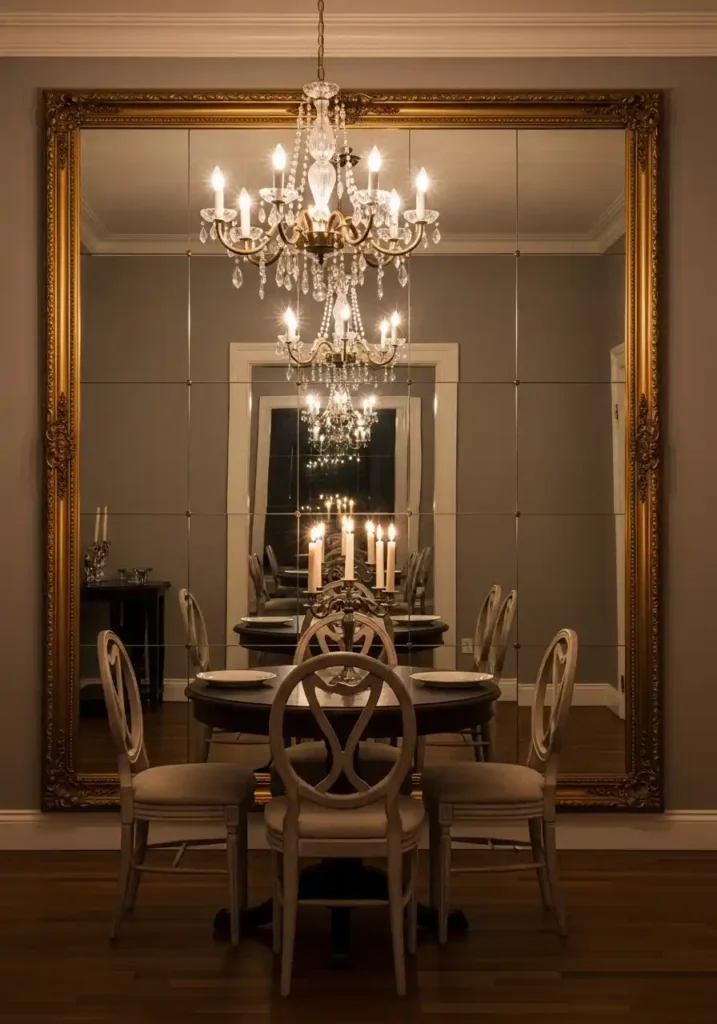
A large mirror in a small dining room is not a decorating accessory — it is a spatial transformation tool of genuine power, and the difference between a small dining room with a large mirror and the same room without one is so dramatic and so immediately apparent that it’s genuinely difficult to understand why every small dining room in the world doesn’t have one. Position a large mirror on the wall that the dining table faces, so that every seated diner looks into its reflection, and the room doubles visually in an instant. The reflected dining table, the reflected chandelier, the reflected candles — all of it creates the impression of a second complete dining room existing just beyond the wall.
The frame of your dining room mirror is a design decision of real consequence in a small room where every element is highly visible and highly impactful. An ornate gilded baroque frame adds glamour and historical grandeur that makes a small dining room feel like a private salon of extraordinary elegance. A thick, dark wood frame brings organic weight and rustic sophistication. A slim, minimal frame in black or brass makes a contemporary statement with quiet confidence. In every case, go larger than feels immediately comfortable — a mirror that is slightly too large for the wall creates a far more powerful spatial impact than one that is cautiously sized, and in a small dining room, that impact is the entire point of the exercise.
6. Slim Profile Furniture for Visual Lightness
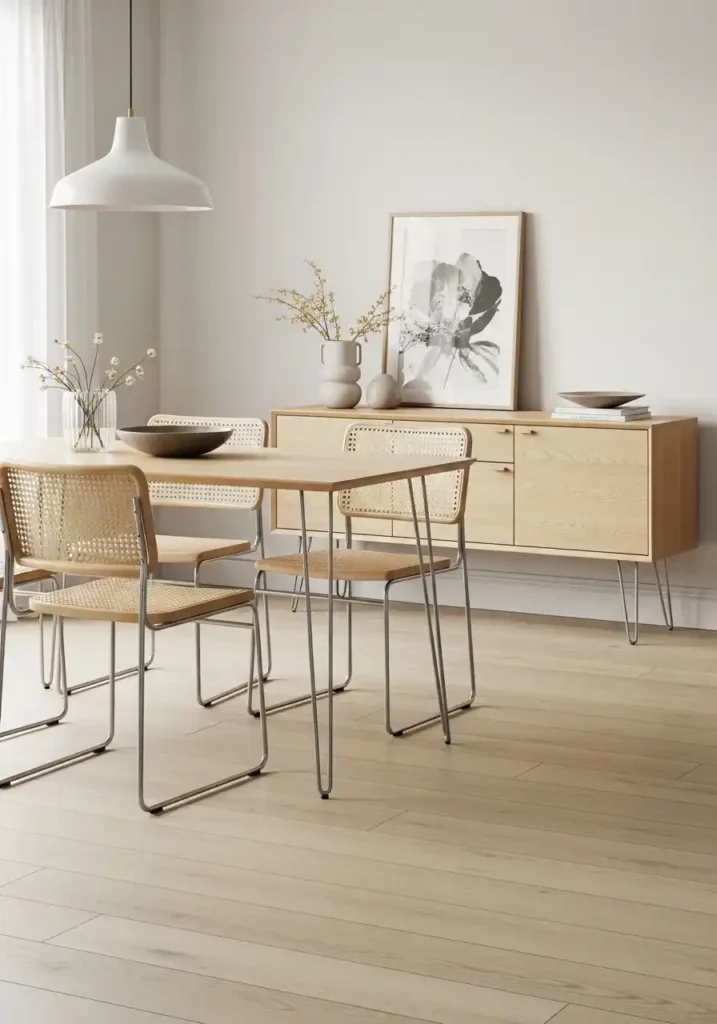
Slim-profile furniture — pieces with slender legs, thin tabletops, delicate frames, and minimal visual mass — is the small dining room decorator’s most consistently reliable tool for creating the illusion of spaciousness in a room that cannot actually be made larger. When every piece of furniture in a small dining room sits on thin legs that reveal the floor running beneath them, when the dining table has a slim top that doesn’t dominate the room with visual mass, when the chairs have delicate frames that almost seem to disappear against the wall behind them, the room reads as far more open, far more airy, and far more generously proportioned than a room filled with heavy, visually substantial furniture of identical dimensions.
The specific furniture design language that delivers the most visual lightness in a small dining room is mid-century modern at its most refined — hairpin legs on tables and consoles, cane backs on chairs that create visual transparency rather than solid planes, slim tapered wooden legs in natural oak or walnut that elevate every piece off the floor with graphic elegance. A hairpin-leg dining table in light oak with a thin tabletop has almost no visual weight whatsoever — the room appears to flow beneath and around it as though the table is barely there. Four matching cane-back chairs around this table create a dining arrangement of extraordinary visual lightness that makes a small room feel genuinely airy and spacious in a way that heavier furniture never could.
7. Pendant Light as the Room’s Star Attraction
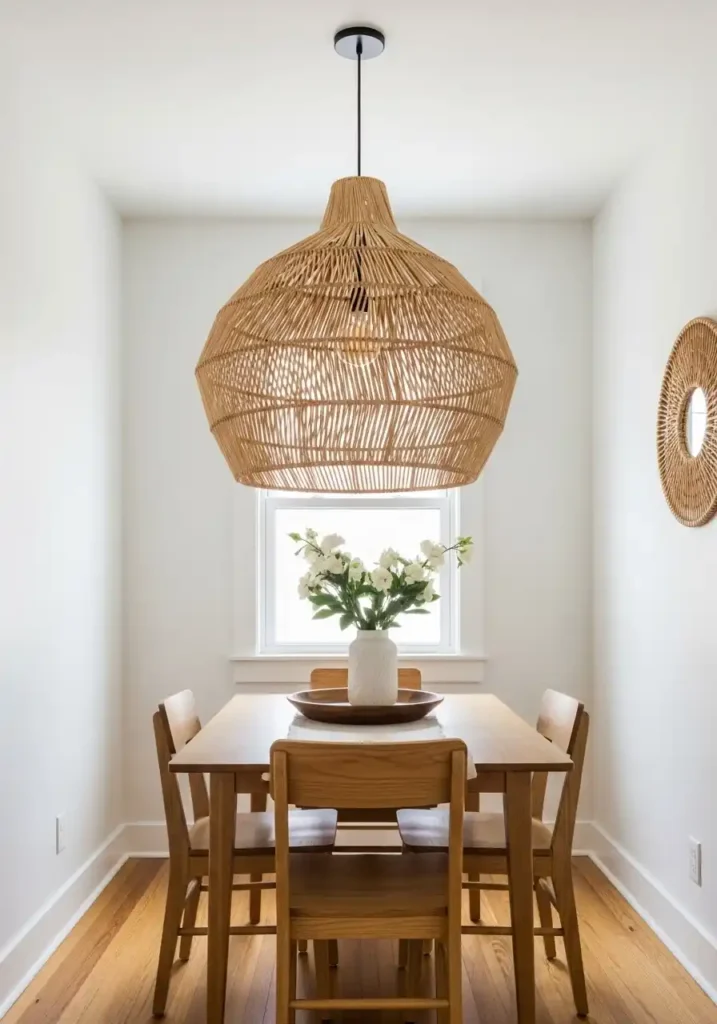
In a small dining room where the furniture must be compact and the layout must be efficient, the pendant light is the one element that can be as large, as dramatic, and as visually extravagant as your taste and your confidence allow — because it hangs from the ceiling and occupies vertical space rather than floor space, demanding visual attention without consuming a single inch of the precious square footage that the room’s furniture arrangement needs. A statement pendant light in a small dining room is the design move that says: I know this room is small, and I have made it spectacular anyway. That confidence is irresistibly beautiful.
The magic of an oversized pendant in a small dining room is the way it reframes the room’s scale — making the smallness of the space feel intentional and intimate rather than limiting and unfortunate. A large woven rattan pendant that seems almost too big for the room creates a sense of dramatic enclosure that makes the dining table beneath it feel like a private stage set for the most beautifully lit performance of every meal. A sculptural blown-glass pendant in deep amber or cobalt transforms the ceiling into a piece of gallery art. A cluster of small pendants at varying heights creates a composition of extraordinary visual complexity that draws every eye upward and fills the room with warm, layered light from multiple angles simultaneously.
8. Floating Shelves Instead of a Bulky Sideboard
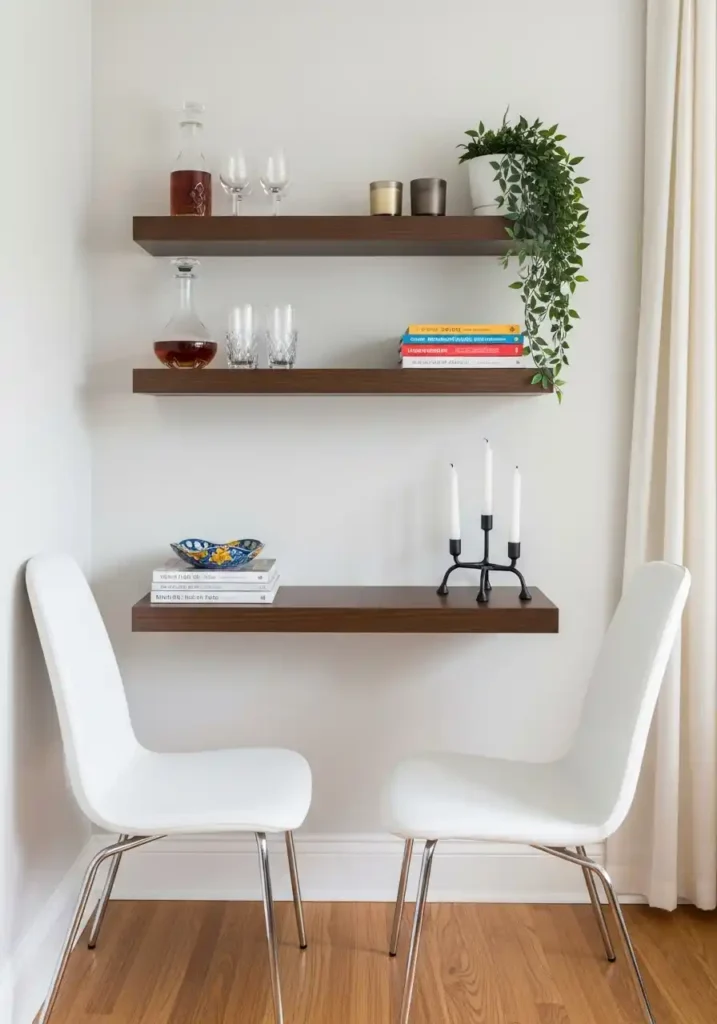
A bulky sideboard or china cabinet in a small dining room is one of the most common and most significant small-space decorating mistakes — because a piece of floor-standing storage furniture that occupies twenty inches of depth along the room’s most available wall can visually reduce the perceived size of a small dining room by a genuinely dramatic amount, making the space feel crowded, tight, and difficult to navigate before a single chair has been pulled out from the table. Floating shelves mounted on the same wall provide equivalent or superior storage and display capacity without consuming a single inch of floor space, and that difference is immediately, visibly transformative.
The styling of dining room floating shelves is simultaneously a practical storage exercise and a decorating opportunity — and doing both well together is enormously satisfying. Dedicate one shelf to genuinely useful dining essentials: a beautiful decanter, your nicest glassware, a set of dinner candles in a holder, and perhaps a small collection of your most beautiful serving pieces. Reserve another shelf for purely decorative elements: a plant, a sculptural object, a stack of cookbooks with beautiful covers. Leave generous empty space on every shelf — the breathing room between objects in a small dining room is as important as the objects themselves, giving the eye places to rest within the overall composition of the styled wall.
9. Color-Drenched Ceiling for Unexpected Drama
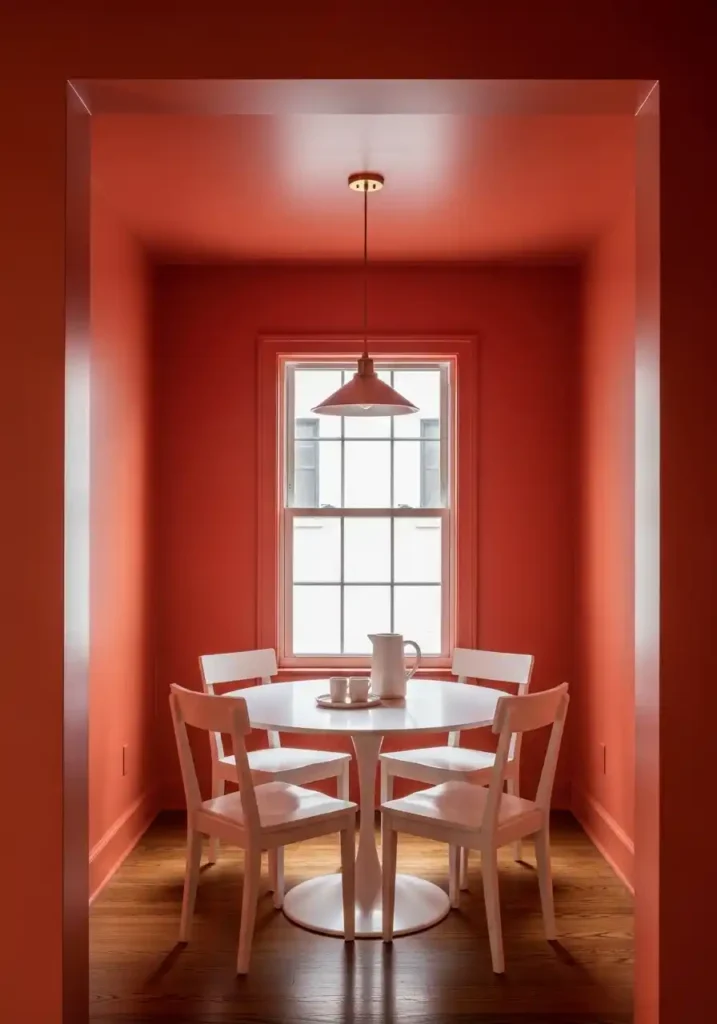
Painting the ceiling of your small dining room the same color as your walls — a technique called color drenching — is the single most unexpected, most counterintuitive, and most consistently spectacular design decision you can make in a compact dining space, and it consistently produces a result that is so much more beautiful than the conventional white ceiling that the only genuine regret most people have after doing it is not having done it sooner. Color drenching removes the visual interruption of the ceiling-wall boundary, creating a seamless envelope of color that makes the room feel like a complete, intentionally designed experience rather than a painted box with a white lid.
The colors that work most magnificently for color-drenched small dining rooms are the deep, saturated, warm tones that create maximum jewel-box effect — terracotta, deep burgundy, forest green, midnight navy, and rich plum all look extraordinary when wrapped continuously from wall to ceiling. The white furniture, the brass fixtures, and the natural wood tones that inhabit the room provide all the contrast and visual relief that the color-drenched envelope needs to avoid feeling overwhelming. In a small dining room, color drenching transforms a spatial constraint — the room’s limited size — into an aesthetic advantage, creating an intimacy and atmospheric richness that a larger room with separated wall and ceiling colors could never quite replicate.
10. Transparent Ghost Chairs for Visual Openness
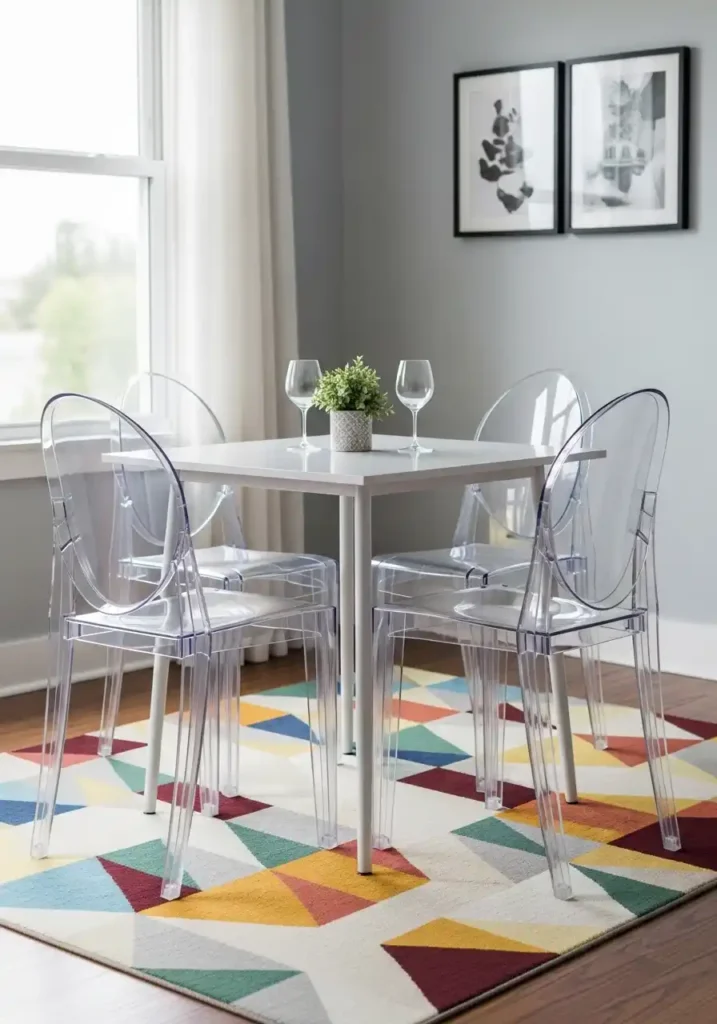
Clear acrylic ghost chairs are the small dining room furniture choice that delivers the most immediate and most dramatic spatial illusion of any seating option available — because chairs that are essentially transparent contribute almost zero visual mass to the room, allowing the floor, the walls, and the space to read as continuous and unobstructed even when the dining area is fully set for four or six people. Solid dining chairs, however beautiful and however carefully chosen, create visual barriers that the eye must navigate around when scanning a small room; ghost chairs create no such barriers and the eye moves freely through them as though they barely exist.
The beauty of ghost chairs in a small dining room extends well beyond their spatial illusionist credentials into genuinely interesting aesthetic territory — they are not invisible, they are translucent, and that translucency creates a fascinating visual quality that changes depending on the light conditions and the colored surfaces visible through them. A vibrant geometric rug seen through the ghost chairs takes on a slightly prismatic quality. The warm wood of the dining table floor reflects through the chair seats in a way that creates a subtle visual depth. Ghost chairs also have the democratic visual quality of working in virtually every possible small dining room aesthetic — they are as comfortable in a maximalist room filled with pattern and color as they are in a minimal white space, because they simply reflect and refract whatever surrounds them.
11. Built-In Corner Dining Nook for Unused Space
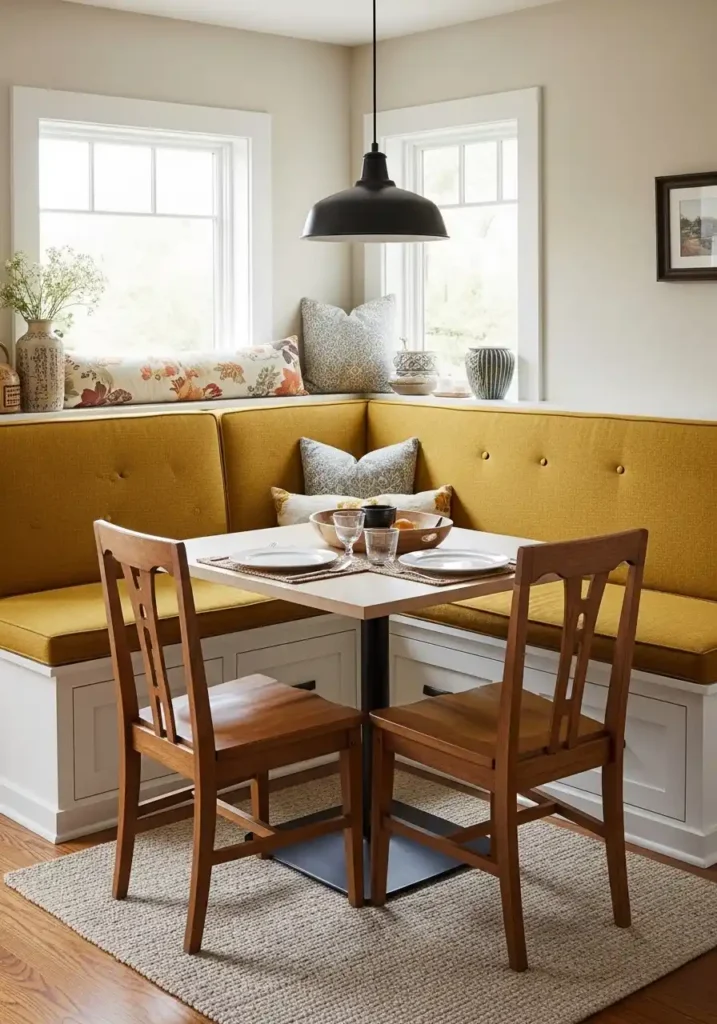
Corners are the most underutilized, most squandered square footage in almost every small dining room — and a built-in corner dining nook that transforms that dead corner space into the most beloved, most used, and most characterful spot in the entire home is the design intervention that makes small dining rooms not just functional but genuinely, deeply delightful. A corner nook creates something that no conventional dining table arrangement can replicate: a sense of being truly nestled, enclosed on two sides, wrapped in warmth and color, in a space that feels specifically designed for the pleasure of sitting and sharing a meal in the most intimate possible setting.
The practical advantages of a corner dining nook compound beautifully with its aesthetic and atmospheric qualities to create a solution that is greater than the sum of its parts. The corner bench seating eliminates chair-pullout clearance on two sides of the table, saving significant floor area in a room that cannot afford to waste it. Storage drawers built into the bench base beneath the cushions provide additional dining room storage that small spaces chronically need. The fixed, custom nature of the installation makes the corner feel finished and intentional in a way that no freestanding furniture can quite match. Add throw pillows in complementary colors, a pendant light above, and perhaps a small shelf or window above the nook, and this corner becomes the room’s heart.
12. Wallpaper on One Accent Wall for Maximum Impact
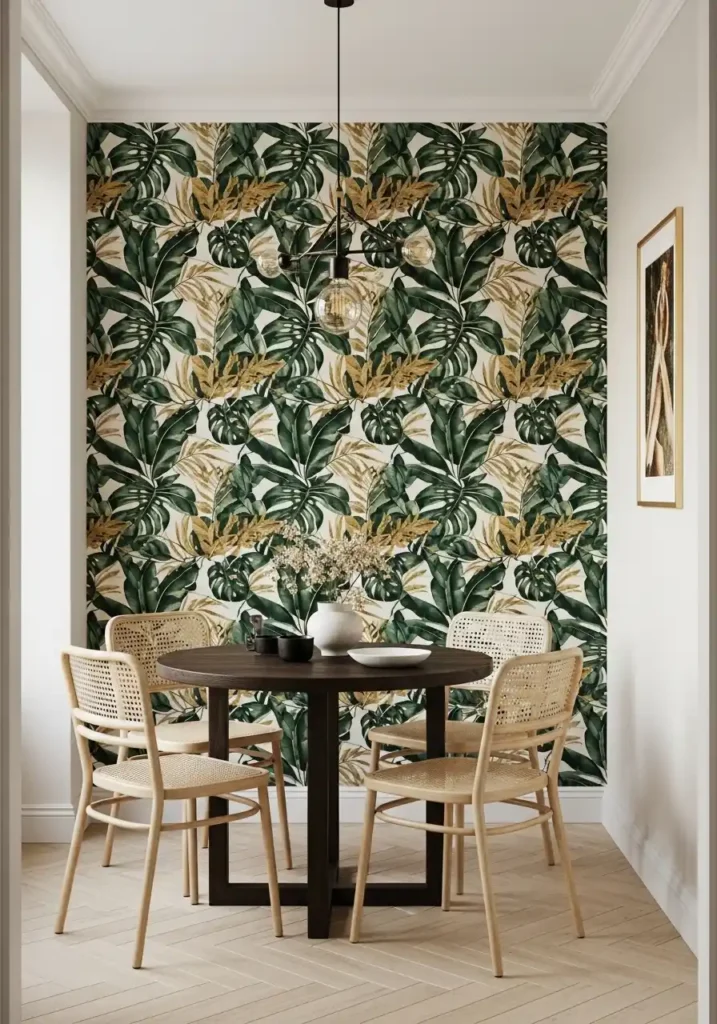
A single accent wall of bold, dramatic wallpaper in a small dining room is the design decision with the highest impact-to-investment ratio in the entire room — because one beautifully wallpapered wall in a small space has approximately twice the visual impact of the same wallpaper in a larger room, simply because the pattern is so much more present and so much more dominant relative to the total amount of wall surface. You don’t need to wallpaper all four walls to achieve an extraordinary result in a small dining room. You need one wall, chosen well, covered in something beautiful and bold, and the room is transformed.
The wallpaper choices that create the most beautiful and most photographically stunning results in small dining rooms are those that are genuinely bold in scale, color, and pattern — designs that would feel timid or underwhelming in a larger room but that fill a small dining room with personality and visual richness in exactly the right proportion. Oversized botanical prints with dramatic leaves in deep greens and warm golds. Maximalist vintage floral designs in jewel tones against a dark background. Bold geometric Art Deco patterns in deep navy and brass. Painterly abstract designs in colors that pick up your dining chairs or your pendant light. Choose one wall — ideally the one you look at most directly while seated at the table — and let it be absolutely magnificent.
13. Layered Lighting for Ambiance Beyond the Overhead Fixture
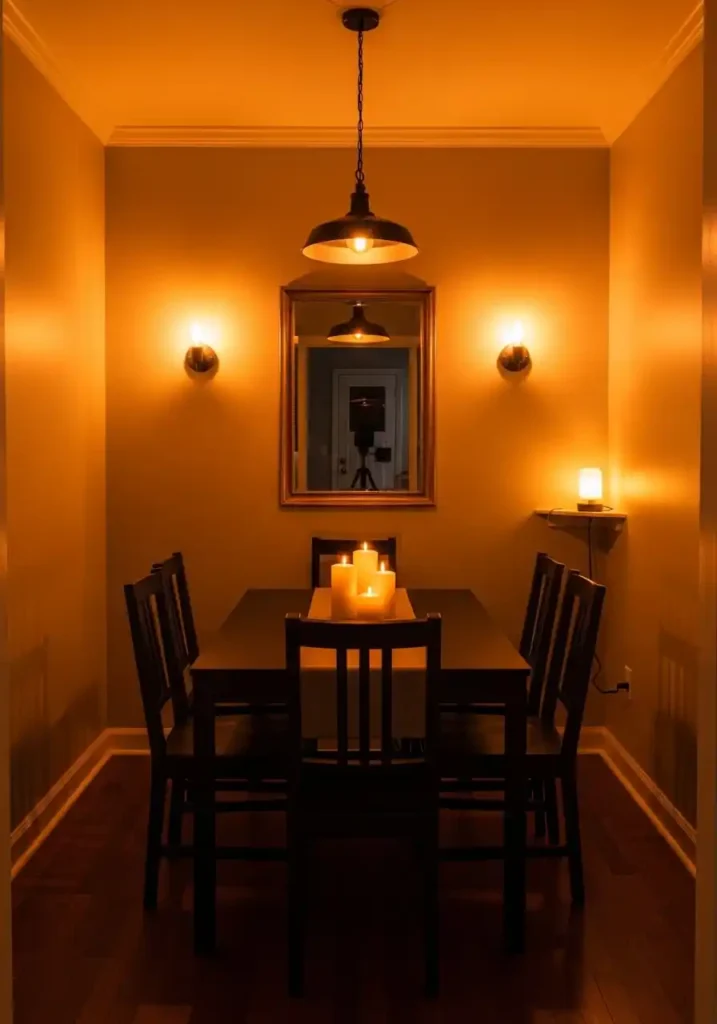
A small dining room lit only by a single overhead light — regardless of how beautiful that light fixture is — is a dining room that will never quite achieve the atmospheric warmth, the intimate glow, and the genuine sense of occasion that makes a meal in a small space feel special rather than merely functional. Layered lighting — multiple light sources at different heights, from different directions, all warm-toned and dimmable — is what transforms a small dining room from a well-lit practical space into a genuinely atmospheric, genuinely beautiful room that people want to linger in long after the plates have been cleared. This is the single most impactful change you can make without touching a wall.
Building a layered lighting scheme for a small dining room is straightforward and enormously rewarding: start with a beautiful pendant above the table as your primary, mood-setting source. Add wall sconces on one or two walls — flanking a mirror, on either side of a piece of art, or simply positioned where they cast the most beautiful warm light across the room — to create flattering directional side lighting that eliminates the harsh shadows a single overhead source creates. Add candles to the table itself — tall tapers in candlesticks, a cluster of pillar candles, or tea lights in glass votives — for the living, flickering warmth that no electric source can replicate. These three layers together create a dining room that glows.
14. Monochromatic Color Scheme for Seamless Visual Flow
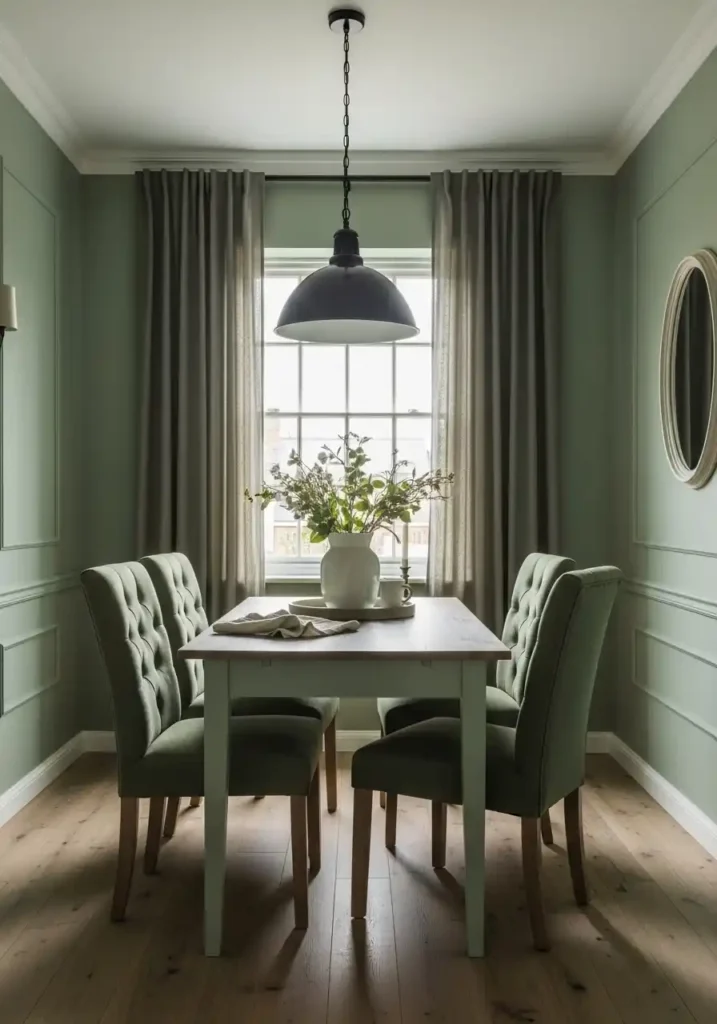
A monochromatic color scheme in a small dining room — where walls, furniture, and soft furnishings are all dressed in tonal variations of a single color family — is the most powerful visual expansion technique available that requires no furniture rearrangement, no structural changes, and no spatial compromise of any kind. When the eye scans a small room and encounters significant color contrast between the walls, the furniture, and the floor, it registers visual boundaries that make the room feel smaller and more compartmentalized than it actually is. When those contrasts are eliminated through monochromatic color choice, the eye travels seamlessly from surface to surface and the room feels significantly larger as a result.
The most beautiful monochromatic small dining rooms are those built around warm, mid-depth colors that create interesting tonal variation without becoming visually monotonous — sage green, warm terracotta, dusty blush, warm taupe, and soft slate blue all work magnificently in this approach. The variation in tone between your walls, your chairs, your table, and your soft furnishings creates all the visual interest the room needs without breaking the seamless flow of color that is the scheme’s fundamental spatial benefit. Layer in natural materials — a wood floor, a jute rug, ceramic tableware — to add warmth and texture contrast without introducing a competing color. The result is a small dining room that feels both larger and more exquisitely designed than its dimensions would suggest possible.
15. Artwork Above the Table as a Focal Point
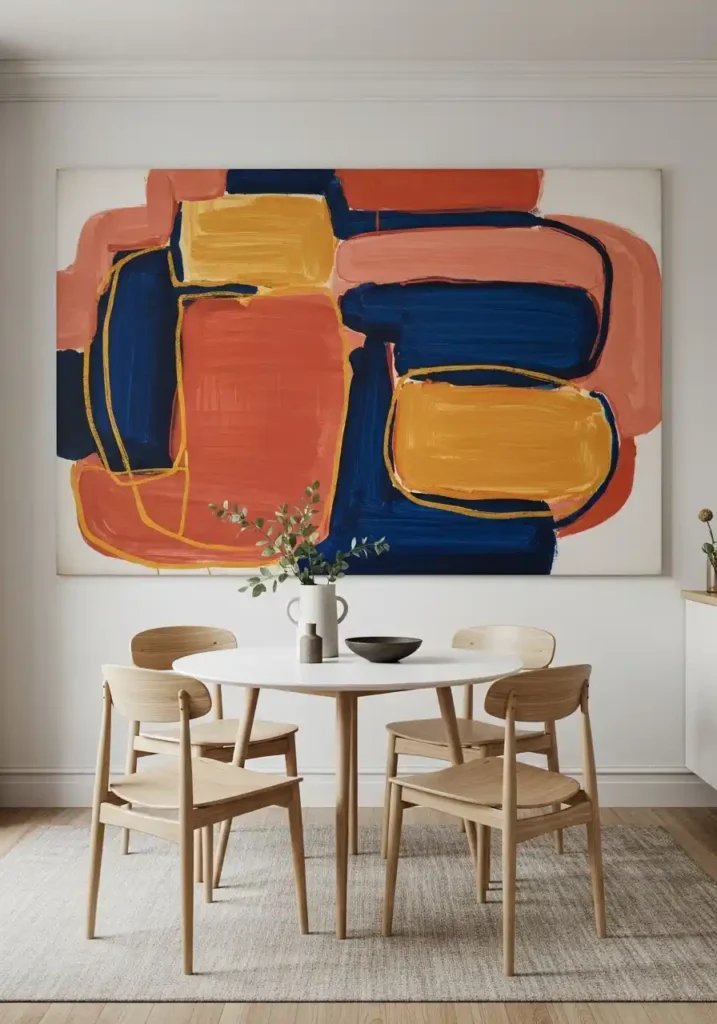
One large, powerful piece of art positioned directly above the dining table in a small dining room does something that no other decorating intervention can quite replicate: it gives the room a visual center of gravity so strong, so compelling, and so immediately engaging that the room’s limited size becomes irrelevant the moment your eye finds it. When you walk into a small dining room and there is a magnificent piece of art on the wall above the table, the first thing you experience is not the room’s dimensions — it’s the artwork. The room stops being a small dining room and becomes the room with that extraordinary painting, and that transformation in perception is genuinely, permanently valuable.
The size relationship between the artwork and the wall it occupies in a small dining room is critically important — and the most common mistake is choosing a piece that is too small, which floats awkwardly above the table without creating the strong focal point that the room needs. In a small dining room, choose artwork that spans at least two-thirds of the wall width above the table, so that the piece reads as genuinely architecturally scaled rather than merely decorative. Abstract works in bold, warm colors — terracotta, deep blue, warm gold, forest green — create the most atmospherically impactful results in dining room contexts. Hang the artwork so its center sits approximately sixty inches from the floor, and step back to verify that it reads as confidently as the room deserves.
16. Extendable Table for Everyday Compactness and Entertaining Generosity
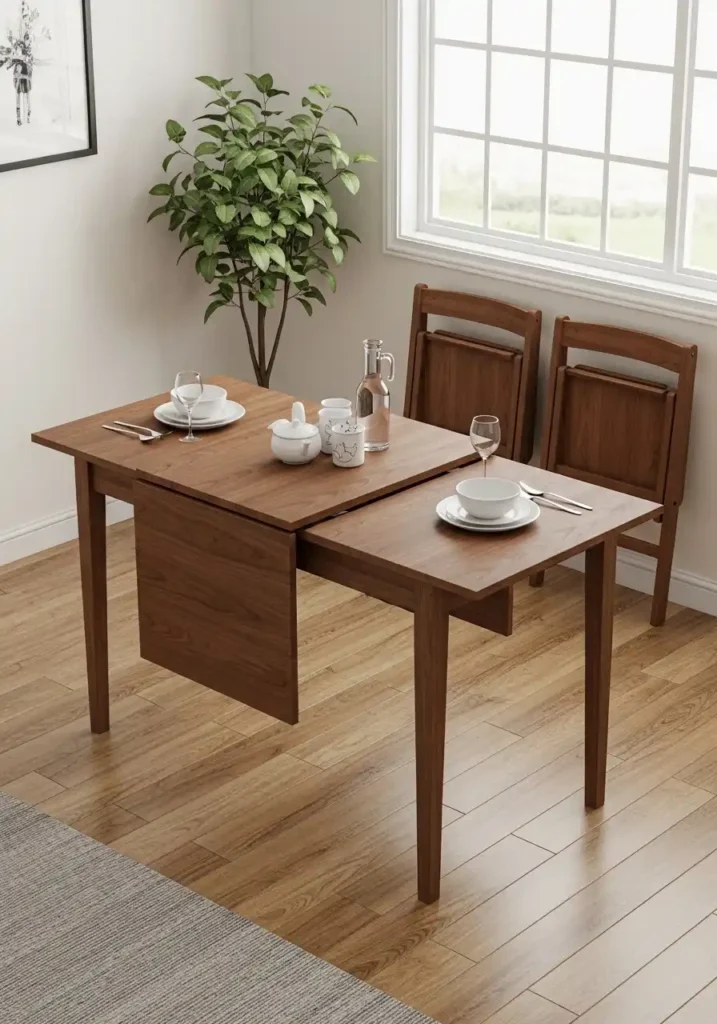
The extendable dining table is the small dining room’s most intelligent and most liberating furniture investment — the piece that reconciles the genuine contradiction at the heart of small dining room design: the need for a table small enough to live with comfortably every day and large enough to seat real guests generously when entertaining requires it. In a compact everyday configuration seating two or three, an extendable table is perfectly proportioned for the small dining room, leaving generous circulation space and making the room feel open and unconstricted during the daily meals that represent the overwhelming majority of the table’s actual use throughout the year.
When guests arrive and the extension leaf is deployed, the same table transforms in under thirty seconds into a generous dining surface that seats six, eight, or even more — depending on the specific table design — turning the small dining room into a proper entertaining space that makes guests feel genuinely, warmly welcomed rather than squeezed in as an afterthought. The butterfly leaf mechanism, which stores the additional table section within the table base and deploys without removing any separate stored piece, is the most elegant and most space-efficient extension system available. Choose a table in a beautiful solid wood or high-quality veneer that is as lovely in its compact everyday form as it is at full extension for a dinner party.
17. Plants and Greenery to Add Life and Dimension
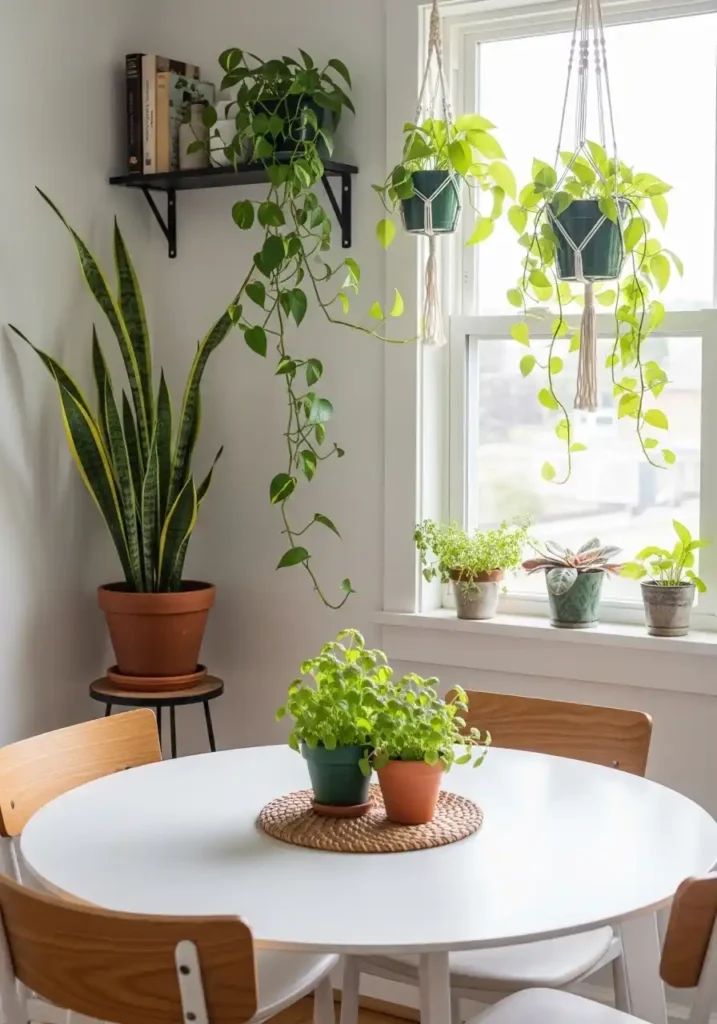
Plants in a small dining room do something for the space that no paint color, no furniture choice, and no lighting scheme can replicate — they make the room feel genuinely alive, genuinely connected to the natural world, and genuinely more interesting to be in for extended periods in a way that purely decorative objects, however beautiful, simply cannot achieve. A dining room with plants is a dining room where the experience of eating is subtly but meaningfully enriched by the presence of living things — where the oxygen is genuinely better, where the visual environment includes the organic movement and growth of real nature, and where the overall atmosphere feels more generous and more nourishing than any purely manufactured interior environment.
The strategic use of plants in a small dining room is about adding vertical dimension and organic richness without consuming the floor space or table surface that the room’s primary furniture arrangement needs. A tall architectural plant — a snake plant, a bird of paradise, or a fiddle leaf fig — in a corner of the dining room draws the eye upward and creates a vertical accent that makes the ceiling feel higher. A trailing plant on a wall-mounted shelf adds cascading greenery at mid-height without occupying any floor area. A small fresh herb centerpiece on the dining table is simultaneously beautiful, fragrant, functional, and completely delightful. Three plants at three different heights transform a small dining room from a pretty space into a genuinely lovely one.
18. Upholstered Dining Chairs for Comfort and Visual Richness
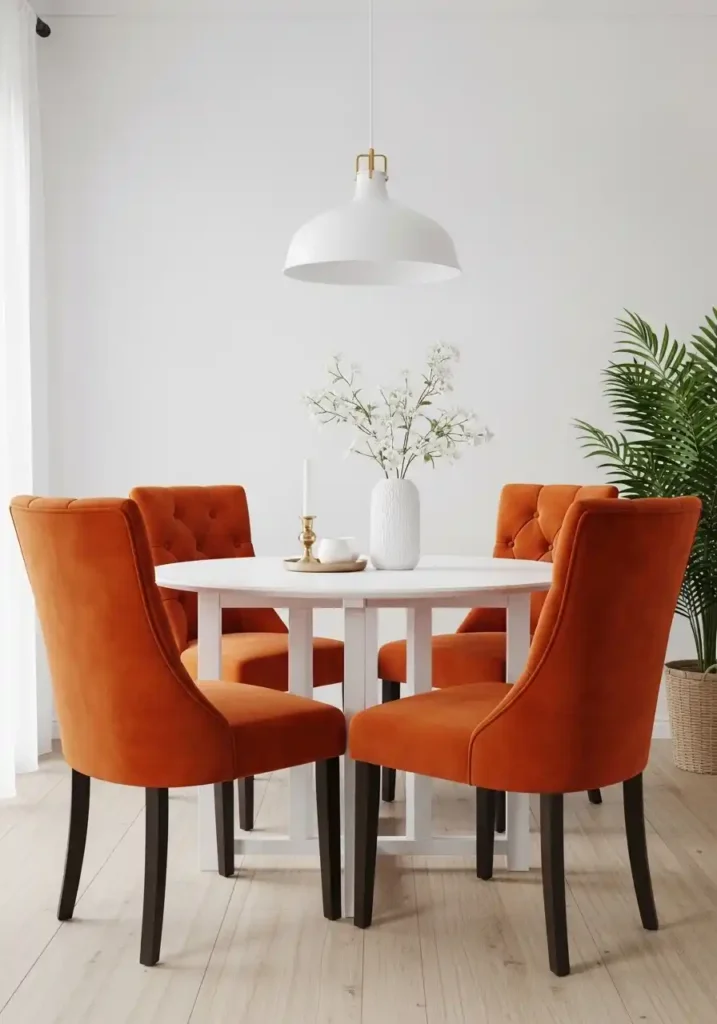
Upholstered dining chairs — particularly those in bold, rich, saturated colors or luxurious textures — are the small dining room’s single most impactful furniture upgrade, delivering simultaneously an improvement in comfort that makes every meal more enjoyable and an elevation in visual richness that makes the room more beautiful with each chair that enters it. In a small dining room where the chairs are always highly visible and always prominent in the room’s overall aesthetic, choosing chairs that are genuinely beautiful in their own right — not just functional seating — makes an enormous difference to the room’s perceived quality, warmth, and design confidence.
The color of your upholstered dining chairs in a small room is the most significant color decision you will make in that space — because four chairs positioned around a dining table occupy a substantial portion of the room’s total visual field and their color will essentially define the room’s dominant tone. Choosing a bold, rich, unexpected color — burnt orange velvet, deep teal boucle, forest green leather, rich burgundy linen — gives the chairs a design presence that makes the small dining room feel deliberately, confidently decorated in a way that neutral chairs never achieve. Keep everything else in the room simple and allow the chairs to be the undisputed, gloriously colored stars of the entire space.
19. Maximizing Natural Light with Strategic Mirror Placement
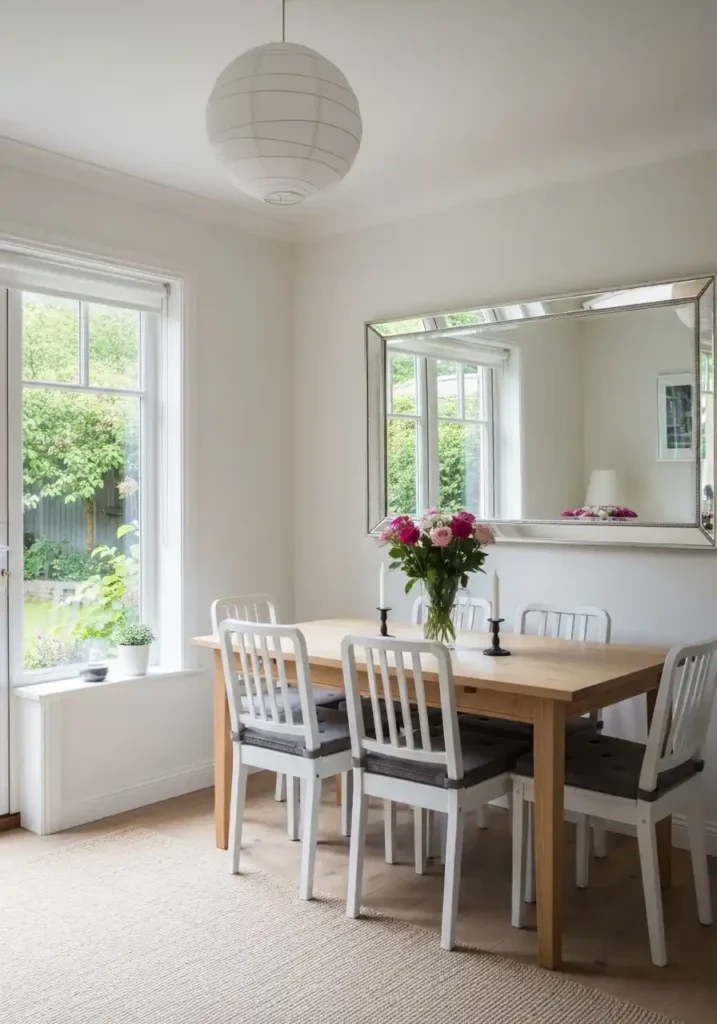
Natural light in a small dining room is more precious than almost any other design element — because it makes the room feel larger, more open, more connected to the world beyond its walls, and more genuinely pleasant to inhabit for the extended periods that meals require. And while you cannot add a window where none exists without significant construction, you can double the effectiveness of every window you have through the strategic placement of mirrors that reflect the incoming natural light deep into the room and create the visual impression of additional light sources where none physically exist. This is optical design intelligence at its most practical and most beautiful.
The most effective mirror for maximizing natural light in a small dining room is one positioned directly opposite the room’s primary window, large enough to reflect the entire window opening including the sky and garden or street view beyond it. The reflected image creates the extraordinary illusion of a second window on the opposite wall — doubling the perceived sources of natural light and making the room feel simultaneously brighter, more open, and more connected to the outdoors. This reflected view also adds visual depth to the small room that is genuinely difficult to achieve by other means — suddenly the dining room seems to open onto a garden or a sky that isn’t actually there, and the spatial effect is both beautiful and thoroughly convincing.
20. Textured Walls for Depth and Character
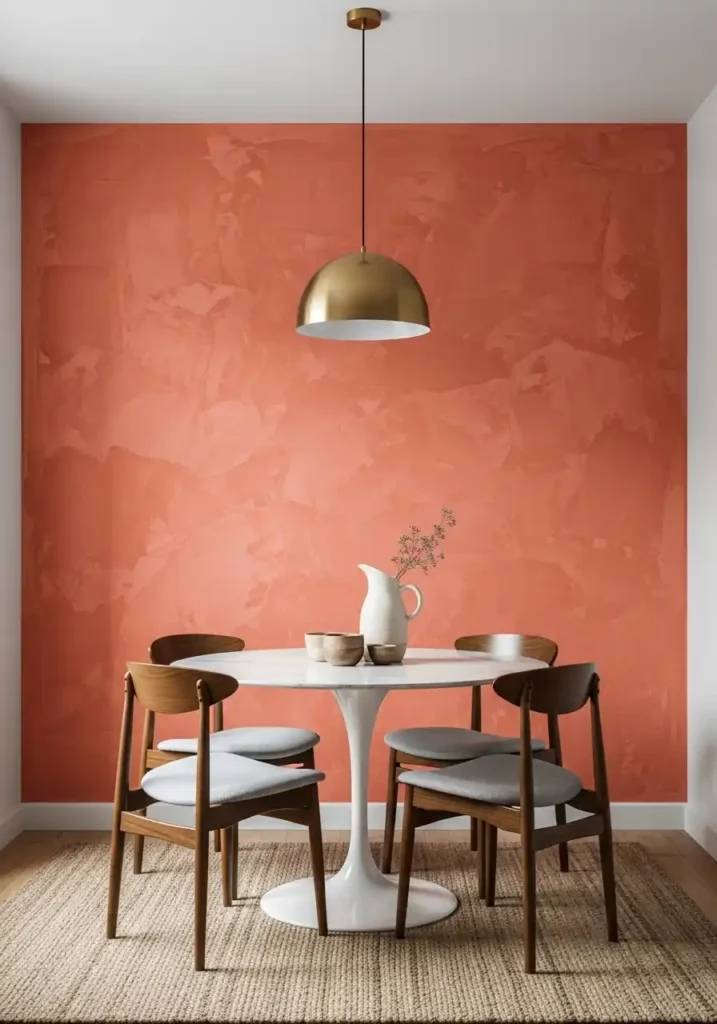
A textured wall finish in a small dining room — whether limewash, Venetian plaster, microcement, or a decorative paint technique that creates visual texture — adds a quality of organic depth, of visual richness, and of genuine handcrafted character to the room that flat paint, however carefully chosen in color, simply cannot provide. Textured walls interact with light in a fundamentally different way than smooth surfaces — every variation in the surface plane catches and casts shadow differently, creating a wall that appears to shift and change throughout the day as the quality and angle of light changes, making the room feel subtly alive and constantly interesting in a way that static, flat surfaces never achieve.
The transformative quality of limewash in particular has made it one of the most beloved and most widely adopted wall finishes in contemporary interior design — and in a small dining room context, its combination of warm color, organic texture, and a slightly matte reflectivity that creates depth without glare makes it the ideal textured finish choice. Applied to the most prominent wall of a small dining room — ideally the wall directly opposite the window, where it receives the most changing natural light throughout the day — limewash creates a backdrop of such organic beauty and such quietly compelling visual complexity that a simple dining table and four good chairs in front of it becomes a dining room composition of genuine elegance and warmth.
21. Maximalist Small Dining Room — More Is More
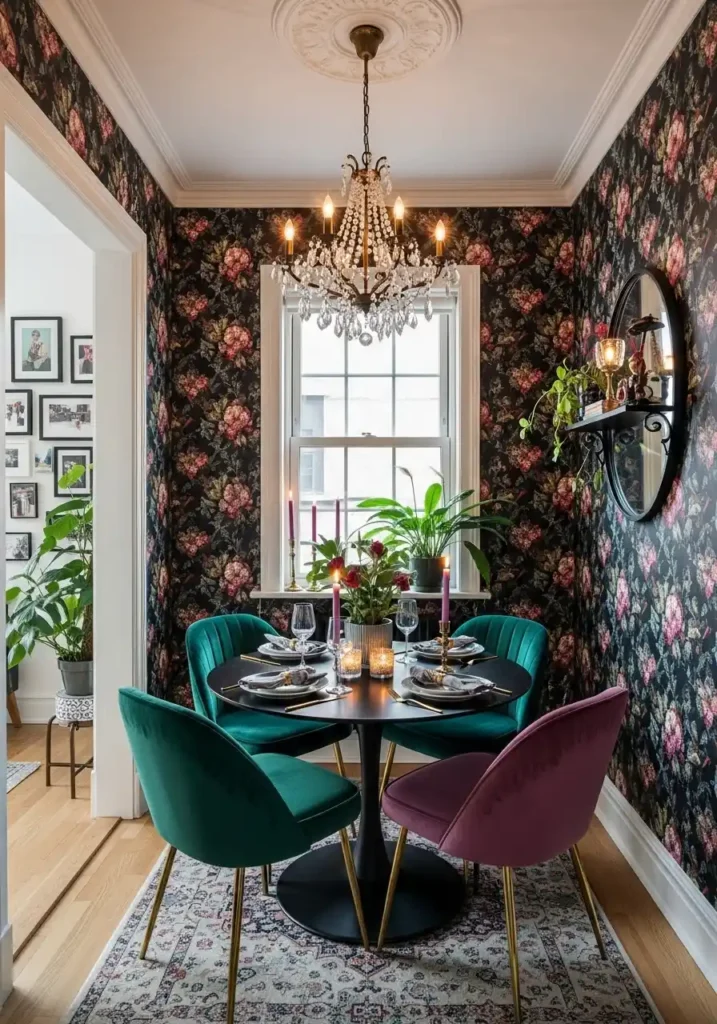
Maximalism in a small dining room is one of interior design’s most gloriously liberating philosophies — the explicit, unapologetic rejection of the idea that small spaces must be minimal, neutral, and carefully restrained in order to feel livable and beautiful. A maximalist small dining room says the opposite: that a small room filled with pattern, color, texture, plants, art, and an abundance of beautiful objects is not a claustrophobic mistake — it is a jewel box, a cabinet of wonders, a room of such concentrated richness and personality that its limited size becomes an aesthetic advantage rather than a spatial limitation. More, in this room, is genuinely and magnificently more.
The secret to maximalism in a small dining room that feels glorious rather than chaotic is finding your unifying thread — the element that connects the abundance into a cohesive, if extravagant, design story. It might be a consistent color family that runs through the wallpaper, the chair upholstery, the artwork, and the accessories. It might be a historical design period — Art Deco, Victorian, maximalist bohemian — whose vocabulary provides coherent context for all the various elements. It might simply be a consistent quality level, where everything in the room is genuinely beautiful and everything has been chosen with genuine care and genuine love. Find that thread and pull it through every corner of the room, and your maximalist small dining room will be the most extraordinary, most memorable room in your home.
22. Functional Sideboard Styling for Small Dining Rooms
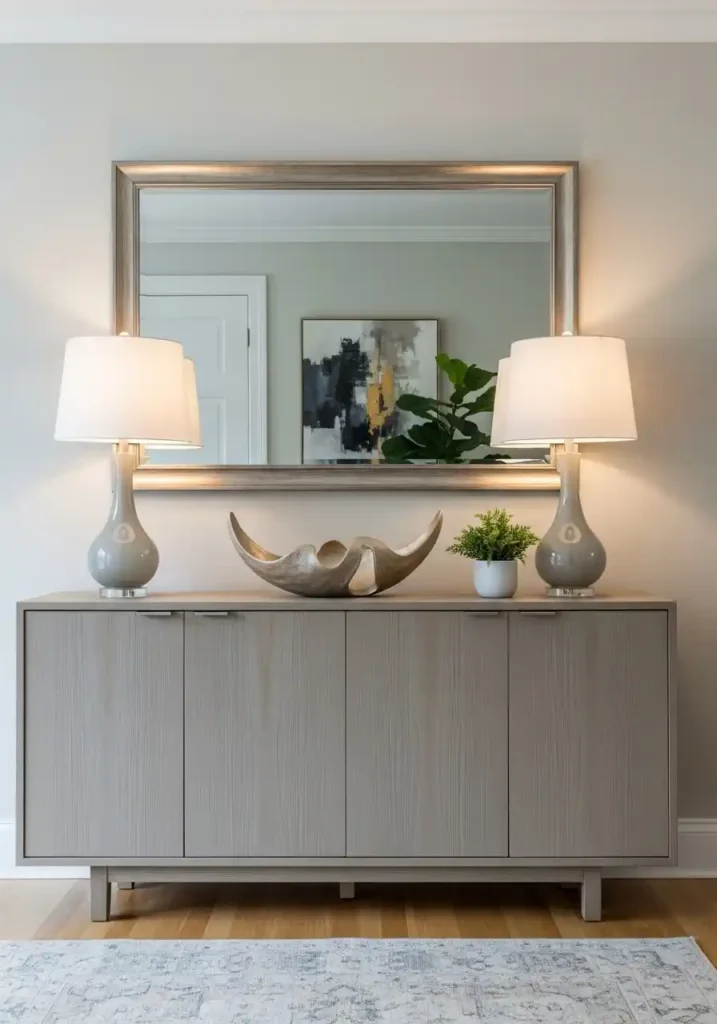
A slim, well-styled sideboard in a small dining room is the storage and display solution that manages the extraordinary feat of being both the room’s most practical furniture piece and one of its most beautiful design features simultaneously — providing the dining storage that every small room desperately needs while creating a vignette of such deliberate, composed elegance that it functions as a genuine focal point for the room rather than merely a utilitarian storage unit pushed against the available wall. The key word is slim: in a small dining room, a sideboard should be no deeper than fourteen to sixteen inches, preserving every possible inch of circulation space.
The styling of your sideboard top in a small dining room is the decorating exercise that delivers the most beautiful results relative to the effort and cost invested — because a sideboard top, positioned at a height and scale that makes it naturally prominent in a small room, is the perfect scale for a composed, balanced, beautifully considered vignette. A large mirror above the sideboard doubles the apparent width of the room and amplifies the light from your pendant and candles beautifully. Two matching table lamps on either side of the mirror create warm, symmetrical lighting that flanks the sideboard with elegance. A single sculptural object at the center, a small plant at one end, and a stack of beautiful dining room books at the other complete a composition of relaxed, confident style.
23. Industrial Style Small Dining Room
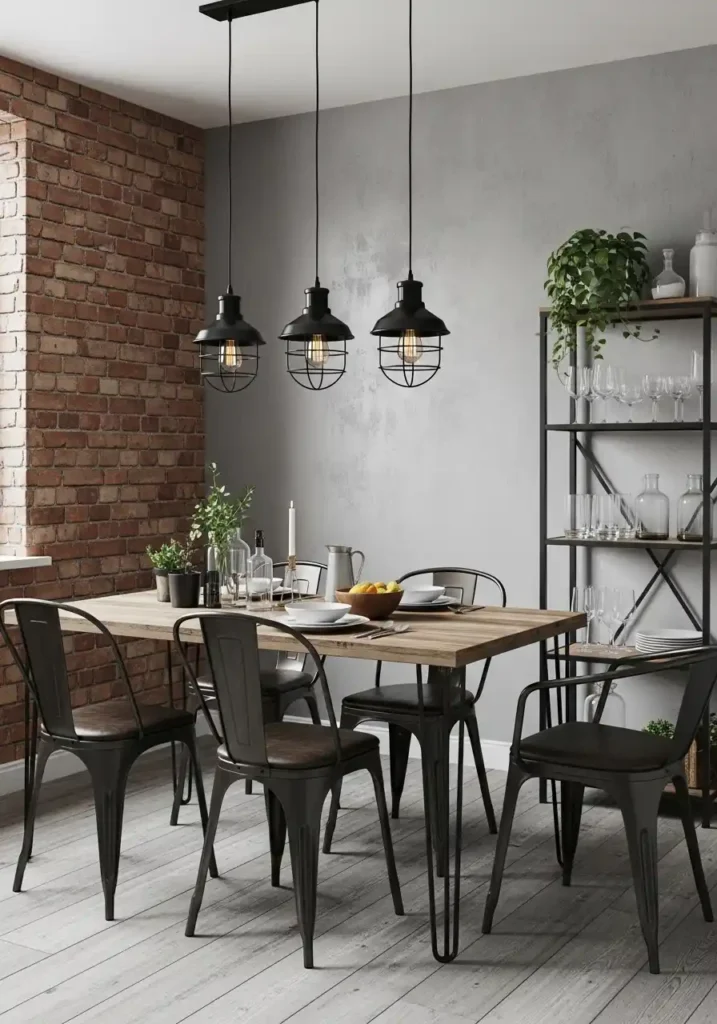
Industrial style small dining rooms occupy a uniquely democratic position in contemporary design — they are the aesthetic that makes exposed brick, raw wood, bare metal, and visible construction details look not like unfinished work but like the most deliberately, most authentically chosen design language in the room. In a small dining room where the budget for expensive finishes and elaborate decoration may be limited, embracing the industrial aesthetic’s fundamental philosophy — that honest, functional, raw materials are beautiful in their own right and require no embellishment to be stylish — liberates the room from the tyranny of expensive luxury materials and produces results that are genuinely, distinctively cool.
The industrial small dining room works most beautifully when the contrast between its raw material elements and a few carefully chosen refined accents is managed with genuine intentionality. A reclaimed wood table with visible grain, knots, and age marks on black hairpin legs is the perfect central piece — warm, organic, and characterful against the harder, cooler industrial elements surrounding it. Black metal chairs with leather seat pads add comfort and a slight softness to what could otherwise become a too-hard aesthetic. Plants on open metal shelves bring the organic world’s warmth and color to the room’s cool, industrial palette. A single industrial cage pendant in matte black provides the perfect overhead accent that ties the whole beautifully edgy composition together.
24. Sconce Lighting for Ambiance Without Ceiling Fixtures
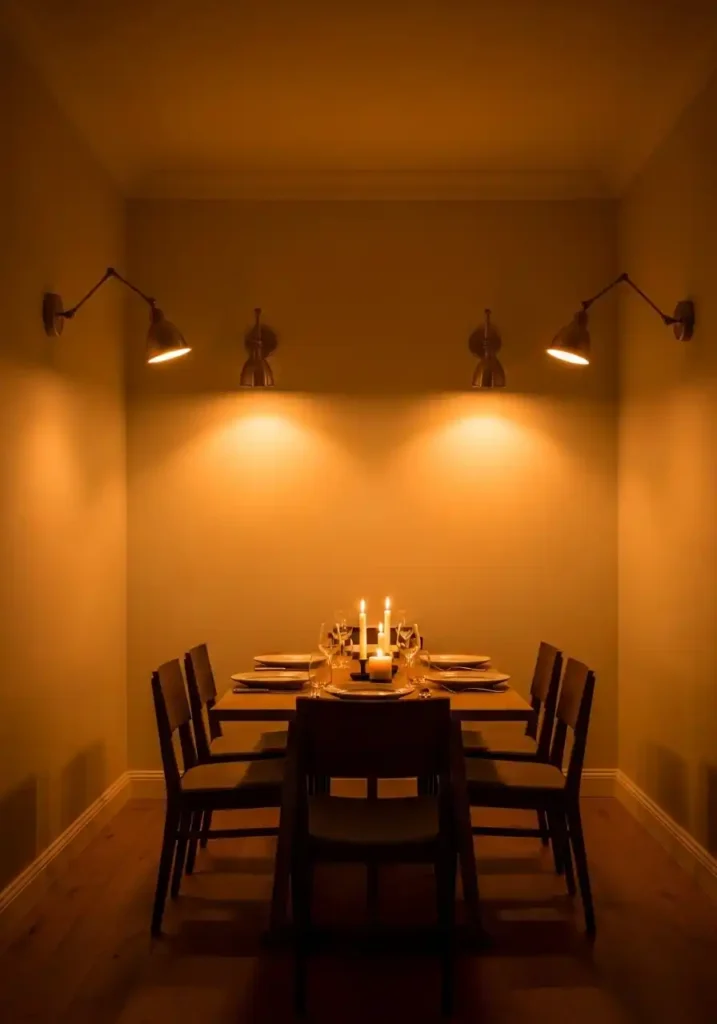
Wall sconces used as the primary or sole lighting source in a small dining room create a quality of intimate, directional, beautifully flattering light that overhead pendant fixtures — for all their design drama and visual impact — can never quite fully replicate. Sconces mounted at seated eye height around a small dining room cast light across the room from a human-scale direction rather than downward from above, eliminating the unflattering overhead shadows that make faces look tired and meals feel more clinical than celebratory. When sconces are the primary light source and candles supplement them on the table, the dining room achieves its most genuinely atmospheric and most romantically beautiful evening incarnation.
The sconce style that works most beautifully in a small dining room is one whose form contributes genuine design elegance to the room’s aesthetic while its light output is warm, directional, and dimmable. Brass swing-arm sconces with linen shades provide warm, focused pools of light and a classic, timeless form that suits almost every dining room aesthetic from traditional to contemporary. Minimal black steel sconces with exposed Edison bulbs create an industrial-modern edge with a warmth of light that belies their cool material palette. Simple ceramic sconces in warm white or terra cotta bring an artisanal, hand-crafted quality that feels genuinely beautiful in casual dining room contexts. Any style you choose transforms the small dining room into a space of genuine atmospheric distinction.
25. The Perfect Small Dining Room — Every Detail Working in Harmony
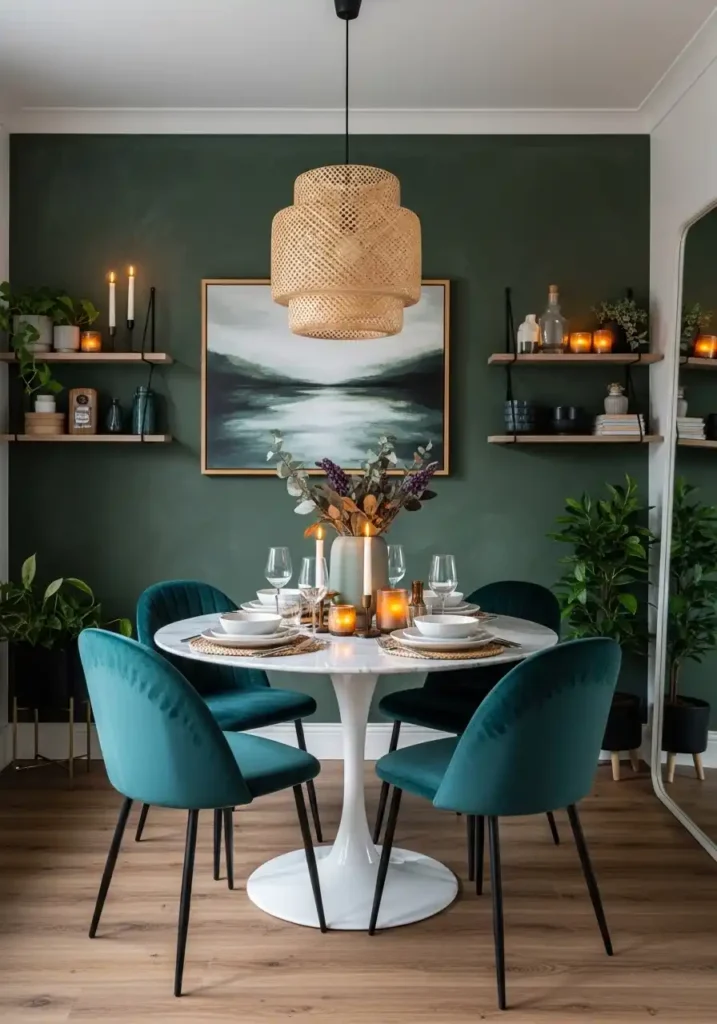
The perfect small dining room — the one that stops your scroll on Pinterest, that makes you save the image immediately, that makes you want to call someone and describe it enthusiastically — is never the result of one brilliant single idea or one extraordinary furniture piece or one perfect paint color chosen in isolation from everything else. It is the result of multiple well-considered decisions working together in a state of complete, beautiful harmony, where every element reinforces every other, where nothing is superfluous and nothing is missing, and where the room’s limited size has been so thoroughly and so intelligently embraced that it reads not as a constraint but as an asset — the specific quality that makes the room as intimate, as warm, and as genuinely magical as it is.
The invitation of this guide is both practical and deeply inspiring: begin with the one idea that excites you most — whether that’s the dark jewel-box walls, the round marble table, the statement pendant, or the bold wallpapered accent wall — and build your perfect small dining room outward from that single brave, beautiful starting point. Trust your instincts. Honor your love of beauty, richness, and genuine style. Resist any voice that tells you a small dining room cannot be extraordinary. Because a small dining room that has been decorated with genuine thought, genuine confidence, and genuine love for the space is not a compromise — it is one of the most beautiful rooms a home can contain, and every meal served within it is the better for it.
Conclusion:
Designing a beautiful dining space doesn’t require a large footprint. With the right layout, lighting, and furniture choices, even the smallest dining areas can feel stylish, welcoming, and functional. These small dining room ideas prove that thoughtful details—like smart storage, cozy seating, and statement decor—can create a big style impact in compact spaces. Whether you’re decorating an apartment, a dining room combo, or a cozy nook, the right design can completely transform your space. Save your favorite ideas and start creating a dining room that feels both practical and beautifully designed.