1. The Small Dining Room with a Round Table for Maximum Flow
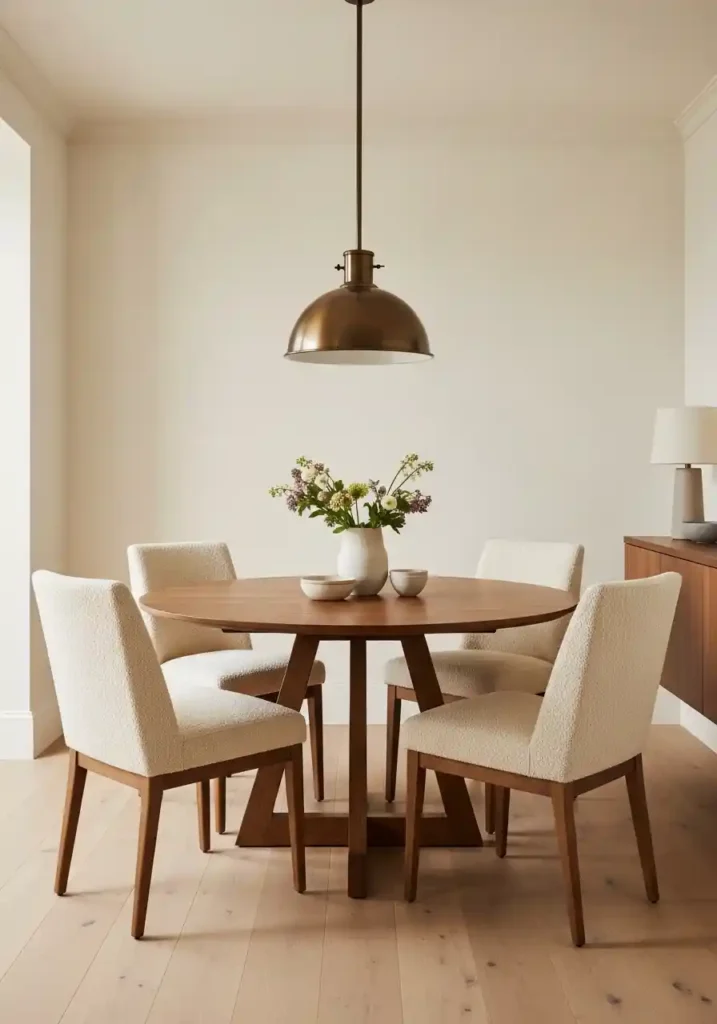
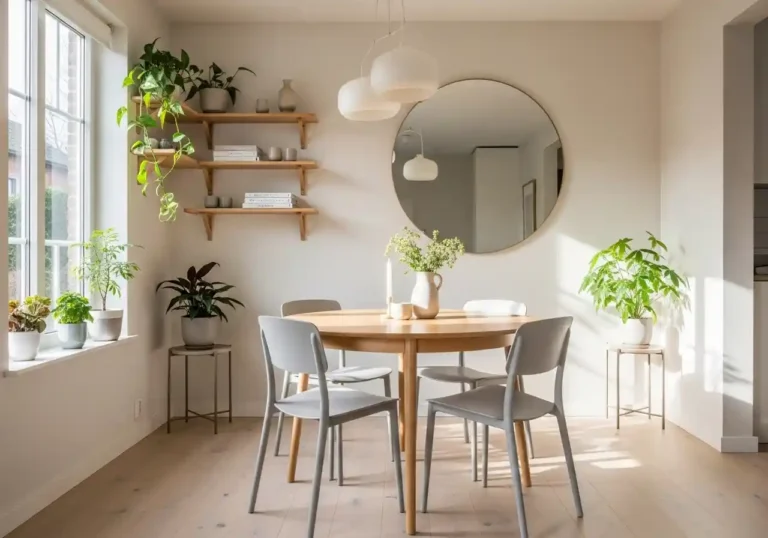
A round dining table is the single most effective space-maximizing furniture choice available for a Small Dining Room Ideas — because the round form eliminates the corners that rectangular tables create, allowing people to move around the table more naturally and more easily in the limited floor space of a compact dining area, while the absence of a table end means that the clearance between the table edge and the walls is more consistently maintained from every angle. A round table for four occupies the same floor area as a rectangular table of equivalent seating capacity but feels dramatically less spatially dominant.
The pedestal base of the round dining table is the specific design detail that most completely fulfills the round table’s space-maximizing potential — because a central pedestal eliminates the four corner legs of a conventional table that create obstacles for seated diners and reduce the practical clearance between the table and adjacent walls. With a pedestal base, the entire floor area beneath the table remains clear and unobstructed, creating a visual openness beneath the table surface that makes the small dining room feel significantly more spatially generous. The pedestal also allows chairs to be pulled in completely flush with the table edge when not in use, further reducing the effective floor space consumed.
2. The Small Dining Room with Built-In Banquette Seating
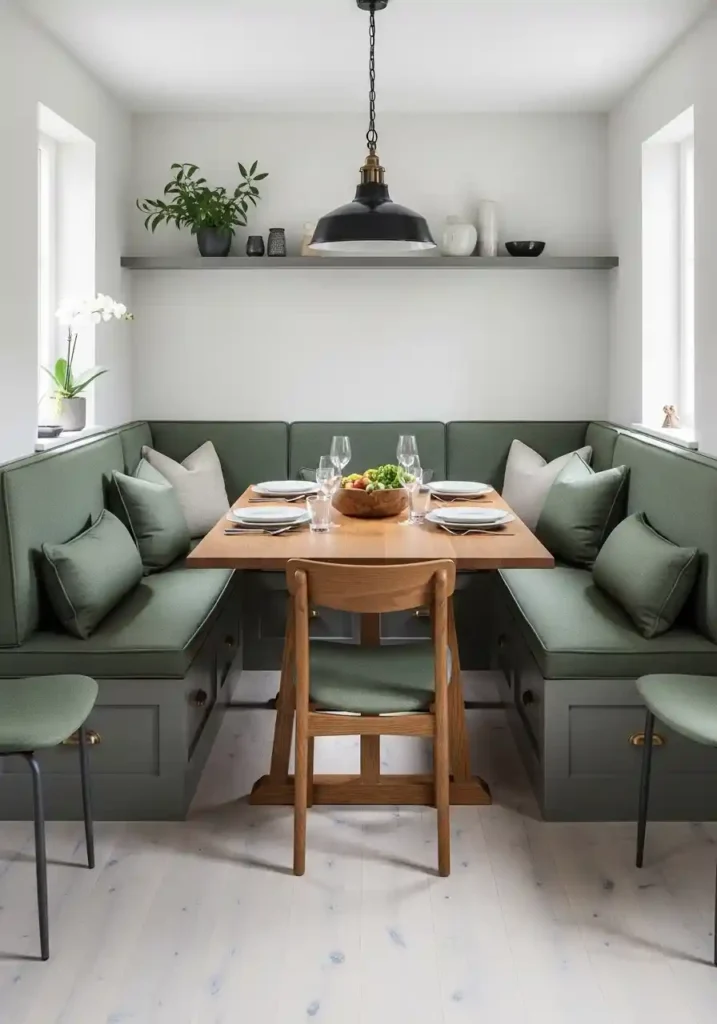
A built-in banquette dining nook is the small dining room’s most spatially efficient and most genuinely cozy dining solution — because the fixed bench seat on two walls requires absolutely zero chair-pullout clearance on the wall sides, making the banquette’s total dining footprint dramatically smaller than an equivalent number of freestanding chairs around a freestanding table would occupy in the same corner. A banquette that seats six people against two walls occupies a floor area that freestanding chairs for six could not approach, making it the most comprehensive seating solution per square meter available in any small dining room.
The storage drawers built into the banquette base transform the seating structure from a beautifully efficient furniture piece into one of the small dining room’s most organizationally intelligent space-saving additions — because the banquette’s base, which would otherwise be solid structural timber contributing nothing beyond its seating function, becomes a concealed storage volume of genuine capacity for table linens, placemats, candles, and dining room extras within the same footprint as the seating. In a small dining room where every inch of storage capacity is genuinely precious, the banquette’s combined seating and storage function makes it the most completely justified and satisfying dining room addition available.
3. The Small Dining Room with Mirrors to Double Perceived Space
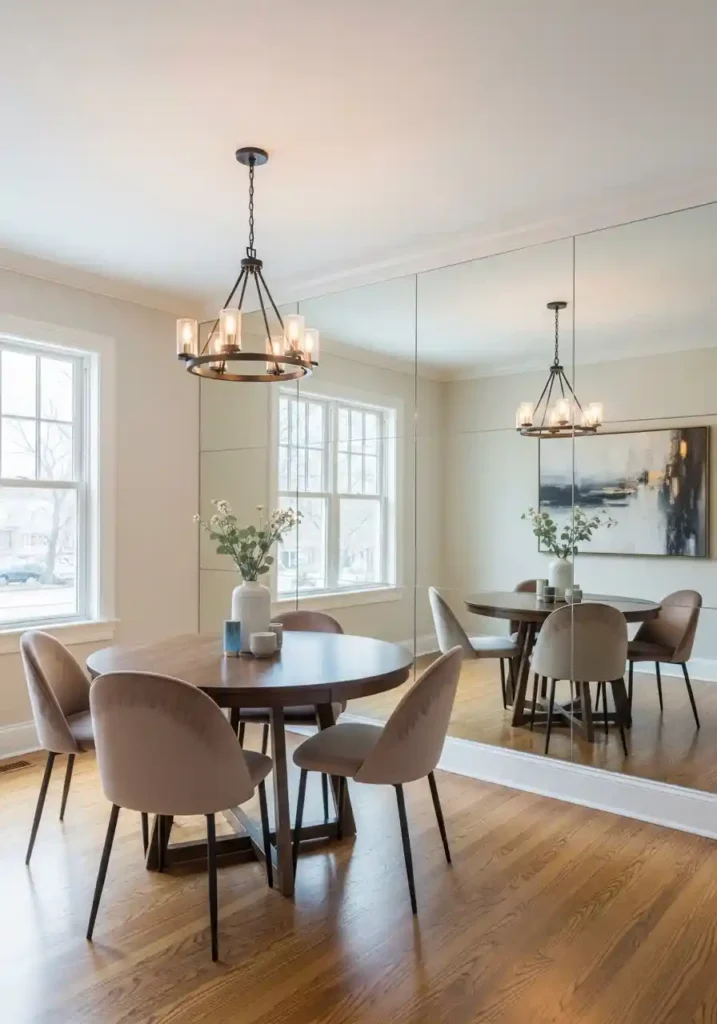
A floor-to-ceiling mirror spanning the full length of one dining room wall is the spatial transformation that most powerfully and most completely creates the impression of a dining room twice its actual size — because a full-height wall mirror reflects the entire dining room composition back into the space with such convincing spatial depth and such complete visual clarity that the room appears to extend equally far in both directions from the viewer, creating the impression of a generously proportioned dining room rather than a compact one. The reflection of the chandelier, the window, and the dressed dining table creates a doubled visual richness of extraordinary beauty.
The specific quality that makes a full-length wall mirror most effective in a small dining room is its placement on the wall most directly opposite the room’s primary natural light source — because a mirror that reflects the window back into the room simultaneously doubles the apparent number of natural light sources, creating a small dining room that appears brilliantly and generously lit from multiple directions simultaneously rather than from a single window. The combined effect of the spatial depth illusion and the doubled natural light creates a small dining room that feels and looks dramatically more generous than its actual square footage. The mirror is the small dining room’s most powerful spatial tool.
4. The Small Dining Room with a Drop-Leaf Table for Flexibility
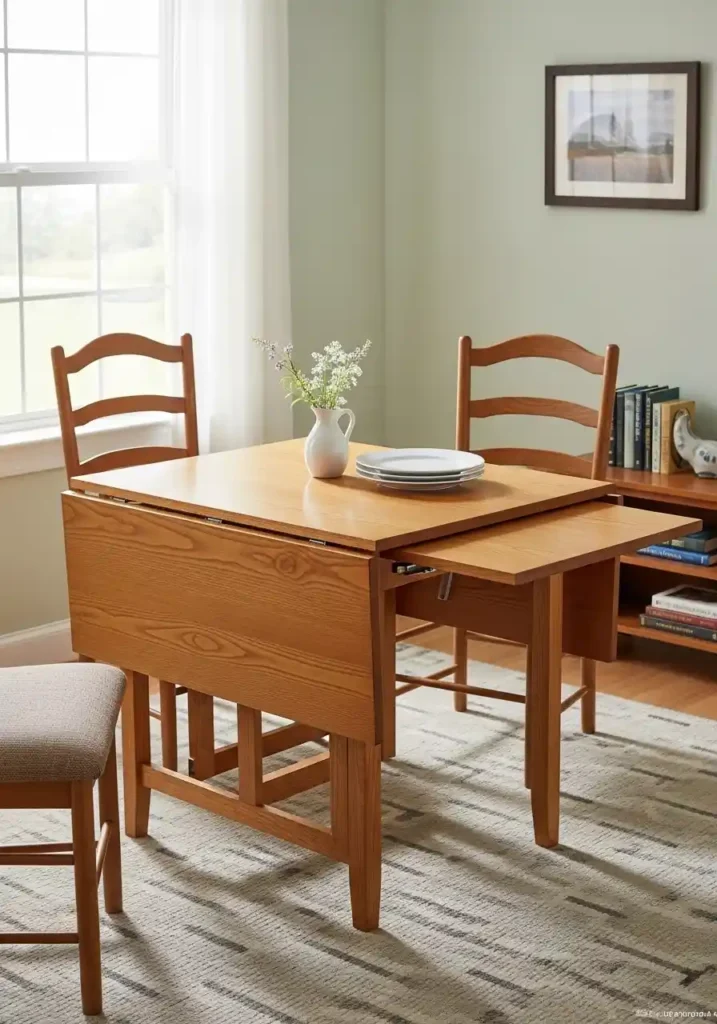
A drop-leaf dining table is the small dining room’s most brilliantly flexible furniture solution — because a table that can be collapsed to a slim, console-like surface of minimal floor footprint for daily life and extended to a full dining table of generous seating capacity for entertaining provides the small dining room with two completely different spatial configurations within a single furniture piece, allowing the room to adapt completely to its changing daily and occasional uses without any permanent compromise between the floor space needed for comfortable daily movement and the table surface needed for properly comfortable group dining. The drop-leaf table makes the small dining room genuinely versatile.
The storage of dining chairs against the walls when the drop-leaf table is collapsed is the organizational strategy that most completely realizes the flexible dining room’s space-saving potential — because chairs stored flat against the wall in the collapsed configuration consume only the depth of the chair back rather than the full chair depth, leaving the dining room floor area maximally clear for daily use as a passageway, a reading space, or simply a room that breathes with comfortable openness between mealtimes. Wall-stored chairs also make the small dining room appear larger and more spatially generous between meals by removing the visual mass of seating from the floor area.
5. The Small Dining Room with Vertical Visual Height Tricks
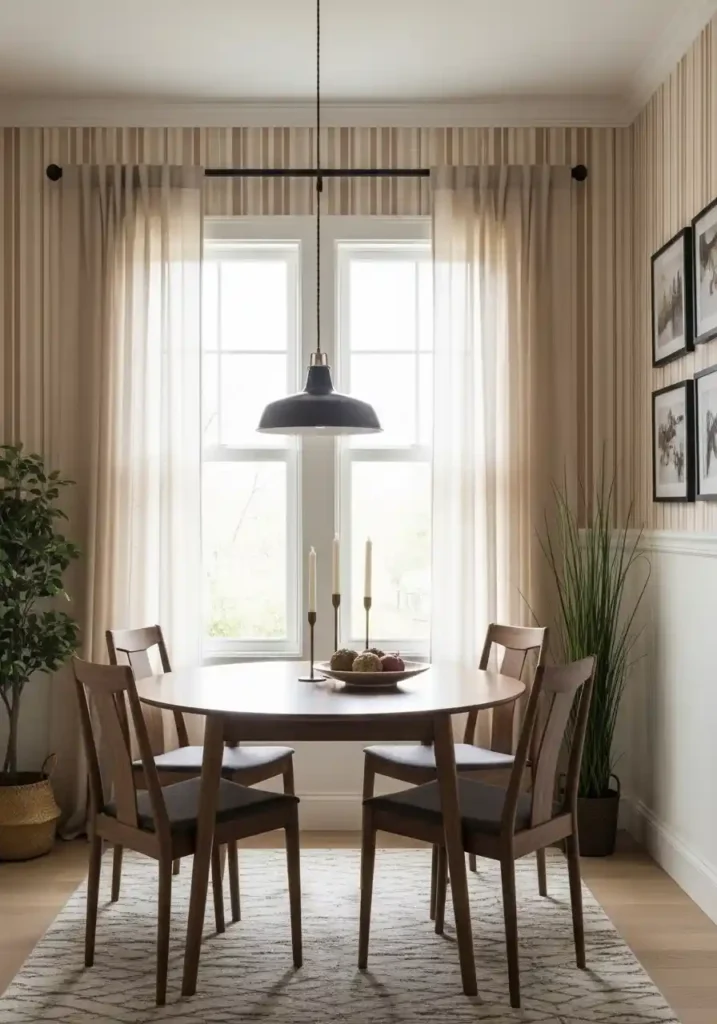
Vertical visual emphasis strategies in a small dining room with low ceilings are the design tools that most effectively and most collectively overcome the specific spatial compression of height-challenged compact dining rooms — because the human eye naturally follows vertical lines upward with compelling urgency, and a dining room where multiple elements simultaneously create strong upward visual emphasis appears genuinely, measurably taller than the same room without these vertical cues, even though no structural change to the ceiling height has occurred. The vertical emphasis transforms perceived height as effectively as an architectural intervention but at a fraction of the cost and disruption.
Floor-to-ceiling curtains mounted as close to the ceiling as possible and falling to the floor are the single vertical emphasis element with the greatest individual impact on the small dining room’s perceived ceiling height — because curtains that begin at the ceiling line and end at the floor create the visual impression that the full height from floor to ceiling is entirely, generously occupied by the curtain’s length, making both the window and the room appear dramatically taller than they actually are. The curtains’ vertical fall draws the eye from the floor to the ceiling in a single, continuous, upward-traveling movement that creates a compelling sense of generous vertical space.
6. The Small Dining Room with a Wall-Mounted Fold-Down Table
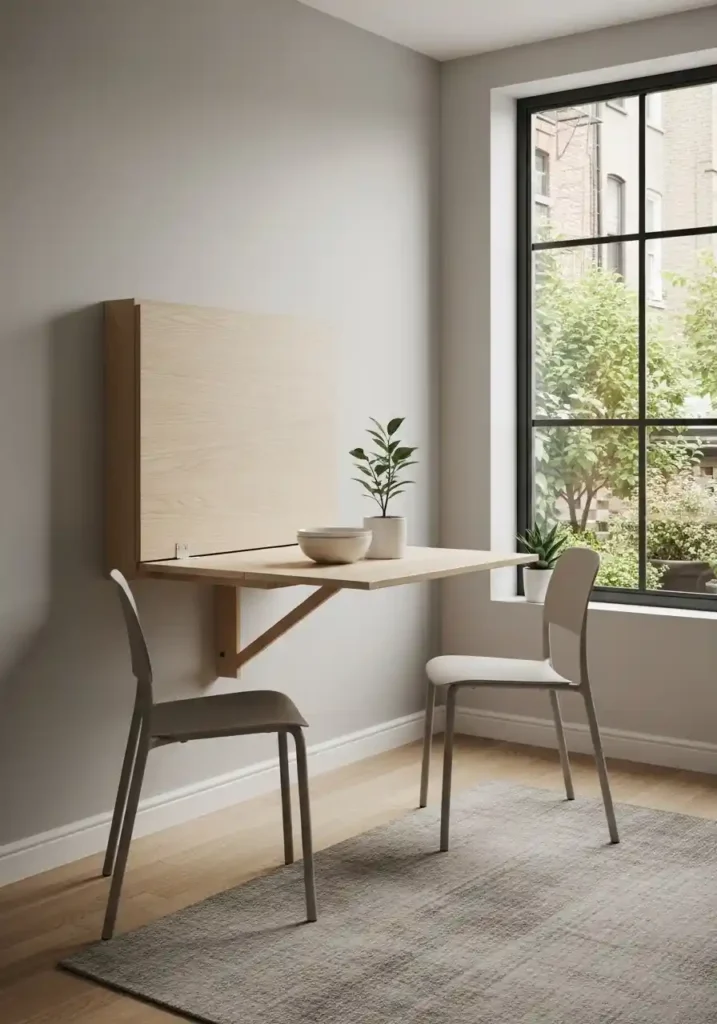
A wall-mounted fold-down dining table is the small dining room solution that provides the most complete floor space recovery when dining is not in progress — because a table that folds completely flat against the wall consumes exactly zero floor space in its stored position, returning the entire dining room floor area to its complete, unencumbered extent for every non-dining moment of the day. The small dining room with a fold-down table is genuinely two rooms simultaneously — a proper, well-equipped dining room when the table is deployed and an open, spacious, multi-purpose room when the table is returned to the wall.
The wall-mounted hooks storing the folding dining chairs flat against the wall beside the folded table are the organizational detail that most completely realizes the fold-down dining room’s full space-recovery potential — because chairs stored on wall hooks consume only the thickness of the chair seat rather than the full chair footprint on the floor, maintaining the maximum possible floor space recovery and the maximum possible visual openness of the small dining room between mealtimes. The combination of the folded table and the wall-stored chairs creates a small dining room of such complete, beautiful spatial efficiency that the transition from open room to fully equipped dining room and back takes less than two minutes.
7. The Small Dining Room with a Bold Accent Wall for Character
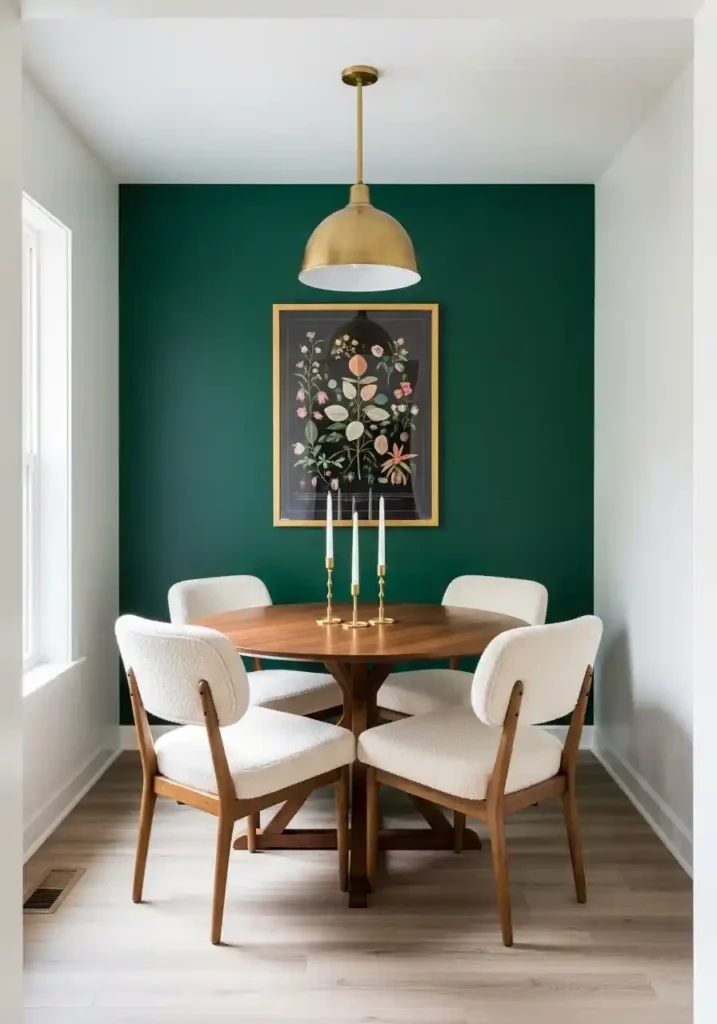
A bold accent wall in a small dining room is the most cost-effective and the most immediately impactful design decision available for creating a compact dining space of genuine visual drama and genuine design character — because a single wall painted in a rich, deeply saturated color creates such a powerful focal point and such a confident design statement that the dining room’s small dimensions become genuinely irrelevant to the quality of beauty and atmosphere the space provides. The bold accent wall makes the small dining room feel deliberately small rather than inadequately, apologetically compact, and the difference between those two qualities is everything.
The specific accent wall color that creates the most beautiful and the most spatially sophisticated result in a small dining room is a color of genuine depth and genuine organic richness — forest green, deep navy, warm terracotta, or rich burgundy — rather than a muted, pale, or cautious tone that creates a tepid accent of insufficient visual impact. The deep, saturated accent wall creates an immediate, concentrated color energy that fills the small dining room with genuine atmospheric character and genuine design confidence, making the compact space feel genuinely, magnificently intentional rather than simply the best available option within a limited floor plan.
8. The Small Dining Room with Transparent Ghost Chairs
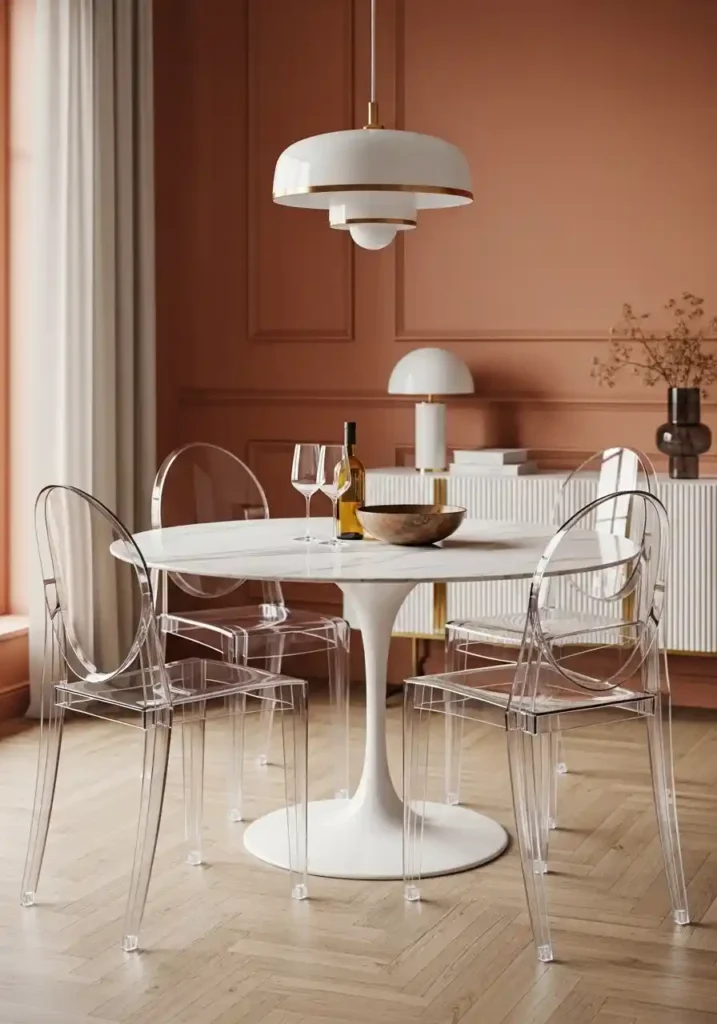
Transparent ghost chairs in a small dining room are the seating solution that delivers the most dramatically effective visual space expansion available — because chairs made from completely clear acrylic are visually absent in the dining room’s spatial composition while being functionally completely present as dining seating, creating a dining room that appears to have a beautifully furnished, properly equipped dining table with no visible chairs consuming the limited floor space around it. The ghost chair’s transparency tricks the eye into perceiving significantly more open floor area around the dining table than actually exists.
The specific visual mechanism that makes ghost chairs so powerfully space-expanding in a small dining room is their complete transparency to the floor surface beneath them — because the flooring visible through the clear acrylic of each chair extends the dining room’s floor plane continuously and uninterruptedly through the chair positions rather than stopping at the chair legs as it would with opaque alternatives. The eye reads the continuous floor plane as open, unoccupied space rather than as chair-occupied territory, creating a perceived floor area of genuine generosity that makes the small dining room feel significantly larger than its actual square footage. Ghost chairs are the small dining room’s best optical illusion.
9. The Small Dining Room with Smart Pendant Lighting
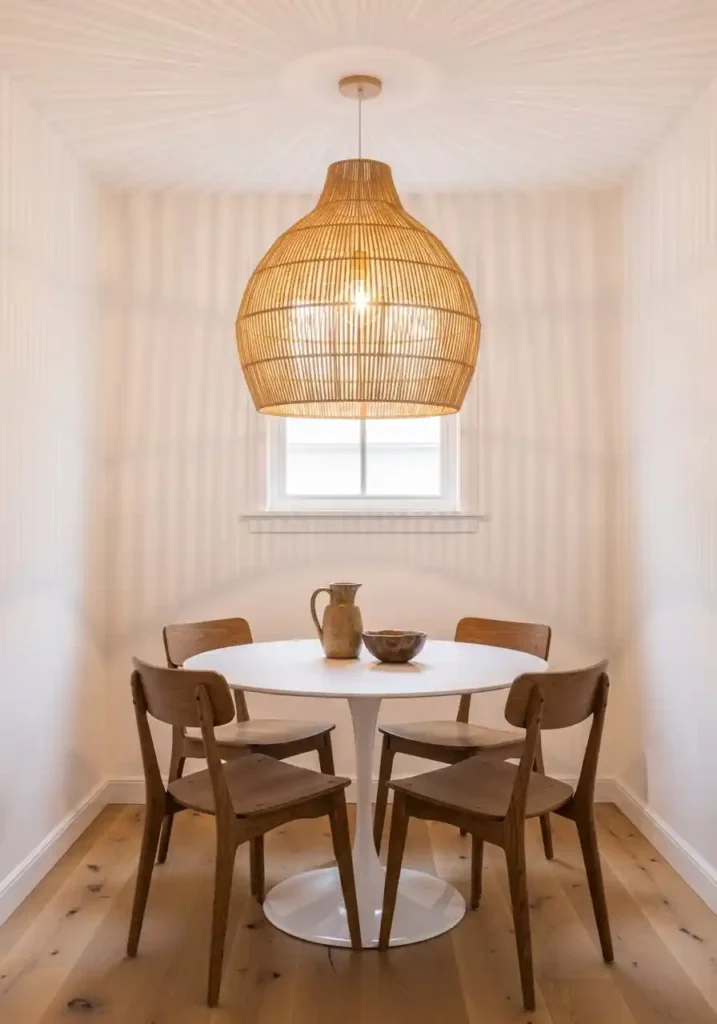
Smart pendant lighting in a small dining room is the investment that most immediately and most dramatically elevates the compact dining space from a small room that happens to have a dining table in it to a beautifully designed dining destination of genuine atmosphere and genuine intention — because the right pendant at the right height above the dining table creates a focal point of such confident, generous design presence that it reframes the dining room’s spatial narrative entirely. The small dining room with a spectacular pendant feels intentionally, beautifully compact rather than apologetically, inadvertently small.
The pendant height above the dining table is the specification detail that most determines the quality of both the lighting’s practical effectiveness and the room’s visual atmosphere — because a pendant hung too high above the table provides insufficient intimacy and insufficient focused table illumination, while a pendant hung at the correct height of 70 to 80 centimeters above the table surface creates the specific quality of concentrated, warm, focused light that makes the dining table glow with a quality of intimate, beautiful, flattering illumination that makes every meal within its pool of warm light feel like a genuinely special occasion. The pendant height is the small dining room’s most consequential lighting specification.
10. The Small Dining Room with a Floating Sideboard for Floor Space
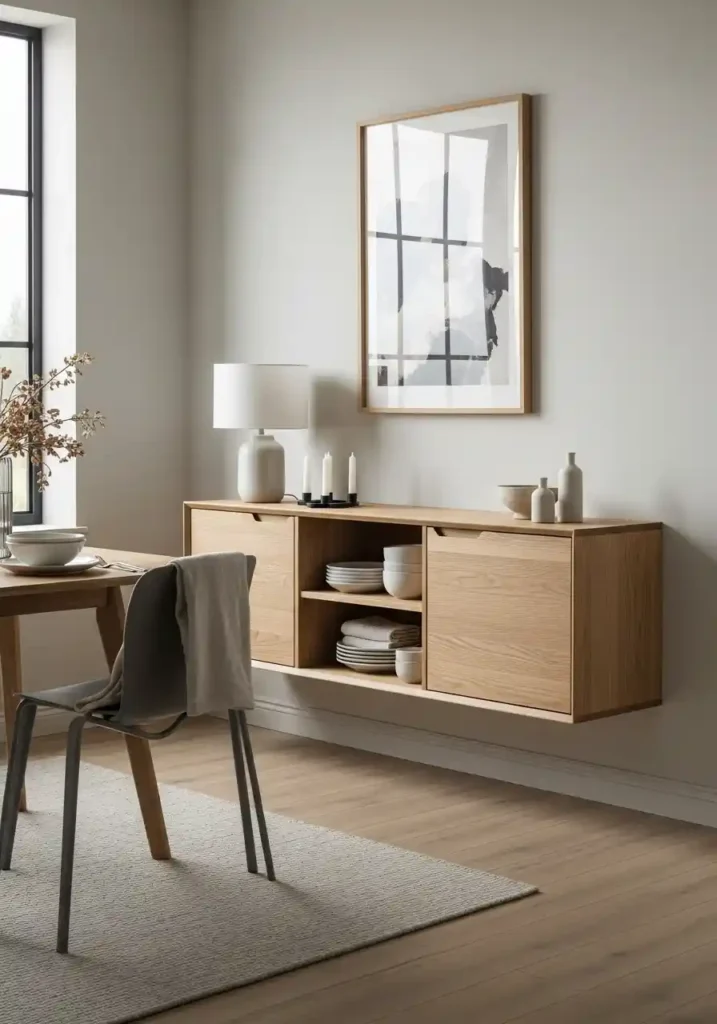
A wall-mounted floating sideboard in a small dining room is the storage solution that delivers the most complete and the most permanently effective combination of generous dining room storage and maximum visual floor space — because a floating sideboard with no legs beneath it allows the eye to read the floor area beneath the cabinet as open, unoccupied floor rather than as storage furniture footprint, creating the consistent visual impression of more floor space than the room actually possesses. The floating sideboard provides the same storage capacity as a legged equivalent while consuming dramatically less perceived floor space in the compact dining room.
The specific floor-to-ceiling height relationship of the floating sideboard mounting position is the specification decision that most determines its contribution to the small dining room’s spatial quality — because a sideboard mounted too low creates insufficient floor clearance beneath it for the floor-space illusion to be convincing, while a sideboard mounted at the optimal height of 85 to 95 centimeters creates a generous floor clearance that the eye reads as a complete, comfortable, properly proportioned open floor zone beneath the suspended cabinet. The floating sideboard at the correct height makes the small dining room appear taller, more spacious, and more generously proportioned from every viewing angle.
11. The Small Dining Room with Layered Rugs for Definition
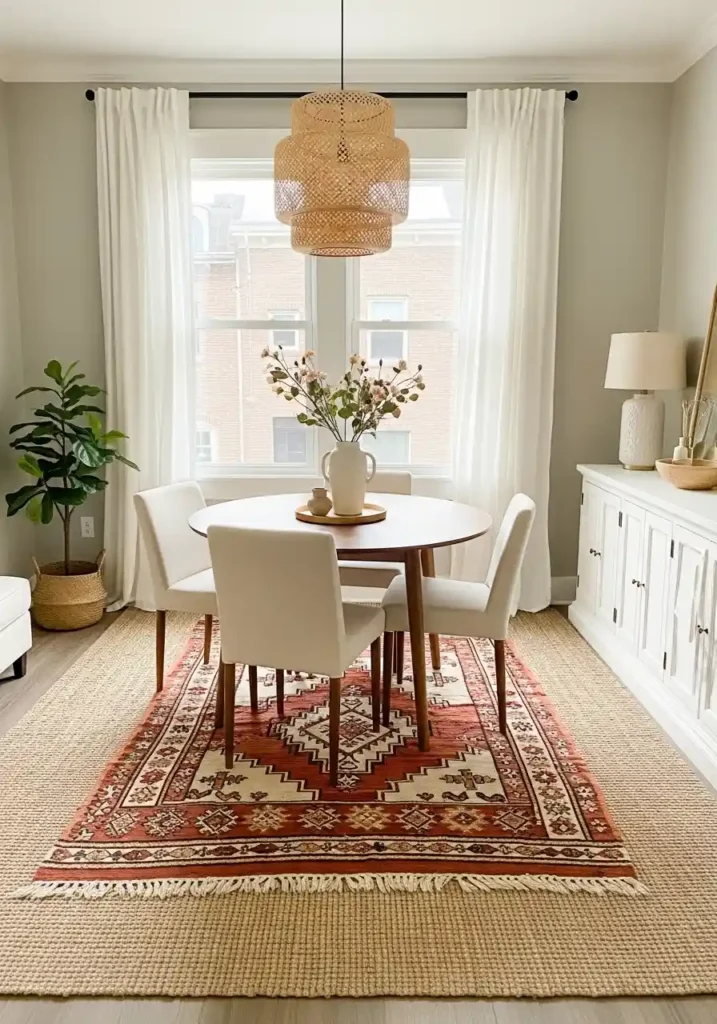
Layered rugs used to define the dining zone within a combined small living and dining space are the zone definition strategy that creates the most visually warm, the most texturally rich, and the most completely beautiful zone boundary available without any physical partition, any furniture divider, or any structural modification of any kind. The combination of a large base rug covering the full combined space and a smaller, richly patterned dining rug centered beneath the dining table creates a clear visual designation of the dining zone that the eye reads immediately and intuitively as a separate, distinct zone within the combined space.
The specific choice of a richly patterned Moroccan kilim or similar traditional patterned rug as the dining zone layer creates the most immediately beautiful and the most texturally interesting dining area designation available — because a kilim’s warm, handwoven patterns in rich, earthy tones creates a dining zone of genuine material beauty and genuine cultural richness that a plain-colored rug of equivalent size could never approach. The layered rug combination also adds the specific acoustic benefit of multiple textile layers in the dining zone, creating a softer, more intimate sound environment that makes conversation more comfortable and the dining atmosphere more genuinely cozy.
12. The Small Dining Room with a Narrow Extendable Table
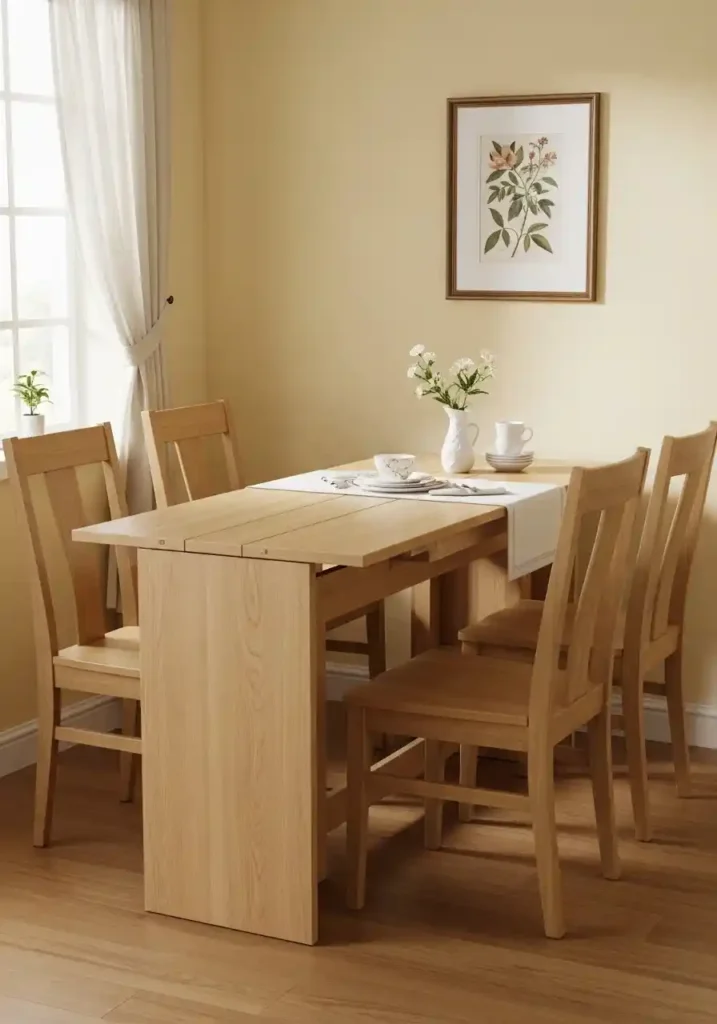
A narrow extendable dining table that starts at the minimum practical dining width for two and extends to a generous length for six is the small dining room furniture solution that most comprehensively and most elegantly resolves the fundamental tension between everyday floor space requirements and occasional entertaining needs — because a table of 80 centimeters width occupies significantly less floor space than a standard dining table while remaining perfectly comfortable for daily meals for two, and its extension to 200 centimeters provides generous seating for six when the dining occasion requires it. One table serves all occasions with equal excellence.
The precision of the extension mechanism is the technical specification that most determines the narrow extendable table’s quality and its daily convenience — because an extension mechanism that operates smoothly and easily with one hand, extends and locks to a rigid, perfectly stable extended position without any perceptible wobble or play, and stores the extension leaves cleanly within the table structure when not in use creates an extending table experience of such genuine, effortless excellence that extending the table for guests becomes a pleasure rather than a mechanical challenge. The extension mechanism quality is the narrow extendable table’s single most important specification decision.
13. The Small Dining Room with a Statement Wallpaper for Character
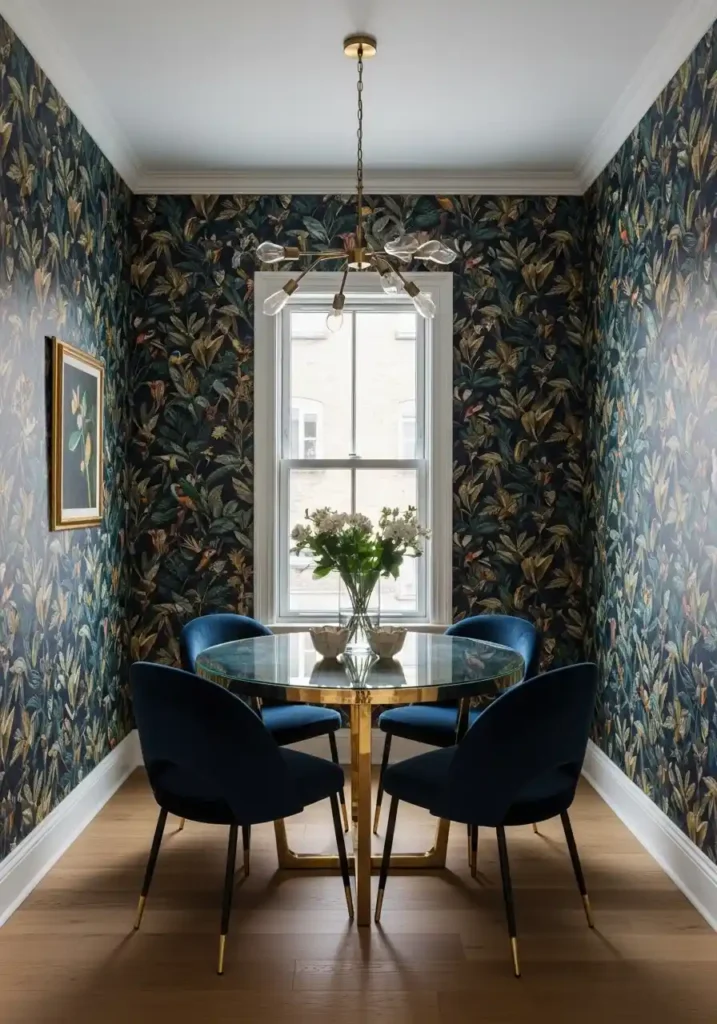
Statement wallpaper in a small dining room is the design decision that most brilliantly converts the small room’s potentially limiting enclosure into its greatest design asset — because the four walls of a small dining room, which in a larger room would simply be the room’s backdrop, become in a compact space an intimate, enveloping surface that is consistently close to every diner and consistently, completely in their field of vision, making the compact room the ideal canvas for the most dramatic, the most richly patterned, and the most immersively beautiful wallpaper available. Small dining rooms were made for extraordinary wallpaper.
The four-wall wallpaper installation — covering every wall of the small dining room with the same bold botanical pattern rather than using wallpaper on a single feature wall — creates the most complete and the most genuinely extraordinary small dining room transformation available, because it creates a quality of total, three-dimensional immersion in the wallpaper’s pattern and color that a single feature wall can never approach. Every diner in the small dining room is surrounded on all sides by the botanical world of the wallpaper, creating a dining experience of such extraordinary, complete sensory immersion that the room’s small size becomes not a limitation but the precise quality that makes the immersive wallpaper experience as intense and as magnificent as possible.
14. The Small Dining Room with a Galley Bench Along One Wall
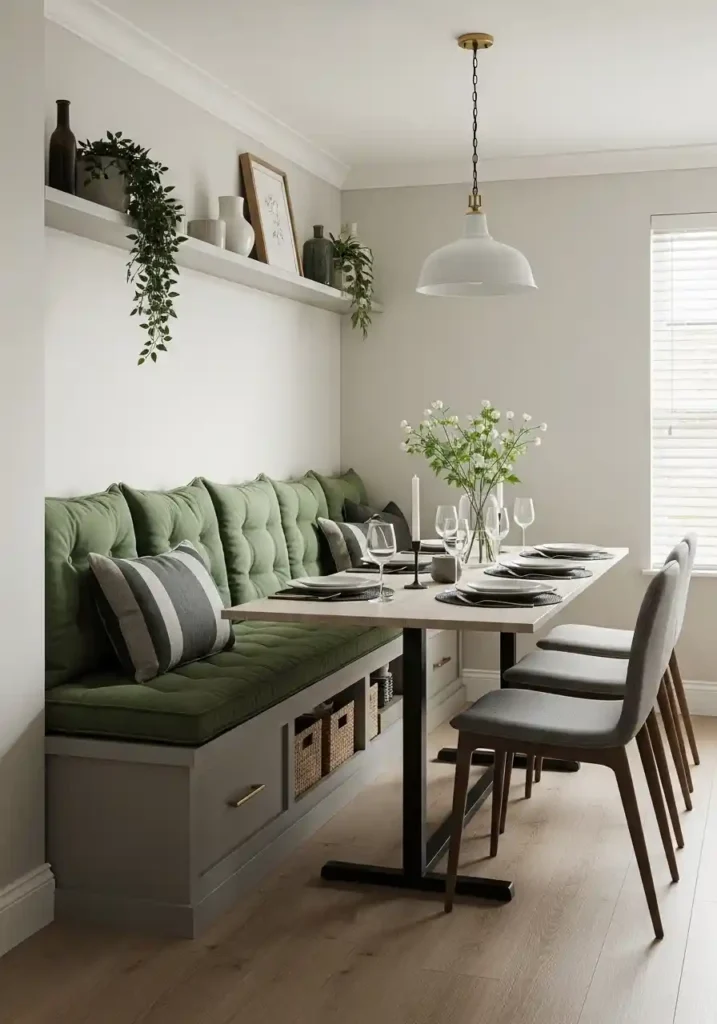
A built-in bench seat running the full length of one dining room wall creates the most space-efficient long seating solution available for a small dining room — because a bench seat positioned against the wall requires absolutely zero chair-pullout clearance on the wall side, creating a dining configuration of such complete spatial efficiency that the dining table can be positioned significantly closer to the wall than a conventional chair-on-both-sides arrangement would allow, dramatically reducing the table’s effective floor footprint while maintaining equivalent seating capacity. The bench against the wall is the long dining table’s most spatially intelligent companion.
The storage drawers within the built-in bench base are the organizational addition that transforms the seating structure from an efficiently positioned furniture piece into the small dining room’s most organizationally complete space-saving installation — providing concealed storage for table linens, placemats, serving accessories, and dining room extras within the same footprint as the bench seating, contributing genuine additional storage capacity to the compact dining room without any visible storage addition and without any floor space beyond what the seating itself already occupies. The bench seat’s combined seating, storage, and space-efficiency functions make it the small dining room’s most complete single furniture investment.
15. The Small Dining Room with Light-Toned Furniture for Openness
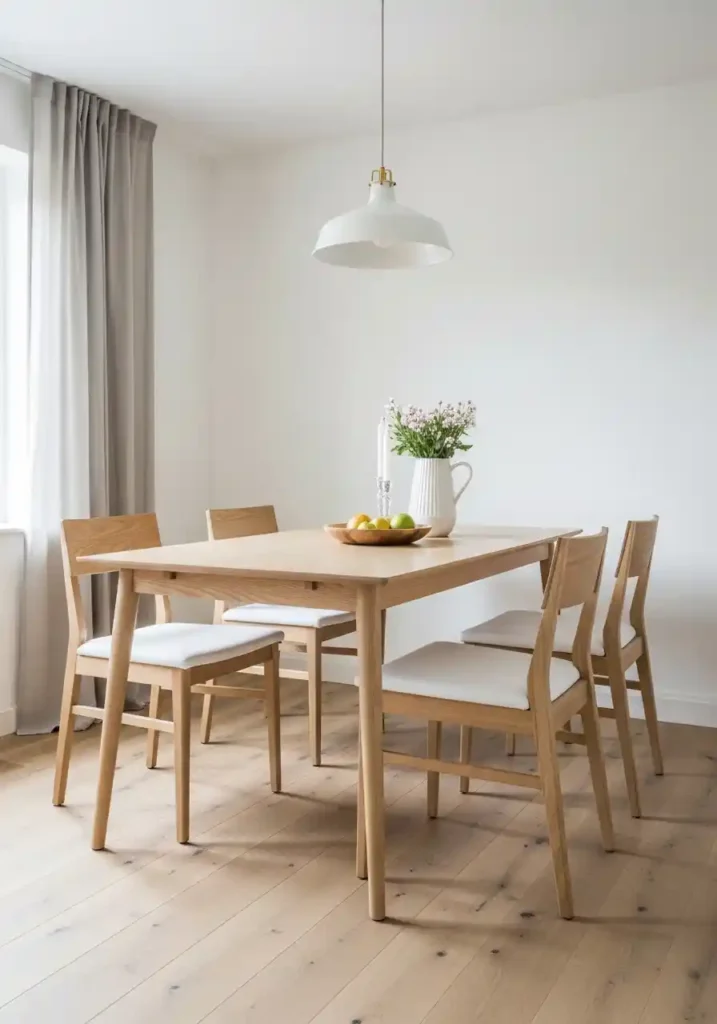
Consistently light-toned furniture in a small dining room creates the most complete and the most genuinely convincing visual space expansion available through furniture selection alone — because pale oak tables and chairs, when positioned in a room of white walls and pale flooring, create a furniture composition that appears to recede into the room’s light tonal environment rather than standing out as space-consuming objects. The eye perceives light furniture against a light background as occupying less visual space than equivalent dark furniture against the same background, creating a dining room that appears significantly more open and more spatially generous than a comparable dark-furniture arrangement in the same room.
The slim legs of the light-toned dining table are the specific furniture design detail that most powerfully enhances the pale furniture’s space-creating quality — because slim, tapered legs that are visible beneath the table create a clear, unobstructed view of the floor extending beneath the table surface, maintaining the visual continuity of the floor plane through the table’s footprint rather than blocking the floor view with solid panels or thick legs. The floor visible beneath the table reads as open, unoccupied space rather than as table-occupied territory, creating the impression of significantly more available floor area in the small dining room than the actual furniture footprint consumes.
16. The Small Dining Room with Sconce Lighting for Counter Space
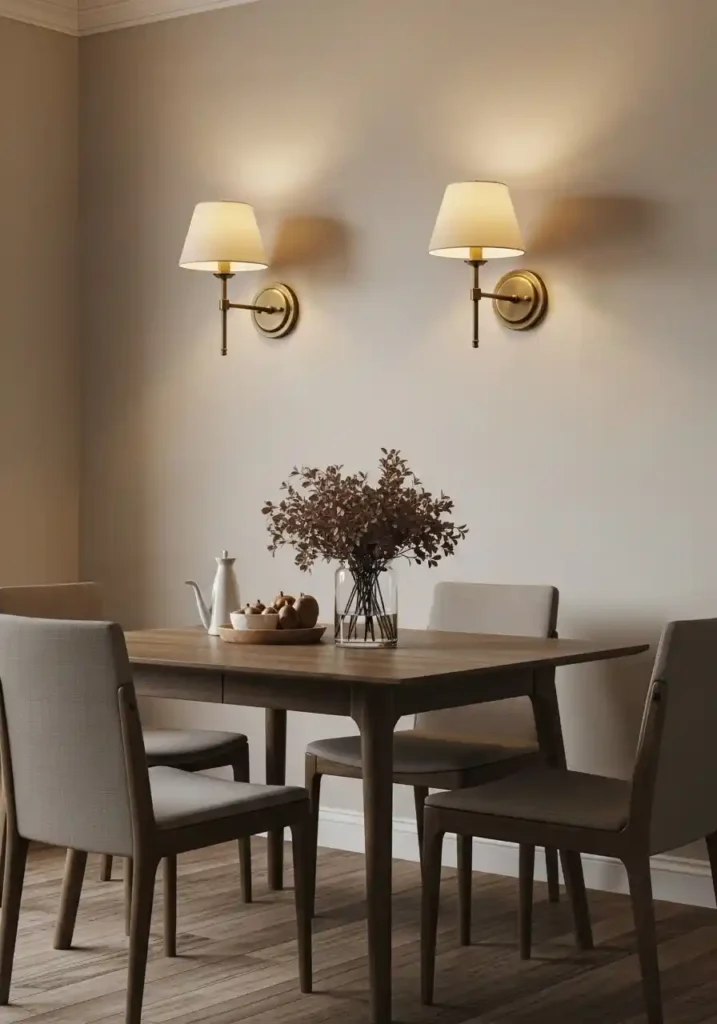
Wall sconces as the primary ambient lighting in a small dining room are the lighting choice that most elegantly and most completely eliminates the floor lamps and table lamps that typically consume both visual and physical floor space in compact dining rooms — because properly specified wall sconces provide warm, generous ambient illumination from wall-mounted positions that consume zero floor space and zero table space, leaving the small dining room’s every inch of floor area and every inch of table surface completely free for the purposes of dining rather than for lamp accommodation. The wall-mounted sconce is the small dining room’s most spatially generous lighting solution.
The swing-arm wall sconce is the specific sconce design that creates the most practically versatile and the most atmospherically flexible small dining room lighting — because a sconce with a swing arm that extends outward from the wall for directional illumination and retracts close to the wall when maximum floor space is needed creates a lighting fixture of complete, effortless flexibility that adapts to the dining room’s changing needs without any permanent commitment to a single illumination direction or a single sconce position. The swing-arm sconce is the small dining room’s most intelligent wall-mounted lighting investment.
17. The Small Dining Room Maximized with Vertical Storage
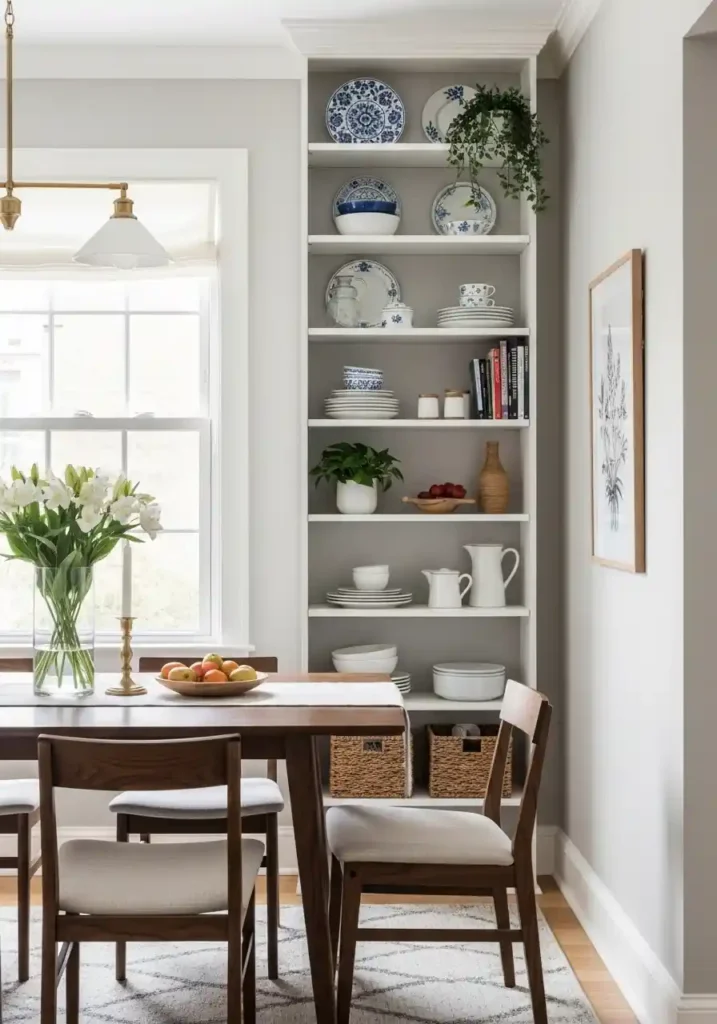
Vertical floor-to-ceiling storage in a small dining room is the space-maximizing strategy that most effectively and most permanently increases the compact dining room’s storage capacity without consuming additional floor area — because a bookcase or shelving unit that extends from the floor to the absolute ceiling height captures every inch of available vertical dimension for organized storage rather than leaving the upper portion of the wall empty and unused. Floor-to-ceiling shelving in a dining room alcove provides a volume of organized dining storage that dramatically exceeds what any lower shelving or sideboard alternative of equivalent floor footprint could accommodate.
The visual effect of floor-to-ceiling shelving in a small dining room extends significantly beyond its practical storage contribution — because a shelving unit that reaches the ceiling creates a strong vertical architectural presence that makes the ceiling appear higher, the room appear taller, and the dining space feel more architecturally generous and more intentionally designed than the same room with lower storage furniture. The floor-to-ceiling shelf unit is simultaneously the most practically storage-generous and the most visually height-enhancing storage solution available for a small dining room, making it the storage choice that most completely serves both the compact room’s practical and aesthetic needs.
18. The Small Dining Room with a Pocket Door for Floor Space
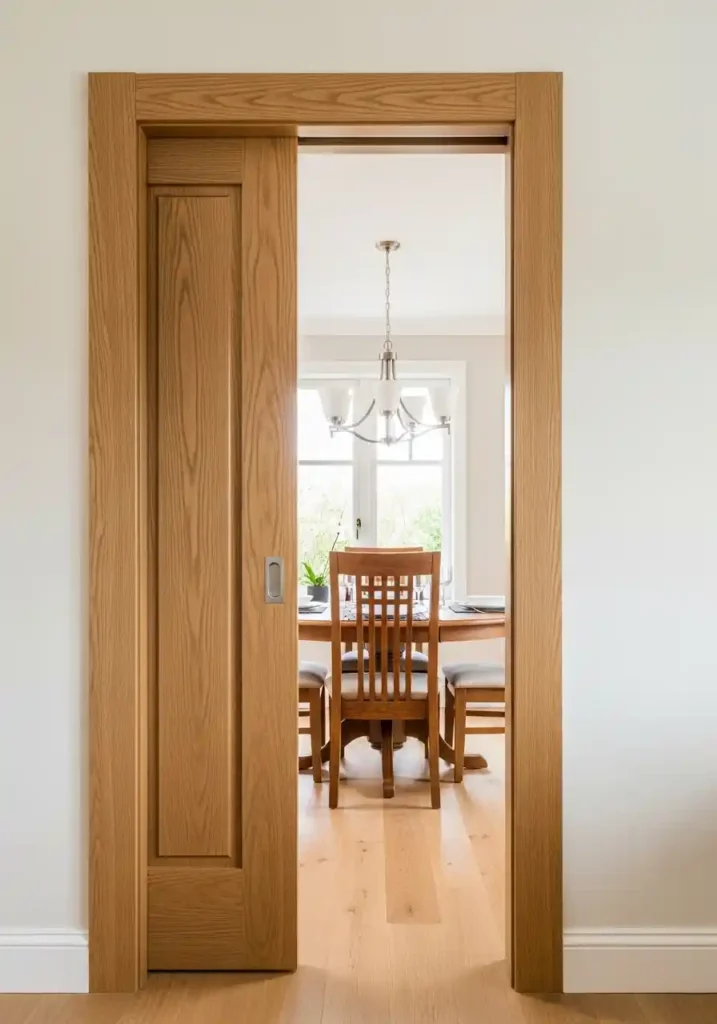
A pocket door that slides into the wall cavity rather than swinging into the dining room or the adjacent space is the architectural intervention that most immediately and most permanently improves the small dining room’s floor space at its most critical and most circulation-sensitive location — the entry threshold. A conventional hinged dining room door requires a clear swing arc of approximately one square meter of floor area on at least one side of the doorway, and in a small dining room where one square meter represents a genuinely significant proportion of the total available floor space, eliminating the door swing arc entirely returns that floor area to the dining room’s permanent, usable territory.
The visual effect of the pocket door on the small dining room’s spatial quality extends beyond the specific floor space it recovers — because a doorway without a door swinging into the room reads as a genuinely open, genuinely generous architectural threshold rather than as a constrained opening negotiated around a door panel, making the small dining room feel more openly connected to the adjacent space and more spatially continuous with the rest of the home. The pocket door is the small dining room entry detail that communicates complete, professional architectural intelligence while delivering the most immediate and the most practical floor space improvement available.
19. The Small Dining Room with Color-Drenched Ceiling Drama
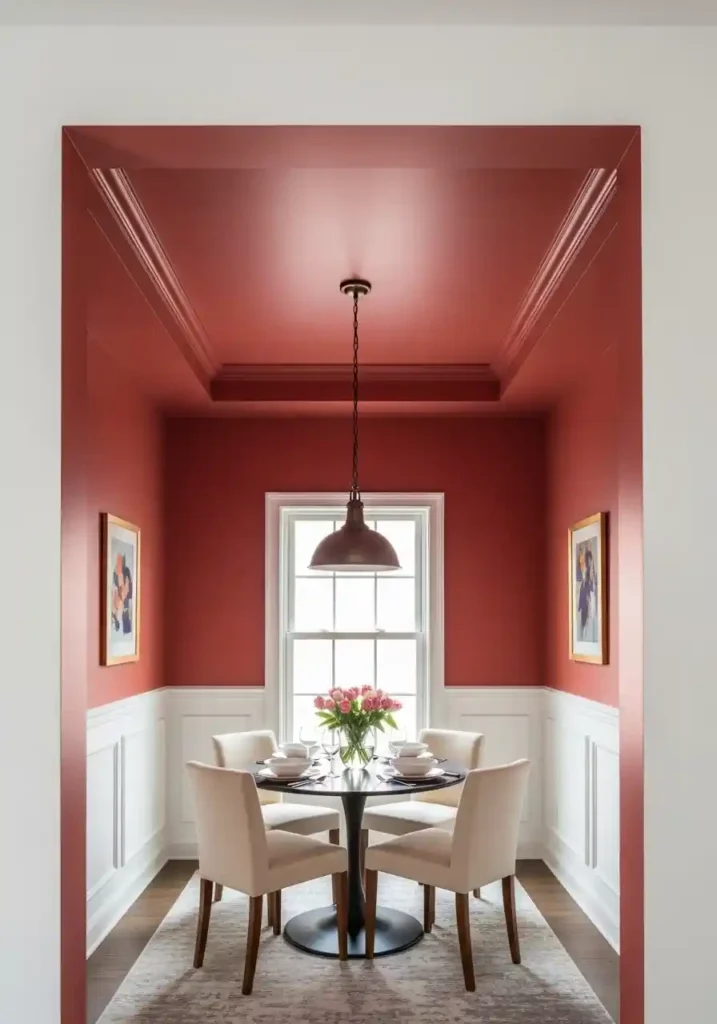
A deep color-drenched ceiling in a small dining room is the design decision that most brilliantly converts the compact room’s most potentially problematic quality — its low ceiling — from a spatial limitation into a genuine, warm, deliberately beautiful design asset, because a ceiling painted in a rich, saturated color creates a quality of intimate, cocooning warmth that makes the low ceiling feel like a deliberate choice of architectural intimacy rather than an inevitable consequence of limited building height. The color-drenched ceiling transforms the small dining room’s dimensional constraint into one of its most distinctively beautiful and most personally expressive design qualities.
The color-drenching technique — extending the ceiling color slightly down the upper wall sections before transitioning to a contrasting lower wall color — creates the most complete and the most convincingly beautiful color-drenched ceiling effect available, because it prevents the ceiling color from appearing as a sharply defined ceiling panel and instead creates the impression of a warm color environment that envelops the upper portion of the room in a continuous, rich color experience of genuine atmospheric depth and genuine visual warmth. The color-drenched terracotta ceiling above white lower walls creates a small dining room of extraordinary intimacy and extraordinary, warm beauty.
20. The Small Dining Room with a Console Table as the Dining Table
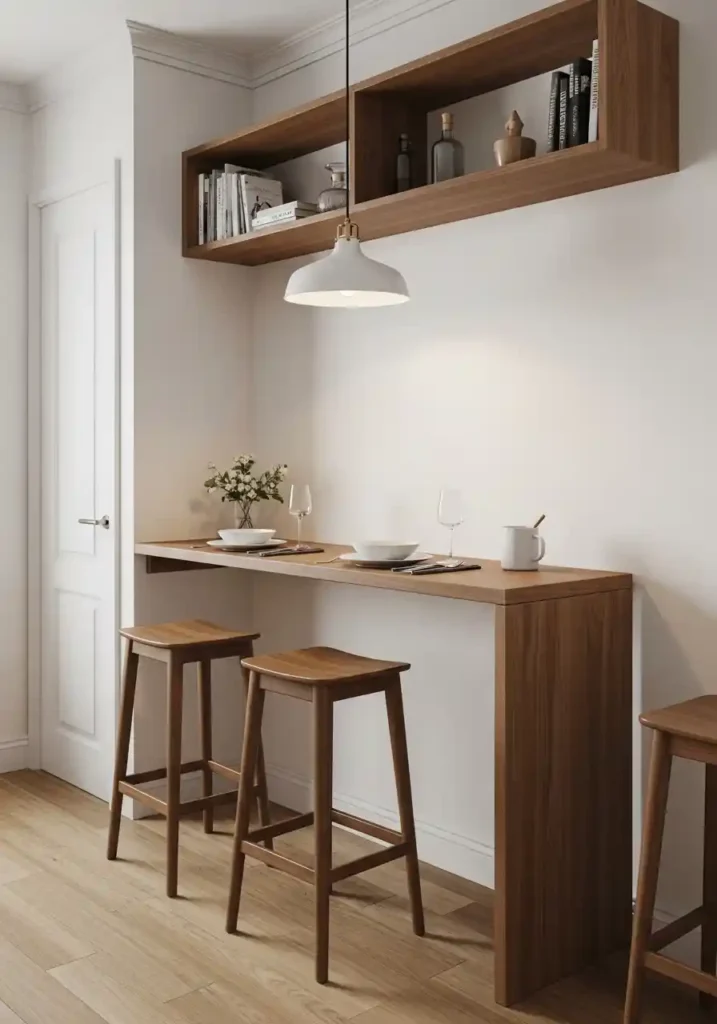
A slim console table repurposed as a dining table is the most radically space-efficient dining solution available for the smallest dining spaces — because a console table of 35 to 45 centimeters depth, when positioned against a wall and used with slim stools or bar chairs on the open side only, creates a complete, properly functional dining surface for two that consumes a fraction of the floor space of any conventional dining table and chair arrangement. The console dining table is the solution for dining spaces where conventional furniture would make movement through the space genuinely impractical.
The slim counter stools that tuck completely beneath the console table when not in use are the seating specification that most completely realizes the console dining table’s full space-saving potential — because stools with no back support and slim profiles that disappear entirely beneath the console surface when pushed in return the full floor area beneath the table to the room’s available floor space, making the console and stool combination consume effectively zero floor area in its stored configuration. The console dining table with fully tucking stools is the small space dining solution that most completely recovers its own floor footprint when not in active use.
21. The Small Dining Room with Strategic Art for Perceived Space
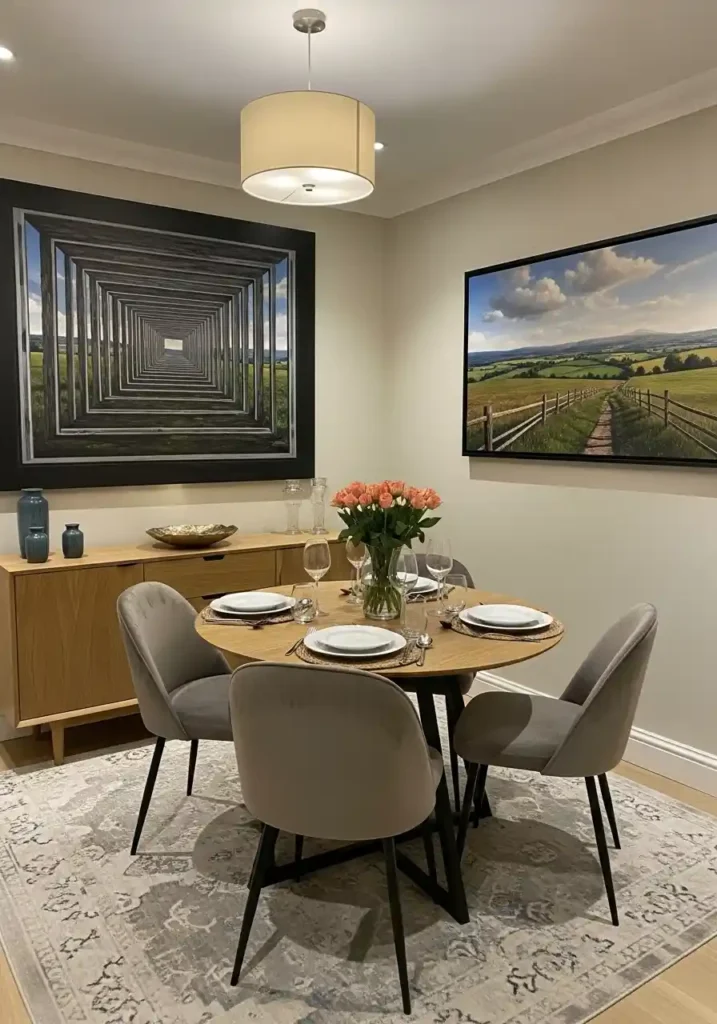
Strategic artwork placement in a small dining room is the design tool that most cleverly and most effectively uses visual perception to create the impression of greater spatial depth and greater room scale without any physical change to the room’s dimensions — because the human visual system responds to depicted space in artwork with the same spatial processing that it applies to actual physical space, and a large painting depicting a deep, receding landscape effectively extends the dining room’s visual field far beyond its actual walls by providing the eye with a compelling, beautifully depicted spatial depth to inhabit. The right artwork makes a small dining room feel significantly less enclosed.
A large landscape painting with strong perspective and significant visual depth — a countryside view receding to a distant horizon, a forest path disappearing between trees, or an architectural view with strong linear perspective — creates the most complete and the most convincing visual spatial expansion in a small dining room by providing a genuinely large, genuinely deep visual field to occupy the diner’s peripheral vision and create the persistent impression of being in a more spatially generous, more open environment than the room’s actual walls define. The landscape painting is the small dining room’s most beautifully artistic spatial tool.
22. The Small Dining Room with a Mirrored Sideboard for Double Light
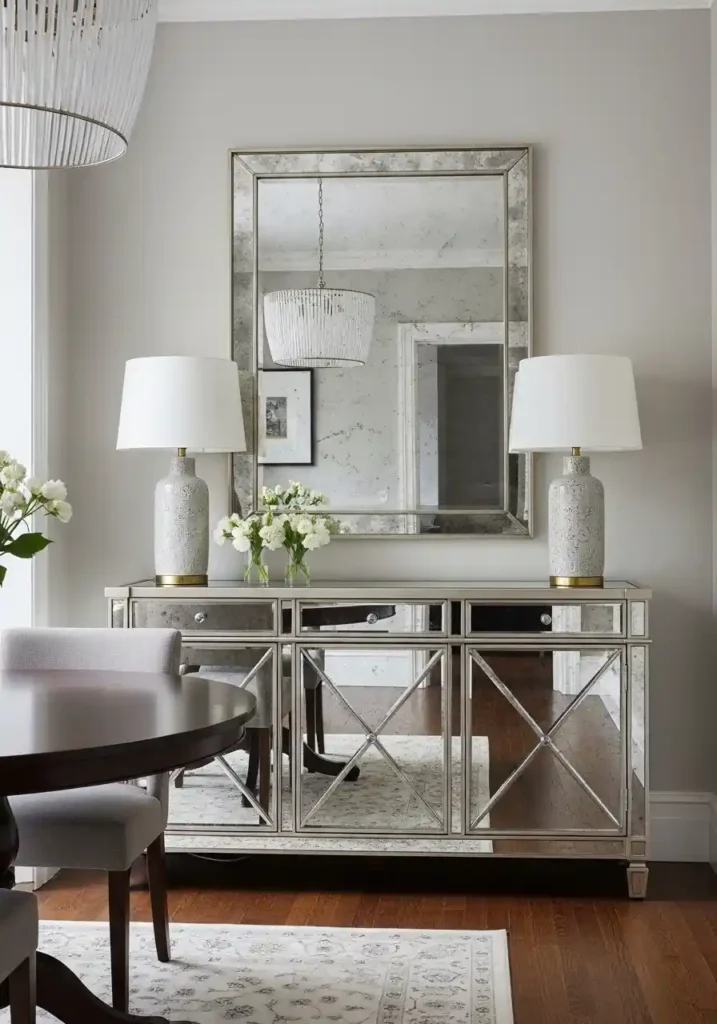
A mirrored sideboard in a small dining room is the furniture piece that most elegantly combines genuine storage functionality with the spatial expansion properties of reflective surfaces — because a sideboard with mirrored front panels and a mirrored top provides the full dining room storage capacity of a conventional sideboard while simultaneously reflecting the room’s natural light, the pendant’s warm glow, and the dining table’s full visual composition back into the compact space, creating a reflected image of such convincing spatial depth that the dining room appears to extend equally far beyond the sideboard as it does in front of it.
The mirrored sideboard’s specific contribution to the small dining room’s lighting quality is as significant as its contribution to the perceived spatial depth — because a mirrored surface positioned opposite the room’s primary window reflects natural daylight into the dining room from a direction opposite to the window, creating the impression of a second window and dramatically improving the natural light quality of the small dining room’s darkest corners. In a compact dining room where natural light is always at a premium, the mirrored sideboard’s ability to redirect and amplify the available daylight makes it simultaneously the most practically storage-generous and the most atmospherically light-enhancing furniture piece available.
23. The Complete Small Dining Room — Every Space-Maximizing Idea in Perfect Harmony
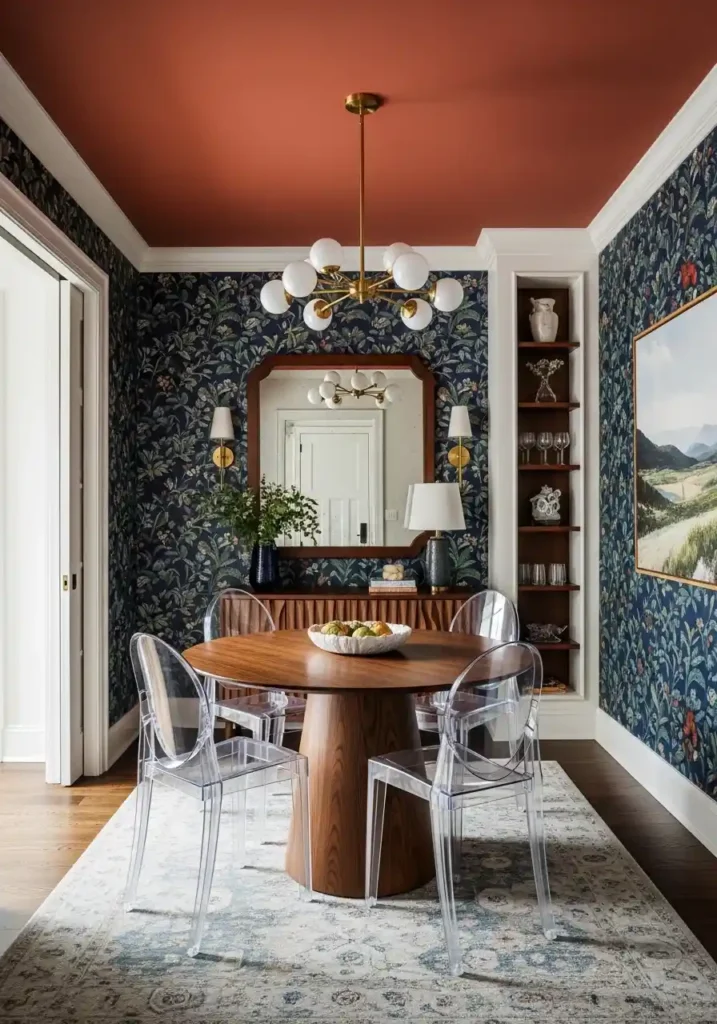
The perfectly maximized small dining room — the one that makes experienced interior designers pause in genuine admiration, that makes dinner guests ask how such a compact space manages to feel so beautiful, so complete, and so genuinely special, and that makes its owner feel genuinely, daily grateful for the intelligence and the creative love invested in every design decision — is the accumulated, harmonious, completely resolved result of multiple complementary space-maximizing ideas working together in complete, reinforcing concert. The round table that flows. The ghost chairs that disappear. The jewel-box wallpaper that makes the scale irrelevant. The mirrored sideboard that doubles the light. Each idea amplifies every other magnificently.
The most important and the most genuinely liberating understanding this guide offers is that small dining room design is not a consolation prize for those without more space but a specific, creative, genuinely exciting design challenge that rewards intelligent engagement with dining rooms of greater beauty, greater atmospheric richness, and greater daily dining pleasure than many much larger dining rooms that simply accommodate more without the organizational intelligence and the creative ambition that limited space demands and inspires. Your small dining room is not a compromise waiting to be resolved by a future house move — it is an opportunity for genuinely extraordinary design, and these twenty-three ideas are the most beautiful proof.
Conclusion:
Incorporating smart design choices into a compact dining area can completely transform how the space looks and functions. From multifunctional furniture and clever storage solutions to light-enhancing colors and space-saving layouts, these small dining room ideas prove that limited square footage doesn’t mean sacrificing style or comfort. By focusing on efficiency and thoughtful design, you can create a dining space that feels open, inviting, and perfectly suited to your needs.
Ultimately, the key to maximizing a small dining room lies in balancing practicality with aesthetics. Whether you’re working with a cozy apartment corner or a narrow dining nook, the right combination of layout, décor, and furniture can make all the difference. With these ideas, you can turn even the smallest dining area into a beautiful and functional space where every meal feels special.