1. Sconce Lighting Instead of Table Lamps for Freed-Up Surface Space
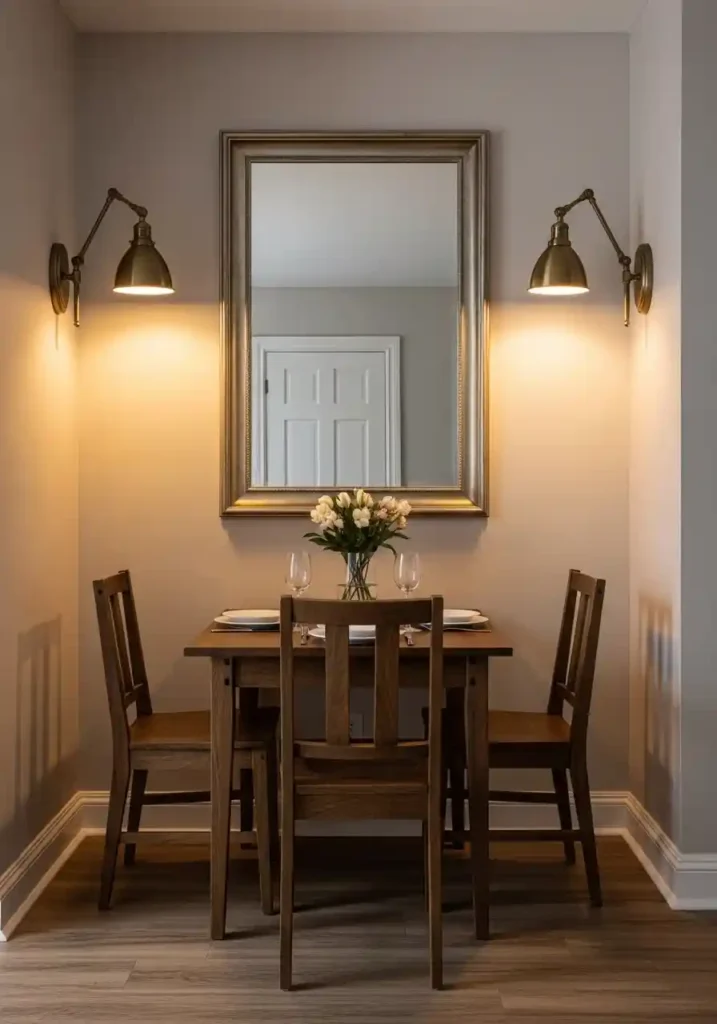
Wall sconces in a Small Dining Room Decor Ideas are the lighting solution that most people never consider and almost everyone wishes they had discovered sooner — because mounting your secondary light sources directly onto the wall eliminates the floor lamps and table lamps that consume precious floor area and surface space in rooms that genuinely cannot afford to spare either. Two beautiful wall sconces flanking a mirror or a piece of artwork do everything a pair of table lamps would do in terms of warm, directional, atmospheric light — and they do it without occupying a single inch of the floor plane or a single inch of the sideboard surface below them.
The style of wall sconce you choose for a small dining room carries significant aesthetic weight because sconces are highly visible architectural fixtures that contribute to the room’s character whether they are switched on or off. Antique brass swing-arm sconces with linen shades provide warm, adjustable, directional light and a timeless elegance that suits almost every dining room aesthetic. Minimal ceramic sconces in warm white or terracotta bring an artisanal, hand-crafted quality to the walls. Industrial black metal cage sconces create an edgy, urban character with a warmth of light that contradicts their cool material. Whatever style you choose, the freed-up floor and surface space they create in a small dining room is an immediate and genuinely significant gift.
2. Two-Tone Paint to Create the Illusion of Higher Ceilings
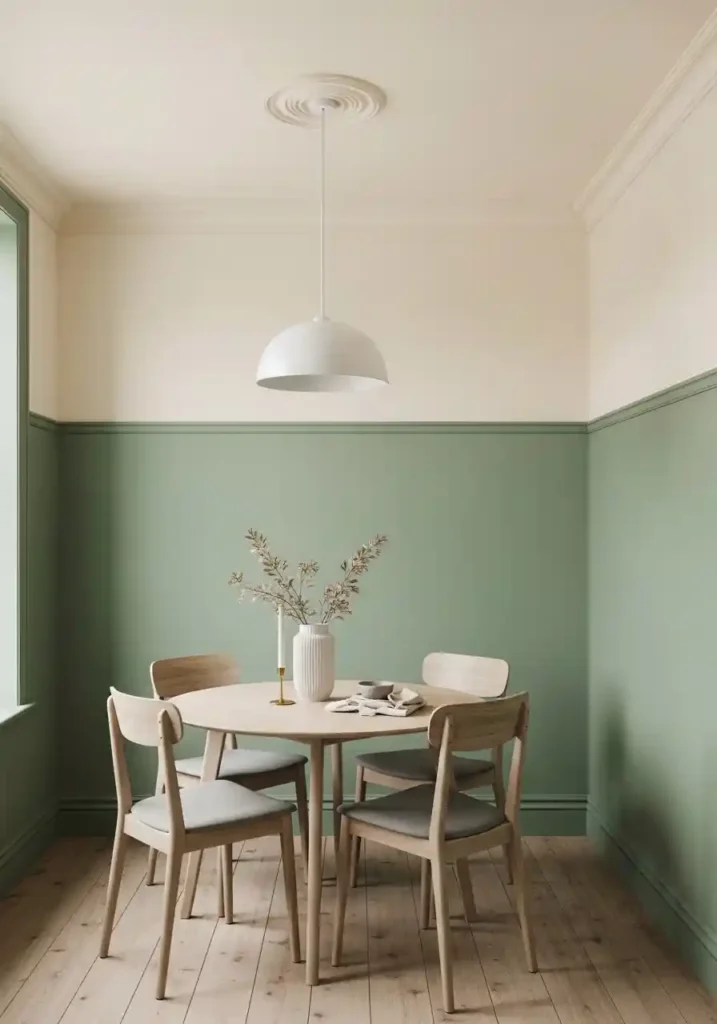
Two-tone wall painting — where the lower portion of a small dining room wall is painted in a deeper, richer tone and the upper portion transitions to a lighter color that continues across the ceiling — is the paint technique that creates the most convincing illusion of greater ceiling height available to anyone working with a brush and a Saturday afternoon. The lighter upper zone visually merges the wall and the ceiling into a single continuous pale plane that recedes upward, while the deeper lower zone grounds the room with color and warmth at the level where furniture and people actually live. The result reads as a room with a significantly higher ceiling than it physically possesses.
The painted picture rail or chair rail that marks the transition between the two tones is the architectural detail that elevates this technique from a simple paint job into a genuinely considered design feature — and it’s a detail worth executing with care. A slim painted timber molding at the transition point, painted in either the upper or lower tone, creates a clean, precise boundary that makes the two-tone treatment look intentional and architectural rather than unfinished or accidental. The lower tone in sage green, terracotta, dusty navy, or warm taupe combined with a warm white upper zone and ceiling creates the most beautiful and most spatially effective results in small dining rooms of virtually every style and proportion.
3. Swap Heavy Drapes for Roman Blinds to Reclaim Wall Space
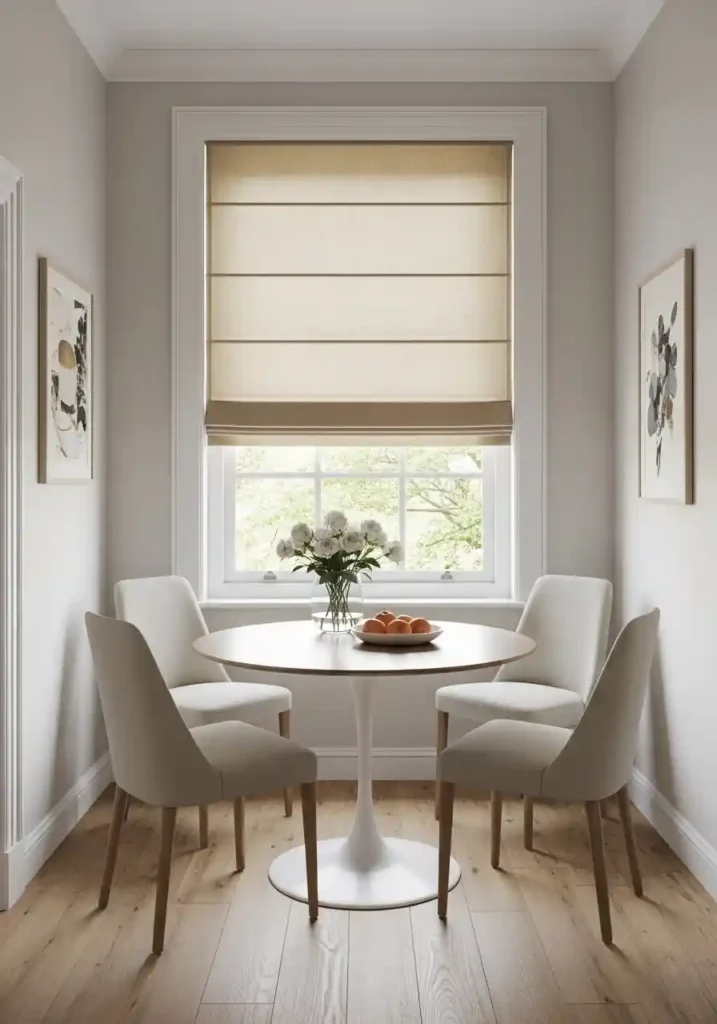
Full curtains in a small dining room — however beautiful the fabric, however carefully chosen the color — consume wall space on either side of the window when open that a compact dining room genuinely needs to feel wide, open, and unencumbered. Roman blinds provide every bit of the privacy, the light control, and the window dressing elegance that curtains deliver, while occupying only the window opening itself when rolled down and rolling neatly and completely out of the way when up, leaving the walls on either side of the window completely free, completely visible, and completely available to contribute to the room’s sense of generous, open width.
The fabric choice for Roman blinds in a small dining room has a significant impact on both the aesthetic quality and the light quality of the space — and the most beautiful and most spatially successful options are those in natural, slightly textured fabrics that allow diffused light to glow through them gently when the blinds are partially lowered. Natural linen in warm oatmeal or ivory, a soft woven cotton in a warm neutral, or a textured weave in a gentle sage or dusty blush all create Roman blinds that look sophisticated and tailored while maintaining the warm, light quality that small dining rooms depend on for their spacious feeling. Choose a fabric that coordinates with your dining room’s primary palette and the blinds become a quietly elegant architectural feature rather than merely a practical window covering.
4. A Mirrored Sideboard That Doubles Visual Depth
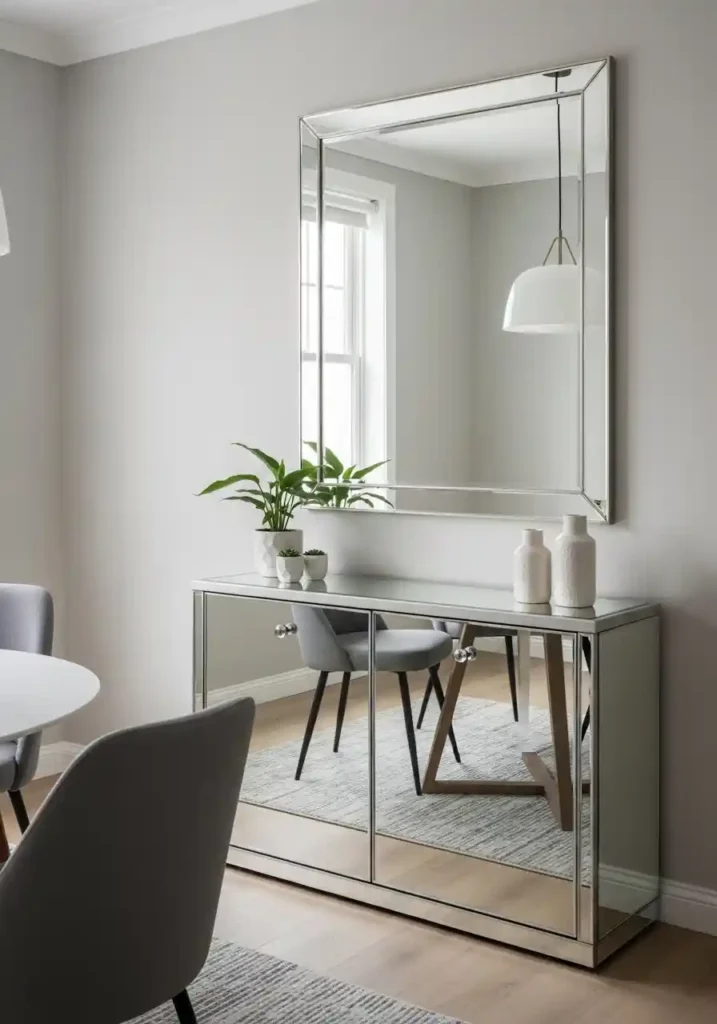
A mirrored sideboard in a small dining room is the furniture piece that performs two of the most valuable spatial functions simultaneously — providing the concealed storage that every dining room needs while acting as a large mirror that visually expands the room in exactly the same way a wall-hung mirror would. The mirrored cabinet doors reflect the dining table, the pendant light, and everything else in the room back into the space, creating the impression of a second room existing just beyond the sideboard’s reflective surface and making the room feel genuinely, convincingly deeper and more spacious than its actual wall-to-wall dimensions. It is the storage solution that gives back more than it takes.
Finding a mirrored sideboard with a genuinely slim profile — no deeper than fourteen to sixteen inches — is the key to making this approach work in a small dining room without the sideboard consuming the circulation space that makes the room comfortable and practical to use. A slim mirrored sideboard styled with restraint on its top surface — one small plant, one or two carefully chosen ceramic objects, nothing more — maintains the clean, uncluttered quality that allows its reflective properties to work fully and effectively. The reflected image is most beautiful and most spatially convincing when the surface in front of the mirror is sparse enough to allow the reflection to be clearly read as a genuine spatial depth rather than as a cluttered reflection of a crowded surface.
5. An Oversized Clock as Statement Art Without Extra Furniture
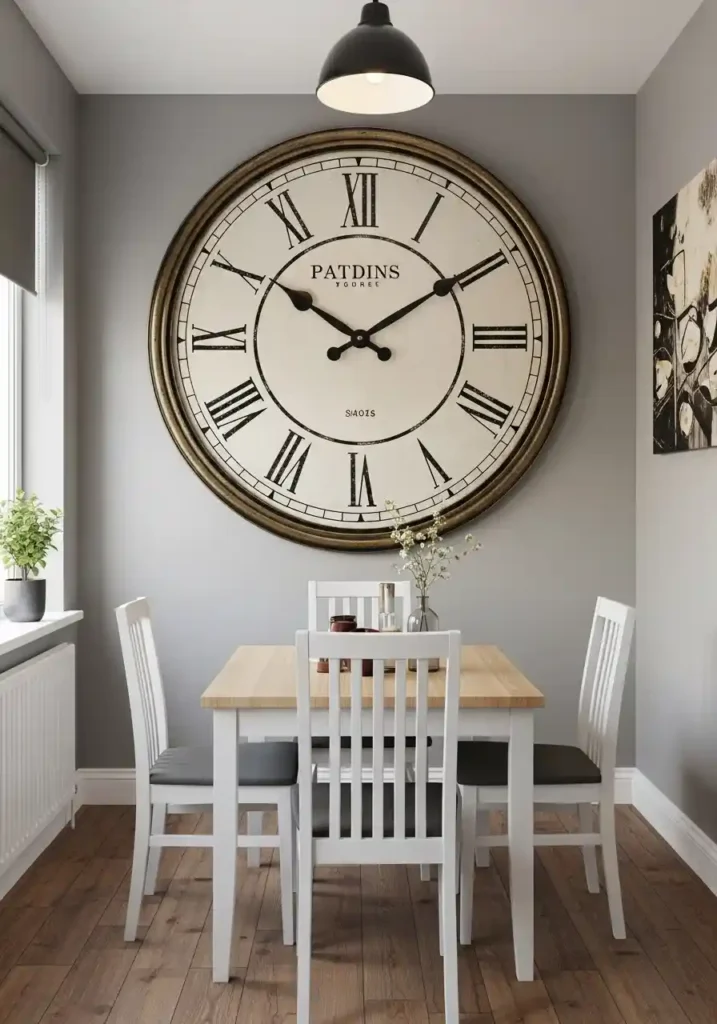
An oversized wall clock in a small dining room is the decorating secret that gives you the visual impact and the personal character of a large piece of artwork while simultaneously providing a genuinely useful function that art cannot offer — and in a small room where every design decision should ideally deliver multiple benefits simultaneously, that combination of aesthetic impact and practical utility makes the oversized clock one of the most efficient and most satisfying additions possible. A clock that spans a significant portion of a dining room wall fills the space with bold, confident character that makes the room feel designed and deliberate rather than simply furnished and functional.
The style of oversized clock that works most magnificently in a small dining room is the one that speaks most directly to the room’s overall aesthetic and the personal taste of the people who dine within it — because an oversized clock is a genuine design statement that communicates personality with real clarity and real confidence. A vintage-style clock in aged brass with cream face and Roman numerals adds warmth, history, and timeless elegance. A minimal, graphic clock in matte black with clean Arabic numerals makes a bold contemporary statement. A botanical or artistic clock face creates the most direct overlap with conventional artwork. Choose one that you genuinely love looking at, because in a small dining room, the oversized clock is always, inevitably, the first thing every eye finds.
6. Cane and Rattan Chairs That Read as Visually Open
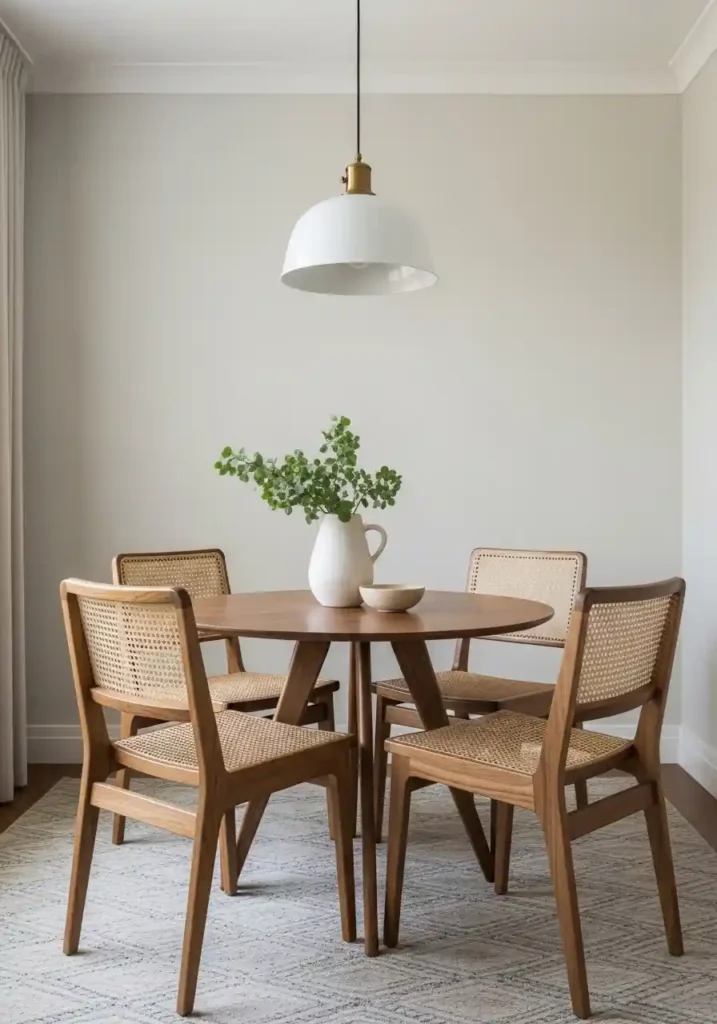
Cane-back dining chairs are the small dining room’s most visually intelligent seating choice after the fully transparent ghost chair — and for people who find the complete transparency of acrylic slightly too contemporary or slightly too clinical for their aesthetic, the woven cane back provides a beautiful, warm, organic alternative that achieves nearly the same spatial benefit through a different and arguably even more beautiful material expression. The open weave of cane creates visual transparency through the chair back — the eye sees through the chair to the wall behind it — and that transparency contributes to the room’s overall sense of openness and visual breathing space in a way that solid upholstered backs simply cannot.
Cane-back chairs also have the significant advantage of working beautifully across an unusually wide range of dining room aesthetics, from the most contemporary minimalist spaces to the warmest, most eclectic bohemian rooms, from Japandi-inspired spaces to mid-century modern dining rooms to coastal and farmhouse contexts. Their natural material warmth and their artisanal quality make them feel at home in virtually any room that values honest materials and genuine craft — which is to say, almost any beautifully designed dining room of any style. Pair them with a round walnut pedestal table for the most beautifully cohesive and most spatially generous small dining room arrangement available in the contemporary furniture market.
7. Nesting Tables as Flexible Side Serving Surfaces
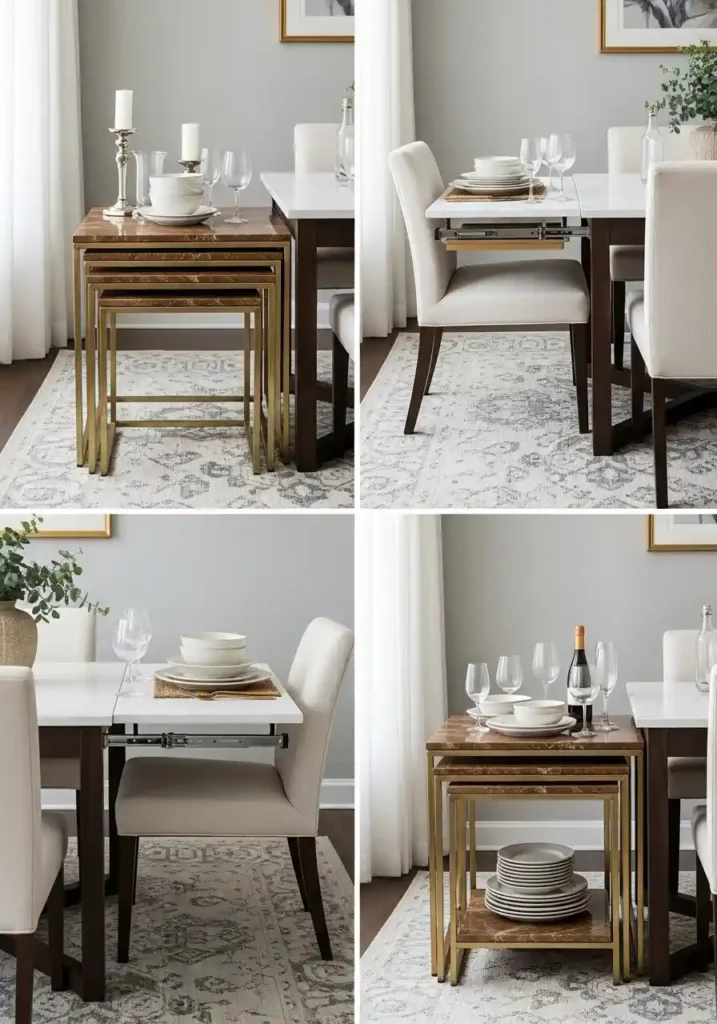
The small dining room’s greatest entertaining challenge is not the dining table itself — most compact dining tables can be extended or supplemented for occasional dinner parties — but the complete absence of any surface for serving dishes, drinks, and all the paraphernalia of a properly hosted meal that isn’t the dining table itself. A set of nesting side tables in a beautiful material combination — marble tops on brass legs, natural oak on black steel, glass on chrome — solves this challenge with total elegance, providing multiple additional serving surfaces that deploy instantly when needed and nest back into a beautifully compact, stylish footprint the moment the meal is over and the floor space is needed back.
Choosing nesting tables that are genuinely beautiful as a display object in their nested everyday configuration is as important as choosing ones that are functional in their deployed entertaining configuration — because in a small dining room, these tables are always visible and always contributing to the room’s aesthetic whether all three surfaces are in use or all three are stacked compactly together. A set of three round tables in warm travertine on slim brass legs looks like a genuinely considered piece of furniture sculpture in its nested form. A set in smoked glass on matte black hairpin legs creates a cool, contemporary effect. Choose tables whose largest piece is generous enough to genuinely serve as an extra serving surface, and the smaller pieces will find their own perfect, effortless uses.
8. Dark Grout Tile Floor for Graphic Impact
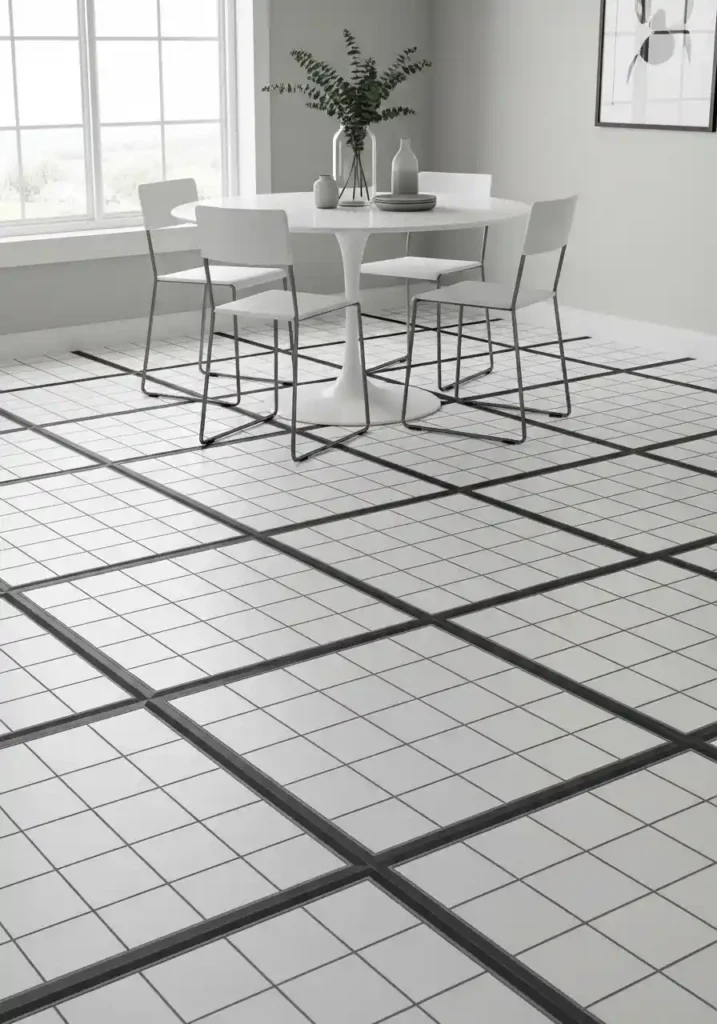
A large-format tile floor with dark, contrasting grout in a small dining room does something that plain, continuous flooring materials — hardwood, polished concrete, seamless resin — cannot achieve: it creates a graphic pattern at floor level that actively draws the eye across the floor surface in all directions simultaneously, creating a sense of visual movement and spatial depth that makes the floor appear larger and the room appear more expansive than a plain, undifferentiated floor surface of identical dimensions would suggest. The grid pattern of the grout lines creates a visual map of the floor that the eye follows outward toward the room’s edges, reinforcing the perception of floor area and spatial generosity.
The specific combination of large white or very pale tiles with dark charcoal or black grout is the version of this technique that creates the most dramatic and most spatially effective result — because the high contrast between the pale tile faces and the dark grout lines makes the grid pattern maximally visible and maximally impactful. Large-format tiles — thirty by thirty centimeters or larger — create a more sophisticated, more contemporary pattern than small mosaic tiles, with fewer grout lines that read as more architectural and less busy in a small room context. The graphic tile floor pairs beautifully with simple, slim furniture above it, allowing the floor pattern to be fully seen and fully appreciated as the design element it has been specifically chosen to be.
9. Pegboard or Slatted Wall Panel for Organized Display
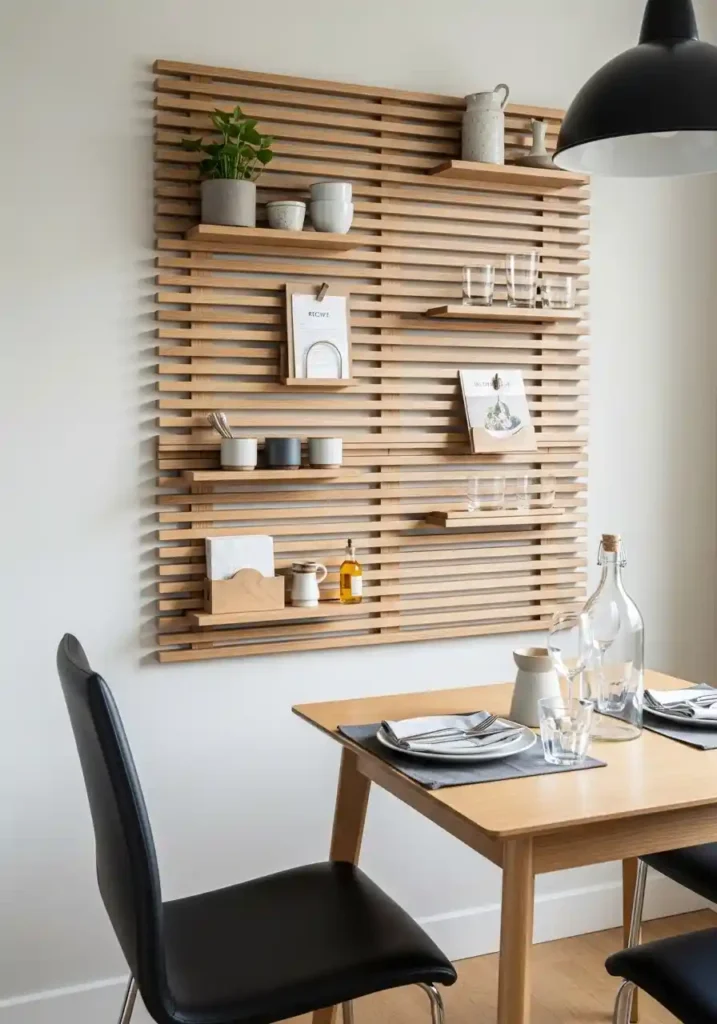
A slatted wall panel — a grid of horizontal wooden slats or a pegboard system finished in a beautiful material — in a small dining room is the organizational and display solution that the most design-forward, most spatially intelligent small dining rooms are embracing as an alternative to both closed cabinetry and conventional open shelving. The slatted system provides completely adjustable, completely flexible storage and display capacity that can be reconfigured as needs change, holds everything from slim shelves to hooks to small baskets to plate holders, and does all of this while looking like a genuinely beautiful, genuinely considered architectural wall feature rather than a storage system that was installed out of spatial necessity.
The material choice for a dining room slatted wall panel determines the aesthetic register it occupies in the room’s overall design story — and natural wood is consistently the most beautiful and most universally versatile choice. A panel of slim horizontal oak or walnut slats brings warmth, craft, and organic character to the dining room wall in a way that white pegboard or industrial metal systems cannot approach. Style the slats with the same editorial restraint that floating shelves require: a few carefully chosen ceramic objects, one small plant, essential dining accessories organized beautifully, and generous empty space between each grouping. The warmth of the natural wood combined with the clean organization of the display creates a wall of genuine beauty and genuine function simultaneously.
10. A Single Dramatic Floral Arrangement as the Table Hero
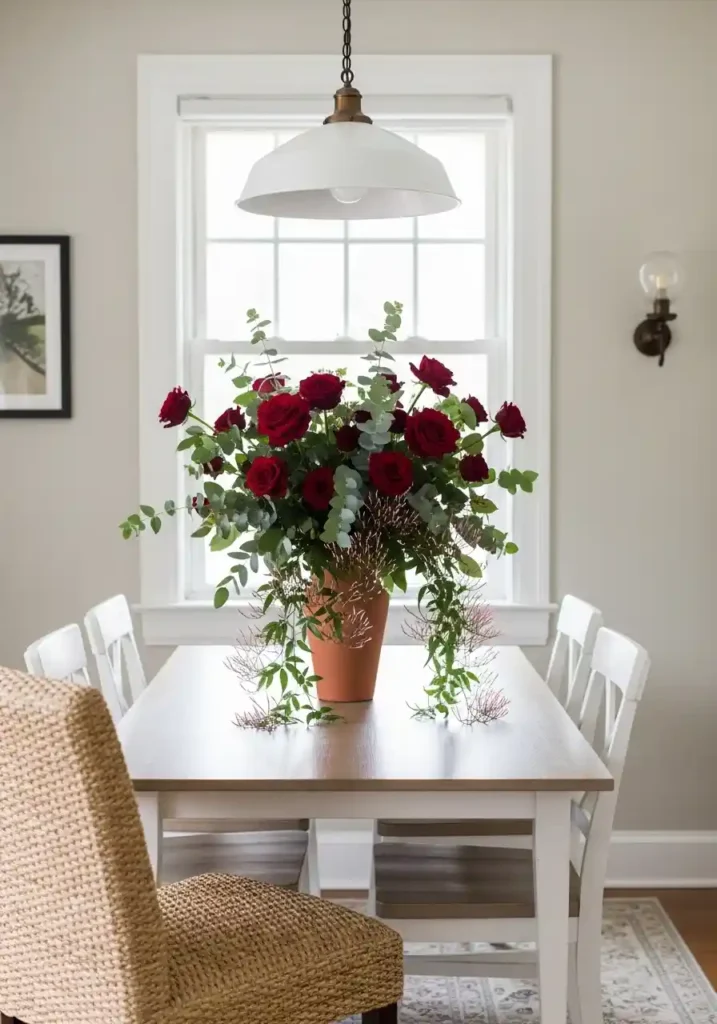
A genuinely beautiful, genuinely generous fresh floral arrangement on the dining table is the small dining room upgrade that delivers the most emotional impact, the most sensory richness, and the most immediate transformation of the room’s character and atmosphere of any decorating decision you can make — and it is the upgrade that requires the least commitment, the least installation, and the least permanent change to the room’s fabric while producing the most immediate and the most dramatically lovely result. A proper flower arrangement — not a single stem in a bud vase but a genuinely generous gathering of complementary flowers at a scale appropriate to the table — changes the entire quality of a dining room with a directness and completeness that is genuinely difficult to replicate through any other means.
The art of a dining room floral arrangement that is both beautiful and spatially appropriate for a small room is entirely about scale and proportion — choosing an arrangement generous enough to feel genuinely impressive and genuinely celebratory while keeping it compact enough in footprint and low enough in height that it doesn’t overwhelm the table surface or block the sightlines across the table that make conversation easy and pleasurable. A wide, low arrangement in a shallow bowl or a generously filled short vase achieves this balance beautifully — maximizing the visual impact of the flowers while maintaining the open, unobstructed quality of the table surface and the unimpeded sight lines between every diner. Change the flowers weekly and the room feels constantly fresh, constantly alive, and constantly beautiful.
11. Concealed Under-Stair Dining Nook for Awkward Spaces
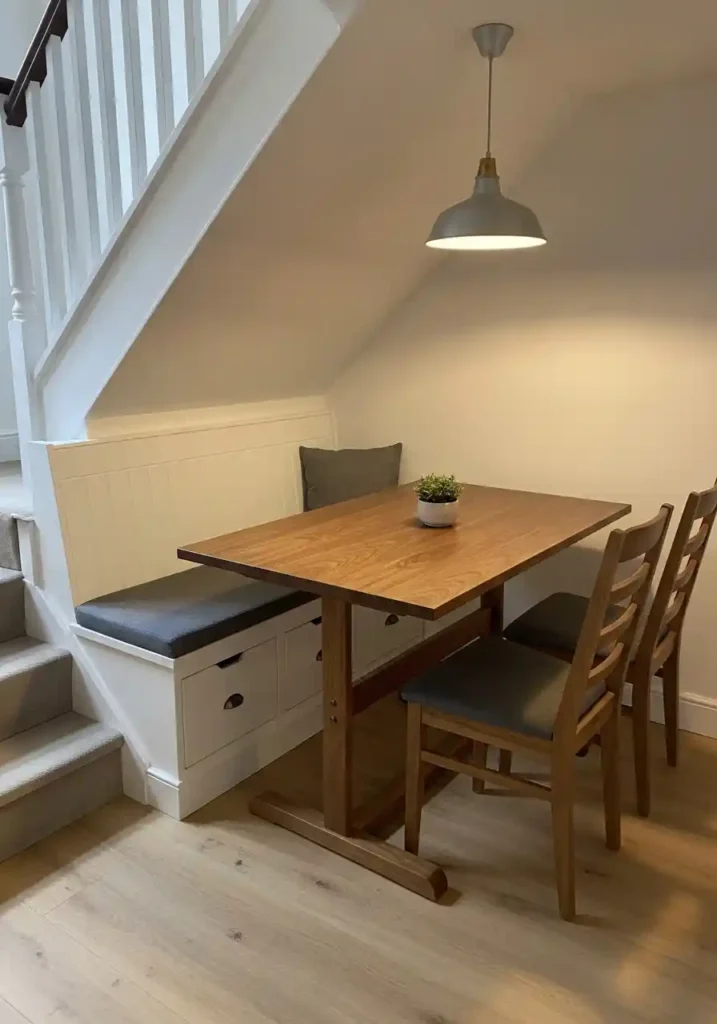
The space beneath a staircase in a home where the dining room or kitchen-dining area shares this architectural feature is one of the most commonly squandered spatial opportunities in domestic design — typically used for shoe storage, cleaning equipment, or simply left as unused dead space when it could be transformed, with relatively modest investment and genuine design intelligence, into the most charming, most intimate, and most characterful dining nook in the entire home. The under-stair alcove has natural walls on three sides, a sloping ceiling that creates a cozy, cave-like enclosure, and a specific, bounded footprint that makes it perfectly suited to a built-in dining arrangement of intimate scale.
Building a dining nook into the under-stair space requires working with the specific geometry of the stair structure — the angled ceiling, the available floor footprint, and the existing wall surfaces — to create a custom seating arrangement that uses every available inch with intelligence and beauty. Custom bench seating built along the back wall with storage drawers fitted into the stair risers provides seating, storage, and spatial efficiency in a single integrated piece of carpentry. A compact table sized specifically for the available footprint fits the nook perfectly. Two dining chairs on the open front side complete the arrangement. A pendant light or recessed LED lighting within the under-stair space creates warm, intimate illumination that makes this the room’s most beloved dining destination.
12. Matching Furniture to Wall Color for Seamless Boundaries
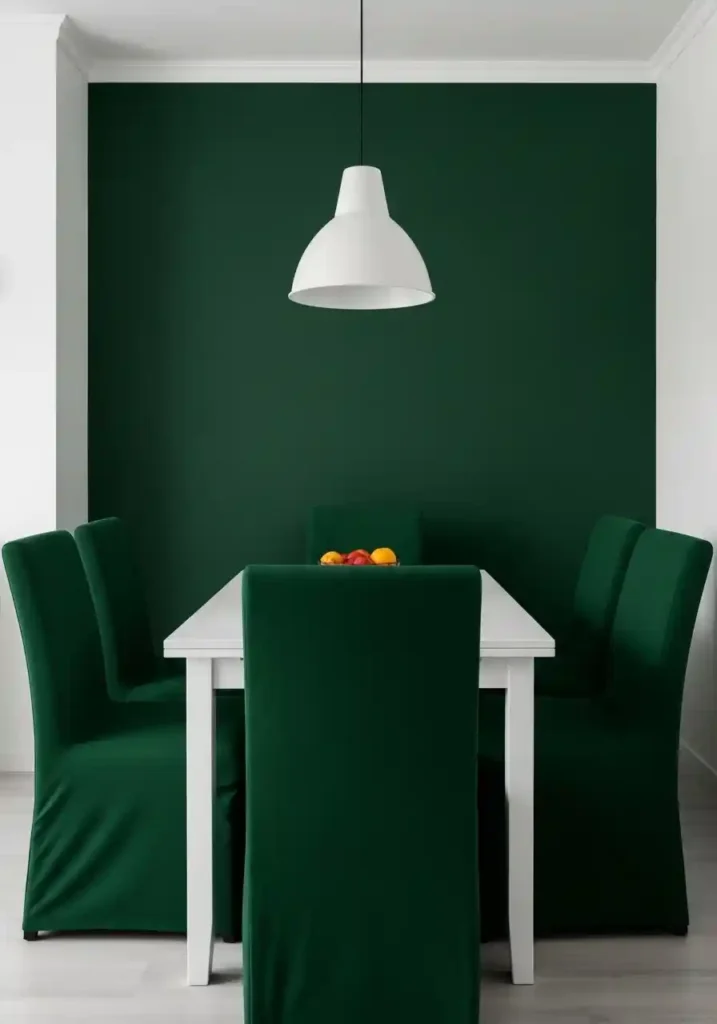
When dining chairs are upholstered in the exact same color as the walls behind them, something visually remarkable and spatially beneficial happens — the chairs partially dissolve into the wall, losing their status as distinct, space-consuming objects and becoming part of the room’s continuous colored envelope. The eye reads the chairs not as separate furniture pieces occupying floor area in front of a wall but as extensions of the wall itself, and the room feels more open, more spacious, and more seamlessly designed as a direct result of that visual merger between furniture upholstery and wall color. It is the spatial equivalent of the chair learning to become part of the room rather than a guest within it.
This technique — matching upholstery precisely to wall color to create furniture that visually merges with its backdrop — works most powerfully with deeper, more saturated wall colors rather than pale neutrals, because the stronger the color match and the more visually distinctive the shared color is, the more completely the chairs disappear into the wall and the more dramatically the spatial benefit registers. Deep forest green chairs against forest green walls. Midnight navy chairs against midnight navy walls. Rich terracotta chairs against terracotta walls. The white dining table at the center of this color-merging arrangement becomes the room’s sole visual focal point, floating in a sea of unified color with a clarity and a visual authority that makes the small dining room feel not just spacious but genuinely, magnificently designed.
13. A Window Seat That Doubles as Dining Seating
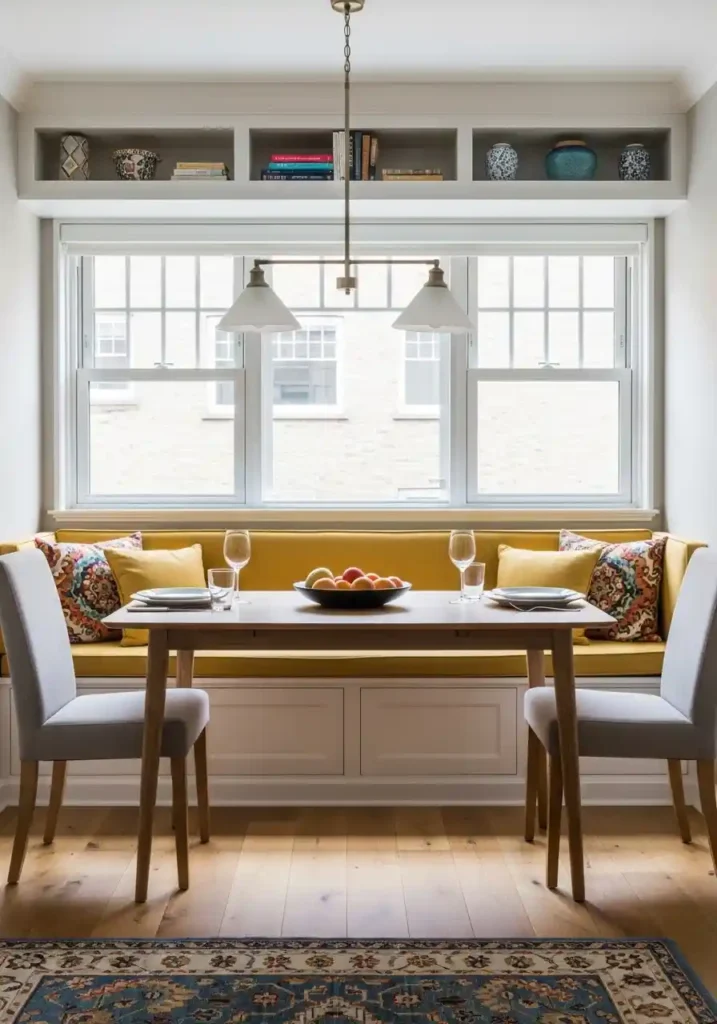
A built-in window seat used as one side of the dining arrangement is the small dining room feature that transforms a potentially awkward, underutilized architectural element — the window and the wall space beneath it — into the room’s most beloved and most practically intelligent design decision. The window seat provides dining seating for two or three people in the position of maximum natural light in the entire room, creating the most pleasant, most bright, and most visually connected-to-the-outdoors dining experience that the space can offer. And because the wall is directly behind the seat, it requires zero chair-pullout clearance on that side of the table, saving valuable floor circulation space that the small room can redirect toward a greater feeling of openness and ease.
The hidden storage beneath the window seat cushion is the practical bonus that transforms this feature from a beautiful luxury into a genuinely essential small dining room element — because lift-up storage in the seat base provides a concealed compartment large enough for table linens, seasonal tableware, children’s art supplies, or any of the many things that small dining rooms need to store and almost never have adequate built-in storage to accommodate. Upholster the seat in a beautiful, durable fabric that complements the dining room’s palette and add three or four generous throw cushions for back support and tactile warmth. This window seat will be the seat everyone wants at every meal, every time.
14. Limewash Texture That Adds Depth Without Pattern
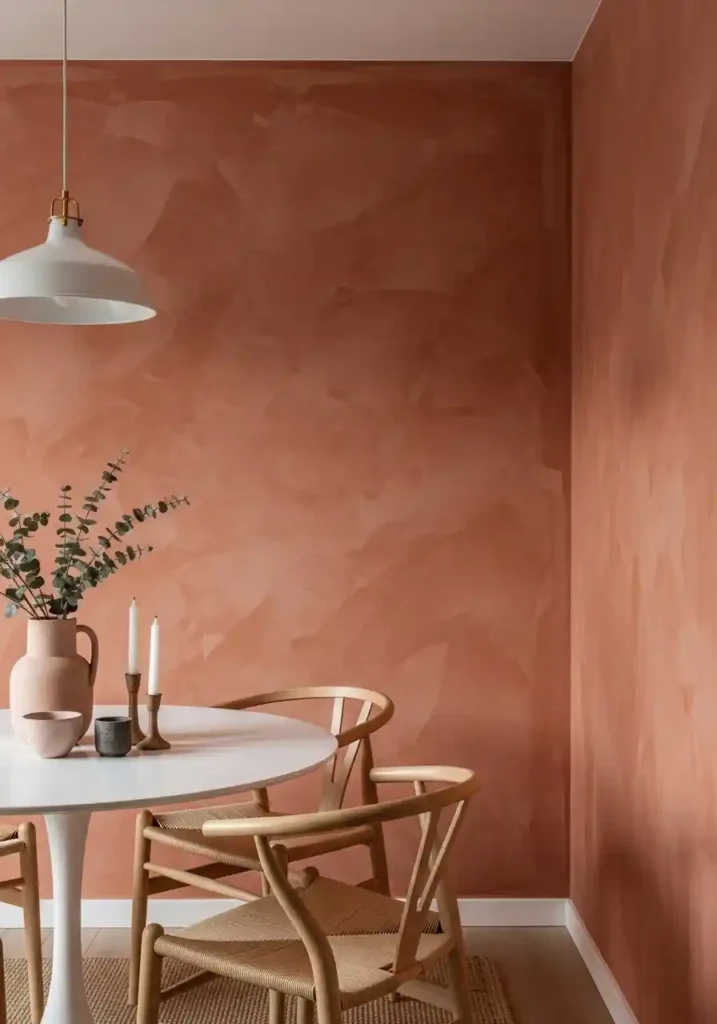
Limewash wall finish in a small dining room is the wall treatment that delivers the most beautiful return on the simplest possible investment — a paint technique that creates an organic, textured surface with a quality of depth and visual interest that flat paint, however perfectly applied and however carefully chosen in color, can never quite replicate. Limewash creates a surface that catches light in subtly different ways at different points across the wall, producing gentle variations in tone that give the wall a living, organic quality — it looks slightly different in morning light than in afternoon light, slightly different in candlelight than in overhead electric light, and that constant, subtle variation makes the room feel more interesting and more alive than static, uniform painted walls.
The specific quality that makes limewash most spatially beneficial in a small dining room — beyond its obvious aesthetic beauty — is the way its slightly matte, softly textured surface absorbs light rather than reflecting it harshly, creating a wall with a warmth and a depth that makes the room feel more enveloping and more genuinely intimate than a flat, bright-white or brightly colored smooth surface would. Warm terracotta limewash creates the most spectacularly beautiful and most instantly inviting small dining room atmosphere — the organic orange-brown of the terracotta tone combined with the texture of the limewash creates a wall that feels ancient, artisanal, and deeply, genuinely beautiful in a way that no manufactured finish can approach. Layer in natural wood furniture and handmade ceramic tableware and the room becomes something truly extraordinary.
15. Continuous Flooring That Flows Into Adjacent Spaces
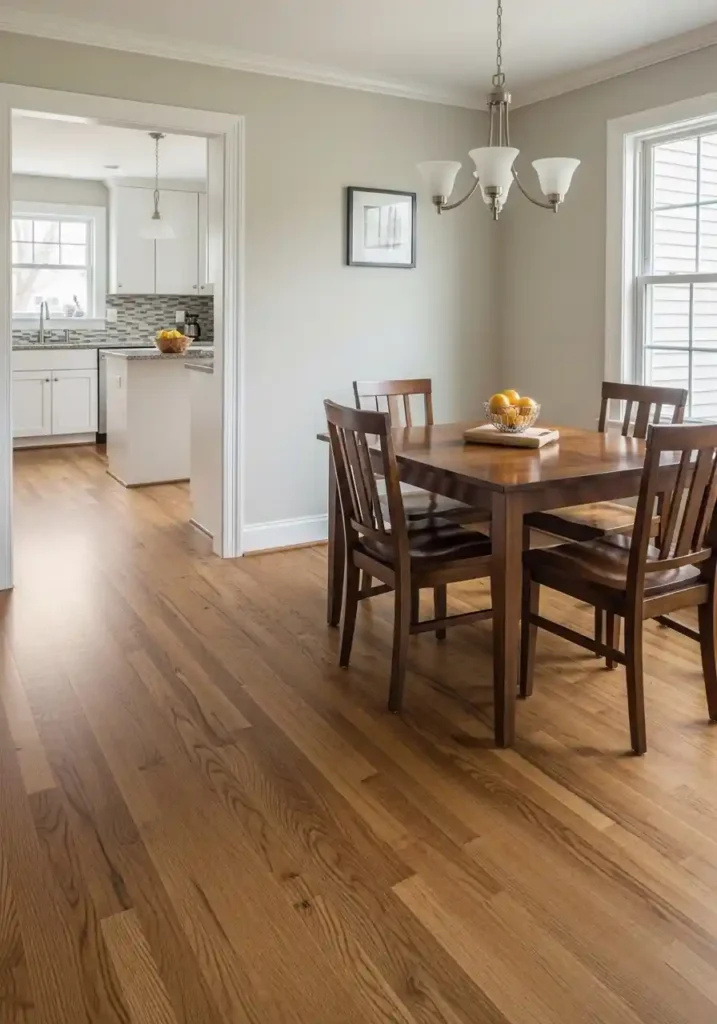
Continuous flooring — the same material, the same finish, the same color, and the same laying direction running without interruption from your small dining room into every adjacent space visible through open doorways — is the most powerful free spatial upgrade available to anyone planning a floor renovation or starting from scratch in a new home. When the dining room floor visually connects to the hallway floor, the kitchen floor, and the living room floor without any transition strip, threshold, or material change interrupting the visual flow, the dining room appears to exist within a much larger spatial whole rather than as a self-contained small room with defined and limiting edges. The eye borrows the visual space of the connecting rooms and the dining room feels genuinely larger as a result.
The specific flooring material and color that creates the most powerful continuous flow effect is one that is light to medium in tone and visually warm — because light-toned floors reflect light and read as generously spatial, while warm undertones create the feeling of genuine comfort and organic richness that makes the connected spaces feel inviting rather than merely efficient. Wide-plank oak hardwood in a warm, natural finish is the gold standard for this approach — its width creates fewer visual seams than narrow planks, its warm tone creates genuine comfort, and its natural wood character makes every space it inhabits feel beautifully grounded in organic material reality. Lay it in the same direction throughout every connecting space and the spatial flow becomes truly seamless and genuinely extraordinary.
16. A Botanical Print Gallery That Brings the Garden Inside
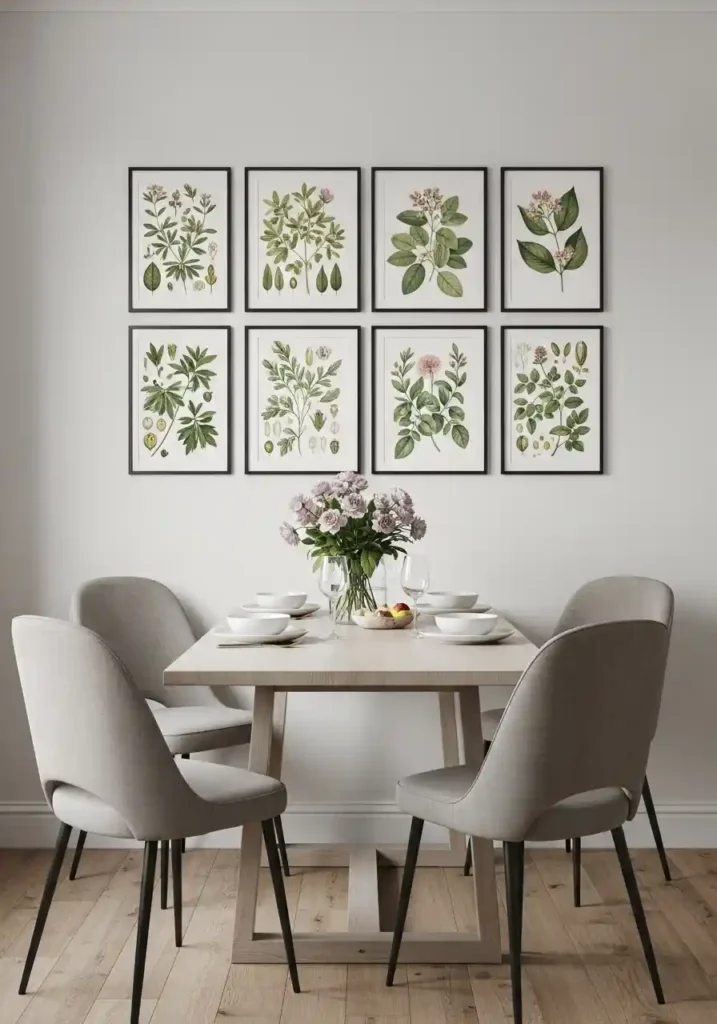
A botanical print gallery wall in a small dining room is the focal point that makes the most natural, most beautiful, and most thematically appropriate connection between the act of eating and the natural world that provides everything we eat — and in a room specifically dedicated to the pleasures of food and shared meals, that connection feels genuinely, meaningfully right in a way that abstract art or purely decorative prints cannot quite replicate. Botanical illustrations have been objects of genuine beauty and genuine scientific reverence since the Renaissance, and their combination of exquisite artistry and natural subject matter makes them the most universally beloved artwork choice for dining room walls across every possible interior design style and personal aesthetic.
A grid of matching botanical prints — same frame color, same mat width, same print size, precisely and evenly spaced — creates a gallery wall composition of such calm, organized elegance that it makes the small dining room feel more structured, more architecturally considered, and more thoughtfully designed than an informal, mixed-frame gallery arrangement could achieve in the same compact space. The grid format suits small dining rooms particularly well because its visual order and its geometric precision contribute to the sense of calm and spacious control that compact spaces benefit from, rather than adding the visual complexity and apparent busyness that mixed-size, mixed-frame gallery arrangements can introduce in rooms that have limited capacity for visual noise.
17. A Statement Ceiling Rose and Decorative Cornice
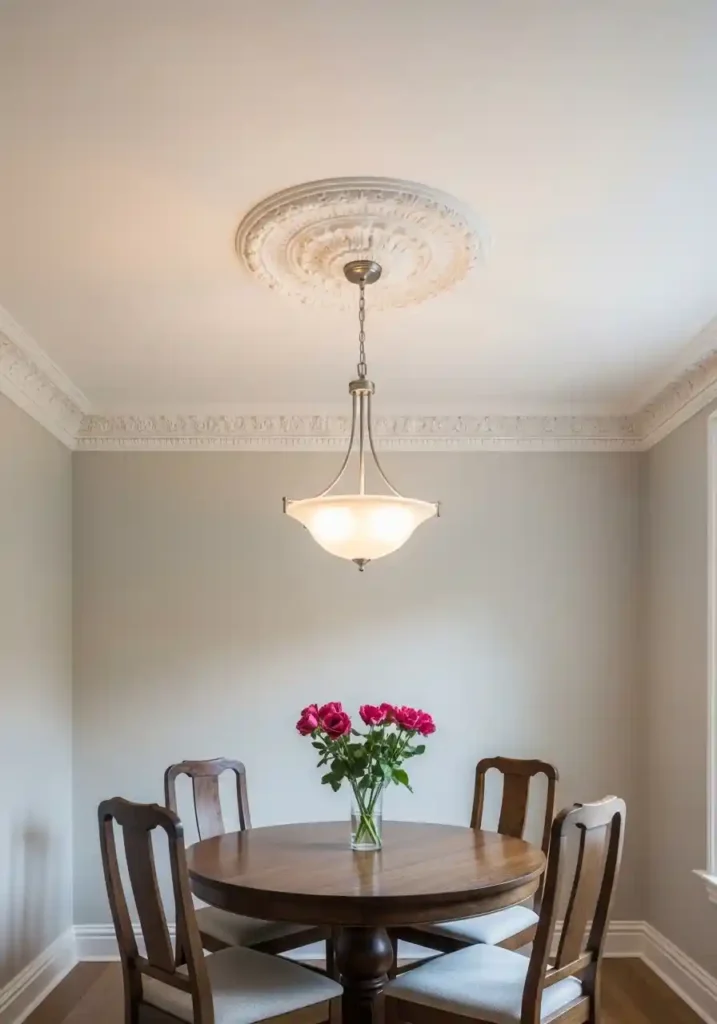
A ceiling rose and decorative cornice in a small dining room are the architectural details that do more to make a compact room feel genuinely, architecturally significant than almost any other decorating intervention available — because they add to the room’s permanent architectural fabric rather than simply decorating its surfaces, and the result is a room that feels like it was designed by an architect who cared about every surface from floor to ceiling rather than a room that was merely furnished and decorated after the fact. These details cost relatively little relative to their transformative impact, and modern lightweight polyurethane versions can be installed without professional plastering skills in an afternoon.
The ceiling rose at the center of a small dining room performs two functions simultaneously — it provides the architecturally correct and visually beautiful mounting point for a pendant light, and it creates a focal point on the ceiling plane that draws the eye upward and makes the ceiling itself feel like an intentional, considered architectural surface rather than a blank, ignored plane overhead. The decorative cornice running around the full perimeter reinforces this architectural intention by creating a clean, considered transition between wall and ceiling that adds visual height to the room rather than simply marking where one surface ends and another begins. Together, these two details transform a plain small dining room into a room of genuine architectural distinction.
18. Warm Timber Paneling on the Feature Wall
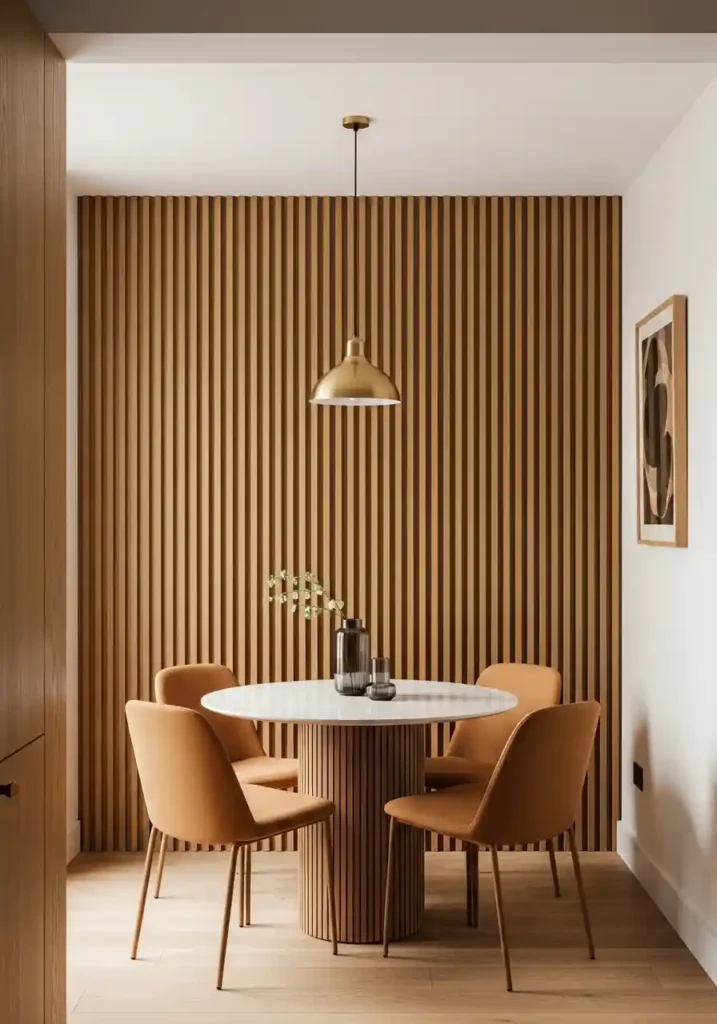
Vertical timber wall paneling on the feature wall of a small dining room delivers a combination of warmth, texture, and architectural richness that is genuinely difficult to achieve with any other wall treatment at any price point — because natural wood in a domestic interior creates an instinctive, almost primal sense of warmth and organic connection that manufactured materials, however skillfully produced and however beautifully finished, can never fully replicate. A wall of vertical timber strips in warm honey oak or pale ash creates a surface of such material beauty, such tactile richness, and such strong vertical emphasis that it transforms the entire character and atmosphere of a small dining room in a way that justifies every moment of its installation effort.
The vertical orientation of timber paneling strips is the specific design decision that makes this wall treatment most spatially beneficial in a small dining room — because vertical lines, like vertical stripes on a wallpaper, draw the eye upward along the wall surface and create the illusion of greater ceiling height that compact rooms consistently benefit from. The natural variation in grain and color between individual timber strips creates a gentle, organic pattern that adds visual interest without the deliberateness and potential visual busyness of a printed or painted pattern. Choose a timber in a warm, light to medium tone — honey oak, pale ash, natural pine — rather than a dark, heavily stained wood that would absorb light and make the small room feel heavy and enclosed.
19. Folding Partition Screen as a Decorative Zone Divider
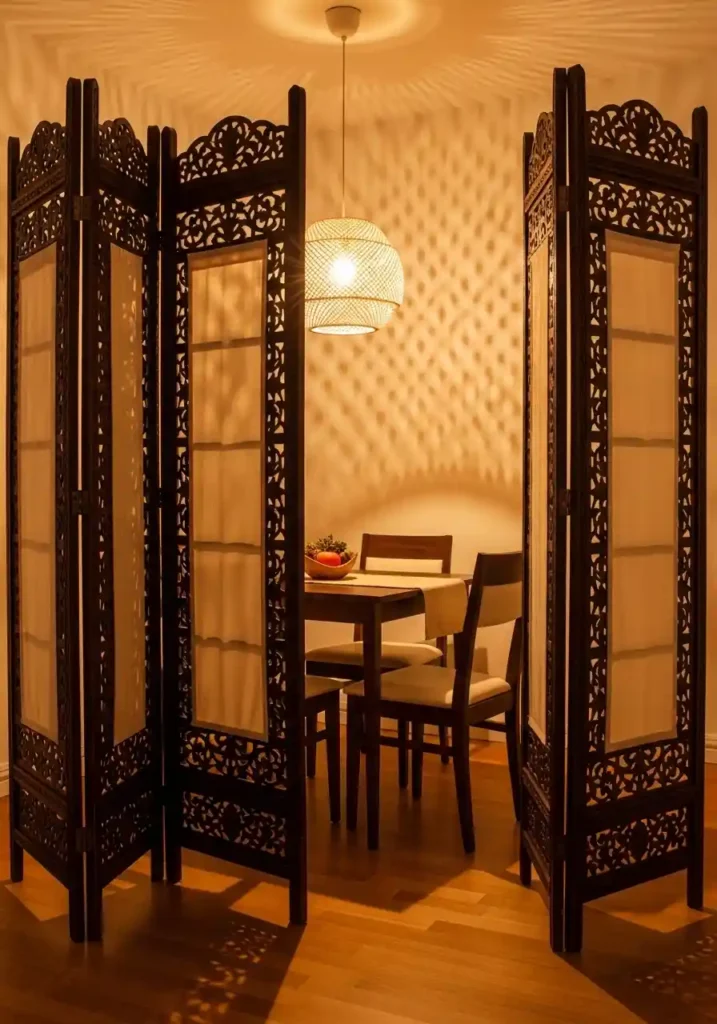
A decorative folding partition screen in a small dining room that shares its space with an adjacent living area, entrance hallway, or kitchen is the most flexible, most beautiful, and most completely reversible zone-definition tool available — because it creates a genuine sense of dining room enclosure and intimate atmosphere through physical presence and genuine visual screening, without requiring any permanent construction, any structural modification, or any commitment beyond the screen’s purchase and its positioning in the room. A beautiful folding screen creates a dining zone with real spatial definition and real atmospheric distinction that a rug, a pendant light, or a paint color change, for all their considerable spatial value, cannot quite match in terms of physical presence and genuine enclosure.
The folding screen’s decorative contribution to the room’s aesthetic is as significant as its zone-defining spatial contribution — and choosing one of genuine beauty rather than purely practical function is the decision that makes this piece a design asset rather than merely a functional solution. A carved dark wood frame with stretched ivory fabric panels creates shadow patterns of extraordinary beauty in warm candlelight. A Japanese-inspired lacquered screen in deep indigo with gold leaf detailing brings cultural richness and genuine artistic quality. A minimal, contemporary screen in natural oak with frosted glass panels achieves clean architectural zone definition with a sophisticated, contemporary restraint. Any screen of genuine beauty makes the small dining zone feel both more spacious in its definition and more special in its atmosphere.
20. Herb Garden on the Wall for Beauty and Function
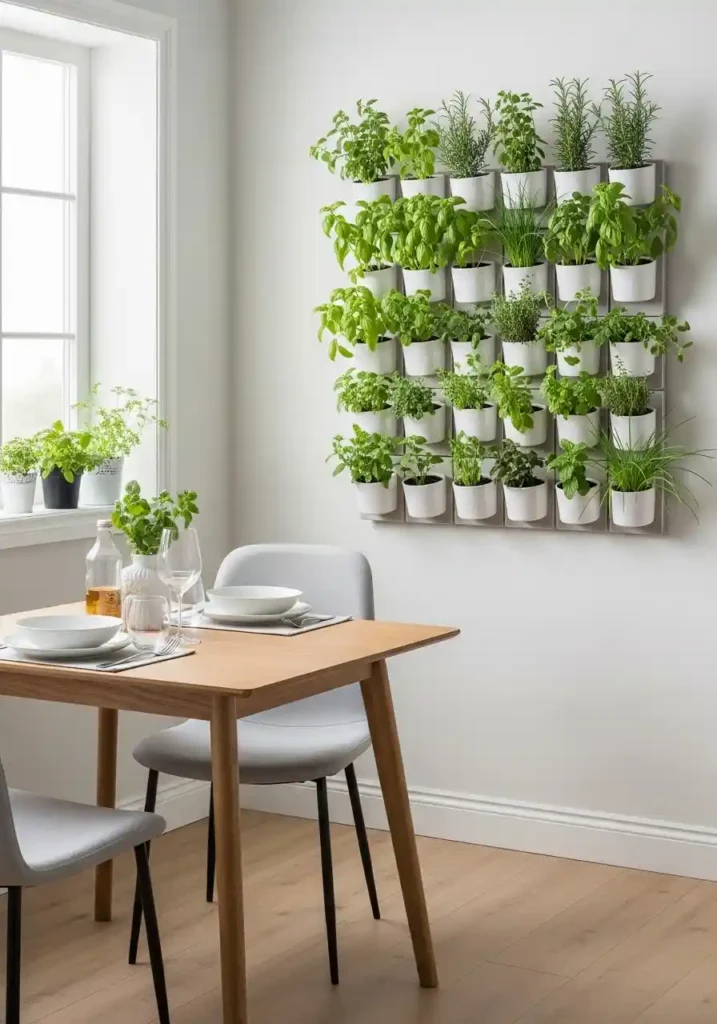
A living herb wall in a small dining room is the wall treatment that is simultaneously the most beautiful, the most practical, the most fragrant, and the most genuinely extraordinary thing you can do to a dining room wall — because it turns a flat, static surface into a living, growing, constantly changing and constantly giving presence that improves the room in every possible dimension at once. Fresh herbs on the dining room wall mean that every meal can include something picked directly from the wall inches from the table. The green, lush, fragrant life of growing herbs makes the room feel like a beautiful indoor garden rather than a simply decorated interior space. And the visual impact of a grid of green-filled ceramic pots against a white wall is genuinely, photographically stunning.
The practical installation of a herb wall in a dining room requires consideration of light availability — herbs need good indirect natural light to thrive, and a dining room with a well-positioned window can support a thriving herb wall beautifully — and an irrigation approach that keeps the herbs well-watered without requiring daily individual pot watering that becomes a chore rather than a pleasure. Self-watering modular pot systems designed specifically for wall mounting solve the irrigation challenge elegantly, providing a reservoir that waters the herbs gradually over several days. Choose herbs that thrive in indoor conditions with moderate light: basil, thyme, rosemary, mint, and chives are all beautiful, fragrant, and culinarily useful choices that together create a herb wall of genuine abundance and genuine beauty.
21. A Jewel-Toned Centerpiece That Commands the Table
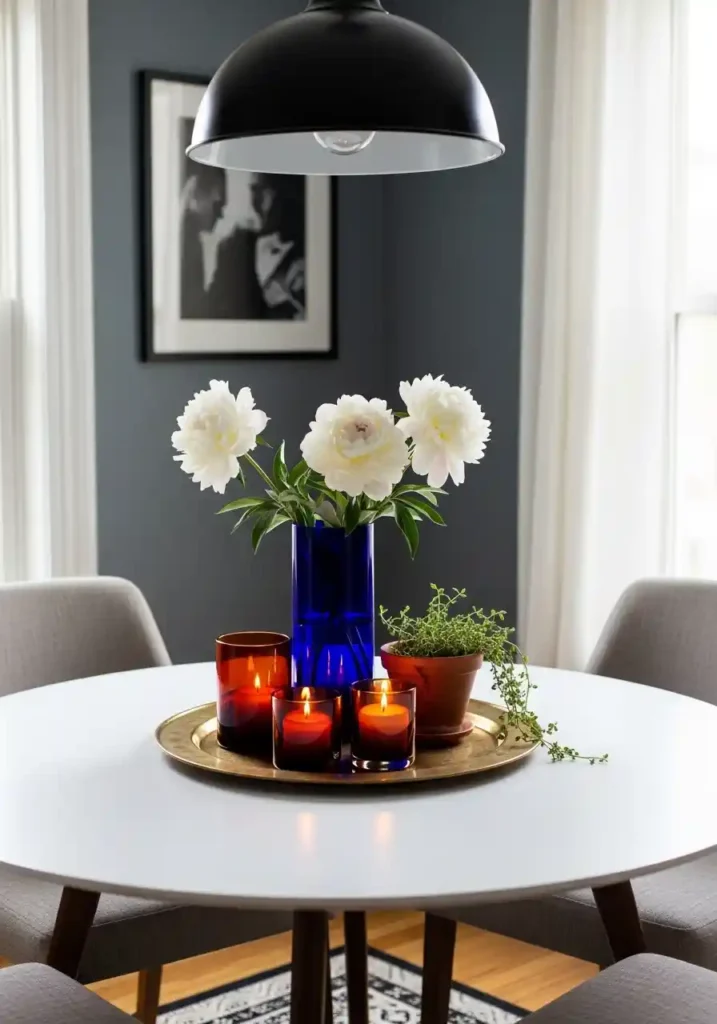
The dining table centerpiece in a small dining room carries a design responsibility that goes beyond mere decoration — it is the visual heart of the entire space, the first thing every eye finds when entering the room, the element that sets the tone for every meal and every gathering that takes place within the room’s walls. In a small dining room where the table is always the dominant furniture piece and always the room’s primary visual focal point, a centerpiece of genuine beauty and genuine impact does more for the room’s overall perceived quality, richness, and design distinction than almost any other single decorating decision. The right centerpiece makes a small dining room feel genuinely extraordinary.
The jewel-toned centerpiece approach — combining deep cobalt blue, rich amber, warm terracotta, and emerald green in a carefully composed arrangement of glass vessels, ceramic pots, and candleholders on an aged brass tray — creates a focal point of such concentrated material richness and such warm, saturated color that the entire small dining room takes on a quality of jewellike beauty and atmospheric warmth that radiates outward from the table to every corner and surface of the space. The tray is essential — it corrals all the individual elements of the arrangement into a single, unified composition that reads as a deliberate, considered design statement rather than a collection of random objects placed together on the table. Change the flowers, rotate the candles, add seasonal botanicals, and the centerpiece evolves beautifully through the year.
22. The Complete Picture — Every Idea Working in Beautiful Harmony
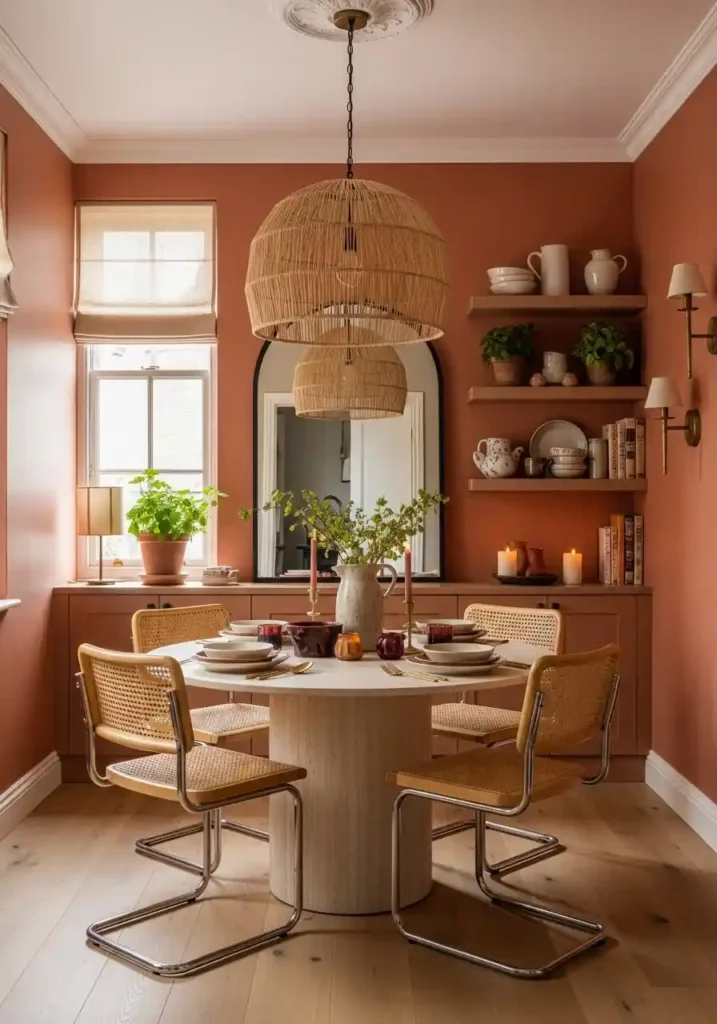
The small dining room that truly, convincingly, and permanently feels spacious is the beautiful result not of one clever single idea or one dramatic intervention but of multiple intelligent, complementary decisions that each contribute their specific benefit to the whole while amplifying and supporting every other decision around them. The limewash texture that adds depth without pattern. The round pedestal table that improves flow. The cane chairs that contribute visual transparency. The large mirror that doubles the light. The floating shelves that free the floor. The layered sconce lighting that creates atmospheric depth. The continuous flooring that borrows visual space from adjacent rooms. Each idea is genuinely valuable independently; together, they create something extraordinary.
The most important and most liberating thing this guide leaves you with is the understanding that transforming a small dining room into a space that feels genuinely spacious is not a project that requires a large budget, a structural renovation, or a complete furniture replacement. It requires clear thinking, confident choices, and the willingness to commit fully to the ideas that will make the greatest difference in your specific room. Start with one idea — the one that excites you most, that feels most immediately achievable, that addresses the specific spacial challenge your dining room presents most directly. Build from there, one beautiful decision at a time. Your spacious small dining room is not a fantasy — it is simply the next chapter of the room you already have.
Conclusion:
A small dining room doesn’t have to feel cramped or limiting. With the right design choices—like smart furniture placement, light color palettes, mirrors, multifunctional pieces, and clever storage—you can transform even the most compact dining area into a space that feels open, stylish, and welcoming. These 22 small dining room décor ideas prove that thoughtful design can maximize both space and functionality without sacrificing beauty.
Whether you choose a minimalist approach, incorporate vertical storage, or add statement lighting, each idea helps create the illusion of a larger, brighter dining space. By blending practicality with creativity, you can design a dining room that feels comfortable for everyday meals and inviting enough for entertaining guests.
Ultimately, decorating a small dining area is all about making intentional choices. With the right small dining room design tips, space-saving furniture, and décor strategies, you can turn even the tiniest dining space into a stylish and functional centerpiece of your home.