1. Two-Tone Cabinets That Add Depth Without Adding Space
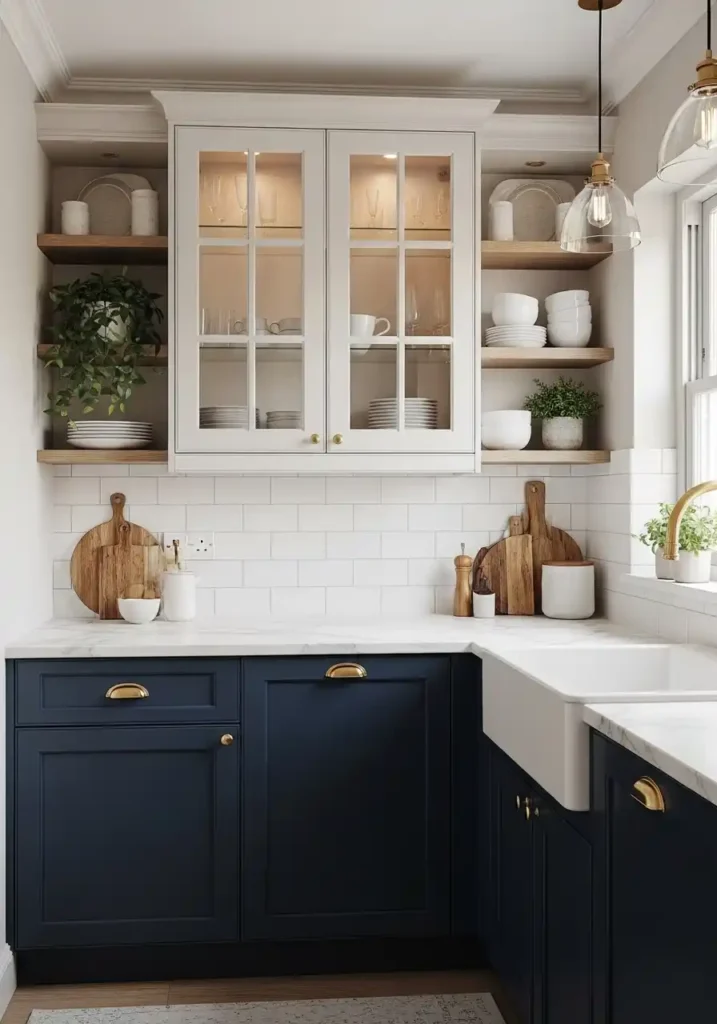
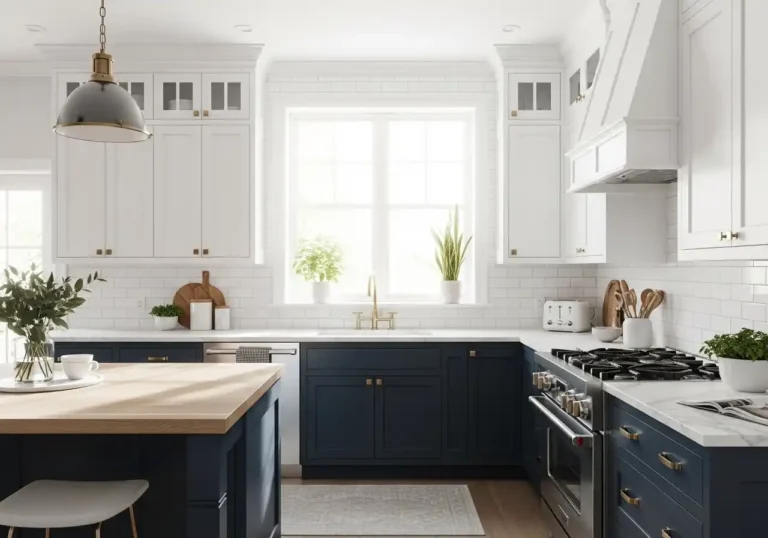
Two-tone cabinets in aKitchen Ideas for Small Spaces deliver the most significant visual transformation of any cabinet treatment available — not by making the kitchen larger but by making it dramatically more interesting, more designed, and more genuinely beautiful than a single-color cabinet scheme could achieve in the same footprint. The lower cabinets in a deeper, richer tone visually ground the kitchen and create a strong base of color that anchors the entire design, while the upper cabinets in a lighter tone keep the wall plane above the counter feeling open, bright, and airy. Together, the two tones create a visual layering and a sense of designed intention that makes the small kitchen feel like the work of genuine design intelligence rather than a basic functional installation.
The specific color pairing that consistently creates the most beautiful and most spatially successful two-tone small kitchen is a deep, saturated lower cabinet color combined with a clean, warm upper cabinet tone — deep navy with warm white, forest green with cream, charcoal with soft sage, or rich burgundy with pale ivory. The contrast between the tones creates a horizon line at counter level that visually separates the kitchen into two distinct zones, making each zone feel more purposeful and more clearly defined than a single color that runs uniformly from floor to ceiling. Brass or brushed gold hardware on both tones ties the two halves together with a warm metallic thread that unifies the composition into a single, cohesive, genuinely beautiful kitchen design.
2. Open Shelving That Makes a Small Kitchen Feel Bigger
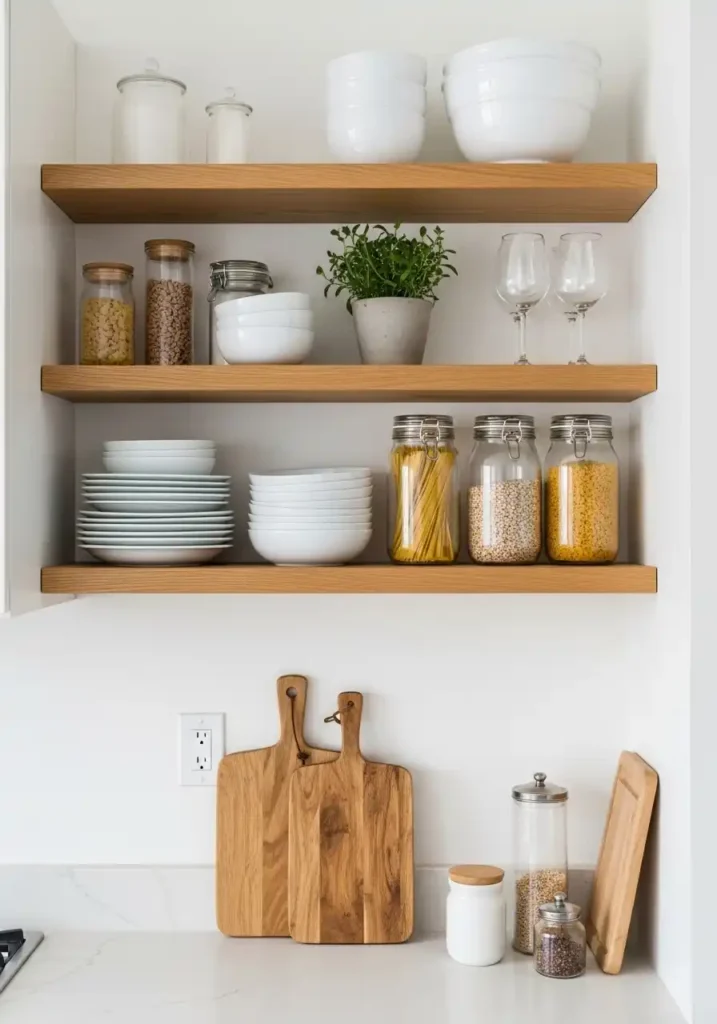
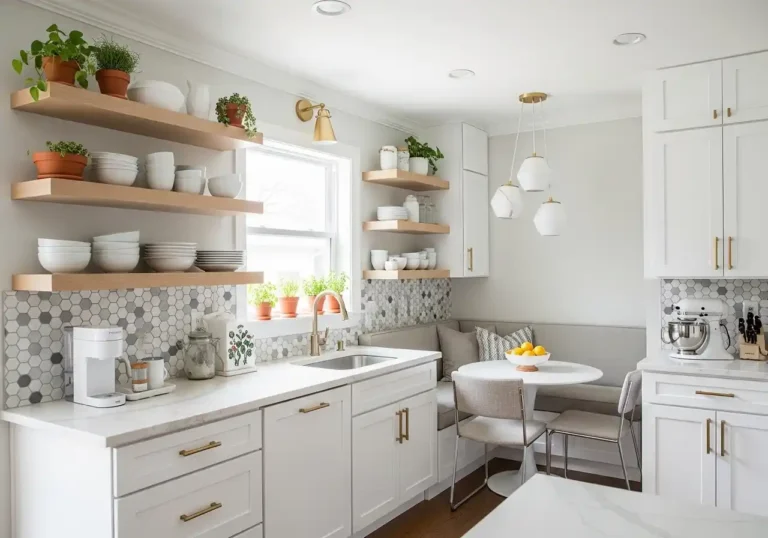
Replacing closed upper cabinets with open floating shelves in a small kitchen is the single renovation decision that delivers the most immediate, the most dramatic, and the most completely convincing improvement in the kitchen’s perceived spaciousness — because closed upper cabinet doors create a solid wall of visual mass that the eye reads as a heavy, space-consuming barrier, while open shelves allow the wall behind them to be seen around and between every displayed object, maintaining the kitchen’s sense of visual openness and spatial breathing room in a way that no closed cabinet door, however beautifully finished, can replicate. The kitchen with open shelves always feels more generous than the same kitchen with upper cabinets.
The practical reality of open kitchen shelving — that everything stored on them is always visible and must therefore always be beautiful, organized, and intentionally chosen — is not a disadvantage but a discipline that consistently produces kitchens of superior aesthetic quality to those with closed upper storage. When every plate, every glass, every jar, and every kitchen essential must earn its visible place on an open shelf, the kitchen naturally accumulates only objects of genuine beauty and genuine daily use, eliminating the clutter of rarely-used items that closed cabinets tend to accumulate over years of convenience. Choose beautiful ceramics, clear glass storage jars, and wooden accessories for your open shelves and the resulting display will be both genuinely functional and genuinely beautiful.
3. A Bold Backsplash That Does the Decorating for You
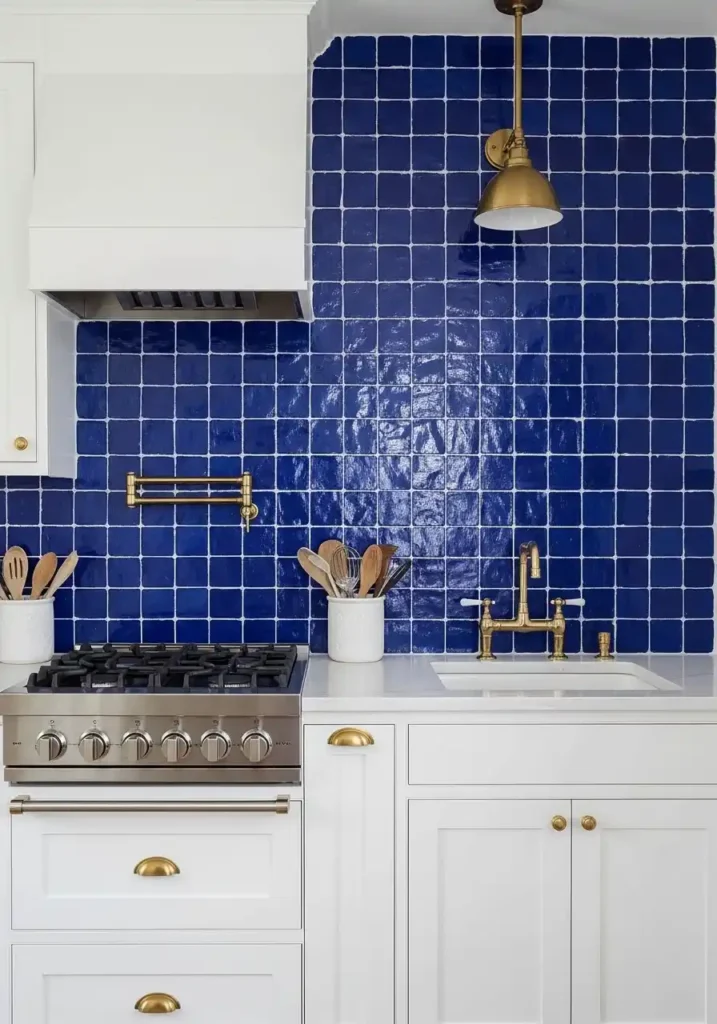
A bold backsplash in a small kitchen is the decorating decision with the highest impact-to-effort ratio of any design choice available in the compact kitchen — because the backsplash area between the counter and the upper cabinets is the kitchen’s most consistently visible and most prominently displayed wall surface, always in the direct line of sight from the kitchen’s working position and from the adjacent living or dining area, and a backsplash of genuine visual drama and genuine material beauty transforms the entire kitchen’s character instantly and completely without requiring any cabinet change, any layout revision, or any structural modification whatsoever. One beautiful backsplash can make an ordinary small kitchen extraordinary.
Handmade zellige tiles in a rich, deep color are the backsplash choice that creates the most spectacularly beautiful result in a small kitchen — because the irregular surface variation of genuine handmade zellige tiles, each one slightly different from every other in its glaze depth, its texture, and its subtle color variation, creates a shimmering, living wall surface of such organic richness and such genuine artisanal beauty that it looks completely different in morning light than it does in evening artificial light, always finding new depths of color and new qualities of surface shimmer to reveal. Plain white cabinets and a simple white countertop create the perfect neutral backdrop that allows a deep cobalt, forest green, or burnt terracotta zellige backsplash to be the complete and magnificent star of the entire kitchen.
4. A Kitchen Island on Wheels for Ultimate Flexibility
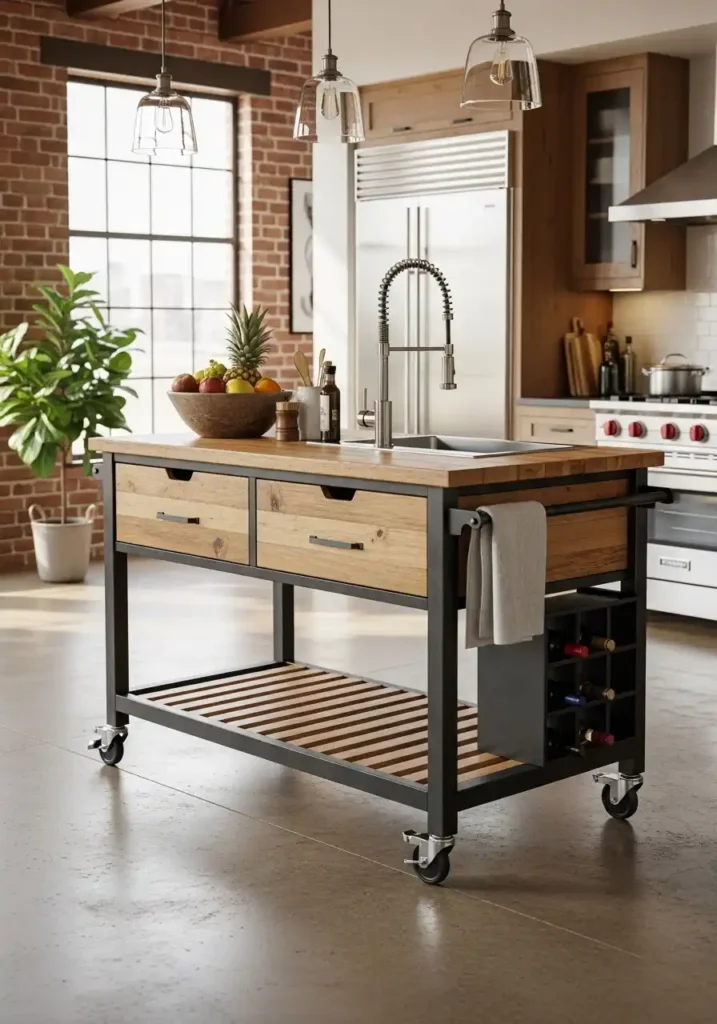
A kitchen island on wheels — a freestanding island with proper lockable casters that allow it to be repositioned anywhere in the kitchen as the task at hand requires — is the small kitchen’s most versatile and most liberating furniture investment, because it delivers all the counter space, storage, and preparation surface benefits of a fixed island while adding a flexibility that the small kitchen desperately needs and that a fixed installation, however well-designed, can never provide. Roll it to the center of the kitchen for meal preparation. Push it against the wall for a dinner party. Position it beside the stove for a cooking marathon. The rolling island serves the kitchen’s changing needs with equal ease and equal efficiency in every configuration.
The design of a rolling kitchen island in a small kitchen should be approached with the same aesthetic seriousness and the same quality standards as any permanent kitchen furniture — because despite its mobility, the rolling island is always a prominent, visible element of the kitchen and always contributing to or detracting from the kitchen’s overall design quality. A beautifully painted base in a rich, unexpected color — forest green, midnight navy, warm terracotta, or deep burgundy — with a warm butcher block or marble top creates an island of genuine character and genuine visual impact that makes the small kitchen feel more designed and more considered than a plain, utilitarian rolling cart could ever achieve. Hooks on the sides for hanging utensils and open shelves beneath for cookbooks and baskets add the practical layers that make the island genuinely hardworking.
5. Vertical Storage That Reaches All the Way to the Ceiling
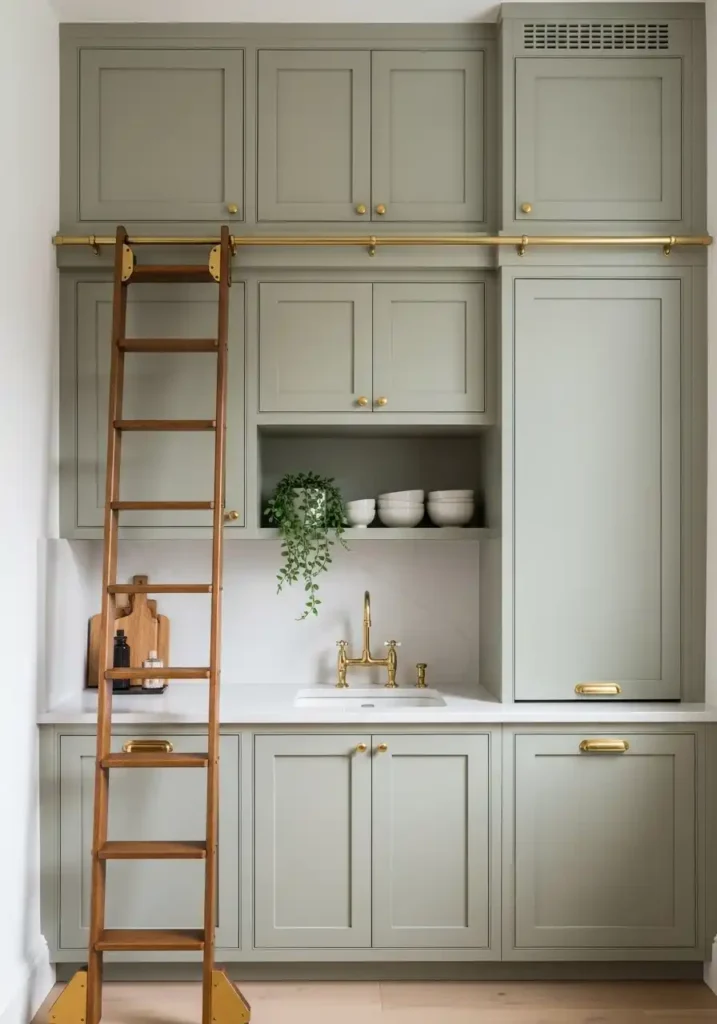
Extending kitchen cabinets all the way to the ceiling is the storage maximization strategy that captures the single most consistently wasted volume in any small kitchen — the cubic footage of empty space between the tops of standard-height upper cabinets and the ceiling above them, which in most kitchens is used for nothing more useful than the accumulation of dust and the occasional decorative object that is never seen and never moved. Floor-to-ceiling cabinetry captures this entire vertical dimension for genuine, usable storage, and in a small kitchen where every cubic inch of storage capacity is precious, the additional storage provided by ceiling-height cabinets above the standard upper cabinet line can make the difference between a kitchen that manages its storage adequately and one that manages it with genuine generosity.
The practical access solution for ceiling-height cabinets — the beautiful, rolling library ladder on a brass rail that slides along the full width of the cabinet run — is the detail that transforms a purely practical storage decision into a genuinely charming, genuinely characterful design feature that becomes one of the small kitchen’s most distinctive and most delightful elements. A library ladder in a small kitchen references the warmth and the bookish romance of a beautiful private library, bringing an unexpected cultural richness and a quality of domestic charm to the compact kitchen that no other storage solution provides. The upper cabinets above head height are ideal for seasonal items, large serving platters, specialty equipment, and anything needed infrequently — organized and accessible via the ladder when required, hidden beautifully behind matching cabinet fronts at all times.
6. A Pegboard Wall That Organizes Everything Beautifully
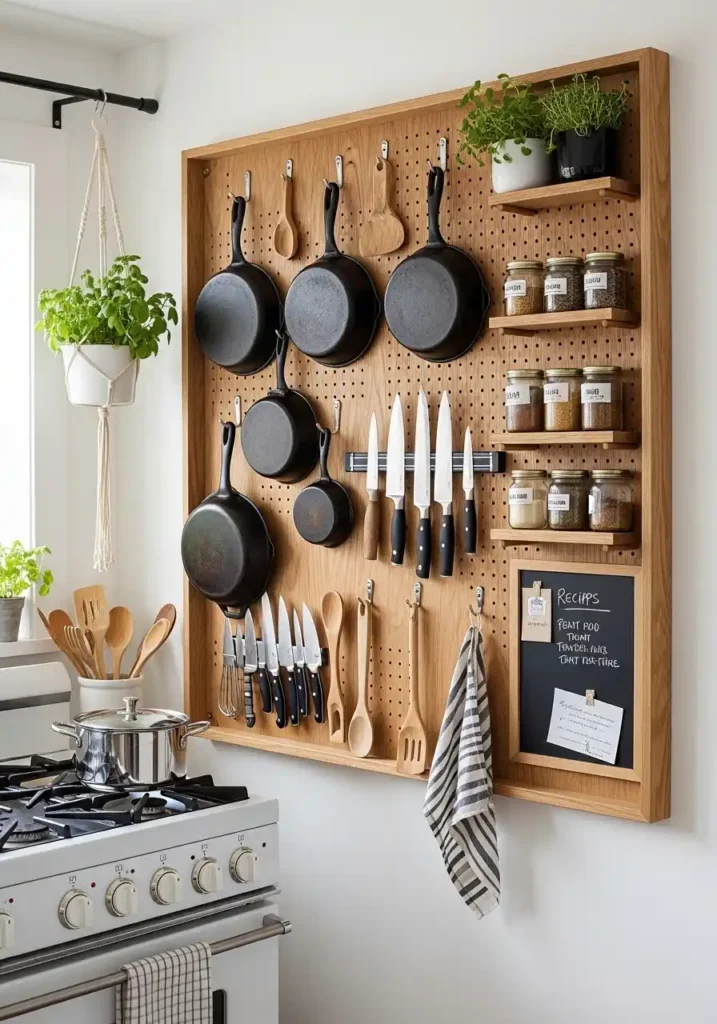
A pegboard in a small kitchen is the organizational solution that most brilliantly converts the most underutilized surface in any kitchen — the wall area between the counter and the upper cabinets, or the wall beside the stove that is too narrow for a full cabinet — into a genuinely useful, genuinely beautiful, and genuinely flexible storage and display system that holds everything from cast iron pans to fresh herbs on a single, elegant, completely adjustable wall installation. The pegboard’s fundamental design advantage over fixed storage solutions is its complete flexibility — hooks, shelves, and accessories can be repositioned in minutes as the kitchen’s storage needs evolve, without any additional installation work or any permanent modification to the wall.
A pegboard in natural oak rather than in the utilitarian painted wood or white MDF that most people associate with pegboards transforms this functional tool into a genuine design feature that adds warmth, material beauty, and a genuinely crafted quality to the kitchen wall. Natural oak pegboard looks like a piece of beautiful, considered kitchen furniture rather than an organizational system installed out of necessity, and when styled with genuine care — cast iron pans grouped by size, wooden utensils arranged by height, fresh herbs hanging from a small planter, spice jars lined up on a tiny shelf — the kitchen pegboard becomes simultaneously the room’s most practical wall and its most visually characterful, most personally expressive surface.
7. Under-Cabinet Lighting That Transforms the Kitchen Atmosphere
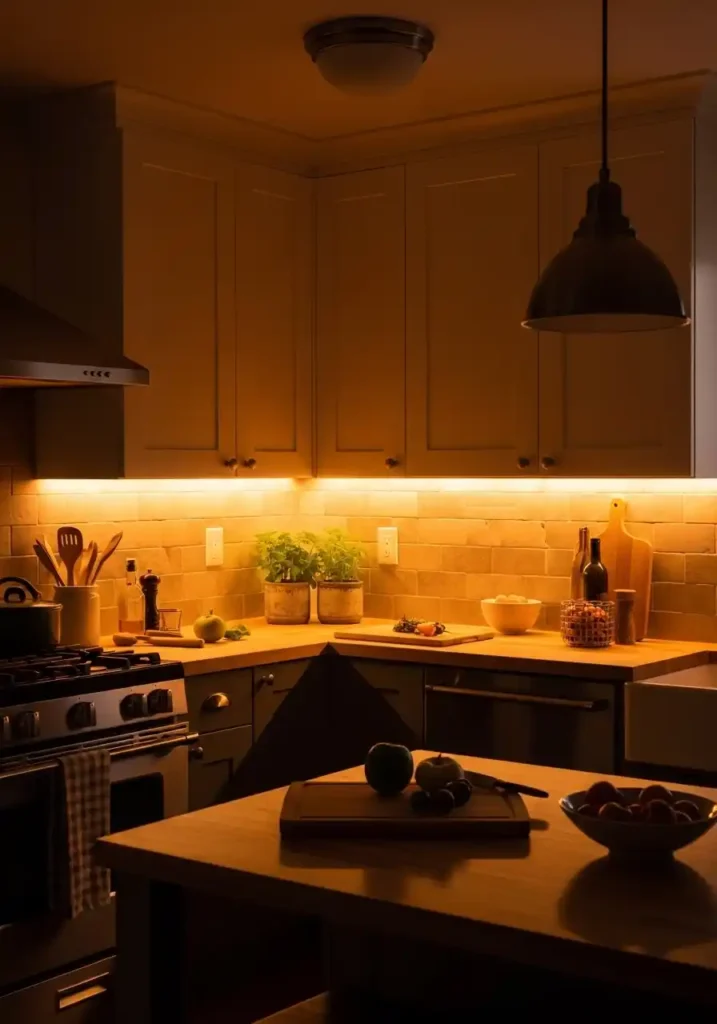
Under-cabinet lighting in a small kitchen is the five-minute installation upgrade with the most dramatically disproportionate impact on the kitchen’s daily livability and daily beauty of any intervention that costs less than a hundred dollars — because warm LED strip lights mounted beneath the upper cabinets transform both the practical quality of the kitchen’s task lighting and the atmospheric quality of its evening mood in a single continuous installation. During cooking, under-cabinet lights illuminate the counter work surface directly and evenly without the shadows that overhead lighting creates when the cook’s own body stands between the light source and the work area. In the evening with overhead lights dimmed, under-cabinet lights make the kitchen glow with an amber warmth of genuine beauty.
The specific color temperature of the LED strips chosen for under-cabinet kitchen lighting is the technical decision with the greatest atmospheric consequence — and warm white LEDs at 2700 to 3000 Kelvin create the most beautiful, most flattering, and most genuinely atmospheric kitchen lighting effect, casting a warm amber glow across the counter and backsplash that makes food look more beautiful, makes the kitchen feel more welcoming, and creates the specific quality of warm, intimate light that makes cooking in the evening feel like a genuine pleasure rather than a functional necessity. Avoid cool white or daylight LEDs, which create a harsh, clinical light that makes the kitchen feel like a hospital operating theater rather than the warm, beautiful heart of the home it deserves to be.
8. A Galley Kitchen Layout Perfected for Maximum Efficiency
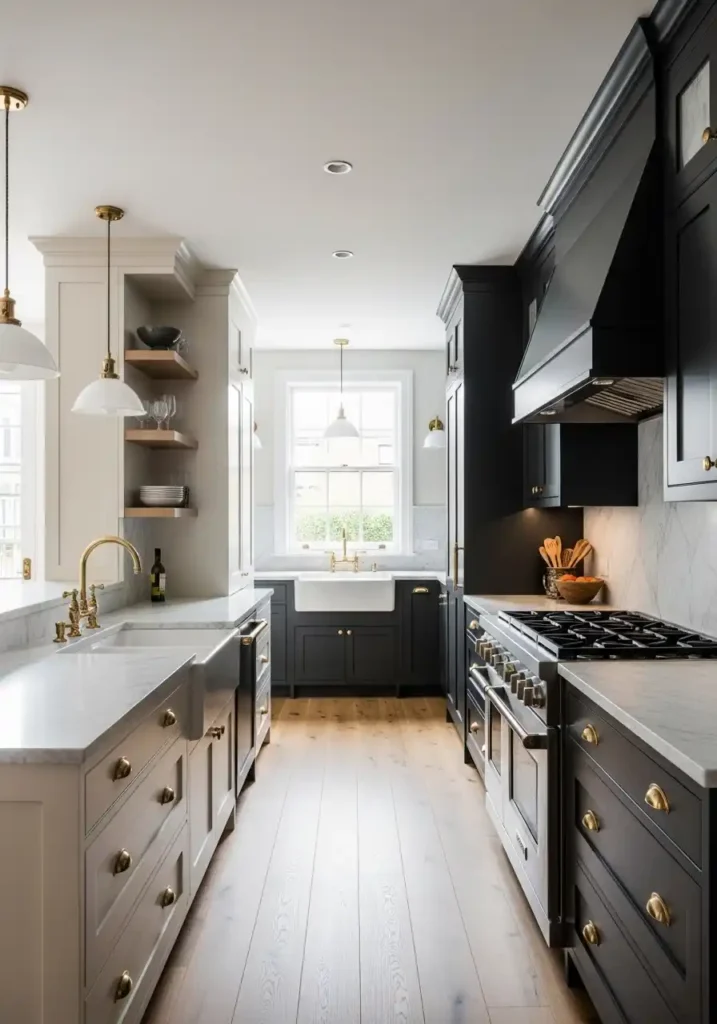
A galley kitchen — two parallel runs of cabinets, counters, and appliances facing each other along a single corridor — is the small kitchen layout that provides the highest ratio of usable counter and storage space to total kitchen floor area of any layout configuration, making it the most spatially efficient kitchen format available and the layout that most completely serves the practical needs of serious cooking in a compact space. The galley’s efficiency comes from the way it places every kitchen function — sink, stove, refrigerator, preparation surface, and storage — within a single step or turn of the working cook, eliminating the wasted movement that less efficient layouts introduce and making the kitchen genuinely ergonomic in its daily use.
The galley kitchen’s greatest design challenge — and the detail that most determines whether a galley feels beautifully considered or claustrophobically tight — is the width of the corridor between the two parallel runs, which should be a minimum of 90 centimeters for comfortable single-person use and ideally 110 to 120 centimeters for two-person cooking without collision. A window or glass door at the far end of the galley corridor is the natural light provision that prevents the galley from feeling like a tunnel and transforms it into a bright, properly illuminated kitchen of genuine spatial quality. Two-tone cabinets — different colors on each parallel run — add visual interest and prevent the galley from feeling like a repetitive corridor.
9. Mirrored Splashback for Light and Depth
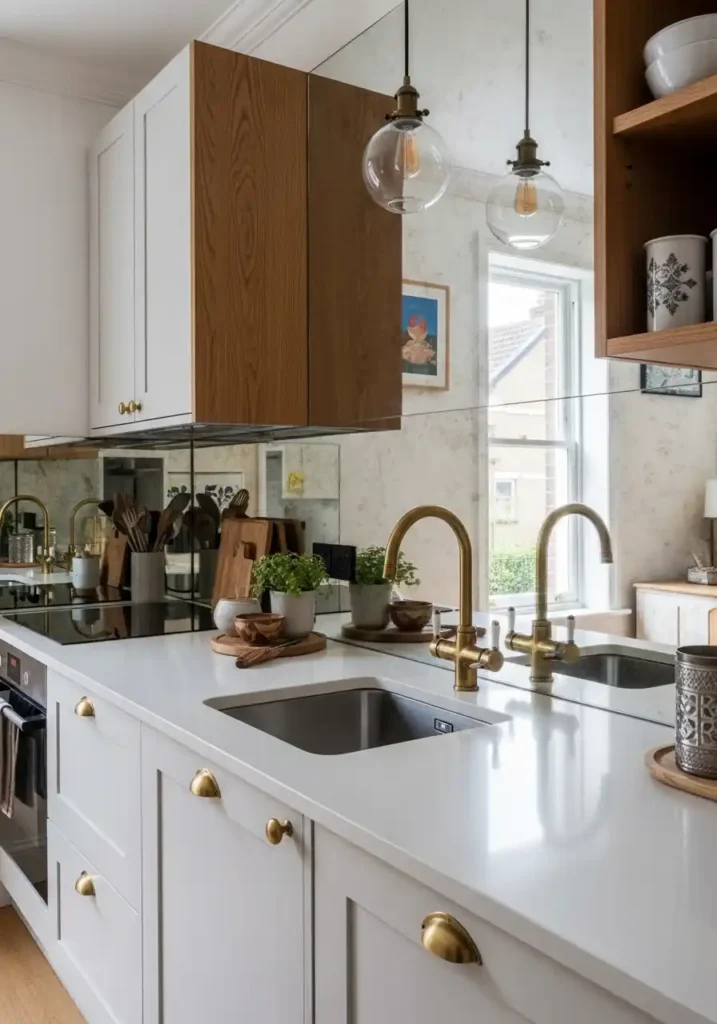
A mirrored splashback in a small kitchen is the spatial transformation that simultaneously addresses the two most significant limiting qualities of compact kitchen spaces — insufficient natural light and insufficient perceived depth — with a single, beautifully practical installation that requires no structural work, no layout change, and no cabinet modification of any kind. The mirror reflects every available source of natural and artificial light back into the kitchen from a direction opposite to its source, effectively doubling the apparent light sources in the compact space. Simultaneously, the reflection of the kitchen cabinets and the opposite window creates the convincing impression that the kitchen extends equally far in both directions, making the room feel genuinely twice as deep.
The material quality and the installation precision of a mirrored kitchen splashback are the details that determine whether it reads as a genuine, beautiful design decision or as a cheap, visually confusing addition to the kitchen. A large, single panel of mirror rather than multiple small mirrored tiles creates the cleanest, the most seamlessly reflective, and the most convincingly spatial result — because a single continuous mirror panel creates one complete, uninterrupted reflected image that the eye reads as a genuine spatial depth, while a grid of small mirrored tiles creates a fragmented reflection of reduced spatial clarity and reduced visual elegance. Have the mirror panel cut to the exact dimensions of the splashback area and professionally installed flush with the surrounding wall surface for a result of genuine quality.
10. A Compact Corner Kitchen That Uses Every Angle
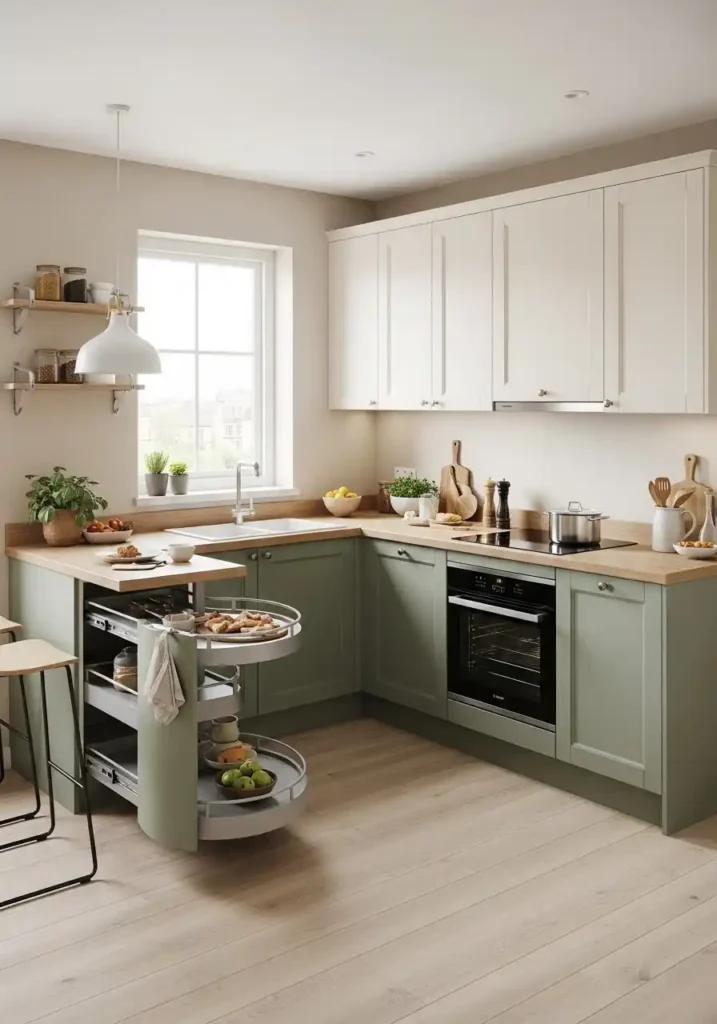
A compact L-shaped corner kitchen is the layout that makes the most complete and the most practically intelligent use of the specific spatial geometry of a corner — creating two full runs of counter and cabinet space that meet at a right angle, providing the kitchen with working surfaces on two walls simultaneously and delivering a total of usable counter length and cabinet volume that far exceeds what a single straight run of the same total cabinet count could provide. The corner junction, which is the layout’s most challenging spatial point, becomes the kitchen’s most storage-rich location when fitted with a properly engineered corner cabinet solution — a full carousel, a magic corner pull-out, or a diagonal drawer unit — that makes every inch of the corner’s depth genuinely accessible.
The breakfast bar overhang on one arm of the L is the compact corner kitchen detail that most significantly improves the kitchen’s daily livability — because a counter extension of 30 to 35 centimeters beyond the standard cabinet depth on one arm of the L, supported by slim hairpin legs or corbels, creates a proper casual dining surface for two bar stools that adds a dining function to the kitchen without requiring any additional floor space beyond the kitchen’s existing footprint. This breakfast bar turns the compact corner kitchen from a purely functional cooking space into a social kitchen where cooking and casual dining happen simultaneously in the same compact, beautifully resolved area.
11. Smart Drawer Organizers for a Kitchen That Works Perfectly
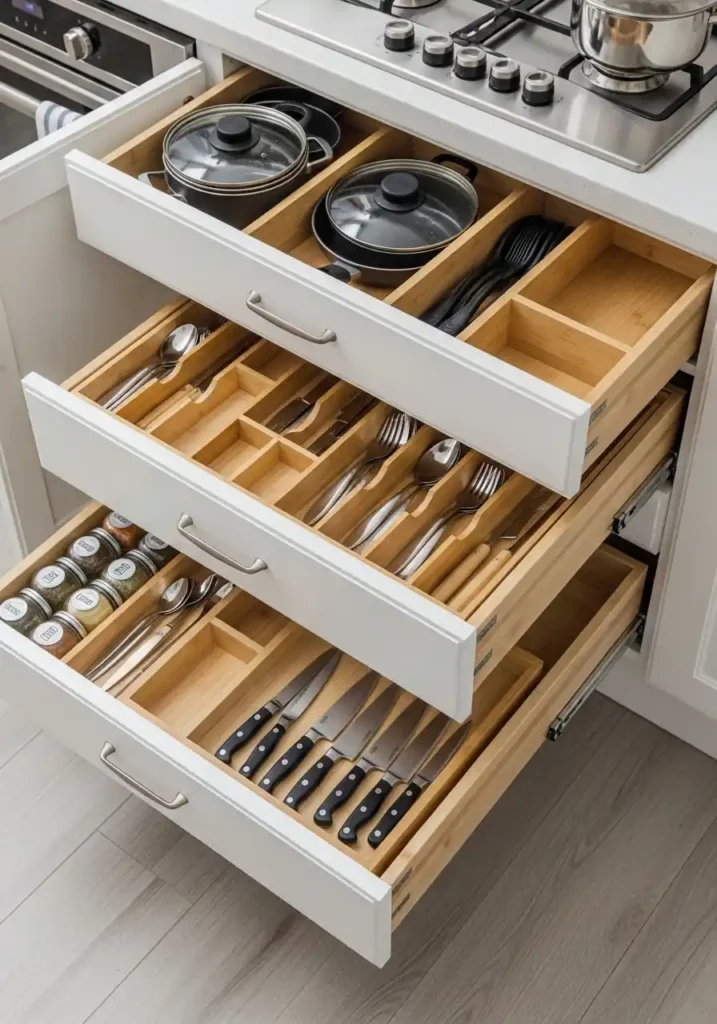
The interior organization of kitchen drawers is the small kitchen improvement that delivers the most significant improvement in daily cooking efficiency and daily kitchen satisfaction relative to its cost and effort of any kitchen project available — because kitchen drawers that are intelligently organized with proper dividers, proper inserts, and proper designations for every category of kitchen content transform the daily experience of cooking from a process of searching, rummaging, and frustrating half-remembered locations into a completely fluent, completely efficient, completely pleasurable flow of movement from drawer to counter to stove without a single moment of hesitation or disorientation. The organized kitchen doesn’t just look better — it makes cooking measurably, genuinely better.
The specific drawer organization systems that deliver the most complete improvement in small kitchen usability are those designed for the kitchen’s most frustrating and most poorly managed content categories — pot lids, which are the kitchen’s most notorious and most universally problematic storage challenge, solved definitively by a deep drawer fitted with vertical wooden slots that hold each lid upright and individually accessible; spices, solved by an angled drawer insert that presents every jar at a tilted angle with its label clearly visible from above; and knives, solved by a fitted wooden knife block insert that keeps every blade safely protected, individually accessible, and beautifully organized in the drawer rather than on the counter where they consume precious workspace.
12. A Kitchen with a Hidden Pantry for Surprising Storage
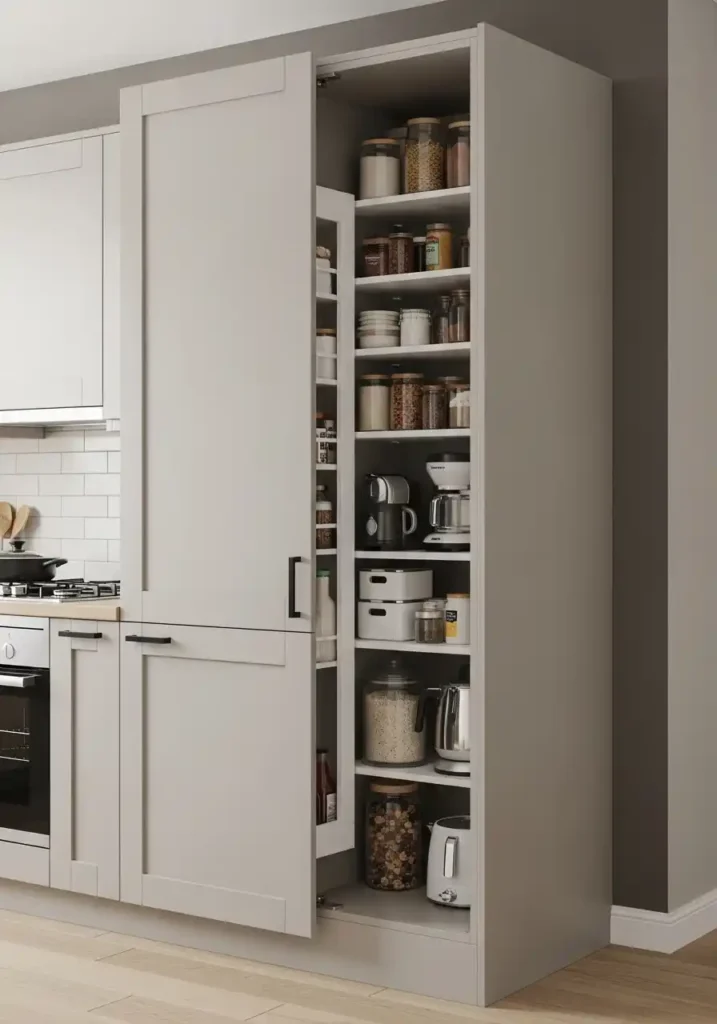
A hidden pantry in a small kitchen — a full pantry cupboard concealed behind a cabinet panel finished in the same material, the same color, and the same hardware pattern as the surrounding kitchen cabinetry, making it completely invisible when closed — is the storage solution that most dramatically changes the experience of cooking and living in a compact kitchen by providing a volume of organized storage for dry goods, canned foods, and small appliances that the kitchen’s visible cabinet runs could never accommodate, while maintaining the visual calm and the uncluttered aesthetic of a kitchen that appears to have perfectly adequate but not excessive storage. The hidden pantry is the small kitchen’s best-kept secret.
The interior organization of the hidden pantry is where the genuine transformation of the small kitchen’s practical capability occurs — because a properly fitted pantry interior with multiple shelves at appropriate heights for different product categories, pull-out drawers for small items, and designated zones for dry goods, canned goods, appliances, and cleaning products creates a behind-closed-doors organizational system of such comprehensive generosity that the kitchen’s visible surfaces can be kept completely clear of the everyday clutter that typically accumulates on small kitchen counters. Adjustable shelving provides the flexibility to reconfigure the pantry as storage needs change over time, and labeled storage bins maintain the organizational system with minimal ongoing effort.
13. Light-Colored Countertops That Visually Expand the Kitchen
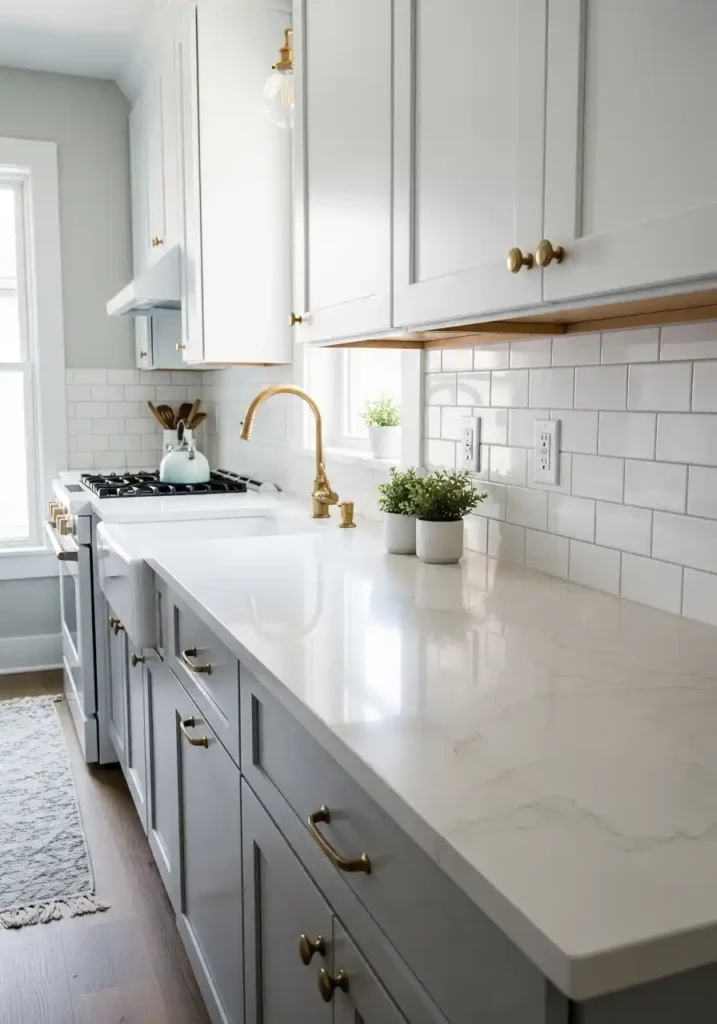
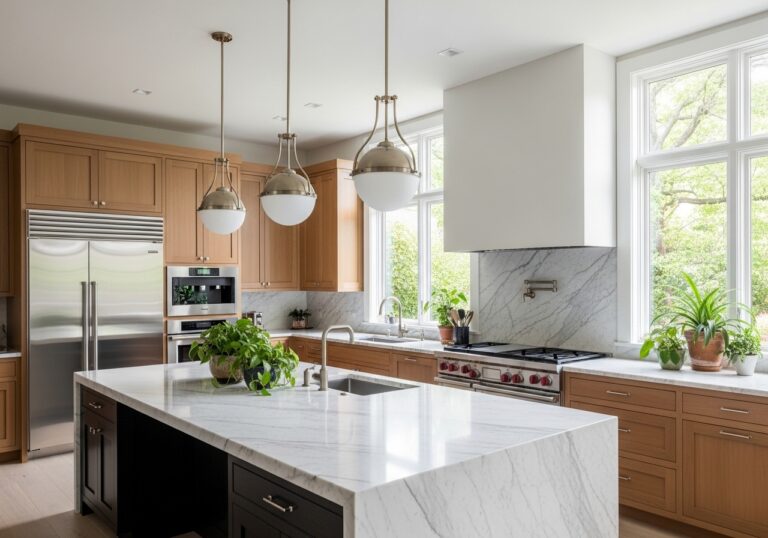
Light-colored countertops in a small kitchen are the design decision that improves the kitchen’s perceived spaciousness through the most fundamental and most powerful of all spatial illusion mechanisms — the reflection of natural and artificial light from pale surfaces that makes rooms feel brighter, more open, and more generously proportioned than the same rooms with dark, light-absorbing surfaces. A white or very pale countertop in a small kitchen reflects every available photon of incoming natural light across the counter surface and upward onto the adjacent surfaces, creating a quality of brightness and visual openness in the kitchen’s most active, most prominently viewed zone that makes the compact space feel genuinely, significantly more spacious.
White quartz is the specific countertop material that delivers the most beautiful and the most practically excellent combination of light-reflective visual benefit and genuine durability for a small kitchen that is in active daily use — because quartz’s non-porous surface resists staining, requires no sealing, and maintains its bright, clean, light-reflective quality without the maintenance demands that natural marble requires. A continuous white quartz countertop running the full length of the kitchen without any interruptions or variations creates a seamless horizontal plane of light reflection that makes the kitchen feel longer, wider, and more generously proportioned from every viewing angle. The uninterrupted continuity of the light countertop surface is as important as its color in creating the spatial expansion effect.
14. A Compact Kitchen with a Built-In Breakfast Nook
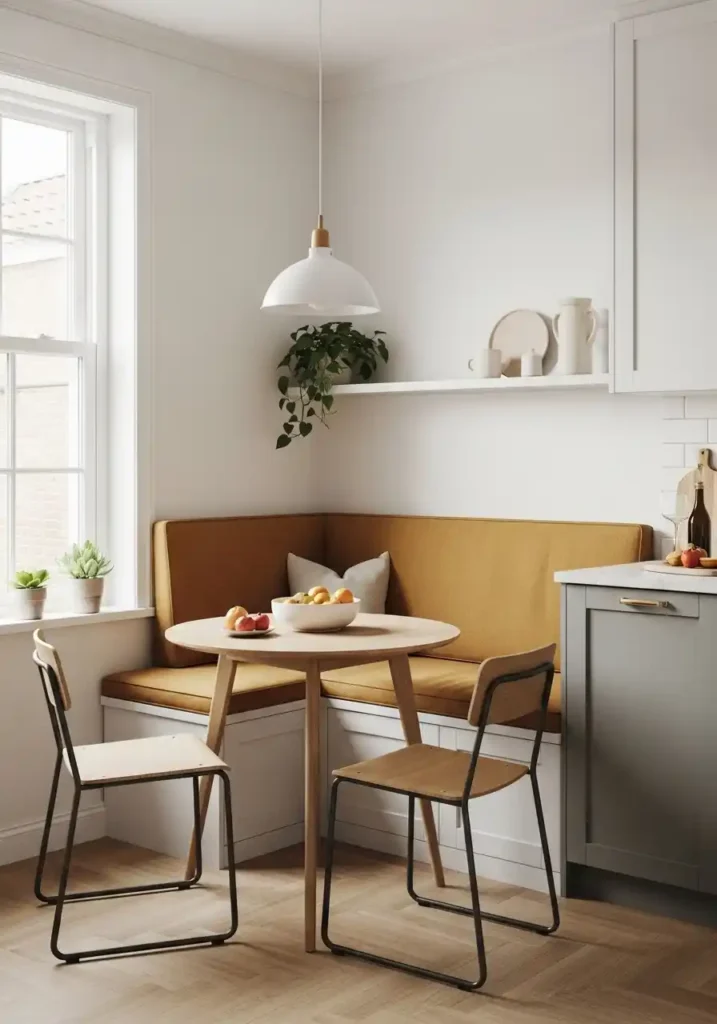
A built-in breakfast nook integrated directly into the small kitchen is the design addition that most completely transforms the kitchen from a purely functional cooking space into a genuinely sociable, genuinely livable room where the daily rituals of eating, drinking coffee, reading the morning news, and casual conversation happen naturally and comfortably within the kitchen itself rather than requiring a separate dining room. The breakfast nook creates a specific quality of domestic warmth and casual intimacy within the kitchen that a separate dining table in an adjacent room cannot replicate — because the nook’s proximity to the stove, the kettle, and the coffee maker makes it the natural destination for every informal meal, every quick snack, and every morning cup of coffee.
The built-in quality of the breakfast nook — the fixed bench seat that cannot be moved, the cushions that stay in position, the shelf above that holds the kitchen’s most decorative and most frequently referenced items — creates a sense of permanence and intentionality that freestanding furniture in the same kitchen corner could never achieve. The fixed bench seat requires zero chair-pullout clearance on its wall sides, making the nook’s footprint dramatically smaller than the equivalent number of freestanding chairs around a freestanding table would require. The storage compartment beneath the bench cushion adds a further practical layer of concealed storage for kitchen extras, linen, or children’s items that the compact kitchen needs to store somewhere accessible and attractive.
15. Handleless Cabinets for a Sleek, Uncluttered Look
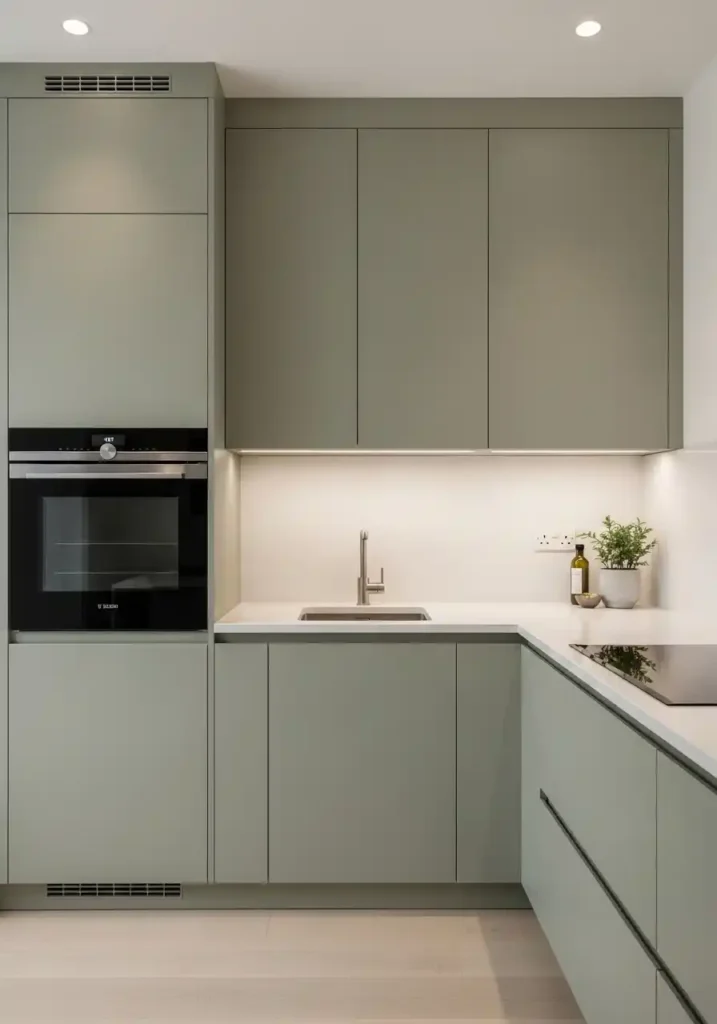
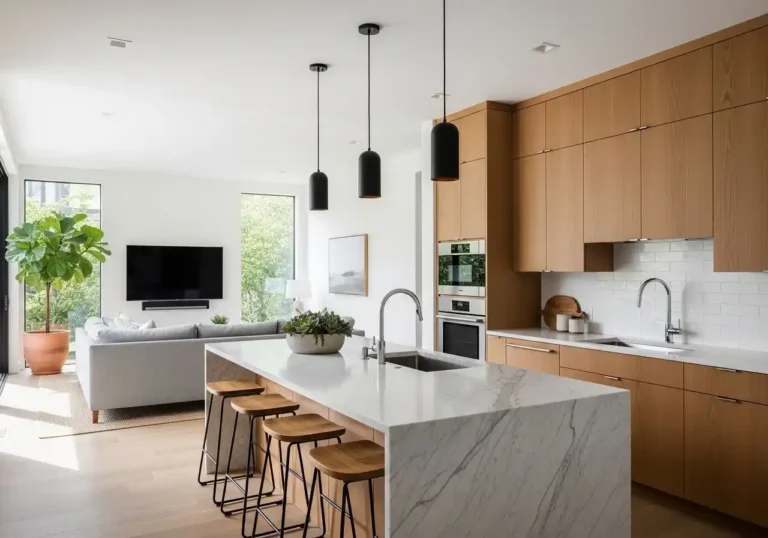
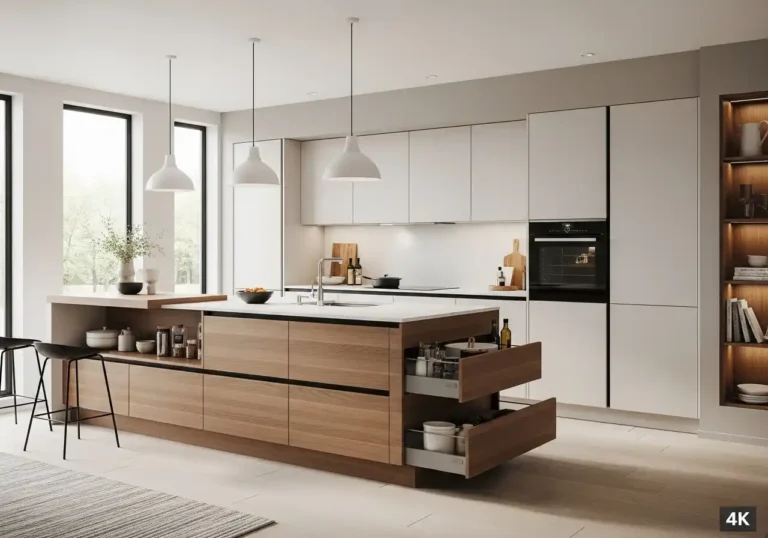
Handleless cabinets in a small kitchen are the design decision that creates the cleanest, the most visually uninterrupted, and the most genuinely contemporary kitchen appearance available — because the elimination of all hardware from the cabinet fronts removes the rows of handles, knobs, and pulls that add visual noise and visual complexity to kitchen walls and replaces them with smooth, continuous, uninterrupted planes of cabinet material that the eye reads as clean, calm, and spatially receding rather than as busy, detailed, and spatially advancing surfaces. In a small kitchen where visual calm and visual simplicity directly contribute to the perceived spaciousness of the space, the handleless cabinet is the most effective single design decision available.
The push-to-open or J-pull mechanism that replaces conventional handles on a handleless kitchen cabinet must be reliable, smooth, and positive in its operation — because a handleless cabinet that requires excessive force to open or that opens inconsistently becomes a daily frustration that completely undermines the kitchen’s practical livability regardless of how beautiful it looks. Properly specified push-to-open mechanisms with genuine quality engineering open consistently, softly, and positively with a single light touch and close with a gentle, satisfying click that communicates quality without drama. J-pull cabinets — where the top or bottom of the cabinet door is routed into a recessed grip — provide an equally clean aesthetic with a marginally more intuitive opening action that many people prefer for daily kitchen use.
16. A Window Above the Sink That Makes Washing Up a Pleasure
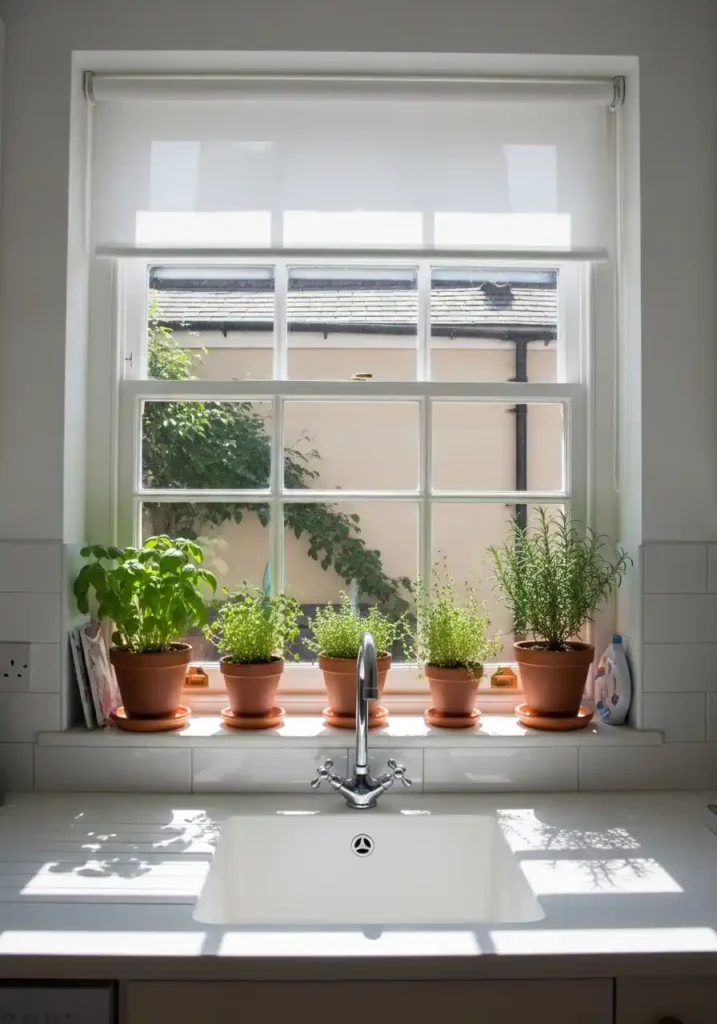
A window directly above the kitchen sink is the architectural feature that transforms the most repetitive and the least beloved kitchen task — washing up — from a chore performed in a dark, enclosed corner of the kitchen into one of the kitchen’s most pleasant positions, bathed in natural light, connected to the view of the garden or the street beyond the glass, and graced by the presence of fresh herbs growing on the sill within reach of the cooking surface. The window above the sink is the small kitchen detail that most directly and most consistently improves the daily lived experience of the kitchen — not because it makes the kitchen larger or more efficiently organized but simply because it makes being in the kitchen more pleasant.
The windowsill above the kitchen sink is the small kitchen’s most perfectly located and most beautifully lit growing surface for fresh herbs — because it provides the direct natural light that herbs require for vigorous growth, the proximity to water that makes watering effortless, and the accessibility from the cooking surface that makes picking fresh herbs a natural and pleasurable part of every cooking session rather than a separate trip to a garden or a reaching expedition to a shelf. Terracotta pots with basil, thyme, rosemary, and chives on the kitchen windowsill are simultaneously the kitchen’s most practical plant collection, its most beautiful organic decoration, and its most aromatic and sensory-enriching daily companion. They transform washing up into gardening.
17. A Compact Kitchen with Smart Appliance Storage
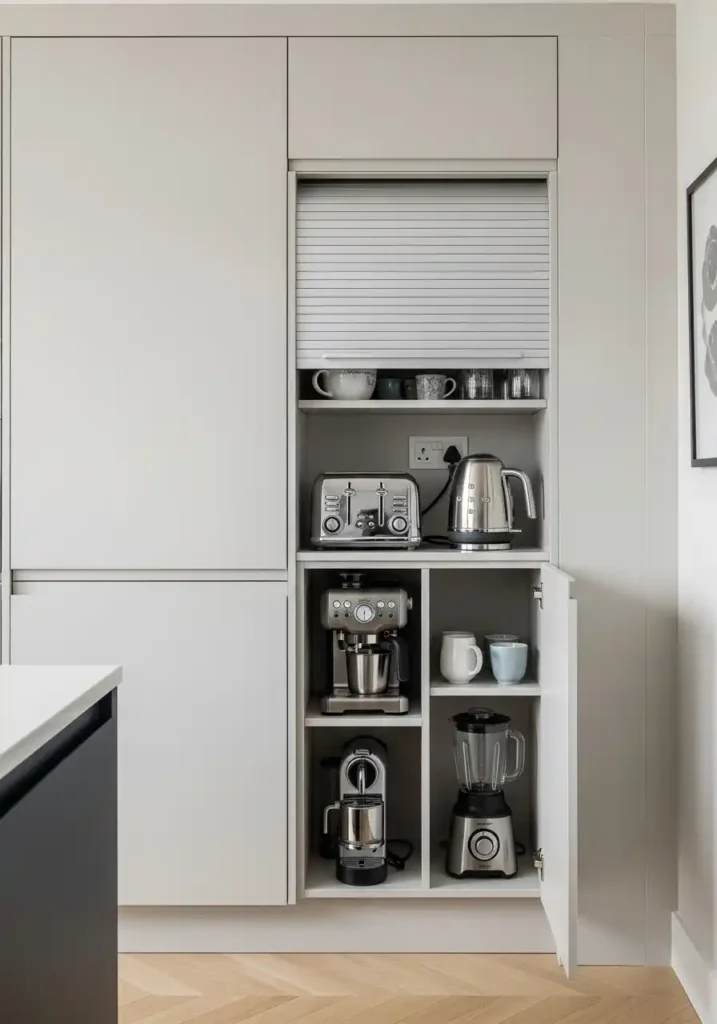
An appliance garage — a dedicated section of counter-height cabinetry with a roll-up tambour door or a hinged lift-up door that completely conceals the kitchen’s small countertop appliances when not in use — is the small kitchen’s most effective and most consistently satisfying solution to the problem that most compromises the compact kitchen’s visual appeal and perceived spaciousness: the accumulation of toasters, coffee machines, kettles, blenders, and other small appliances on the counter that consumes precious workspace and creates the visual clutter that makes small kitchens feel messy, cramped, and perpetually inadequate. The appliance garage hides everything and returns the counter to the clear, useful, beautiful working surface it was always meant to be.
The design of a genuinely excellent appliance garage requires careful attention to the practical requirements that make it genuinely useful rather than merely aesthetically pleasing — and the most important of these is the provision of properly positioned electrical outlets within the garage interior, so that appliances can be used without being removed from the garage or with the garage door only partially open. A power strip with multiple outlets mounted to the back wall of the appliance garage at counter height provides power to every appliance simultaneously, makes the garage genuinely functional as an in-place use position for regularly used appliances, and eliminates the trailing cables across the counter that undermine the clean, organized appearance that the appliance garage is specifically designed to create.
18. A Colorful Small Kitchen That Radiates Pure Joy
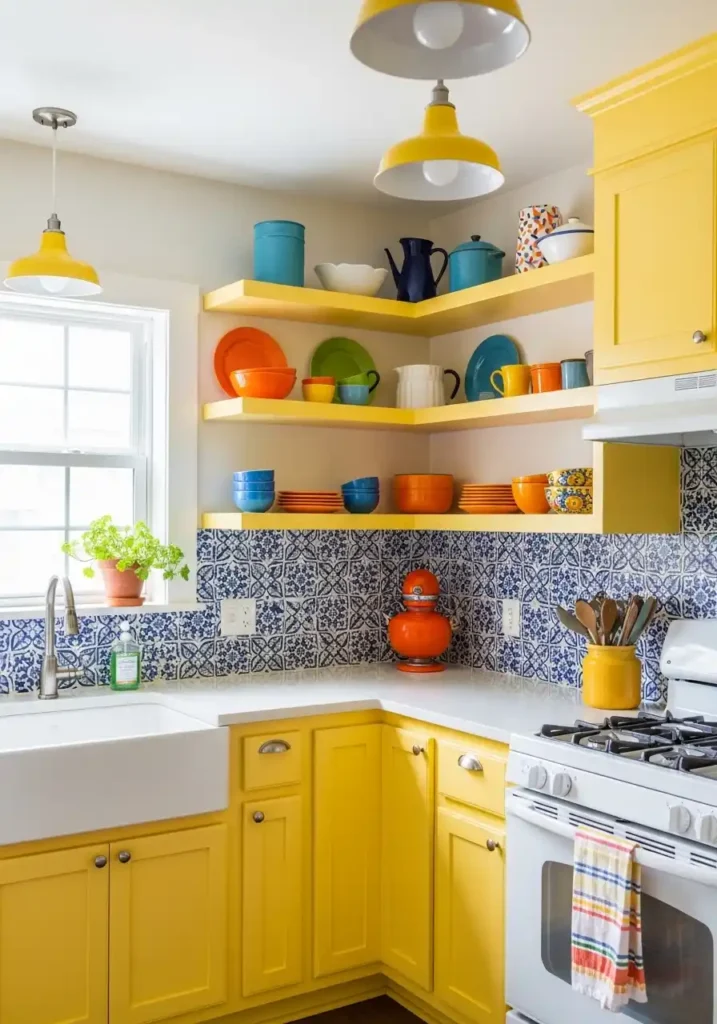
A colorful small kitchen is the most direct and most complete rejection of the idea that small spaces must be neutral, restrained, and carefully edited in order to feel livable and beautiful — and the colorful small kitchen that is decorated with genuine boldness, genuine personality, and genuine commitment to the specific colors that make its owner genuinely happy is consistently, demonstrably more beloved and more genuinely pleasurable to spend time in than the cautiously neutral small kitchen designed by someone who was afraid of color. Bold color in a small kitchen does not make it feel smaller — it makes it feel more alive, more personal, and more completely and unreservedly itself.
Sunshine yellow is perhaps the most joyfully transformative and the most consistently mood-lifting color choice for a small kitchen — because yellow is the color of sunlight, of warmth, of morning optimism, and of the specific energy that cooking and eating and sharing food together most naturally inhabit. A small kitchen in sunshine yellow cabinets with a blue and white Mediterranean tile backsplash, colorful ceramic dishes on open shelves, and cheerful vintage-style pendant lights creates a room of such concentrated, unapologetic happiness that every person who enters it feels immediately, physically better than they did before. This is the kitchen that makes cooking dinner a genuinely pleasurable experience rather than an obligation to be fulfilled in a room that inspires nothing.
19. Smart Corner Solutions That Banish Wasted Space
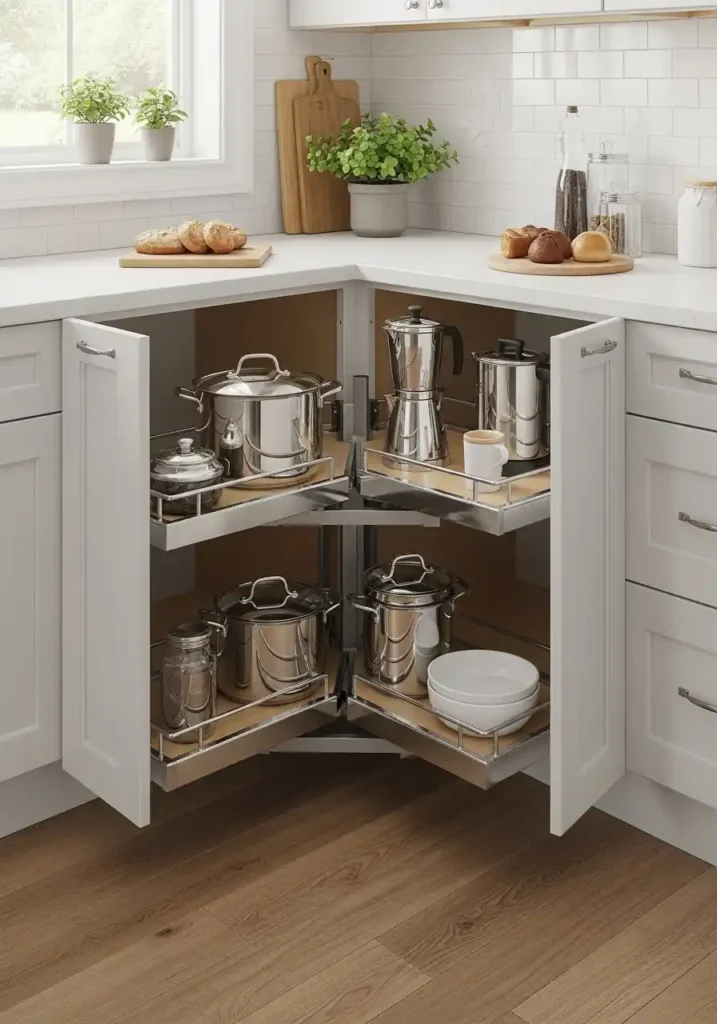
Kitchen corners are the most consistently wasted and the most consistently frustrating storage locations in any kitchen layout — because the diagonal depth of a corner cabinet interior creates a storage space that is simultaneously enormous in volume and completely inaccessible in practice when fitted with conventional fixed shelving, leaving a vast dead zone of unusable space behind the point where the human arm can comfortably reach. The various engineered corner storage solutions developed specifically to solve this problem — the magic corner, the full carousel, the diagonal drawer system, and the Le Mans pull-out — transform the kitchen’s most frustrating storage failure into one of its most generous and most satisfying storage successes.
The magic corner pull-out system is the corner storage mechanism that provides the most complete and the most accessible use of the full corner cabinet volume — because its two full-width shelves extend completely out of the corner and beyond the cabinet opening when deployed, making every inch of the corner’s depth visible, accessible, and genuinely usable without any reaching, squinting, or rummaging. The mechanism’s smooth, well-engineered movement makes deployment and return effortless in daily use, and the full extension of the shelves beyond the cabinet opening means that even the most deeply stored items are as accessible as those on a conventional open shelf. A properly specified magic corner mechanism transforms the kitchen corner from dead space into the kitchen’s most surprisingly generous storage location.
20. A Kitchen with Integrated Dining Using a Peninsula
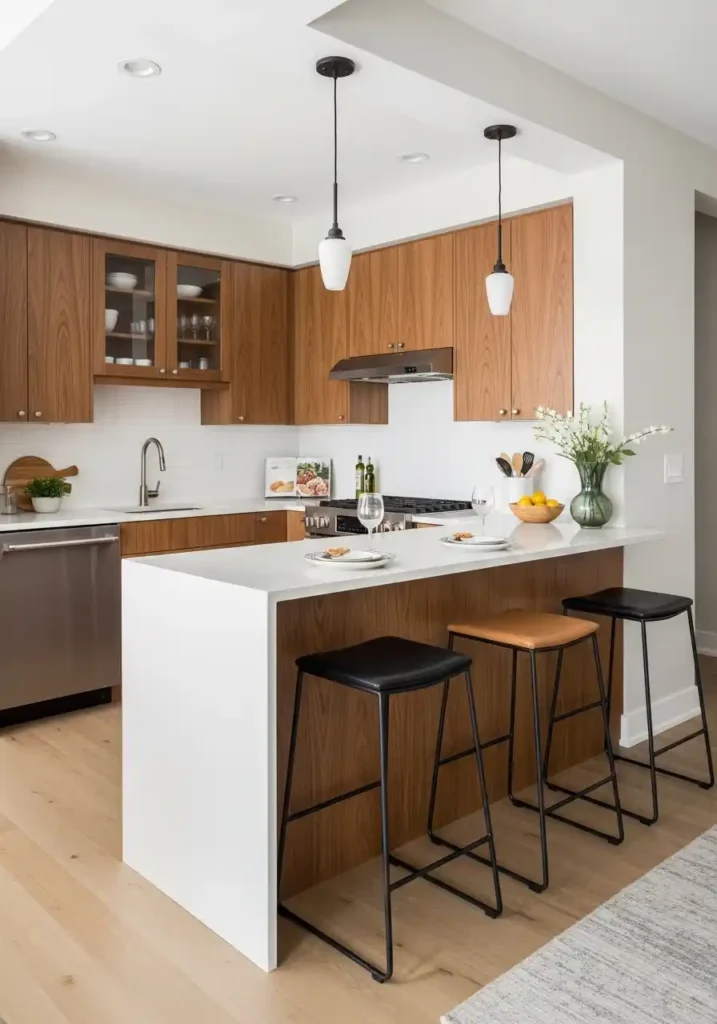
A kitchen peninsula — a counter extension that projects from the main kitchen run into the adjacent living or dining space rather than connecting to a second parallel run — is the small kitchen addition that delivers the most significant improvement in both cooking function and social connectivity of any kitchen modification available, because it simultaneously adds counter workspace on the kitchen side, creates a casual dining bar on the living side, and establishes a gentle, furniture-level boundary between the kitchen and the adjacent living space that defines each zone without any physical partition. Three counter stools on the living side of the peninsula create a dining and social hub that makes the kitchen the most connected, most social, and most naturally gathering room in the home.
The overhang dimension on the living side of the peninsula — the distance by which the countertop extends beyond the base cabinets to create a knee space for stools — is the critical measurement that determines the peninsula’s success as a dining and social surface. An overhang of 30 to 35 centimeters provides adequate knee space for comfortable seated dining at counter-height stools, while an overhang of less than 25 centimeters creates an uncomfortable, knee-banging dining experience that makes the peninsula feel like a design compromise rather than a genuine dining provision. Match the peninsula’s countertop material to the main kitchen counter for a seamless, unified appearance, or use a contrasting material — warm walnut against white quartz — for a peninsula that reads as a deliberately distinct piece within the kitchen composition.
21. Recessed Shelving in the Kitchen Wall for Display and Storage
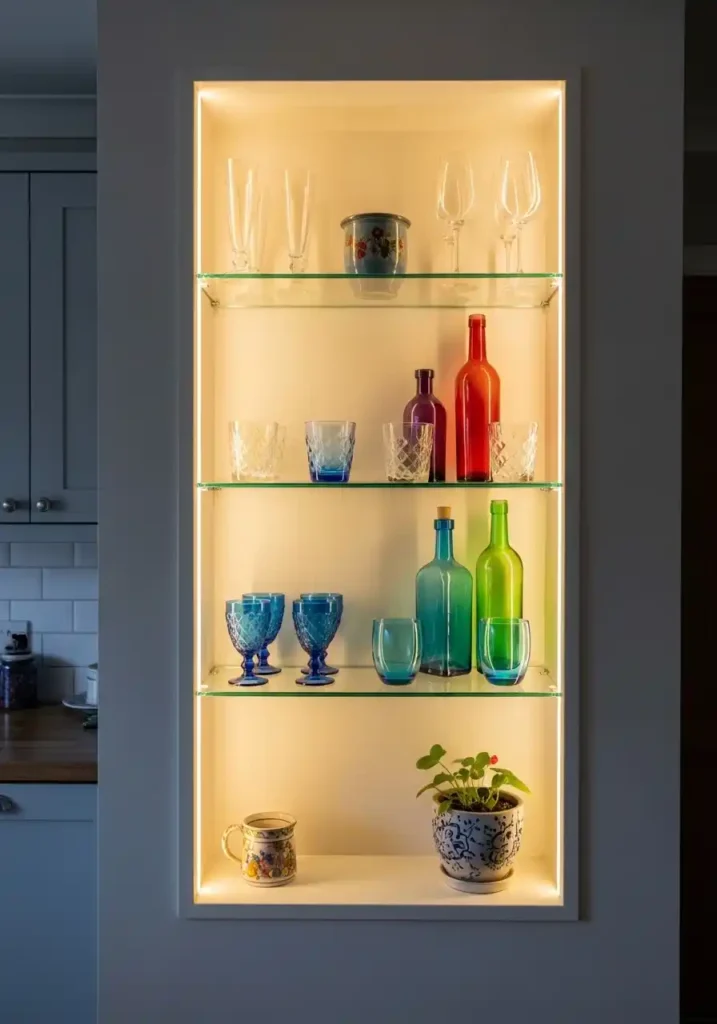
Recessed shelving built into the wall of a small kitchen — a niche cut into the wall thickness and fitted with shelves and interior lighting — is the storage and display solution that provides the most complete spatial efficiency of any kitchen storage option because it stores and displays within the wall’s existing thickness rather than projecting into the kitchen’s floor area or consuming cabinet space that could be used for other storage. A recessed kitchen niche adds genuine storage and genuine display capacity to the small kitchen at the cost of zero floor area and zero counter space, making it the most spatially democratic storage solution available to a compact kitchen that cannot afford to give up any further floor or counter territory.
The interior lighting of a recessed kitchen niche transforms it from a purely practical storage recess into a glowing architectural feature of genuine beauty that adds warmth, depth, and a quality of considered elegance to the small kitchen’s wall surface. Warm LED strips installed along the niche’s top edge or side edges create a pool of warm amber light within the recess that makes every object displayed within it — a collection of beautiful glassware, a row of colored glass bottles, a ceramic plant pot — glow with an intensity and a warmth that the same objects on an ordinarily lit shelf could never match. The glowing niche becomes one of the small kitchen’s most visually beautiful and most atmospherically generous design elements, visible from the adjacent living area as a warm, inviting window of warm light within the kitchen wall.
22. The Complete Small Kitchen — Every Idea Working in Perfect Harmony
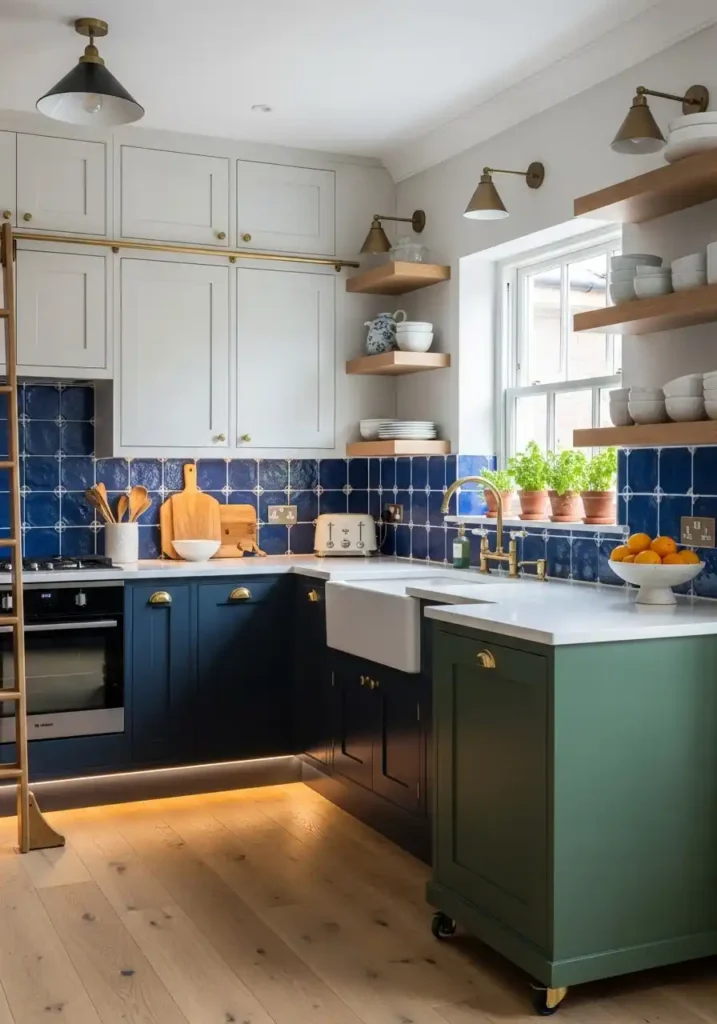
The perfect small kitchen — the one that makes every meal cooked within it a genuine pleasure, that keeps every essential within effortless reach, that looks beautiful from every angle at every hour of the day, and that makes its compact square footage feel not like a limitation but like a quality of focused, considered, deliberately intimate design — is never the result of a single brilliant idea implemented in isolation. It is the accumulated, harmonious result of multiple intelligent decisions, each one contributing its specific functional or aesthetic benefit to the whole while working in complete concert with every other decision to create a kitchen that is greater than the sum of its beautifully resolved parts.
The invitation this guide offers is both entirely practical and genuinely exciting — because every one of these twenty-two ideas is achievable in a real small kitchen with a real everyday budget, and each one improves the kitchen in a specific, tangible, immediately felt way that makes daily cooking more efficient, more beautiful, or more enjoyable. Start with the one idea that addresses your most immediate kitchen frustration — the storage that doesn’t work, the light that isn’t there, the counter that isn’t enough — and build your perfect small kitchen outward from that single confident starting point. Your compact kitchen is not a compromise. It is an opportunity to design more intelligently, more beautifully, and more thoughtfully than any amount of space has ever required.
Conclusion:
Designing a functional and stylish kitchen in a limited space may seem challenging, but with the right ideas, even the smallest kitchens can become efficient, beautiful, and highly practical. These 22 kitchen ideas for small spaces show that smart layouts, clever storage solutions, multi-functional furniture, and thoughtful lighting can completely transform a compact kitchen into a space that feels open and organized.
Whether you choose vertical storage, foldable elements, minimalist designs, or light color palettes, the key is to maximize every inch while maintaining comfort and usability. Small kitchens don’t have to compromise on style or efficiency — in fact, they often inspire the most creative solutions.
By applying these small kitchen design ideas, you can create a kitchen that not only saves space but also enhances your daily cooking experience. Start with one or two changes, and you’ll quickly see how even the smallest upgrades can make a big difference in your kitchen’s functionality and overall appeal.