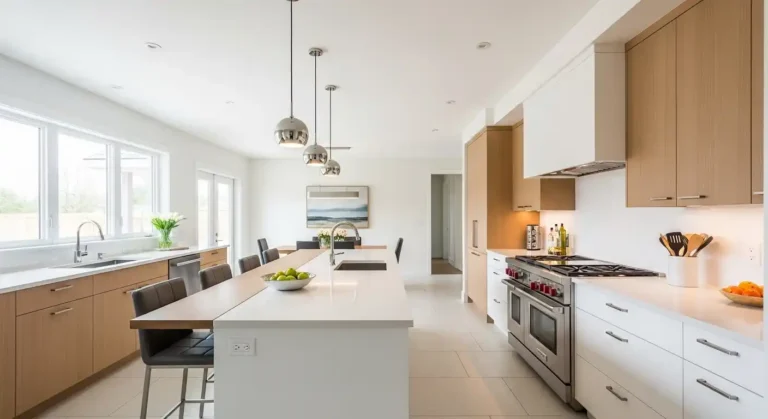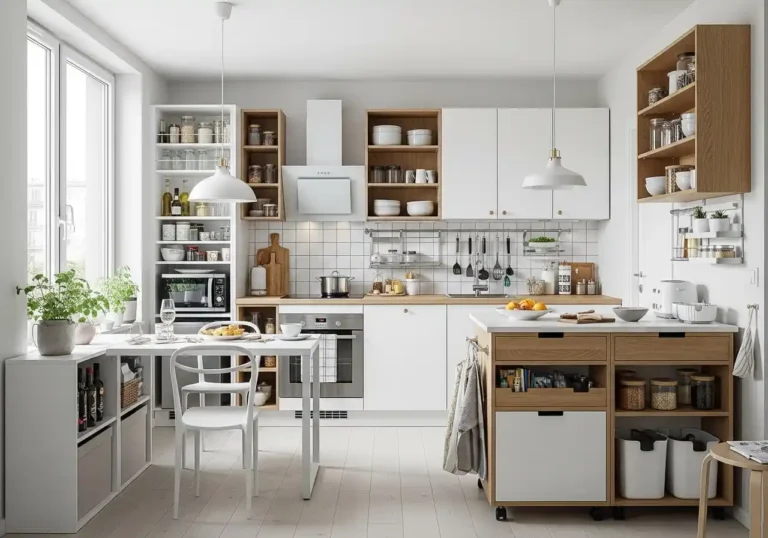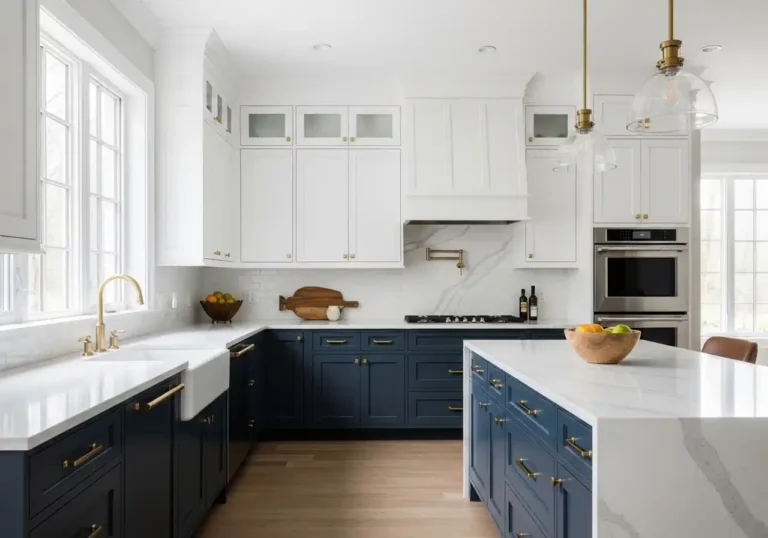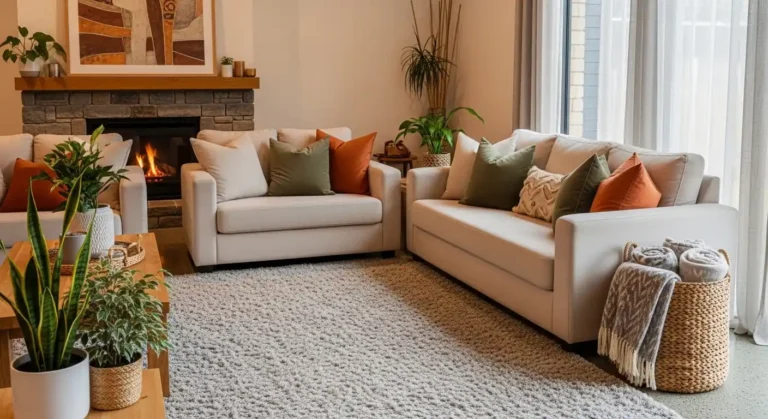
1. The Classic White Timeless Kitchen Aesthetic
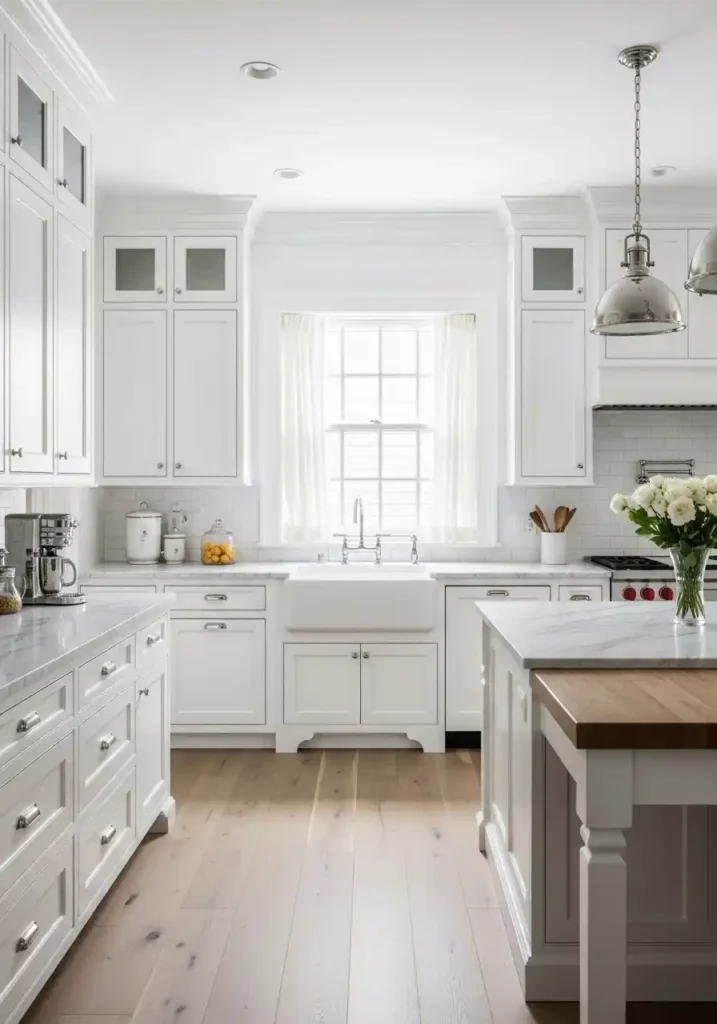
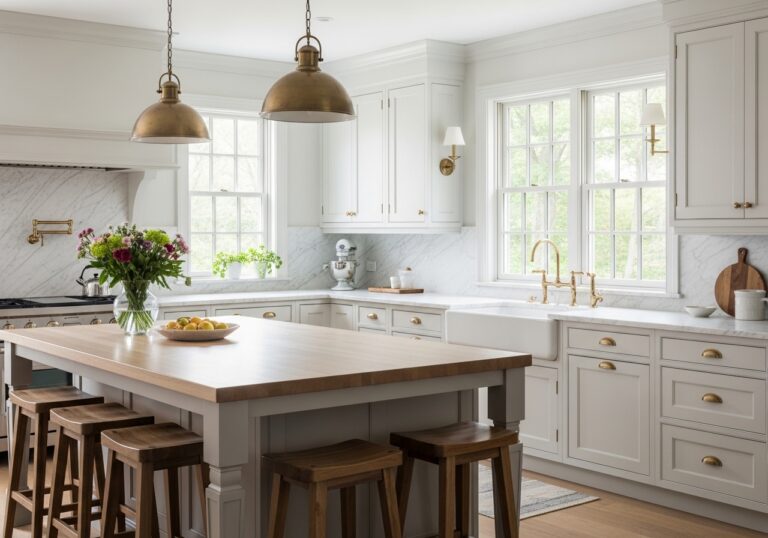
The classic white Kitchen Aesthetic Inspirations are the most enduring, the most universally beloved, and the most completely timeless kitchen design in the entire residential interior vocabulary — because it is not a trend, not a moment, and not a reflection of any particular decade’s design preferences but a permanent, continuously renewed expression of the specific qualities that human beings have always found most beautiful in domestic spaces: light, clarity, cleanliness, and the specific quality of luminous, open spaciousness that white creates more completely and more consistently than any other color. The classic white kitchen was magnificent a hundred years ago and will be magnificent a hundred years from now.
The specific white kitchen details that separate the truly timeless from the merely conventional are the ones that communicate material quality most directly and most honestly — the thickness of the marble countertop, the depth of the shaker cabinet’s recessed panel, the quality of the nickel hardware’s finish, and the warmth of the white oak floor’s grain. These details are visible only upon close attention and appreciated only over time, which is precisely what makes them timeless rather than trendy: they reward the sustained attention of daily use rather than making their entire impact in a single photographic glance, creating a kitchen that is genuinely, continuously, increasingly beautiful the longer you live within it.
2. The Moody Dark Academia Kitchen Aesthetic
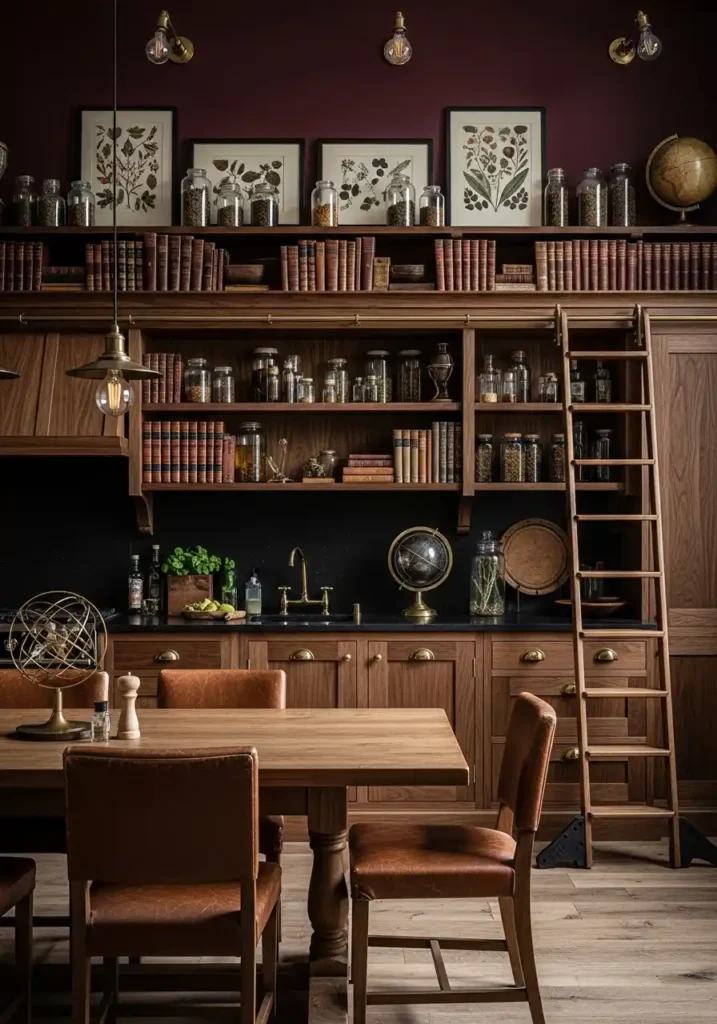
The dark academia kitchen aesthetic is the design approach that most completely transforms the kitchen from a functional cooking environment into an atmospheric, intellectually rich, deeply atmospheric space that references the specific qualities of Victorian and Edwardian domestic learning — the private library, the natural history cabinet, the scholarly study — creating a kitchen in which every object, every material, and every design decision communicates a specific kind of cultivated, bookish, genuinely curious engagement with the world’s knowledge and the world’s beauty. This kitchen is for people who read while they cook and who find cooking itself a form of intellectual pleasure.
The glass specimen jars with preserved herbs, dried botanicals, and interesting spices that populate the dark academia kitchen’s open shelving are simultaneously the aesthetic’s most practically useful and its most perfectly characteristic decorating element — because they combine the genuine functional purpose of beautiful, properly sealed ingredient storage with the specific visual language of Victorian natural history collections, where everything interesting about the natural world was preserved, labeled, and arranged for study and contemplation. A shelf of well-labeled specimen jars holding saffron, dried lavender, star anise, and crystallized violets looks like a Victorian apothecary and functions like a perfectly organized pantry simultaneously.
3. The Coastal Hamptons Kitchen Aesthetic
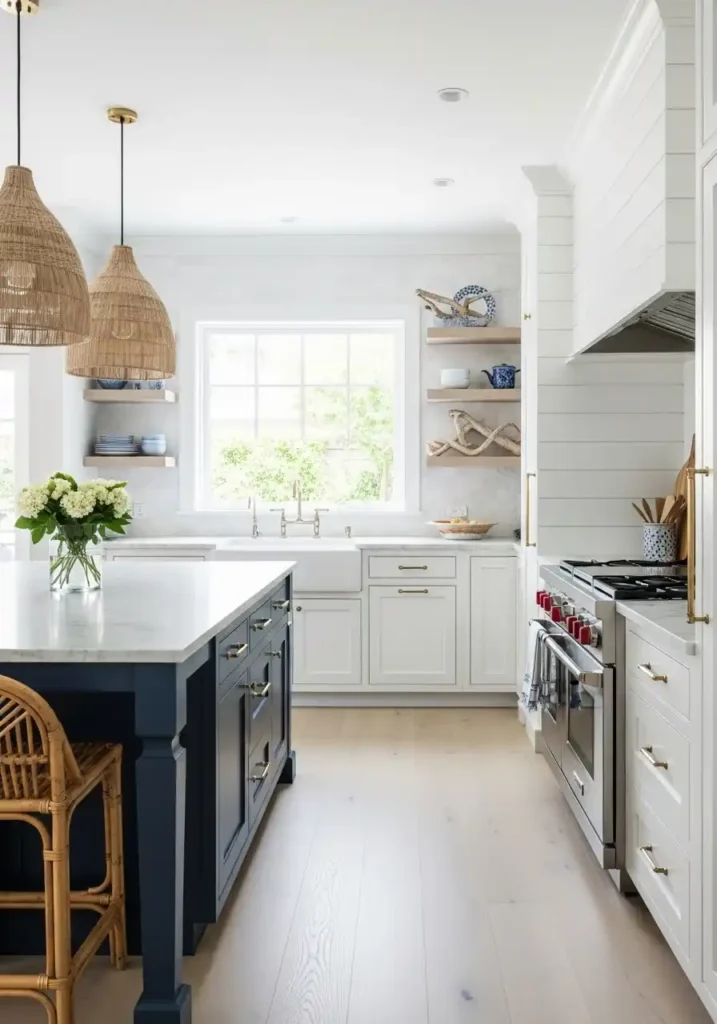
The coastal Hamptons kitchen aesthetic is the design language of effortless, sun-bleached, genuinely unpretentious luxury — the kitchen of a beautiful beach house where the windows are always open, the light is always brilliant, and every surface appears gently softened by proximity to the sea and the sun. It combines the architectural confidence of serious, properly proportioned American kitchen design with the relaxed, organic, slightly salt-weathered quality of genuine coastal living, creating a kitchen that feels simultaneously lavishly appointed and completely, effortlessly casual in the specific way that only genuinely expensive, genuinely confident design can achieve without appearing to try.
The navy blue island against white perimeter cabinets is the Hamptons kitchen’s most defining and most photographically spectacular design moment — because the combination of classic white and classic navy is the most fundamental and the most enduring expression of the coastal color story, referencing the specific visual world of nautical life — navy uniforms, white sails, blue water, white foam — with a domestic sophistication and a design confidence that makes the kitchen feel like the most beautifully appointed room on the most beautiful boat imaginable, anchored permanently on the most perfect stretch of coastal real estate. The rattan stools and the seagrass pendant lights complete the coastal material story with the organic warmth of natural fibers.
4. The Maximalist Colorful Eclectic Kitchen Aesthetic
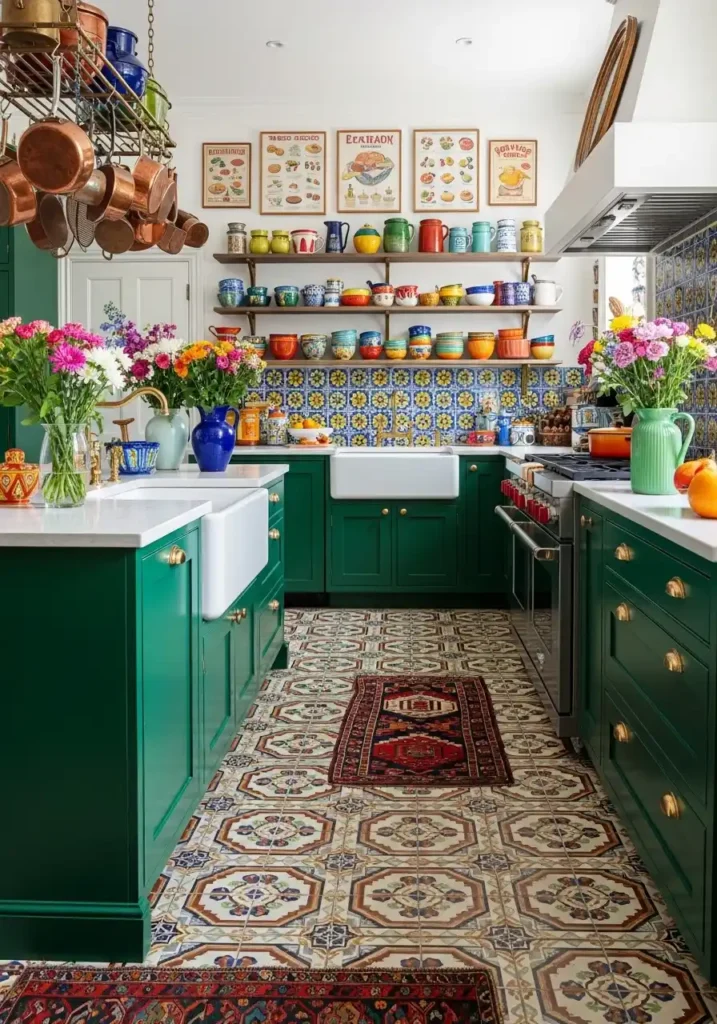
The maximalist eclectic kitchen aesthetic is the design approach that most completely, most joyfully, and most unapologetically celebrates the beauty of abundance, color, pattern, and the specific richness of a kitchen that has been assembled over years from a collection of genuinely loved, genuinely personal, genuinely beautiful objects gathered from different places, different traditions, and different moments in the collector’s life rather than selected all at once from a single catalog or a single design aesthetic. The maximalist kitchen is the kitchen that looks like someone actually lives there — fully, richly, and with genuine, unsuppressed love of beautiful things.
The specific quality that separates beautiful maximalism from mere clutter is the presence of genuine design intelligence in the curation and arrangement of the abundant objects — because a maximalist kitchen of real beauty is not simply a kitchen with a lot of things in it but a kitchen where every object has been chosen with genuine knowledge, genuine aesthetic judgment, and genuine personal meaning, and where the arrangement of those objects reflects a genuine compositional intelligence that creates visual richness without visual chaos. Emerald green cabinets with ornate brass hardware, encaustic tile floors, and a global pottery collection create a maximalist kitchen of such completely confident, completely personal, completely magnificent abundance that it makes every minimalist alternative appear comparatively impoverished.
5. The Japandi Minimalist Kitchen Aesthetic
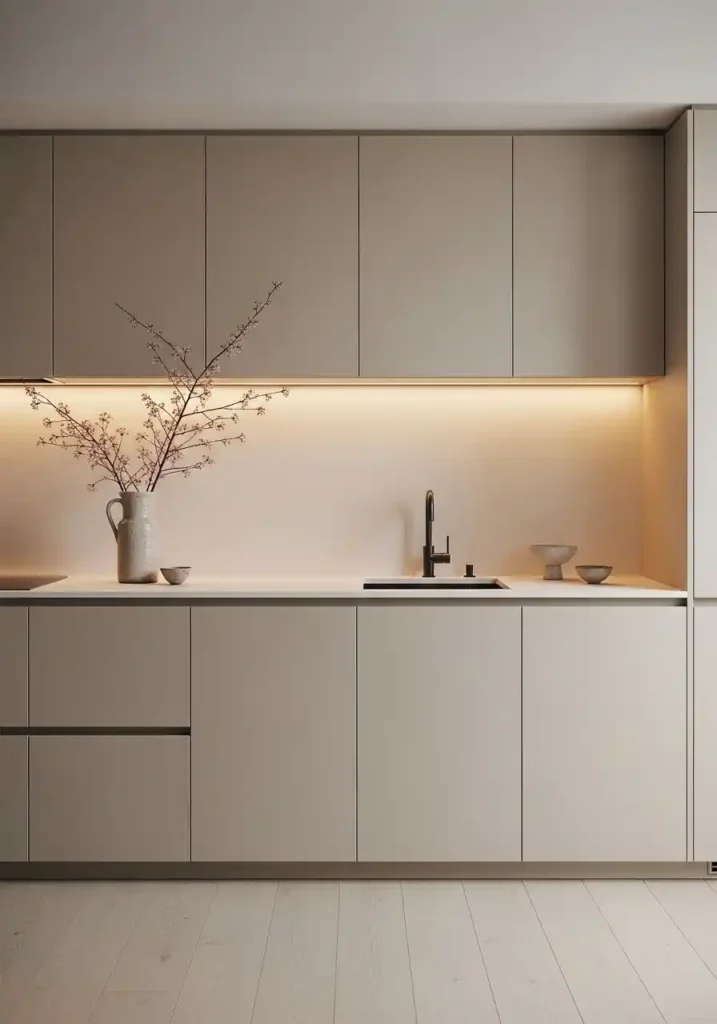
The Japandi kitchen aesthetic is the design philosophy that achieves the most profound, the most sustained, and the most genuinely restorative kitchen beauty through the most disciplined and the most intelligently considered simplicity — because Japandi combines the Japanese aesthetic’s commitment to spatial emptiness, material honesty, and the specific beauty of perfectly resolved negative space with the Scandinavian aesthetic’s commitment to organic material warmth, human comfort, and the specific quality of gentle, welcoming domestic coziness, creating a kitchen that is simultaneously the most precisely minimal and the most warmly inviting available in contemporary kitchen design. This kitchen is empty and full of beauty.
The single dried cherry blossom branch in the tall handmade ceramic vase is the Japandi kitchen’s most philosophically significant and most aesthetically precise design element — because it demonstrates the central Japandi principle that one beautiful, carefully chosen natural object in the right position contributes more beauty and more atmospheric meaning to a room than any number of additional objects, no matter how individually beautiful those additional objects might be. The branch occupies space with the specific authority of something that has been placed with complete, deliberate intention — and its presence makes the surrounding emptiness of the pale countertop and the clean cabinet surfaces appear not as absence but as the generous, breath-giving space that allows the single beautiful object to be fully seen and fully appreciated.
6. The Industrial Urban Loft Kitchen Aesthetic
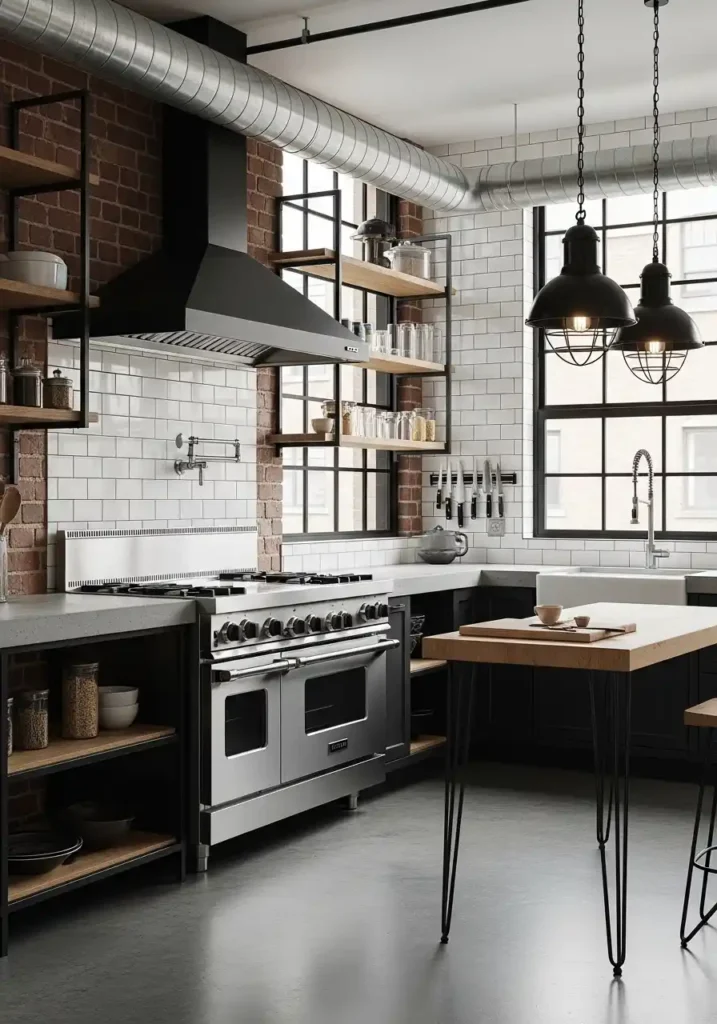
The industrial urban loft kitchen aesthetic is the design language that most completely and most authentically translates the specific visual and material vocabulary of genuine industrial architecture — exposed structural steel, polished concrete, raw brick, factory-style windows, commercial-grade equipment — into a residential kitchen context of genuine domestic warmth and genuine culinary ambition. The industrial kitchen is not rough or unfinished by accident or by budget limitation — it is rough and honest by deliberate design choice, choosing to expose and celebrate the genuine structural and material character of industrial construction rather than concealing it behind the smooth, finished surfaces of conventional residential decoration.
The polished concrete countertop is the industrial kitchen’s most completely honest and most materially confident surface choice — because polished concrete is not imitating any other material, pretending to be stone or trying to appear more expensive than it is, but presenting itself completely as what it genuinely is: a mixture of cement, aggregate, and water, formed in place and ground to a smooth finish that reveals the material’s own specific internal character of small aggregate stones, mineral variations, and the occasional small bubble or void that the concrete’s natural formation process creates. This quality of complete material honesty is the industrial aesthetic’s most fundamental value, and polished concrete expresses it more directly and more completely than any other kitchen countertop material.
7. The Cottagecore Romantic Kitchen Aesthetic
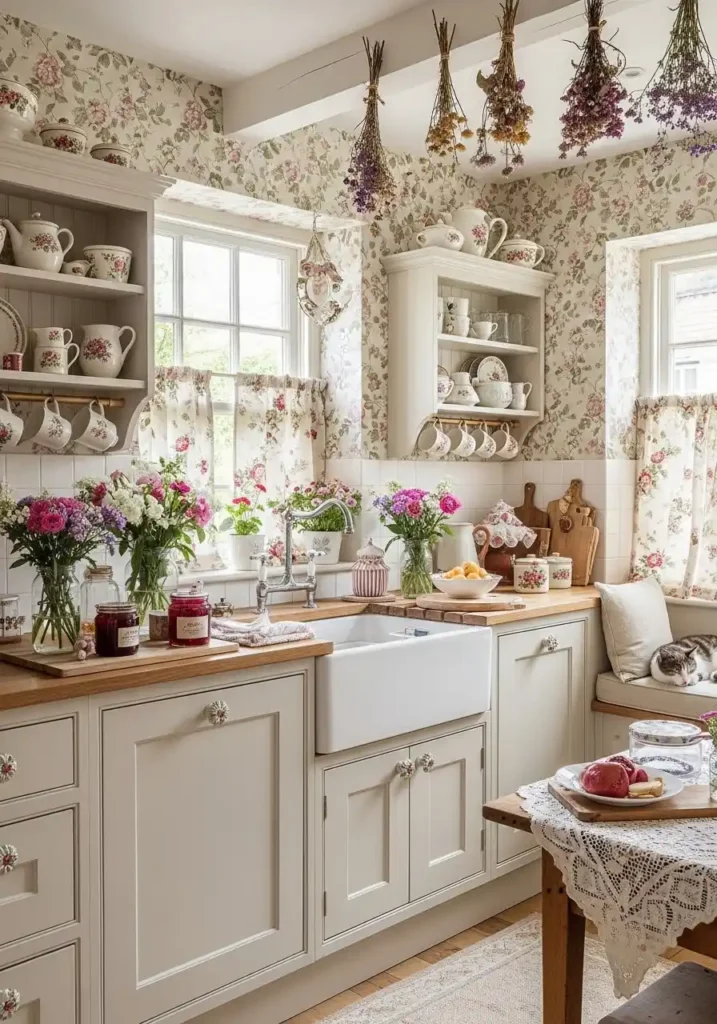
The cottagecore kitchen aesthetic is the design response to the specific longing for a quality of domestic life that is simpler, more connected to the natural world, more romantically beautiful, and more genuinely, unhurriedly pleasurable than contemporary urban life typically provides — a longing for the specific warmth and the specific beauty of a small, flower-filled, gently imperfect English country cottage kitchen where everything is slightly worn, slightly faded, slightly fragrant, and completely, radiantly lovely. The cottagecore kitchen does not aspire to precision or perfection — it aspires to genuine warmth, genuine natural beauty, and the specific quality of domestic happiness that makes every morning in it feel like a moment from the most beautiful novel you have ever read.
The floral wallpaper above the kitchen counter is the cottagecore kitchen’s most romantically powerful and most atmospherically complete design statement — because floral wallpaper in the kitchen transforms the cooking environment from a functional room into a garden room, surrounding the cook with the visual abundance of flowers and botanical forms that reference the garden just outside the window while creating a quality of domestic warmth and gentle, pattern-rich beauty that the most expensive hard surface material could never replicate. Soft pinks, warm creams, and sage greens in a traditional floral pattern create the specific gentle, nostalgic color world that cottagecore inhabits most beautifully — not loud or saturated but soft, slightly faded, and completely, timelessly romantic.
8. The Scandi Hygge Kitchen Aesthetic
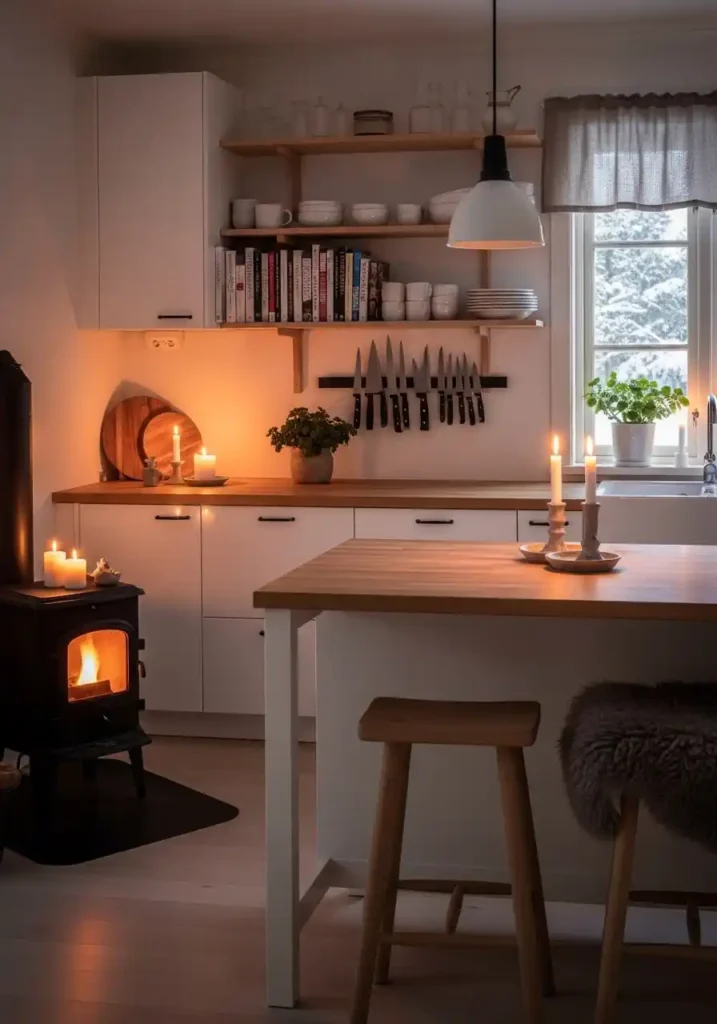
The Scandi hygge kitchen aesthetic is the design philosophy that most directly and most intentionally addresses the human need for genuine domestic comfort, genuine warmth, and the specific quality of peaceful, candle-lit, quietly content domestic happiness that the Nordic concept of hygge captures so beautifully and so completely — a quality of warmth that is not about luxury or expense or design sophistication but about the specific feeling of being completely safe, completely comfortable, and completely at ease in a warm, beautiful, unpretentious domestic space surrounded by the simple things you love most. The hygge kitchen is small, warm, candle-lit, and completely, profoundly sufficient.
Candles are the hygge kitchen’s single most important and most atmospherically transformative design element — because candlelight creates a quality of warm, intimate, gently flickering illumination that no electric light source, however warm its color temperature, can replicate with the same organic, living quality of light movement and the same specific psychological effect of creating genuine warmth and genuine relaxation in every person who sits within its glow. A hygge kitchen illuminated by candles on the counter and the island, with a small potbelly stove casting its amber warmth from the corner, creates an atmosphere of such complete, deeply satisfying domestic comfort that every evening meal prepared within it feels like a genuinely precious, genuinely cherished moment.
9. The Mediterranean Rustic Kitchen Aesthetic
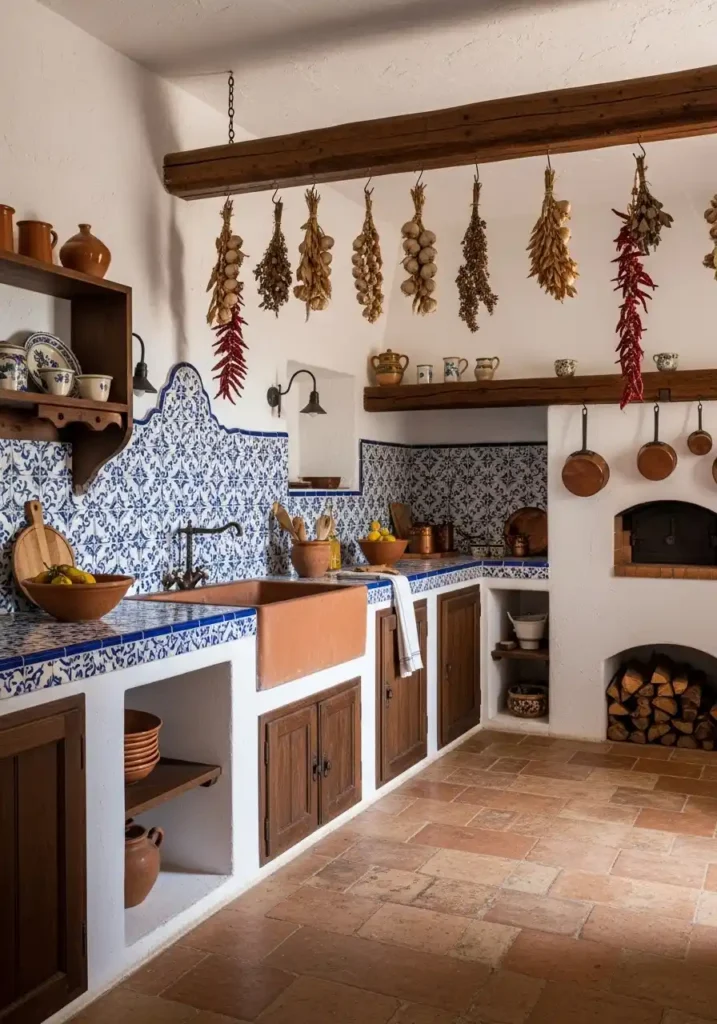
The Mediterranean rustic kitchen aesthetic is the design approach that most completely recreates the specific quality of ancient, sun-warmed, genuinely agricultural domestic beauty that centuries of Mediterranean cooking culture have produced in the farmhouse kitchens of Greece, Italy, Spain, and North Africa — kitchens where the food is extraordinary because the ingredients are extraordinary, where the cooking is magnificent because the kitchen is magnificent, and where the beauty of the space is inseparable from the beauty of the food produced within it in the most direct and the most authentic way possible. This kitchen smells of garlic, olive oil, and dried herbs and looks exactly as it should.
The hand-painted Azulejo tile backsplash is the Mediterranean kitchen’s most immediately recognizable, most culturally specific, and most completely beautiful design element — because the Azulejo tradition of hand-painted blue and white ceramic tile, developed in Portugal and Spain over five centuries of extraordinary craft refinement, creates a backsplash of such completely individual artisanal beauty that every tile is a small painting and every backsplash is a unique, irreplaceable work of applied ceramic art that tells the story of the specific tradition, the specific craftsperson, and the specific pattern vocabulary that created it. No two Azulejo-tiled kitchens in the world are alike, and that complete individuality is their most precious quality.
10. The Mid-Century Modern Kitchen Aesthetic
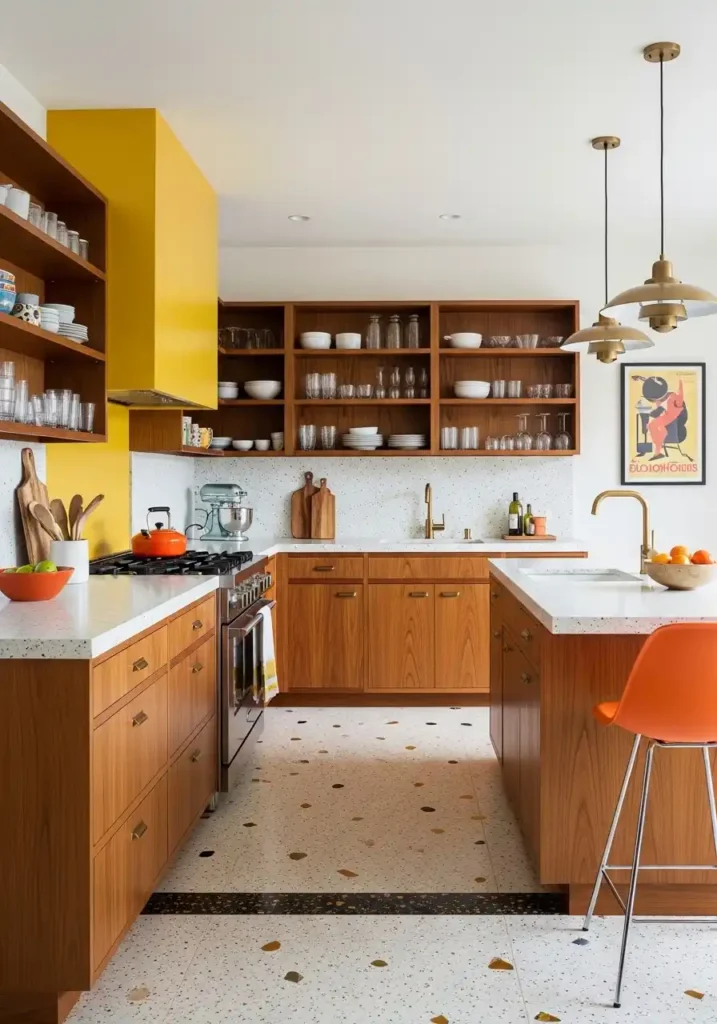
The mid-century modern kitchen aesthetic is the design language that most precisely and most lovingly recreates the optimistic, forward-looking, beautifully resolved domestic design culture of the 1950s and 1960s — a period when architects and designers genuinely believed that good design could improve daily life for everyone, and created furniture, buildings, and domestic interiors of such complete, democratically minded, functionally brilliant aesthetic quality that their best examples remain as fresh, as relevant, and as genuinely beautiful today as they were the day they were designed. Mid-century modern kitchen design is not nostalgic — it is timeless.
The warm teak veneer cabinet in a mid-century modern kitchen is the surface material that most authentically and most warmly recreates the specific material character of genuine 1950s and 1960s furniture design — because teak, with its warm honey-brown tone, its characteristic straight grain, and its specific quality of dense, durable, beautifully finished natural wood, was the defining cabinetry material of the mid-century modern period in domestic design, appearing in the best furniture of that era with a consistency and a quality that made it the material most immediately and most completely associated with the optimistic, beautifully crafted domestic aesthetic that mid-century modernism aspired to create in every home.
11. The Parisian Bistro Kitchen Aesthetic
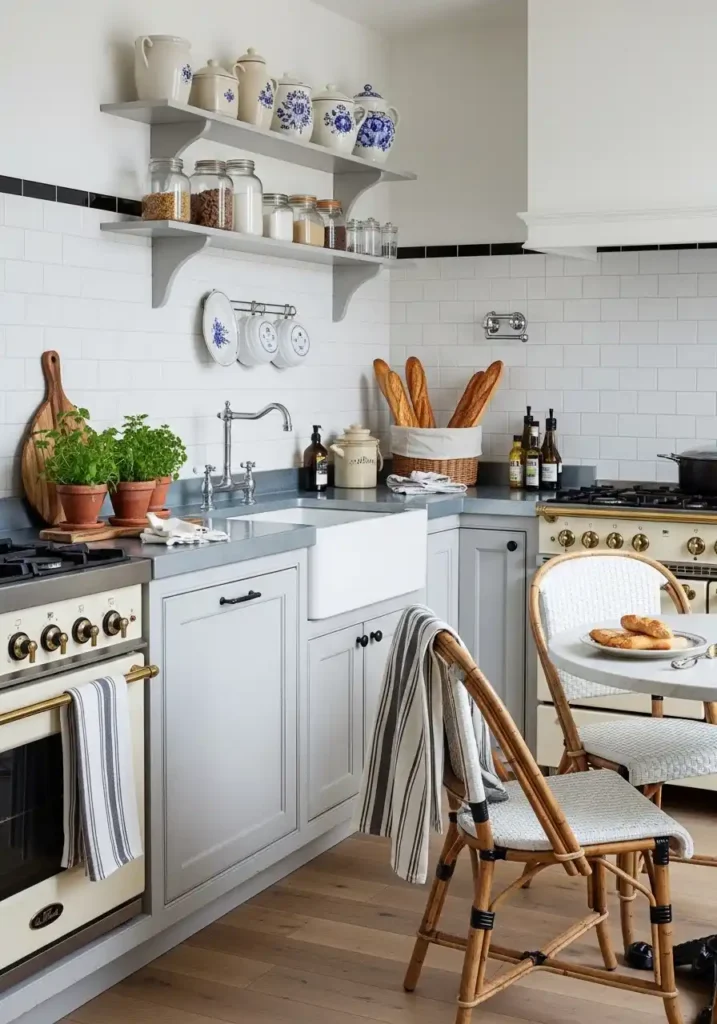
The Parisian bistro kitchen aesthetic is the design language that most completely and most effortlessly recreates the specific quality of French domestic confidence — the specific ease, the specific unpretentiousness, and the specific quality of beautiful things used without ceremony that characterizes the best French domestic interiors and that makes every kitchen in Paris appear to have been furnished and decorated by someone who knew exactly what they were doing and didn’t need to think about it very hard. The Parisian kitchen is not designed — it is simply the result of having excellent taste and the confidence to express it simply and directly without decoration for its own sake.
The zinc countertop with its natural patina is the Parisian bistro kitchen’s most authentic and most characterful surface choice — because zinc is the material of genuine French bistro and brasserie bar counters, worn smooth and silver-gray by decades of glasses, bottles, and elbows, and its presence in a domestic kitchen creates an immediate, unmistakable connection to that specific world of Parisian street-level cafe life that is one of the most romantically beautiful and most genuinely appealing aspects of French urban culture. The zinc develops a continuously evolving patina of extraordinary beauty with use and age, making it a living, changing material that becomes more beautiful every year.
12. The Bohemian Free-Spirit Kitchen Aesthetic
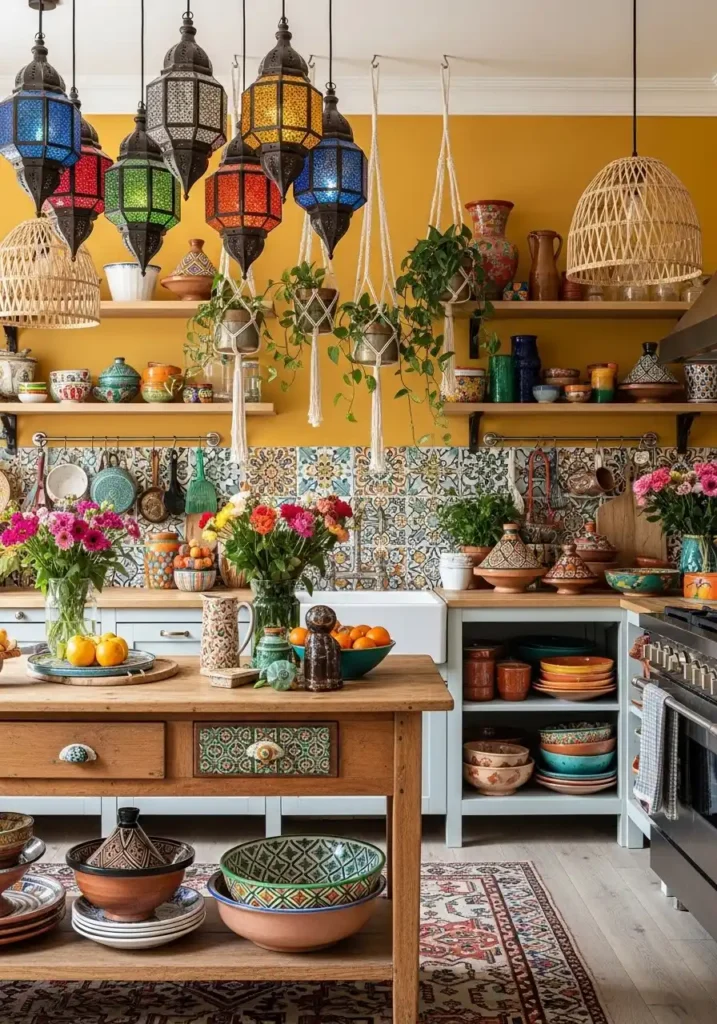
The bohemian kitchen aesthetic is the design philosophy that most completely, most joyfully, and most personally expresses the free-spirited, globally curious, deliberately unconventional sensibility of people who find beauty in unexpected places, collect objects from multiple cultures and traditions, and believe that the domestic environment should reflect the full richness and diversity of the world’s material and aesthetic traditions rather than conforming to any single design canon or any single cultural aesthetic. The bohemian kitchen has no rules except the rule that everything in it must be genuinely loved and genuinely beautiful to the person who lives within it.
The mixed pattern ceramic tile backsplash is the bohemian kitchen’s most colorfully confident and most globally expressive design element — because a backsplash that deliberately combines tiles from different pattern traditions, different color families, and different cultural origins in a single, rich, apparently improvised but genuinely considered composition creates a surface of such visual complexity and such accumulated cultural richness that it functions as a permanent, installed work of global ceramic art that no single-pattern, single-culture tile selection could approach in terms of visual energy and personal expression. Turquoise Moroccan zellige beside orange Mexican Talavera beside gold Indian mirror tile creates a kitchen backsplash of genuinely extraordinary, genuinely one-of-a-kind beauty.
13. The New England Preppy Kitchen Aesthetic
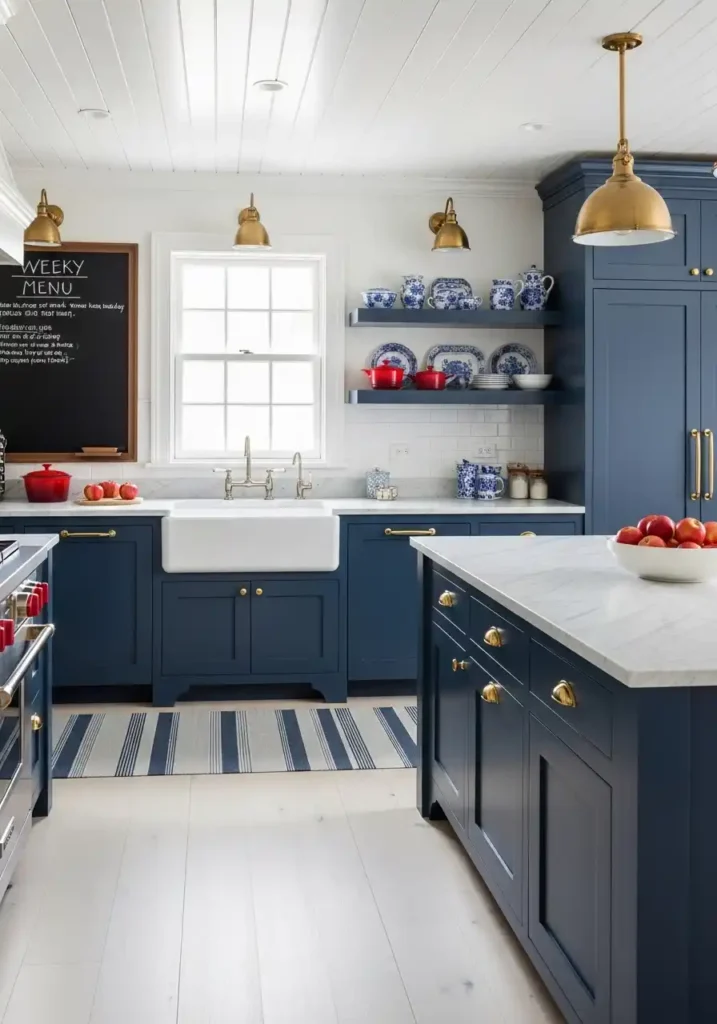
The New England preppy kitchen aesthetic is the design language of confident, classic, genuinely American domestic beauty — the kitchen of the beautiful New England farmhouse or the weekend beach cottage where everything is well-made, properly proportioned, and decorated with the specific combination of blue and white, brass and oak, shiplap and marble that has defined the American Northeast’s most beautiful domestic interiors for generations. The preppy kitchen is not trying to be fashionable or forward-thinking — it is trying to be excellent, and it succeeds so completely that it never needs to be updated, refreshed, or reconsidered because it was never following a trend in the first place.
The blue and white transferware pottery collection displayed on the New England kitchen’s open shelves is the preppy aesthetic’s most culturally specific and most historically rich decorating element — because blue and white transferware, with its specific tradition of English and American ceramic manufacture and its characteristic scenes of pastoral landscapes, classical architecture, and botanical subjects rendered in the specific blue of cobalt on white ceramic, connects the kitchen to a tradition of beautiful domestic objects that extends back to the eighteenth century with complete, unbroken cultural continuity. A shelf of well-chosen blue and white transferware is as beautiful today as it was two hundred and fifty years ago.
14. The Art Deco Glamour Kitchen Aesthetic
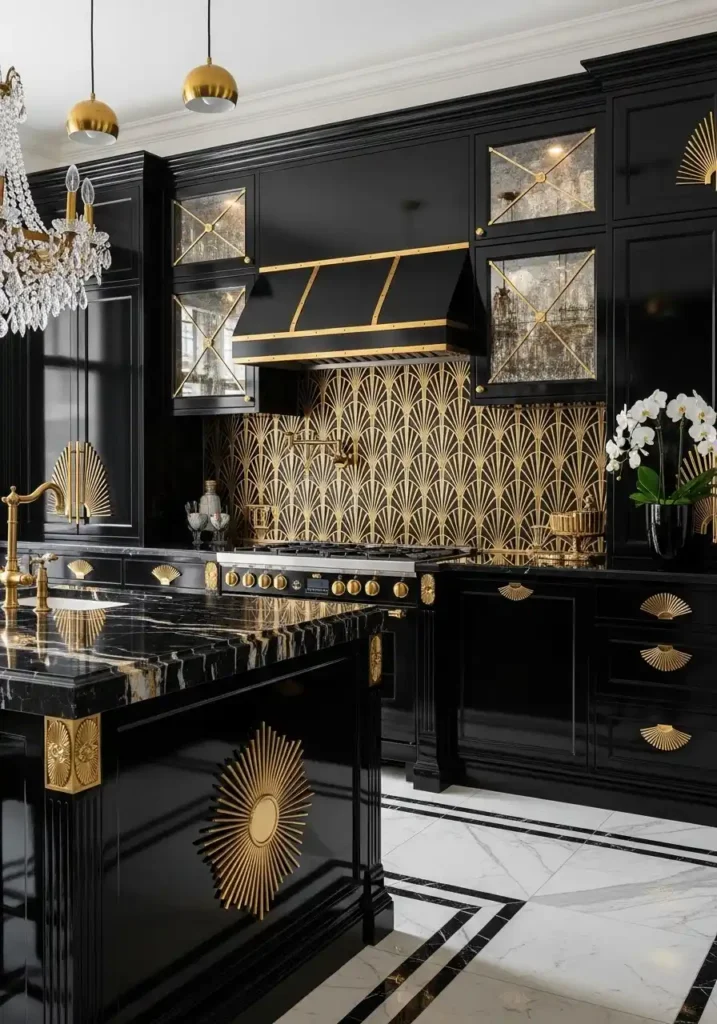
The Art Deco kitchen aesthetic is the design language that most completely and most magnificently translates the extraordinary glamour, the geometric confidence, and the unashamed luxurious ambition of 1920s and 1930s decorative design into the domestic cooking environment — creating a kitchen that possesses the specific quality of theatrical, geometrically perfect, opulently beautiful design that the Art Deco period at its finest achieved in its most spectacular hotels, ocean liners, and public buildings, and that makes every moment of cooking within it feel like a scene from the most beautifully designed film ever made. The Art Deco kitchen is genuinely, magnificently glamorous.
The geometric fan and sunburst hardware in polished gold on black lacquer cabinets is the Art Deco kitchen’s most immediately recognizable, most completely period-authentic, and most spectacularly beautiful design detail — because the Art Deco period’s specific vocabulary of geometric ornament — the fan, the sunburst, the stepped pyramid, the zigzag — was the first truly modern ornamental language in the history of Western decorative design, replacing the organic curves of Art Nouveau with a bold, angular, machine-age geometry of extraordinary visual precision and extraordinary decorative confidence. This hardware is not decoration — it is the manifestation of a complete, brilliantly resolved design philosophy expressed in the most intimate and the most daily-handled form available.
15. The Rustic French Country Kitchen Aesthetic
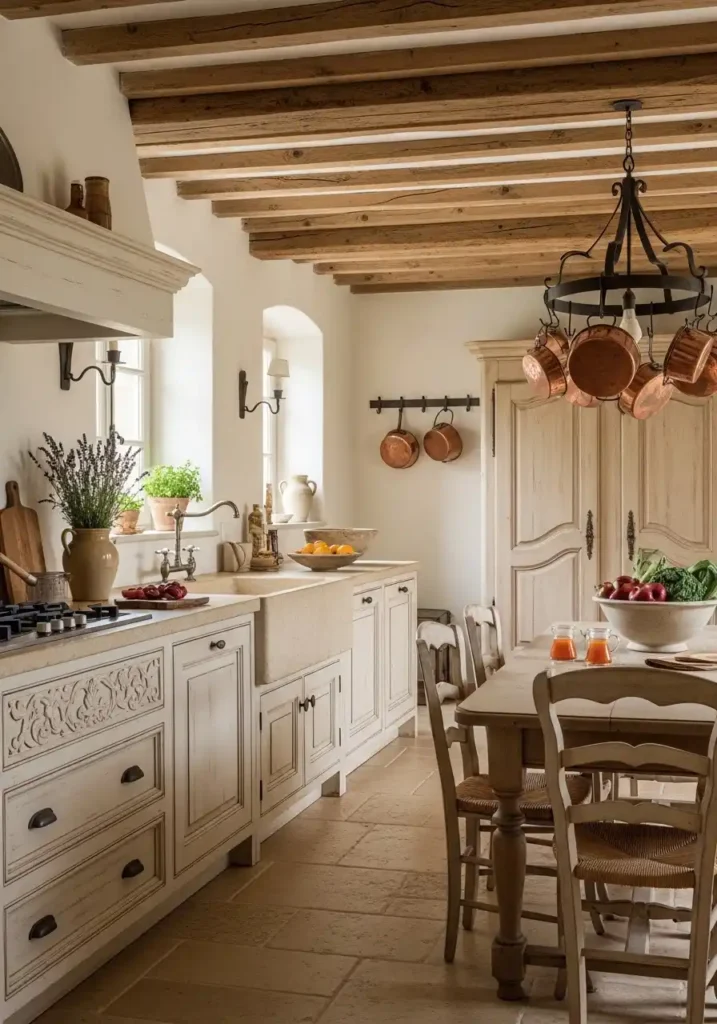
The rustic French country kitchen aesthetic is the design approach that most completely and most authentically recreates the specific quality of warm, beautiful, genuinely agricultural domestic life in the French countryside — the kitchen of a Provençal farmhouse or a Burgundian manor where the cooking is serious, the ingredients are exceptional, the equipment is honest and hardworking, and the beauty of the space emerges not from designed decoration but from the accumulated presence of beautiful, genuinely functional objects used with love and knowledge over generations. The French country kitchen has no aesthetic ambitions beyond being completely honest and completely genuine — which is why it is always, without exception, completely beautiful.
The exposed oak ceiling beams of a rustic French country kitchen are the architectural element that most powerfully and most immediately establishes the space’s historical character and its genuine connection to the agricultural building tradition of the French countryside — because the massive, hand-hewn beams of an original French farmhouse kitchen were not decorative choices but structural necessities, the actual timber frame of a building whose construction preceded the invention of the power tools that would have made their fabrication easier, and their presence in the kitchen communicates the building’s genuine age, genuine solidity, and genuine historical character with a directness and an authority that no decorative treatment applied to a modern structure can replicate.
16. The Tropical Maximalist Kitchen Aesthetic
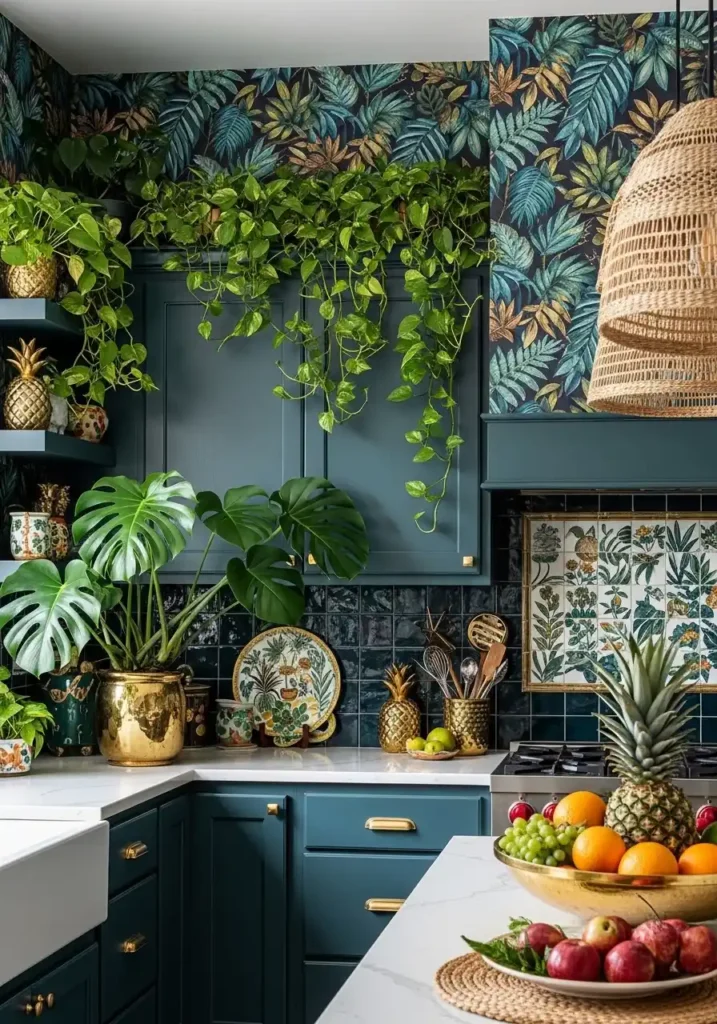
The tropical maximalist kitchen aesthetic is the design approach that most completely and most exuberantly brings the specific visual richness, the botanical abundance, and the warm, saturated color world of the tropical garden into the domestic cooking environment — creating a kitchen of such complete, immersive, gloriously lush natural beauty that cooking within it feels like preparing food in the most beautifully overgrown, most vibrantly colorful garden greenhouse imaginable. The tropical kitchen is not subtle, not restrained, and not trying to be — it is the design equivalent of a tropical garden at its most abundant and most spectacular, and it achieves that quality with complete, magnificent confidence.
The dramatic tropical leaf wallpaper above the kitchen counter is the tropical maximalist kitchen’s most atmospherically powerful and most completely immersive design element — because large-scale tropical botanical wallpaper in deep, saturated greens and blues creates an immediate, total visual environment of such rich, abundant, genuinely tropical botanical beauty that it transforms the kitchen from a room with nice decoration into a genuinely immersive space where the cook is surrounded on all sides by the visual richness of monstera leaves, palm fronds, and bird of paradise flowers rendered at a scale and a color intensity that makes the kitchen feel like stepping into the most beautiful tropical botanical garden rather than simply a room with a floral pattern on the wall.
17. The Grandmillennial Vintage Kitchen Aesthetic
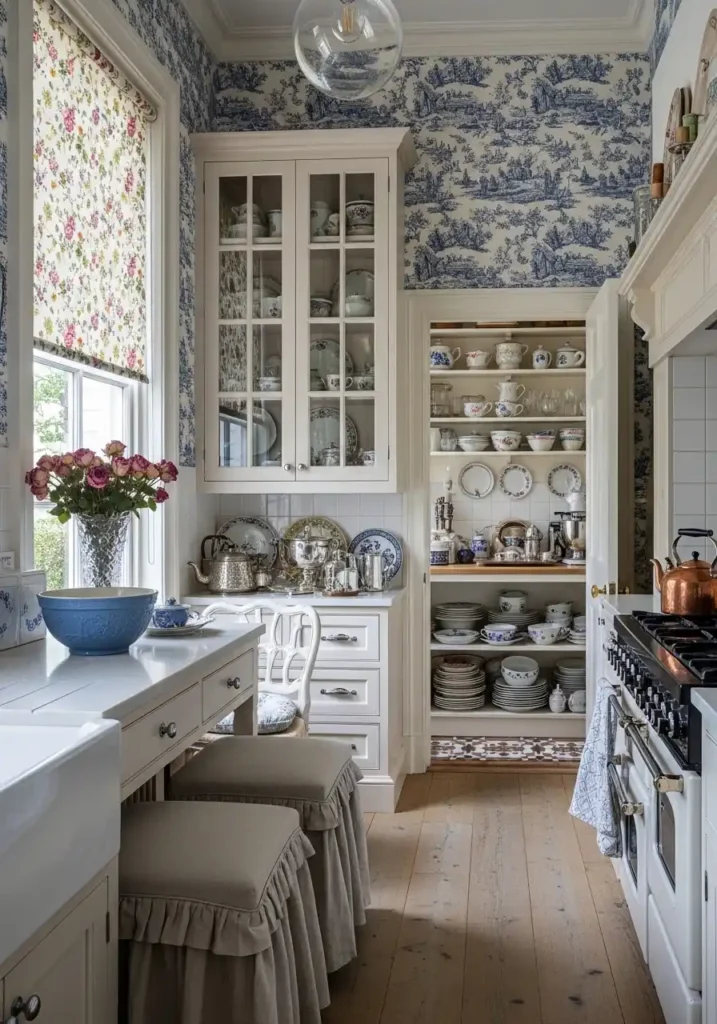
The grandmillennial vintage kitchen aesthetic is the design movement that most directly and most affectionately reclaims the specifically feminine, specifically accumulated, specifically layered domestic aesthetic of grandmothers’ kitchens — the aesthetic that an entire generation of minimalist design culture tried to consign to the past as outdated, cluttered, and insufficiently contemporary, and that is now being recognized and celebrated as one of the most warm, the most personal, and the most genuinely beautiful domestic aesthetics available. The grandmillennial kitchen is not trying to look vintage — it is vintage, assembled over time from genuinely loved, genuinely beautiful objects that tell the real story of a real domestic life.
The glass-fronted display cabinet loaded with mismatched vintage china and crystal is the grandmillennial kitchen’s most characterful and most personally expressive storage and display element — because a collection of genuinely mismatched vintage china assembled from family inheritance, antique markets, and charity shops over decades of domestic life creates a display of such completely individual, completely personal, completely irreplaceable material character that no deliberately curated, perfectly matched cabinet of new china could approach in terms of genuine warmth, genuine personal expression, and genuine domestic history. The mismatching is not a failure of coordination — it is the proof of a real life, genuinely and beautifully lived.
18. The Organic Modern Kitchen Aesthetic
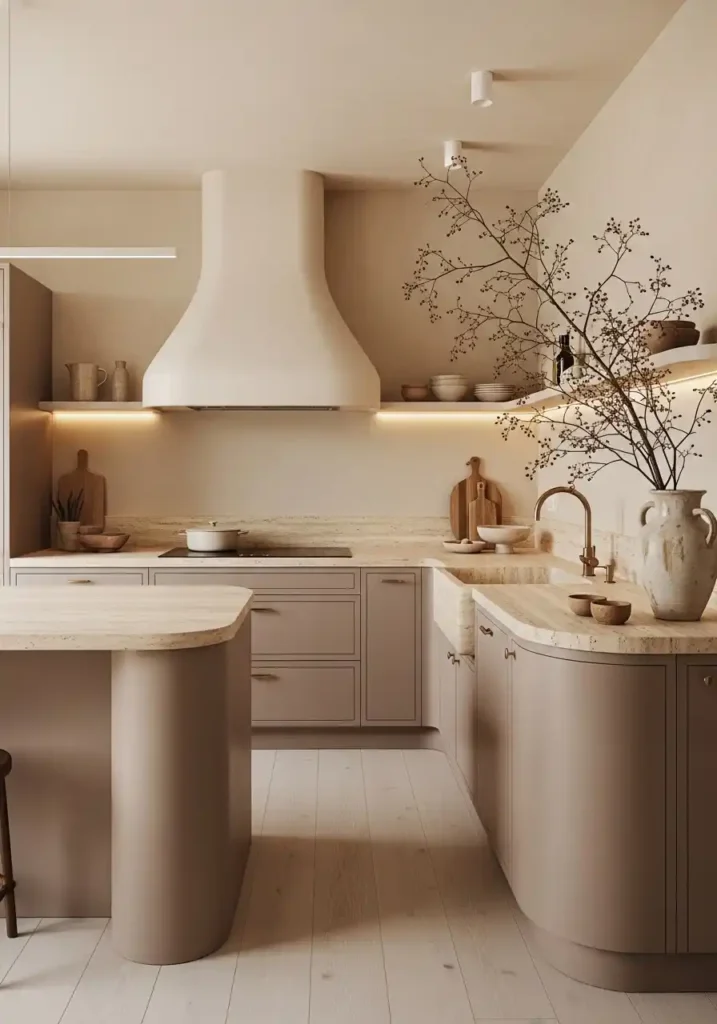
The organic modern kitchen aesthetic is the most genuinely contemporary and the most completely forward-thinking of all current kitchen design directions — because it represents the synthesis between minimalist contemporary precision and the organic, biomorphic warmth of natural forms that is the specific aesthetic achievement of the current design moment: the recognition that the purely rectilinear, purely geometric aesthetic of hard-edged contemporary design produces spaces of impressive visual precision but insufficient human warmth, and that introducing organic curves, natural materials, and the specific quality of form inspired by the natural world creates contemporary spaces of both genuine precision and genuine warmth simultaneously.
The warm putty cabinet tone of the organic modern kitchen is the specific color choice that most completely expresses the aesthetic’s essential character — because warm putty occupies the precise tonal territory between the cold, blue-toned whites of clinical minimalism and the warmer, more saturated tones of earthy or rustic design directions, creating a color of such complete, quiet, organic sophistication that it makes every natural material it accompanies appear more beautiful and more warmly resolved by its presence. Putty with travertine, with pale oak, with limewash walls, and with the warm amber of indirect LED lighting creates a kitchen of such sustained, complete, continuously beautiful warmth that it is genuinely impossible to tire of.
19. The Biophilic Nature-Immersed Kitchen Aesthetic
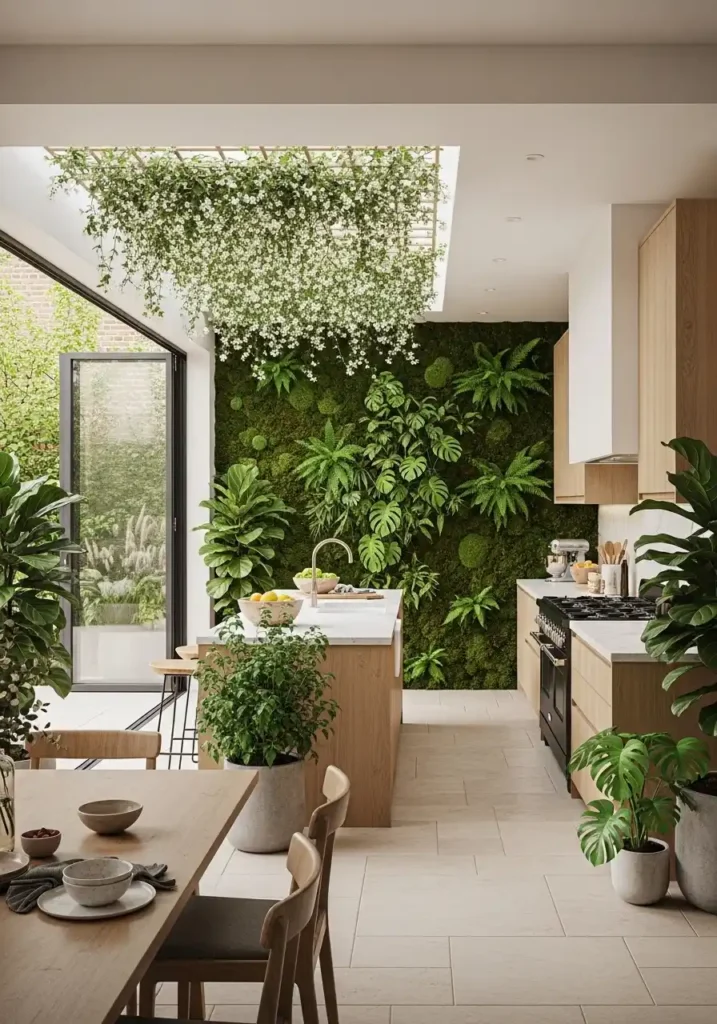
The biophilic kitchen aesthetic is the design approach that most directly, most deliberately, and most completely responds to the specific human need for genuine, continuous, multi-sensory connection with the living natural world — a need that contemporary research has consistently demonstrated is not merely an aesthetic preference but a genuine biological requirement for human physical and psychological health, wellbeing, and happiness. The biophilic kitchen is not decorated with plants — it is designed as a space of complete, immersive natural connection where the boundaries between interior cooking environment and exterior living world are reduced to the minimum possible or eliminated entirely, creating a kitchen that is genuinely, fundamentally part of the natural world it inhabits.
The full living green wall panel is the biophilic kitchen’s most spectacular and most completely realized expression of its design philosophy — because it transforms one entire kitchen wall from an inert, manufactured surface into a genuinely living, breathing, constantly growing and changing vertical garden of genuine organic complexity and genuine organic beauty. A properly designed living wall with a range of fern species, trailing pothos, moss panels, and climbing plants creates a kitchen wall of such rich, green, living material presence that it appears to breathe with the kitchen’s air and to change subtly with every season, every day, and every shift in natural light, making the kitchen feel genuinely, continuously alive in a way that no other design intervention can achieve.
20. The Rustic Lodge Kitchen Aesthetic
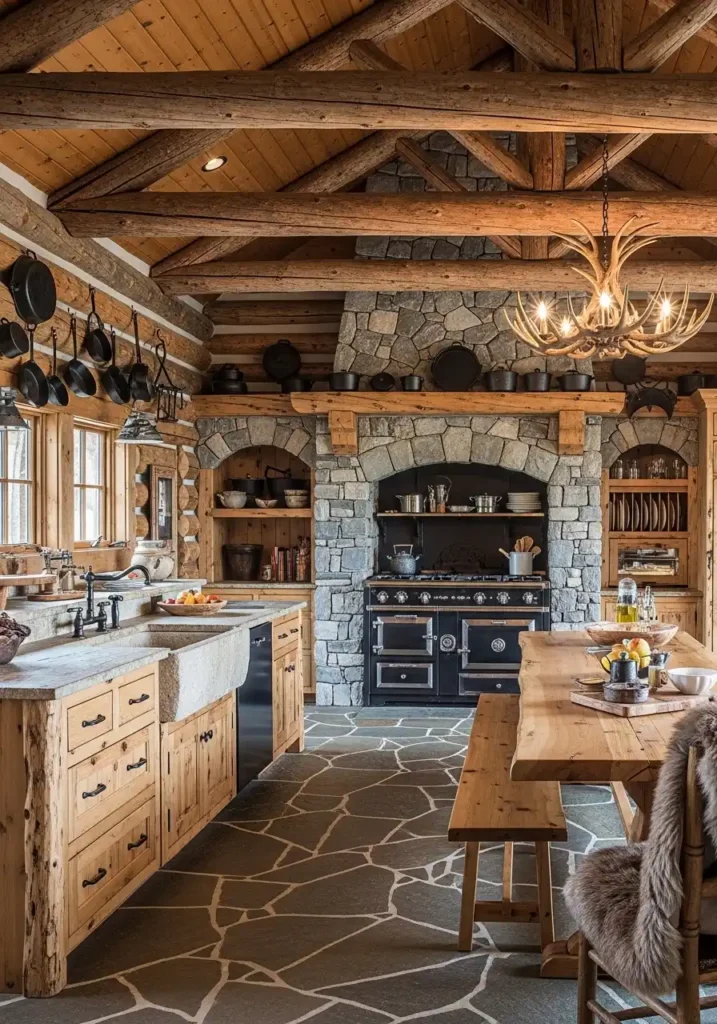
The rustic lodge kitchen aesthetic is the design language of genuine wilderness retreat and mountain cabin architecture — a kitchen that most completely recreates the specific quality of warmth, solidity, and deeply satisfying natural material abundance that the best mountain lodge interiors provide, where every material is genuinely local, genuinely structural, and genuinely exposed in its most honest and most visually dramatic form. The lodge kitchen is the kitchen of a place that takes the seriousness of cold winters and the beauty of mountain landscapes equally seriously, and designs its domestic spaces with the specific combination of genuine warmth and genuine natural grandeur that both realities demand.
The massive stone fireplace integrated into the lodge kitchen wall beside the cooking range is the architectural element that most powerfully and most completely defines the lodge kitchen’s specific domestic character — because it combines the functional warmth of a genuine hearth with the visual grandeur of a natural stone masonry construction of genuine scale and genuine weight, creating a focal point of such overwhelming material presence and such completely primal domestic warmth that every other element in the kitchen exists in relation to it rather than independently of it. The stone fireplace is the lodge kitchen’s architectural heart — the point around which cooking, warming, gathering, and the most ancient human rituals of fire and food naturally organize themselves.
21. The Modern Farmhouse Kitchen Aesthetic
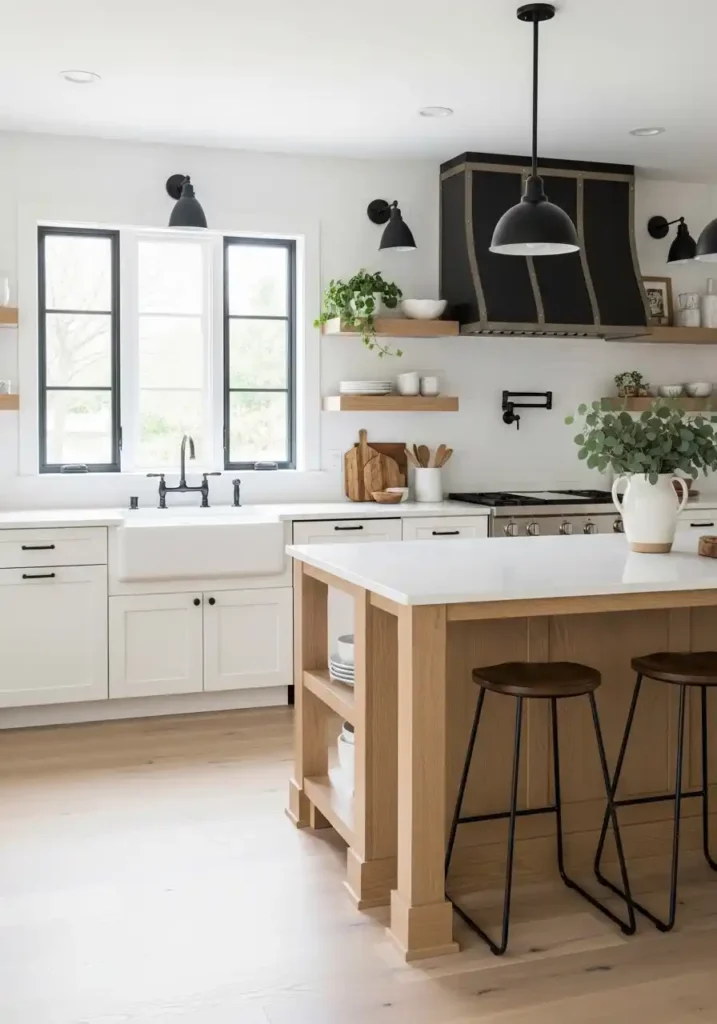
The modern farmhouse kitchen aesthetic is the design synthesis that most successfully and most beautifully resolves the apparent tension between the warmth, the character, and the organic authenticity of traditional farmhouse design and the precision, the clean lines, and the material confidence of genuinely contemporary kitchen design — creating a kitchen that possesses both the comforting familiarity and genuine domestic warmth of the traditional farmhouse and the spatial clarity and design intelligence of the contemporary home, without compromising either quality in service of the other. The modern farmhouse kitchen is the kitchen that makes everyone feel immediately at home and immediately impressed simultaneously.
The black steel and glass window above the farmhouse sink is the modern farmhouse kitchen’s most defining and most contemporary architectural detail — because the combination of the black steel frame’s industrial precision with the traditional farmhouse apron sink below creates the specific visual and material contrast that defines the entire modern farmhouse aesthetic in a single, beautifully resolved architectural moment. The black steel frame is contemporary, industrial, and precise. The white ceramic apron sink is traditional, warm, and domestic. Together, they create the most complete and the most convincing expression of the modern farmhouse’s fundamental design principle: that contemporary and traditional materials, in the right relationship and the right proportions, make each other more beautiful and more interesting than either could be alone.
22. The Maximalist Pattern and Tile Kitchen Aesthetic
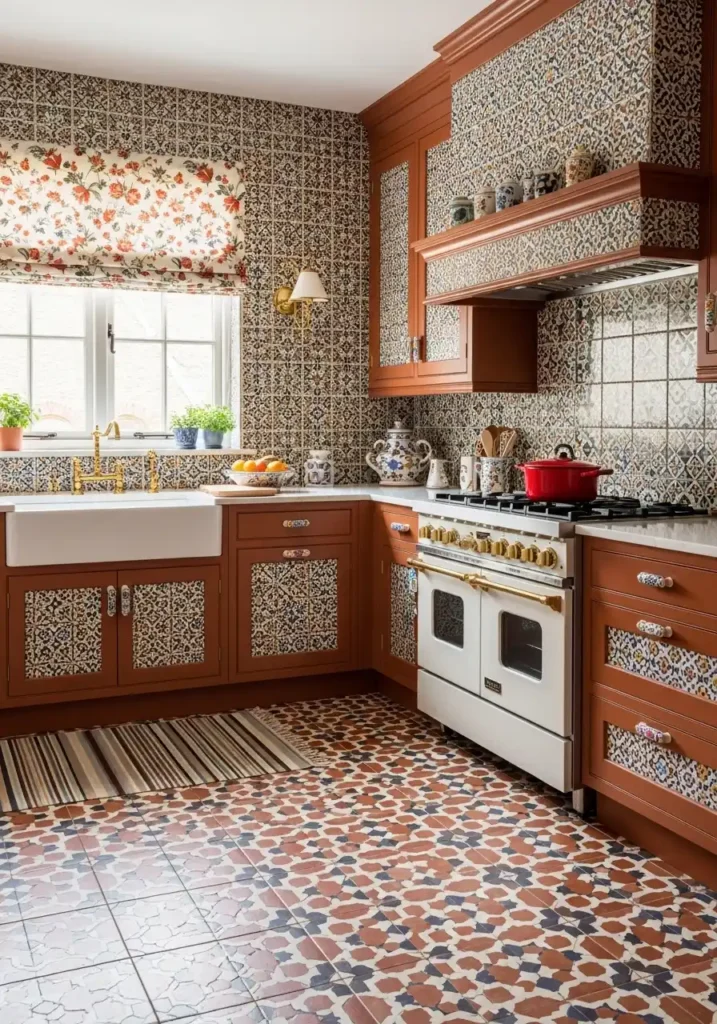
A maximalist pattern and tile kitchen is the design approach that most completely, most boldly, and most joyfully embraces the specific visual language of global pattern traditions — Moroccan geometric, Portuguese Azulejo, Victorian encaustic, Indian ikat, Mexican Talavera — combining them in a single kitchen that functions as a living celebration of the extraordinary richness and the extraordinary diversity of the world’s pattern-making heritage. The key to making multiple pattern traditions work together in a single kitchen is the principle of color palette unity — when patterns from different traditions share the same family of colors, their visual languages can coexist in a single space with complete harmony despite their structural differences.
The encaustic tile floor is the pattern kitchen’s most spatially generous and most continuously visible pattern surface — because the floor, as the room’s largest surface visible from every position within it, carries the pattern kitchen’s most important and most compositionally foundational pattern decision, setting the color palette and the pattern vocabulary that every other surface in the kitchen must reference and complement. A floor of rich terracotta, cobalt, and cream encaustic tiles creates a warm, jewel-toned pattern foundation from which a Moroccan backsplash in complementary tones, a geometric cabinet insert, and a striped runner in coordinating colors can all depart and to which they all simultaneously and naturally return.
23. The Contemporary Luxe Kitchen Aesthetic
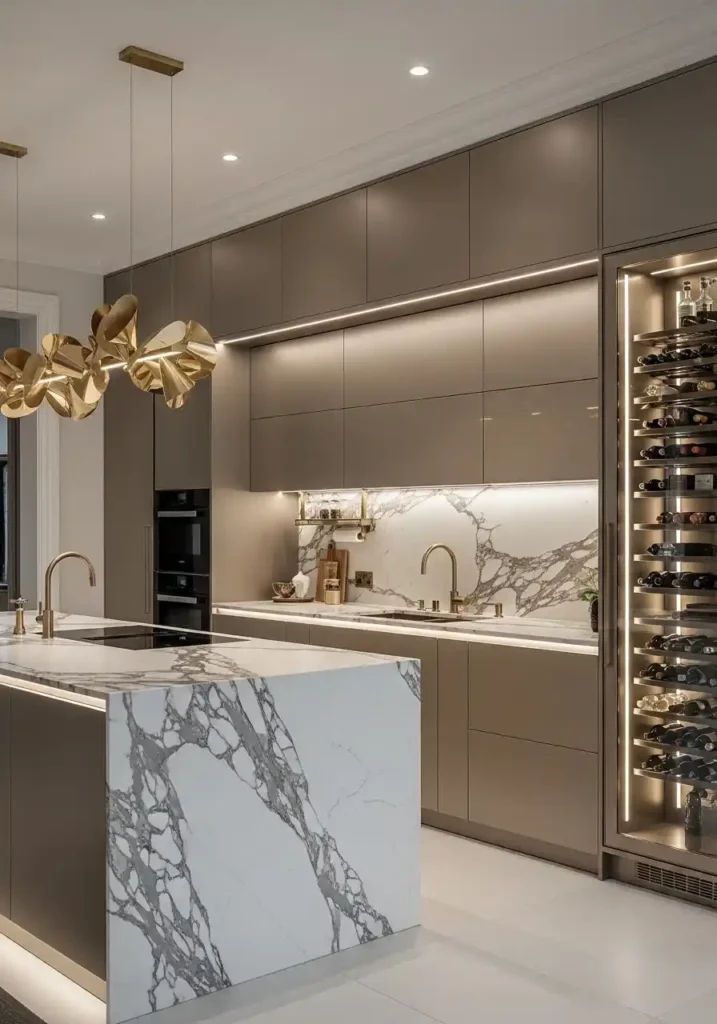
The contemporary luxe kitchen aesthetic is the design approach that communicates premium quality, exceptional craftsmanship, and genuine luxury most completely and most quietly — without the need for conspicuous display, obvious brand references, or any design gesture that announces its own expensiveness. The contemporary luxe kitchen is expensive in the way that the most genuinely expensive things are always expensive: through the quality of material specification, the precision of manufacturing execution, the intelligence of design resolution, and the subtle accumulation of exceptional details that are visible only to those who know to look for them, and that are felt by everyone through the specific quality of the daily experience they create.
The bookmatched Paonazzo marble waterfall island is the contemporary luxe kitchen’s single most spectacular and most materially magnificent design element — because Paonazzo marble, with its extraordinary white ground crossed by dramatic purple-red and gray veining of such geological confidence and such natural artistic beauty that it appears to have been painted by the most skilled and the most boldly composed abstract artist rather than formed by geological processes, creates a waterfall island of such complete, concentrated material splendor that it functions simultaneously as the kitchen’s most practical working surface and its most extraordinary, most completely irreplaceable work of natural art.
24. The Complete Kitchen Aesthetic Inspiration — Finding Your Perfect Style
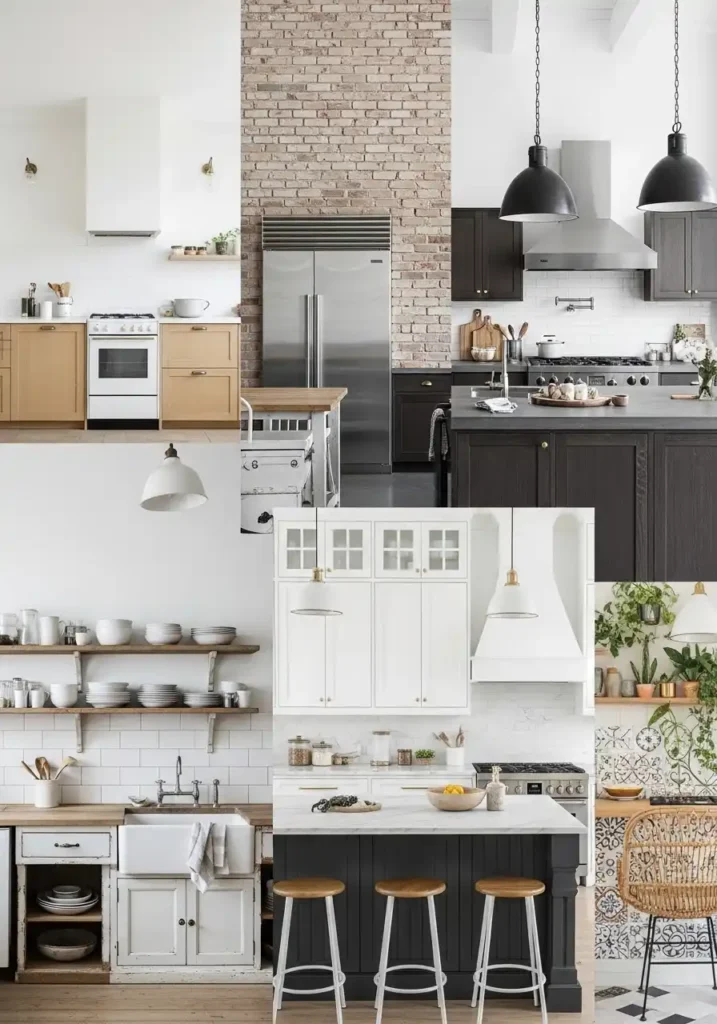
The twenty-four kitchen aesthetics this guide has explored represent not twenty-four separate, mutually exclusive design choices but twenty-four different points of entry into the single, endlessly rich conversation about what makes a kitchen genuinely, personally, and completely beautiful for the specific person who will cook, eat, gather, and live within it every day. The perfect kitchen aesthetic for you is not the one that appears most frequently on Pinterest or the one that photographs most dramatically or the one that the most celebrated interior designers are currently specifying — it is the one that most completely reflects the specific quality of domestic beauty, the specific material warmth, and the specific everyday pleasures that make your daily cooking and eating life most genuinely, most continuously, most deeply satisfying.
The invitation this guide extends is the most personal and the most genuinely liberating of any kitchen design resource — because it encourages you not to choose an aesthetic from a list and apply it wholesale to your kitchen but to use these twenty-four aesthetic directions as a language of design possibilities from which you can select, combine, and personalize the specific elements that speak most directly and most powerfully to your own specific vision of kitchen beauty. The classic white kitchen with a bohemian pottery collection. The Japandi minimalism with a cottagecore floral blind. The industrial aesthetic with a Mediterranean tile backsplash. The most beautiful kitchens are always the ones that are completely, unapologetically, magnificently personal.
Conclusion:
In the end, creating a beautiful kitchen is about blending style, functionality, and personality. Whether you prefer a modern minimalist kitchen, a rustic farmhouse vibe, a cozy cottage look, or a bold contemporary design, the right aesthetic can completely transform the heart of your home. These 24 kitchen aesthetic inspirations show that with the right colors, textures, lighting, and décor, any kitchen can become both practical and visually stunning.
When designing your space, focus on elements that reflect your lifestyle—such as smart storage, natural materials, statement lighting, or sleek cabinetry. Even small updates like open shelving, stylish backsplashes, indoor plants, or warm lighting can elevate the overall kitchen atmosphere.
Ultimately, the perfect kitchen aesthetic is one that balances beauty with everyday usability. By exploring different kitchen design styles and incorporating ideas that resonate with you, you can create a space that feels welcoming, inspiring, and uniquely yours.
Pro tip: Save your favorite ideas from these kitchen aesthetics and start planning small upgrades that gradually turn your dream kitchen into reality.