1. Shiplap Accent Wall Behind the Sofa
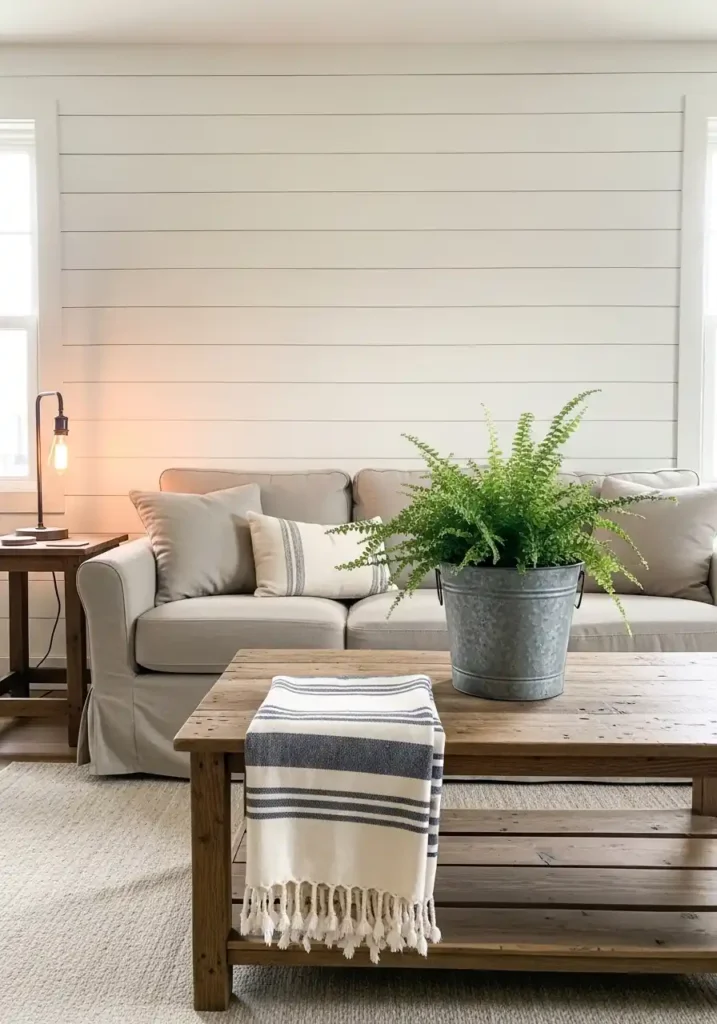
If there is one single design element that says farmhouse living room more clearly, more beautifully, and more instantly than anything else in the entire world of interior design, it is a shiplap wall — and the moment you install one behind your sofa, your living room crosses a threshold it can never come back from. In the best possible way. Shiplap adds horizontal texture, architectural character, and a deeply satisfying sense of craftsmanship to a room that painted drywall simply cannot replicate no matter how carefully it’s prepared and finished. It’s the element that transforms a nice room into a room with genuine soul.
What makes shiplap so enduringly beloved — and why it continues to dominate farmhouse living rooms on Pinterest year after year — is its remarkable versatility within the rustic aesthetic. Paint it crisp white for a bright, clean, coastal-farmhouse feel that bounces light beautifully across the room. Leave it in its natural wood tone for a warmer, more rugged, deeply rustic atmosphere that feels like a mountain cabin and a farmhouse had the most beautiful design baby imaginable. Whitewash it for something in between — weathered, organic, full of character. Any direction you take it, shiplap immediately makes your living room look intentional, designed, and deeply, genuinely charming.
2. Exposed Wooden Ceiling Beams for Rustic Drama
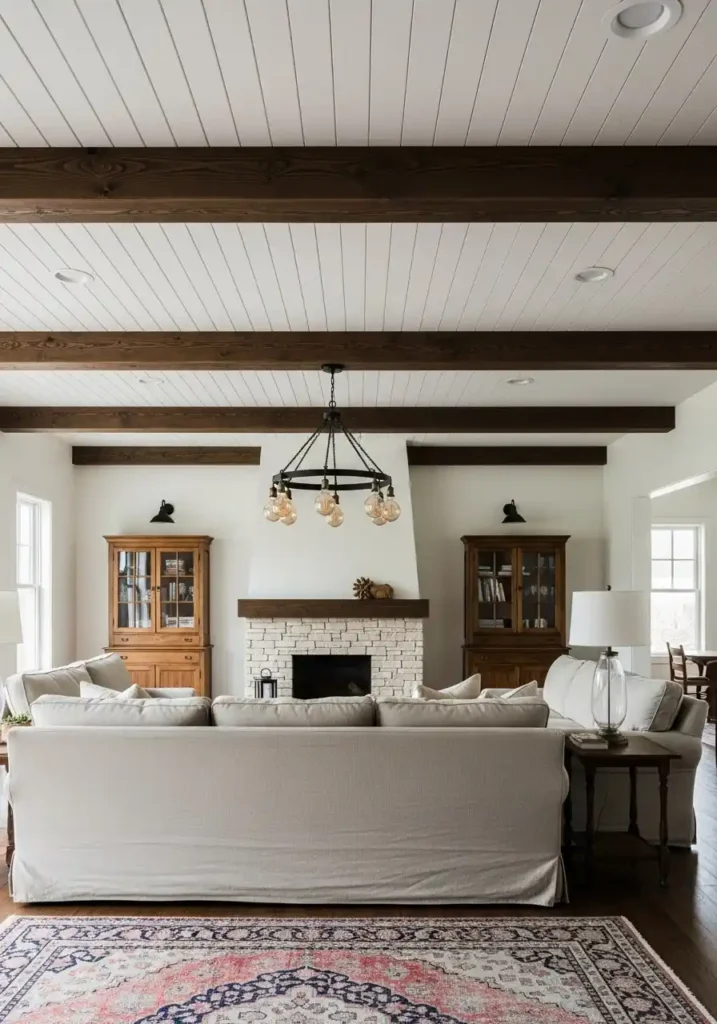
Exposed wooden ceiling beams are the farmhouse living room feature that makes people stop mid-conversation, tilt their heads upward, and say the same three words every single time: “I love that.” There is something about the combination of rough-hewn wood suspended overhead, the shadow lines they cast across a ceiling, and the unmistakable sense of age and craftsmanship they communicate that triggers an almost primal response of warmth and comfort in virtually every person who experiences them. Ceiling beams are farmhouse design at its most architectural, most dramatic, and most irreplaceably beautiful.
The great news for anyone who doesn’t happen to live in a nineteenth-century barn is that incredibly realistic faux beam options have made this look accessible to virtually any living room in any style of home. Lightweight hollow polyurethane beams that look and feel exactly like genuine reclaimed wood can be installed in a single weekend without structural considerations or specialist contractors. For the most authentic farmhouse effect, choose beams in a dark walnut or weathered gray stain, space them evenly across the ceiling’s full width, and complement them with a simple Edison bulb pendant light or a wrought iron chandelier hanging from the central beam. The transformation is nothing short of extraordinary.
3. Vintage Galvanized Metal Accents Throughout the Room
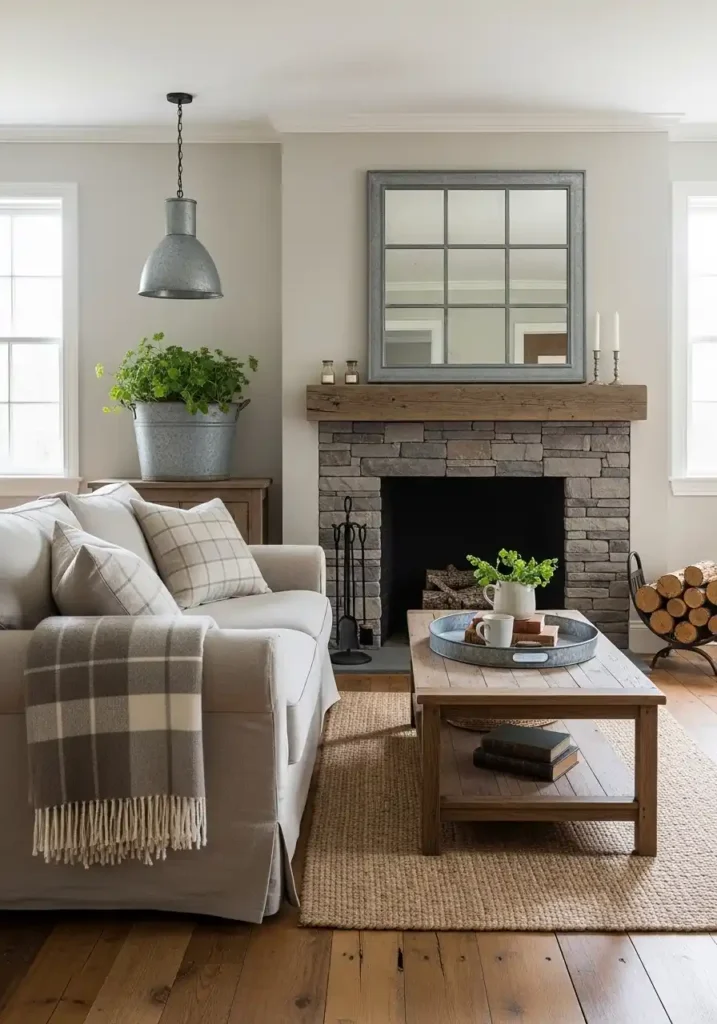
Galvanized metal is the farmhouse living room material that ties everything together with an honest, unpretentious beauty that speaks directly to the agricultural roots that farmhouse design was always meant to celebrate and honor. The slightly matte, silvery-gray surface of galvanized steel reflects light softly rather than brilliantly, adding a gentle shimmer to a room without ever feeling flashy or out of place in a rustic context. It’s the material of water troughs and milk cans and fence posts — humble, hardworking, completely beautiful — and when you bring it inside and use it as a deliberate design element, it grounds the whole farmhouse story in something authentic and real.
Incorporating galvanized metal into your farmhouse living room is one of the most joyful and affordable decorating projects you can undertake, because the pieces are widely available, inexpensive, and look beautiful in virtually every configuration you place them in. Use a large galvanized metal bucket as a planter for a fiddle leaf fig or a bundle of dried pampas grass. Hang a galvanized metal pendant shade above a reading corner. Use a galvanized metal tray on your coffee table to coral remotes, candles, and small objects into an organized, intentional display. Frame a mirror in galvanized metal above your fireplace. Every piece you add reinforces the farmhouse character of the room with an understated, completely authentic charm.
4. Cozy Stone Fireplace as the Ultimate Farmhouse Focal Point
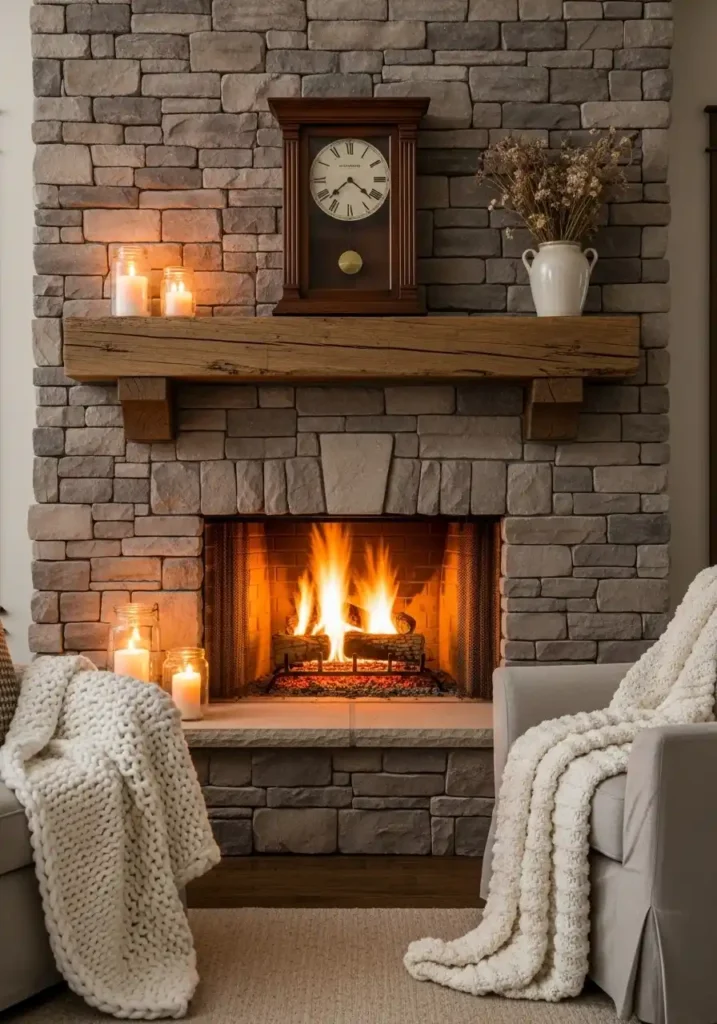
There is no design element in the entire farmhouse aesthetic that creates more warmth, more atmosphere, more gravitational pull on everyone in the room, or more of that deep-seated feeling of being truly, completely home than a real stacked stone fireplace with a rough-hewn wooden mantel. It is the farmhouse living room’s undisputed centerpiece, its heart, its reason for existing — the thing everything else in the room organizes itself around and points toward. On a cold evening with a fire burning in the hearth, the rest of the world disappears entirely, and the only thing that exists is the warmth, the light, and the absolute, uncomplicated perfection of that moment.
Styling a farmhouse fireplace mantel is one of interior design’s most delightful creative exercises, because the rustic context welcomes an eclecticism and imperfection that more polished design styles would never allow. A rough wooden mantel is the perfect stage for an honest, curated collection of meaningful objects: mason jar candles of varying heights, a vintage wooden clock with visible age, dried wildflowers or cotton stems in a handmade ceramic vase, a framed family photograph, and perhaps a simple painted wooden sign with words that matter to you. Layer these objects with asymmetrical intention — taller pieces on one side, lower groupings on the other — and let the whole arrangement look slightly imperfect. In farmhouse design, imperfection is always the most beautiful choice.
5. Linen Slipcovered Sofa — The Farmhouse Essential
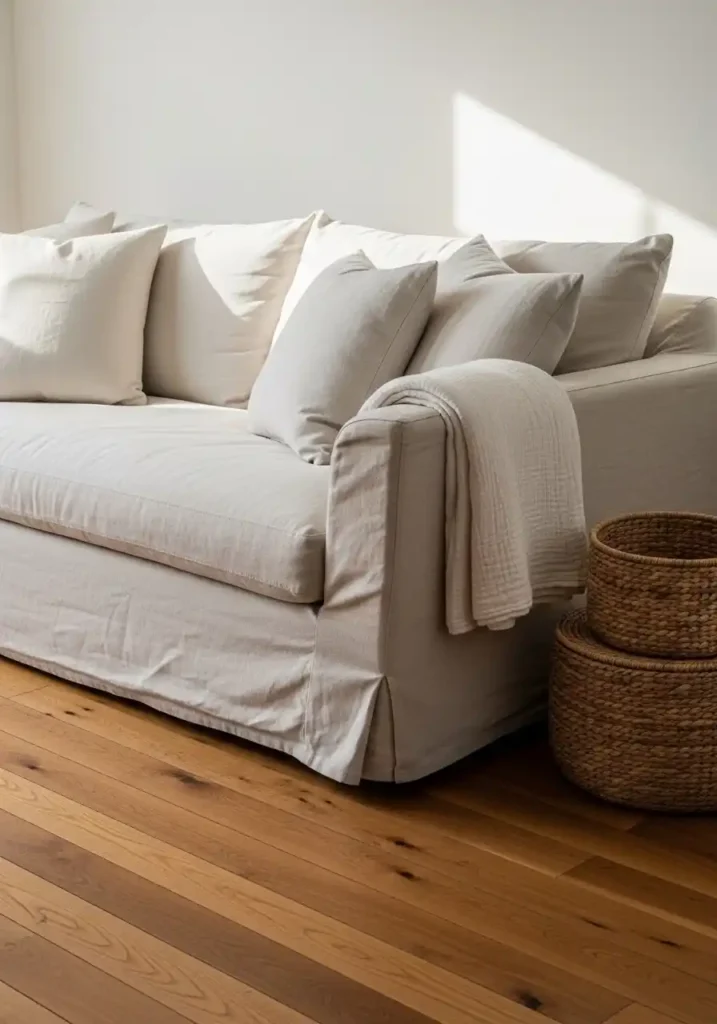
The linen slipcovered sofa is to farmhouse design what the little black dress is to fashion — the absolute essential, the piece that everything else builds around, the choice that is simultaneously the most relaxed and the most sophisticated option available. There is no upholstery fabric in the world that communicates ease, authenticity, and casual farmhouse elegance more naturally and more beautifully than loosely woven natural linen in an undyed cream or warm oatmeal tone. It looks intentionally relaxed. It softens and relaxes further with every washing. And rather than showing wear, it develops a patina of genuine beauty that gets better with every year of real family life lived on and around it.
The slipcovered nature of this sofa style is a practical farmhouse blessing that goes hand in hand with the aesthetic’s fundamental philosophy of honest, livable beauty. When life happens — as it inevitably and wonderfully does — you simply remove the cover, wash it on a gentle cycle, and put it back on. No professional cleaning, no anxiety about everyday use, no treating your sofa like a museum piece that nobody is allowed to truly enjoy. Choose a slipcovered sofa with deep, plump cushions filled generously with down or a down-alternative blend, and pile it with cotton and linen throw pillows in ticking stripe, faded plaid, and simple natural textures. This is the sofa you actually live on, and it’s all the more beautiful for it.
6. Reclaimed Wood Coffee Table with Natural Character
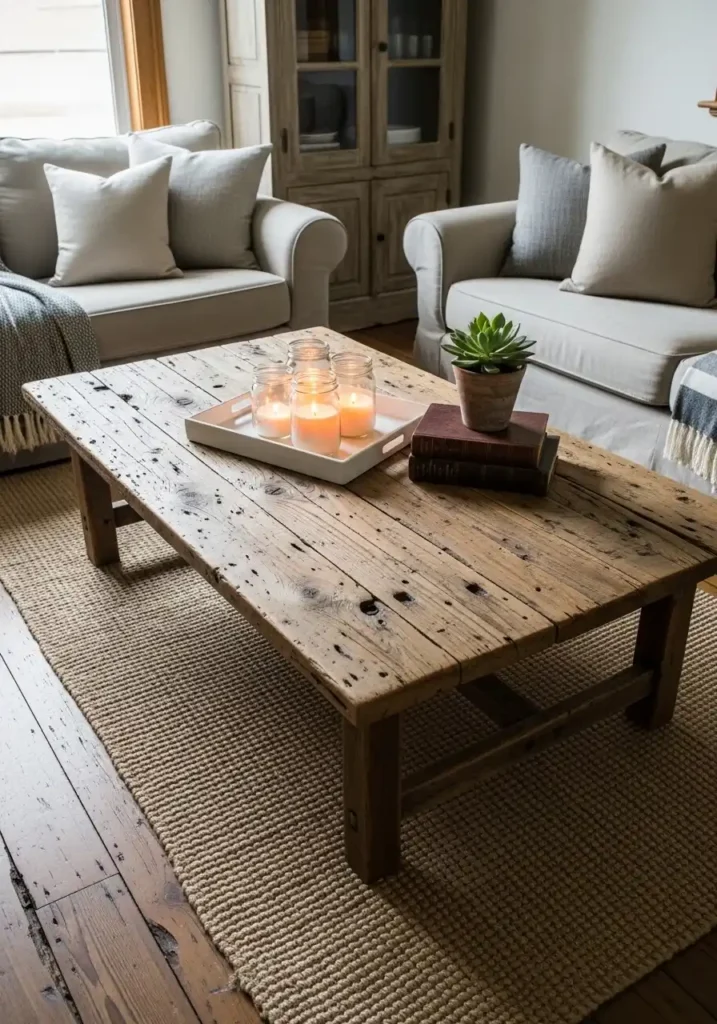
A reclaimed wood coffee table is the farmhouse living room piece that brings more genuine character, more authentic beauty, and more real conversation-starting interest than virtually any other furniture choice you could make for that central position in the room. The visible history written into the wood — the grain patterns that took decades to develop, the knots that mark where branches once grew, the saw marks and age marks and slight imperfections that prove this wood lived a full life before it became your coffee table — make every reclaimed piece truly one of a kind in a way that no new furniture, however beautiful, can ever truly replicate. This is a piece with a story.
Finding the right reclaimed wood coffee table is part of the joy of the farmhouse decorating journey — and it’s a journey worth taking slowly and with genuine patience, because the right piece, when you find it, will be absolutely unmistakable. Visit architectural salvage yards, antique markets, vintage furniture dealers, and online marketplaces where craftspeople build tables from reclaimed barn wood, old factory floors, and salvaged structural timbers. Look for pieces where the wood’s natural character is celebrated and preserved rather than sanded away and hidden. The most beautiful reclaimed coffee tables are those where you can look at the surface and imagine the history — and where every ring, every mark, every imperfection tells a story you’ll love having in your home.
7. Mason Jar Styling for Authentic Farmhouse Character
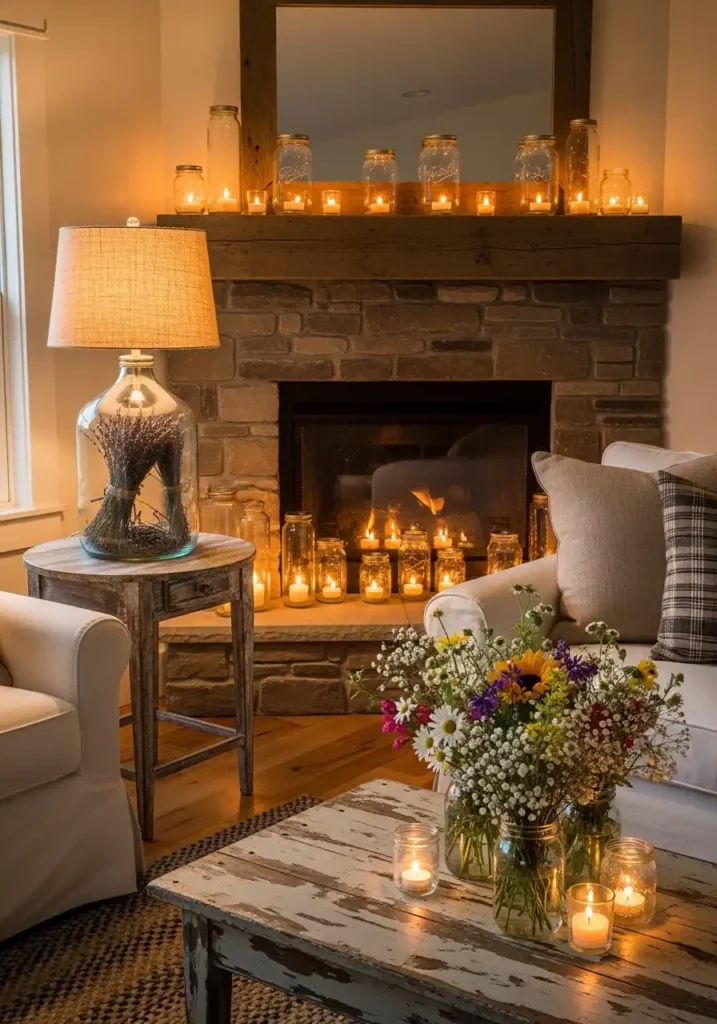
Mason jars are the farmhouse aesthetic in its most concentrated, most distilled, most joyfully unpretentious form — and the living rooms that use them with genuine creativity and abundance are always the ones that feel most authentically, most warmly, most believably farmhouse rather than farmhouse-themed. There is a fundamental difference between a room that was designed to look like a farmhouse and a room that actually feels like one, and mason jars — with their honest simplicity, their clear glass beauty, their complete absence of pretension — are one of the most reliable markers of the latter. They cost almost nothing and add something that money genuinely cannot buy.
The creative possibilities for mason jars in a farmhouse living room are far more extensive than most people initially imagine. Group three or five jars of varying sizes on the coffee table as simple flower vases — wildflowers, cotton stems, eucalyptus branches, dried lavender, or whatever your garden or local market offers that week. Cluster a collection of mason jar candle holders on the fireplace mantel at varying heights for a warm, glowing evening display. Repurpose large wide-mouth mason jars as small table lamp bases, filling them with dried botanicals, colored river stones, or fairy lights before adding a simple clip-on shade above. Every use is simple, beautiful, and completely, authentically farmhouse in the best possible way.
8. Plaid and Ticking Stripe Textiles for Classic Farmhouse Pattern
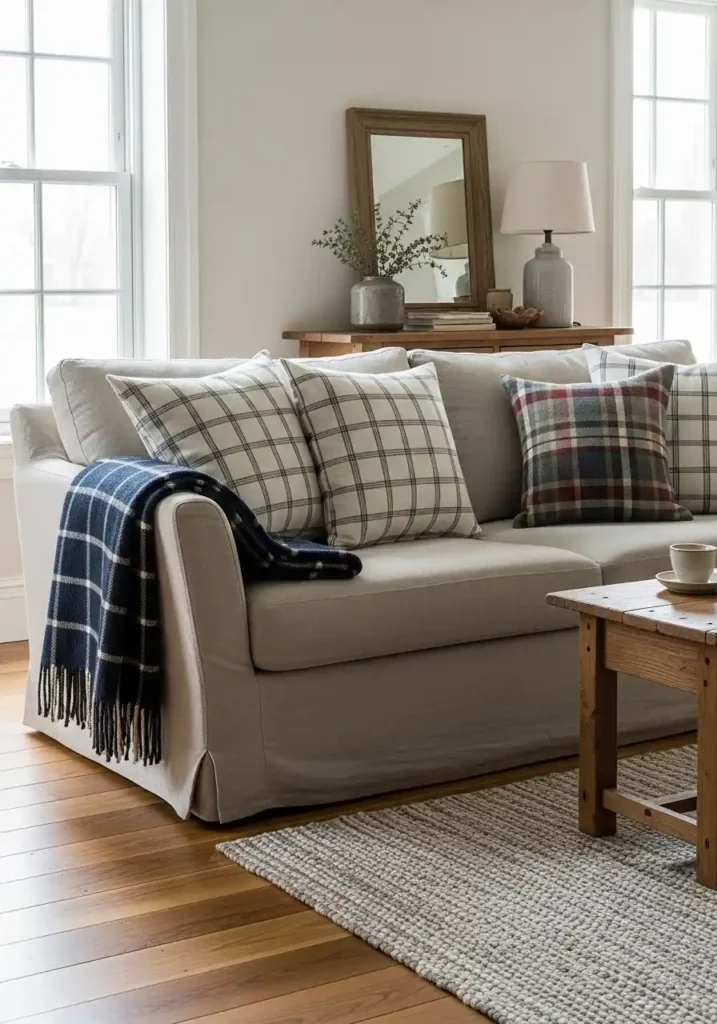
Plaid and ticking stripes are the two textile patterns that have defined American farmhouse interiors for generations — and their enduring presence in the most beautiful, most authentically rustic living rooms being created and pinned today is no accident of trend or fashion. These patterns have survived because they are genuinely, fundamentally beautiful in the farmhouse context: they reference working fabrics, honest materials, and a design tradition rooted in practicality rather than decoration for its own sake. When you layer plaid and ticking stripe into your farmhouse living room, you’re not following a trend — you’re connecting to a design lineage that stretches back centuries and will still be beautiful centuries from now.
The art of layering plaid and ticking stripe in a farmhouse living room without the result feeling like a catalogue page from a country store is about restraint in color and variation in scale. Keep your plaid palette tightly edited — navy and cream, muted red and black, faded green and tan — and choose ticking stripes in the same tonal family so the patterns complement rather than compete with each other. Mix the scales deliberately: a large-scale buffalo check throw against a fine ticking stripe cushion cover creates a pleasing rhythm of bold and delicate that reads as curated rather than confused. Let your natural linen sofa serve as the neutral canvas that holds all the patterns together without competing for attention.
9. Antique and Vintage Finds as Living Room Décor
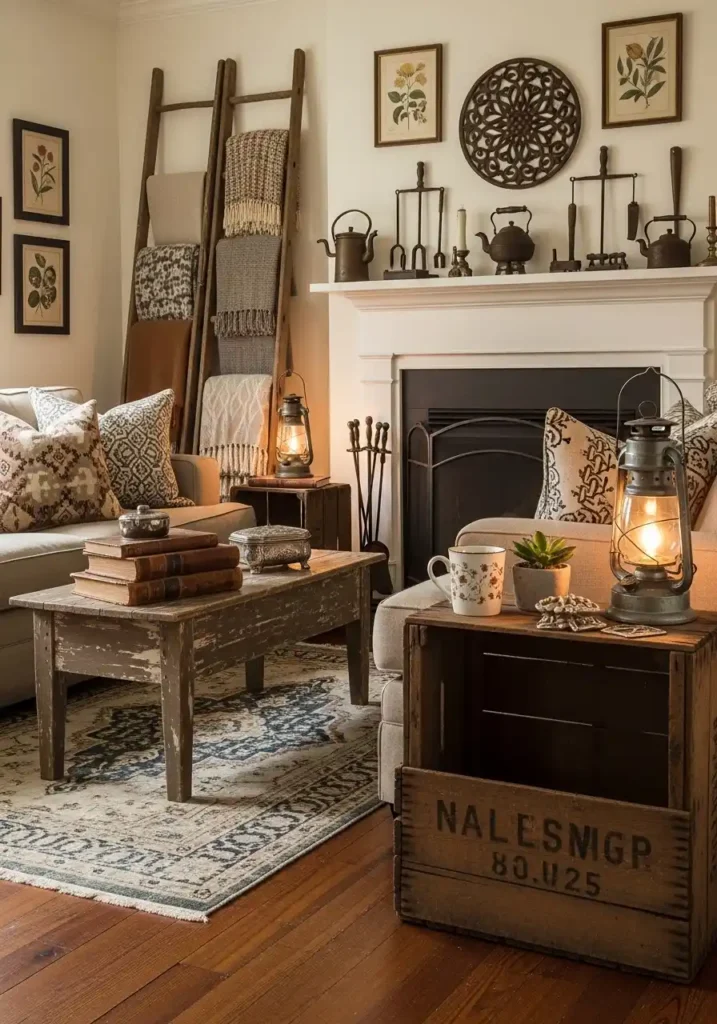
The farmhouse living rooms that stop your scroll on Pinterest and make your heart do something unexpected are almost always the ones that contain real, genuine vintage and antique pieces with actual history — not reproductions, not items distressed artificially in a factory, but objects that have genuinely lived through time and arrived in your living room carrying the evidence of that journey openly and beautifully. There is a warmth and an authenticity that only genuinely old things possess, and a farmhouse living room filled with them feels less like a designed space and more like a place that simply evolved naturally over generations of good taste and careful accumulation.
Building a farmhouse living room through antique and vintage collecting is one of the most joyful, most personal, and most endlessly evolving decorating approaches available. Estate sales are your greatest resource — they yield genuine farmhouse pieces at genuinely accessible prices that no retail store can approach. Flea markets on early weekend mornings reward the patient and the early-rising with extraordinary one-of-a-kind finds. Vintage online marketplaces connect you with dealers across the country whose expertise and inventory would have been completely inaccessible to previous generations of home decorators. Train your eye to look past surface grime and peeling paint for genuine quality of form, material, and craftsmanship — and the pieces you find will reward you with beauty and character that only deepens with every passing year.
10. Farmhouse Gallery Wall with Botanical Prints and Family Photos
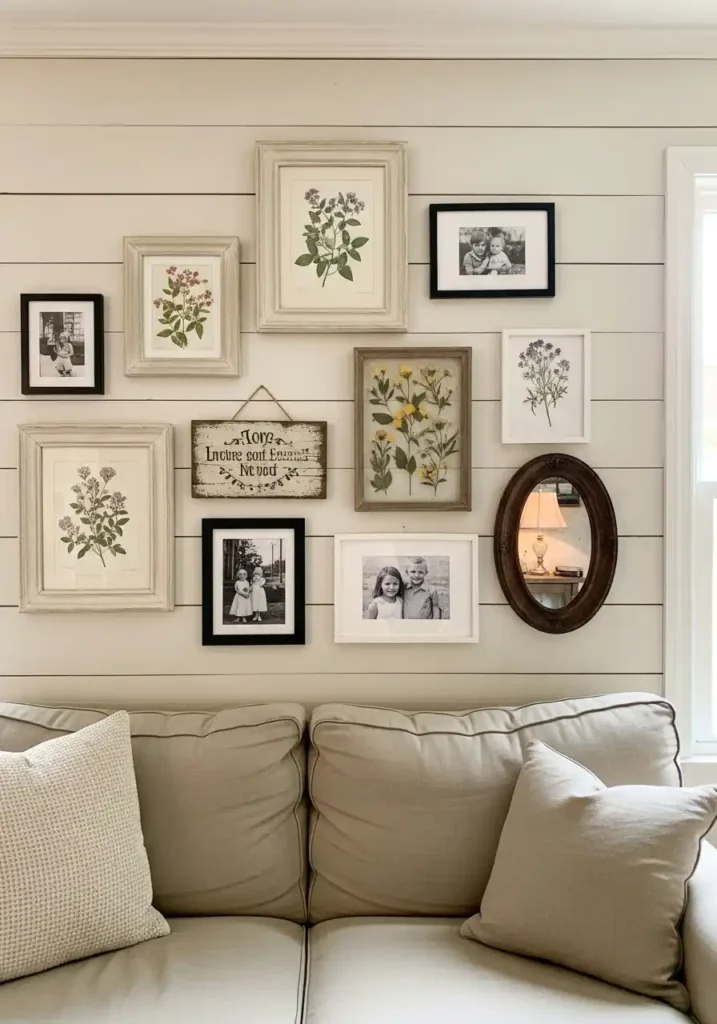
A farmhouse gallery wall is not the sleek, perfectly grid-aligned gallery walls of minimalist design — it’s something warmer, more personal, more imperfect, and infinitely more charming. It’s the wall that tells your family’s story alongside a deep appreciation for the natural world, mixing botanical prints that reference the garden and the landscape with family photographs that anchor the room in love and memory and the specific, irreplaceable narrative of your particular life. Every element has meaning. Every frame has been chosen with care. And the asymmetrical arrangement that holds it all together has the kind of casual confidence that only comes from genuine feeling rather than calculated design.
Creating a farmhouse gallery wall that feels authentically personal rather than store-bought requires collecting its elements over time with real intention and patience. Vintage botanical prints — particularly those from nineteenth-century natural history publications with their hand-drawn illustrations and aged paper tones — are beautiful, widely available, and relatively inexpensive to print or purchase as originals. Family photographs printed in black and white and placed in simple frames have a timeless quality that color photographs sometimes lack in this context. Mix in a small wooden sign with a meaningful word or phrase, a simple oval mirror, and perhaps a pressed flower arrangement under glass. Arrange everything on the floor first until the arrangement feels right before committing a single nail to the wall.
11. Woven Baskets as Farmhouse Storage and Décor
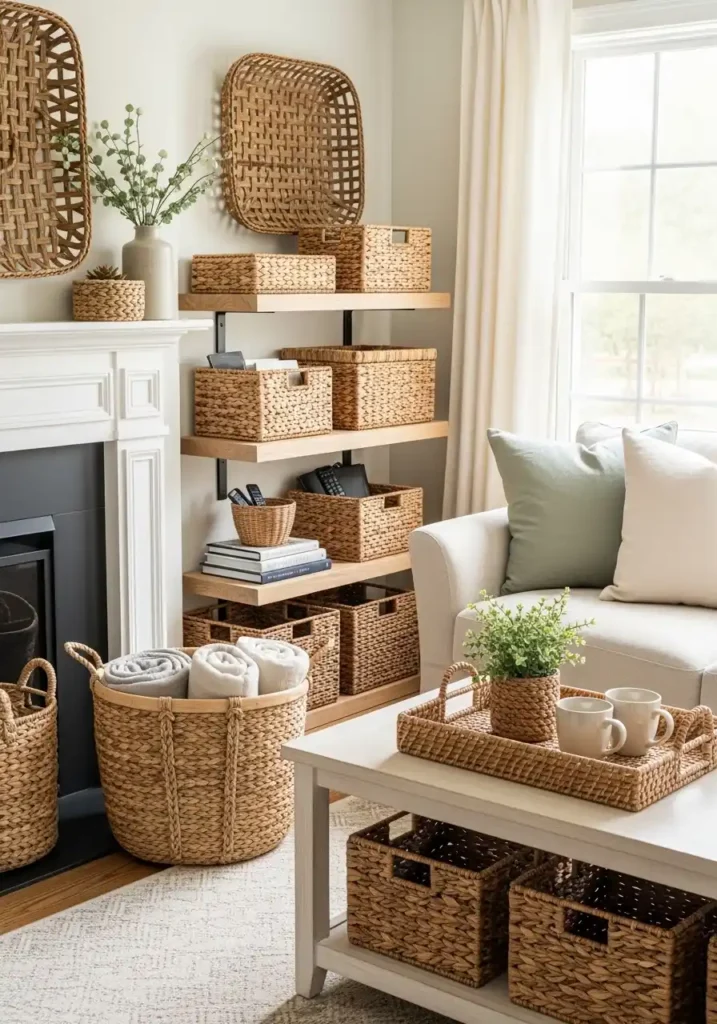
Woven baskets are one of those rare decorating elements that are simultaneously practical storage solutions and genuinely beautiful decorative objects — and in a farmhouse living room, they are as essential and as natural as the wooden beams overhead and the linen on the sofa. Baskets bring organic texture, handcrafted warmth, and a connection to natural materials and traditional craft that no manufactured storage solution can replicate. They look like they belong in a farmhouse because they genuinely do — they always have, in every farmhouse culture across every continent throughout all of human history. They are the storage solution that time itself has endorsed.
Using baskets in your farmhouse living room effectively is entirely about variety in size, scale, and purpose — and about resisting the urge to relegate them purely to functional storage roles when they are equally beautiful as pure decorative objects. A large round floor basket beside the sofa holds rolled throw blankets accessibly and beautifully, eliminating the need for a dedicated blanket storage piece. Medium baskets with lids on open shelves corral remotes, chargers, children’s toys, and all the necessary everyday clutter of a genuinely lived-in room behind a face of organized, natural beauty. A cluster of three different-sized baskets on a wall, arranged asymmetrically, creates a striking piece of organic wall art that costs almost nothing and always draws compliments.
12. Farmhouse Ladder Shelf for Rustic Display
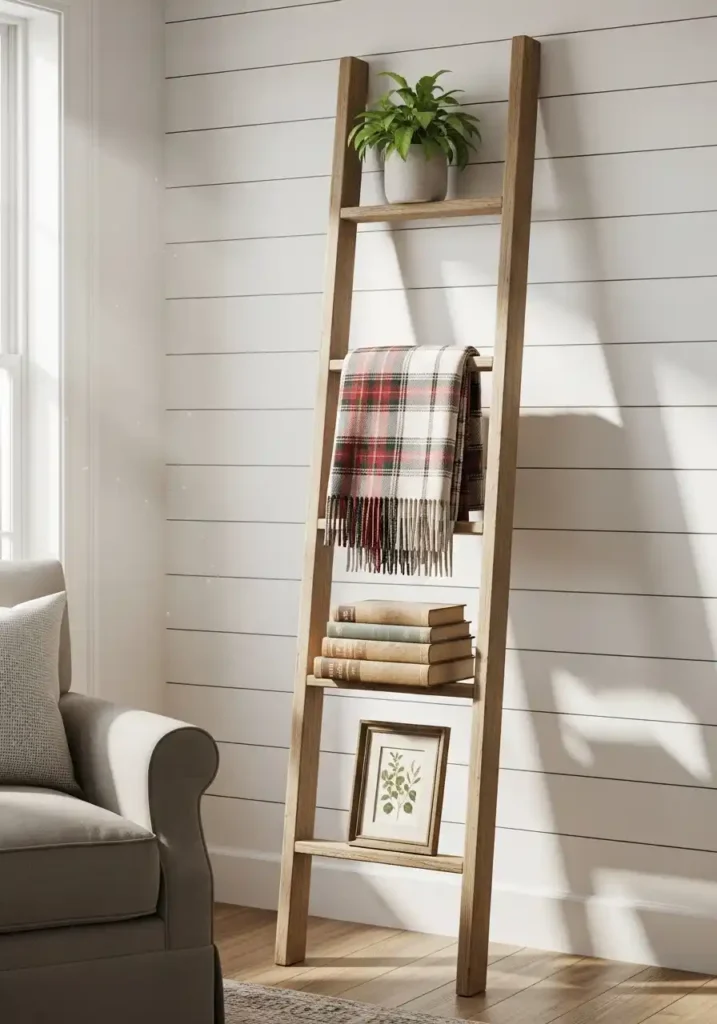
A reclaimed wooden ladder repurposed as a decorative shelf is one of those farmhouse design ideas that is so simple, so clever, and so genuinely beautiful that it’s almost surprising it needed to be invented at all — and yet the first time most people see one leaning against a shiplap wall with blankets and plants draped across its rungs, they immediately want one in their own living room. It takes up almost no floor space, it adds significant vertical interest and rustic texture to a wall, and it provides multiple levels of display and storage that a conventional shelf unit would require multiple brackets and hardware to create. It is, in the most farmhouse way possible, both functional and beautiful.
The most beautiful ladder shelves for farmhouse living rooms are those that have genuine age and character — an old wooden ladder from a barn or workshop, a vintage orchard ladder with its distinctive A-frame form, or a simple straight ladder in rough-sawn timber with visible tool marks and natural imperfections. If sourcing a genuinely vintage ladder proves difficult, new wooden ladders can be aged beautifully with a gray or warm brown wood stain diluted with water and applied with a rag for an authentic weathered effect. Style each rung deliberately: a folded plaid throw on one rung, a trailing pothos in a small terracotta pot on another, a stack of vintage books tied with twine, and a small framed botanical print leaning against the wall behind it.
13. Neutral Farmhouse Color Palette — White, Cream, and Warm Gray
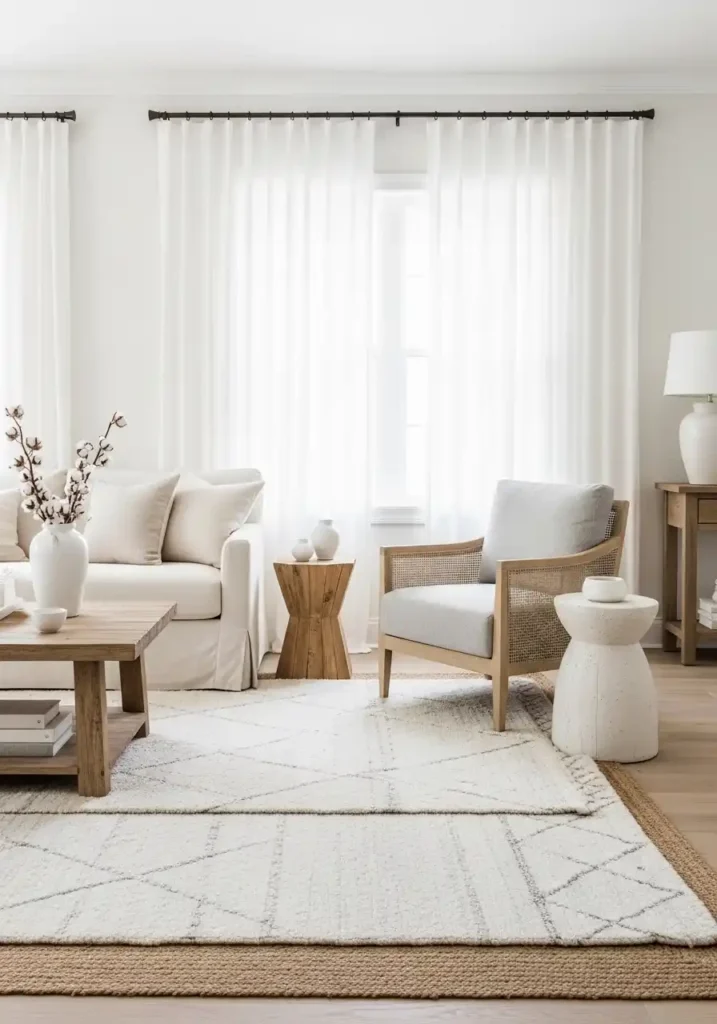
The neutral farmhouse color palette — that beautifully considered family of soft whites, warm creams, aged linens, and gentle warm grays — is not the absence of design ambition. It is the most sophisticated, most deeply considered, and most enduringly beautiful color choice available to anyone creating a farmhouse living room that they genuinely want to live in rather than simply photograph and post. These colors create a room that breathes, that rests the eyes and the mind after a full and demanding day, and that serves as the most perfect backdrop imaginable for the natural textures, honest materials, and genuine vintage character that farmhouse design is built on celebrating.
Working successfully within a neutral farmhouse palette requires the same skill as any great monochromatic approach: you earn your visual interest entirely through variation in texture, material, and tone rather than through color contrast. Your soft white walls read differently from your cream linen sofa, which contrasts beautifully with your warm gray accent chair, which sits against your natural wood floors, which are anchored by a layered combination of a cream cotton rag rug over a natural jute base. Every material — the rough jute, the smooth linen, the soft cotton, the grainy wood, the cool ceramic — catches the light differently and contributes a distinct tactile note to the room’s quiet, beautiful symphony of neutral tones. This is a color palette that gets richer and more beautiful the more carefully you look at it.
14. DIY Wooden Signs with Farmhouse Sayings
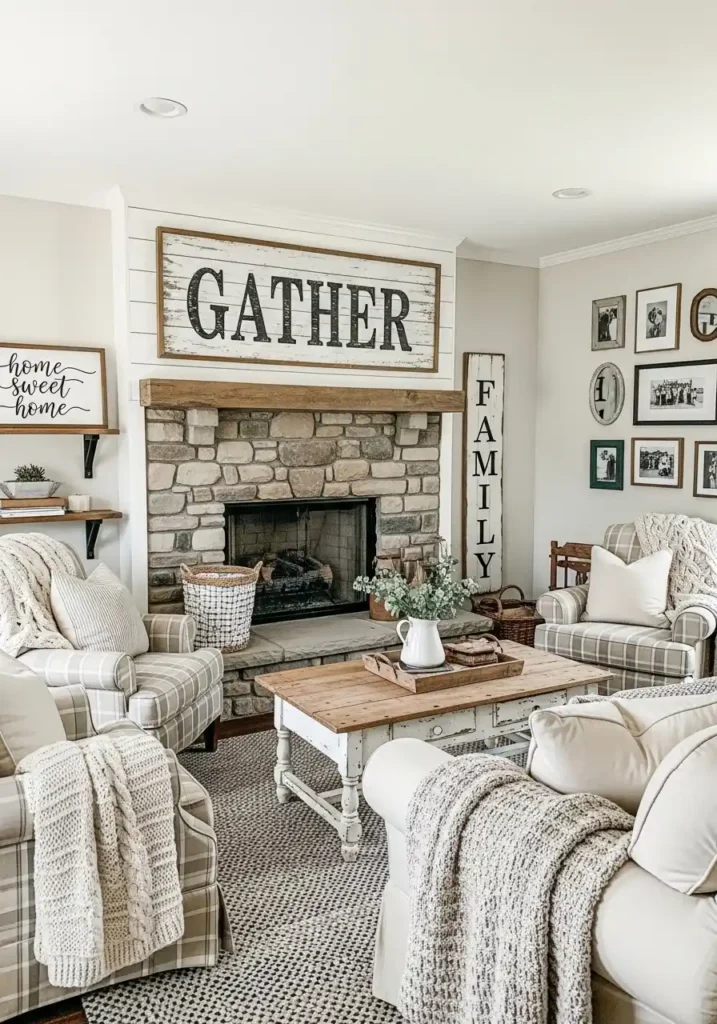
There is something about a hand-painted wooden sign displayed in a farmhouse living room that speaks directly to the values at the absolute heart of this design philosophy: warmth, family, simplicity, and a genuine love of home as a place of refuge, gathering, and meaning rather than merely a container for furniture and belongings. Wooden signs with farmhouse sayings are not just decoration — they are declarations of intention, small philosophical statements about what you believe your home should be and how you want everyone who enters it to feel. And when they’re done well, with real hand-crafted character and honest simplicity, they are genuinely beautiful.
Making your own farmhouse wooden signs is one of the most satisfying and affordable DIY projects in the entire home decorating world, and the results are almost always more beautiful, more personal, and more authentic-looking than anything available to purchase in a store. Start with a piece of rough-sawn pine or a genuine reclaimed wood plank with natural character. Dilute white chalk paint with water and apply it in loose, directional brushstrokes for an aged, weathered base coat that lets the wood grain show through beautifully. Use letter stencils or hand-paint your chosen words freehand in a muted black or deep navy. Sand the edges and surface lightly once dry to reveal the natural wood beneath the paint and create that perfectly worn, authentically aged quality that makes farmhouse signs so irresistibly charming.
15. Farmhouse Rug Layering for Warmth and Texture
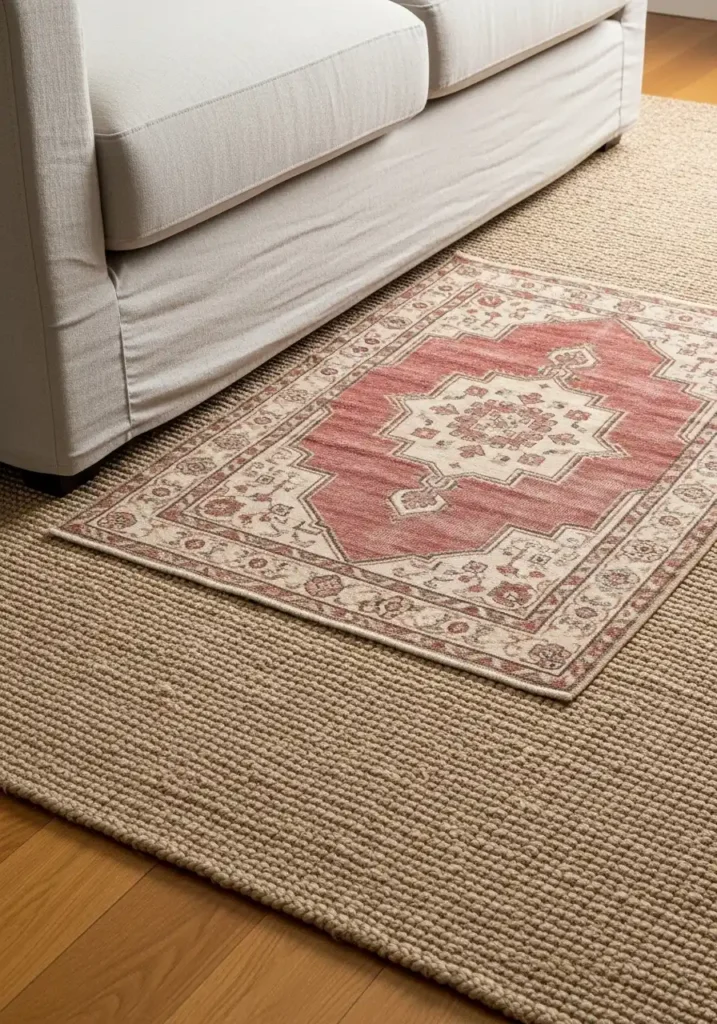
Rug layering is the farmhouse living room flooring technique that Instagram and Pinterest have collectively fallen deeply, permanently in love with — and the moment you try it in your own space, you will understand completely and immediately why. Layering a smaller, more decorative rug on top of a larger, neutral base rug creates a richness of texture, a depth of color, and a sense of warmth underfoot that a single rug, however beautiful, simply cannot achieve alone. It looks collected and curated, like two beautiful rugs found in two different places at two different times that turned out to belong together in the most perfect, unplanned way.
The most successful farmhouse rug layering combinations follow one simple principle: pair a large, neutral, natural-fiber base rug with a smaller, more characterful top rug that brings pattern, color, or vintage interest to the floor plane. A large natural jute or sisal rug in a neutral weave makes the perfect base — it grounds the room with honest natural texture and creates a warm canvas for everything above it. On top, layer a vintage-inspired cotton dhurrie, a faded Persian-style rug, a simple plaid wool rug, or a patterned kilim that introduces the farmhouse warmth and character the plain jute base cannot provide on its own. Position the top rug slightly at an angle or aligned with the seating furniture for a styled, intentional look that still feels relaxed and organic.
16. Dried Botanicals and Wildflowers for Natural Farmhouse Beauty
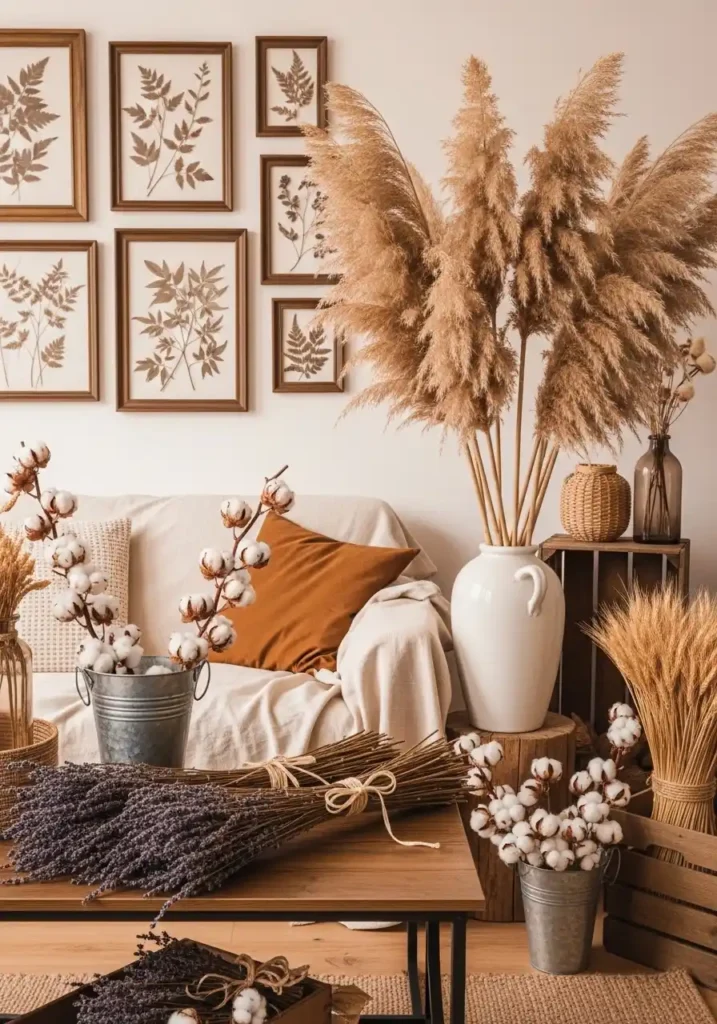
Dried botanicals are the farmhouse living room’s most honest and most beautiful connection to the natural world beyond the front door — and they bring a quality of organic warmth, gentle color, and textural richness to a room that fresh flowers, as beautiful as they are, simply cannot sustain consistently through the changing seasons of a full year. Dried pampas grass, lavender bundles, cotton stems, wheat sheaves, seed heads, and preserved eucalyptus branches are all genuinely beautiful in their own right — not substitutes for fresh flowers but distinctive, worthy design elements that deserve to be used with confidence and creative abundance.
Building a dried botanical collection for your farmhouse living room is a project that connects you beautifully to the seasonal rhythms of the natural world in a way that modern life too rarely allows. In late summer and early autumn, cut tall grasses, seed heads, and wildflowers at their peak and hang them upside down to dry in a warm, well-ventilated space — the results are both deeply satisfying and completely free. Purchase pampas grass plumes, dried lavender bundles, and cotton stems from farmers’ markets and botanical shops for the pieces you can’t grow or forage yourself. Display them generously and without overthinking: a large ceramic floor vase with an armful of pampas grass, a cluster of lavender tied with rough twine on the coffee table, a simple jar of dried wildflowers on the windowsill. Farmhouse beauty at its most natural and its most genuine.
17. Farmhouse Window Treatment — Simple White Cotton Curtains
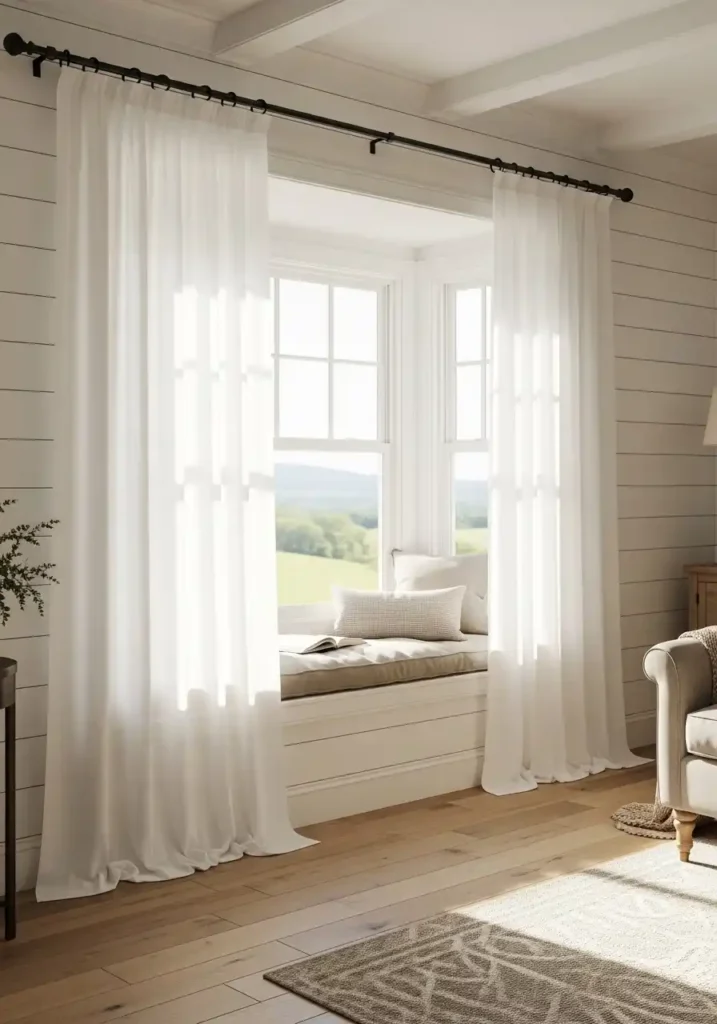
In a design world full of elaborate window treatment options — complex valances, layered sheers and drapes, custom fabrications in expensive fabrics — the farmhouse living room makes the most confident and most beautiful choice by going back to the simplest possible option: generous panels of crisp white cotton hung on classic black wrought iron rods and allowed to fall simply and naturally to the floor. This combination achieves something that far more elaborate treatments often fail to deliver: it looks effortlessly beautiful, it allows maximum natural light into the room, and it communicates a no-fuss, genuine confidence that is the absolute essence of authentic farmhouse style at its best.
The details that elevate simple white cotton curtains from basic to genuinely beautiful in a farmhouse living room are all in the hanging. Always mount your curtain rod close to the ceiling rather than at the top of the window frame — this elongates the window visually and makes the ceiling feel higher, which is a design gift in any room. Choose panels that are wide enough to stack generously on either side of the window when open, ensuring the window itself is fully unobstructed to light. Let the curtains pool slightly on the floor — just an inch or two of extra length creates a sense of relaxed luxury that precise floor-length panels never quite achieve. Wash your curtains regularly so they maintain that crisp, clean brightness that makes white cotton so beautiful in a farmhouse context.
18. Farmhouse Bookshelf Styling with Personal Collections
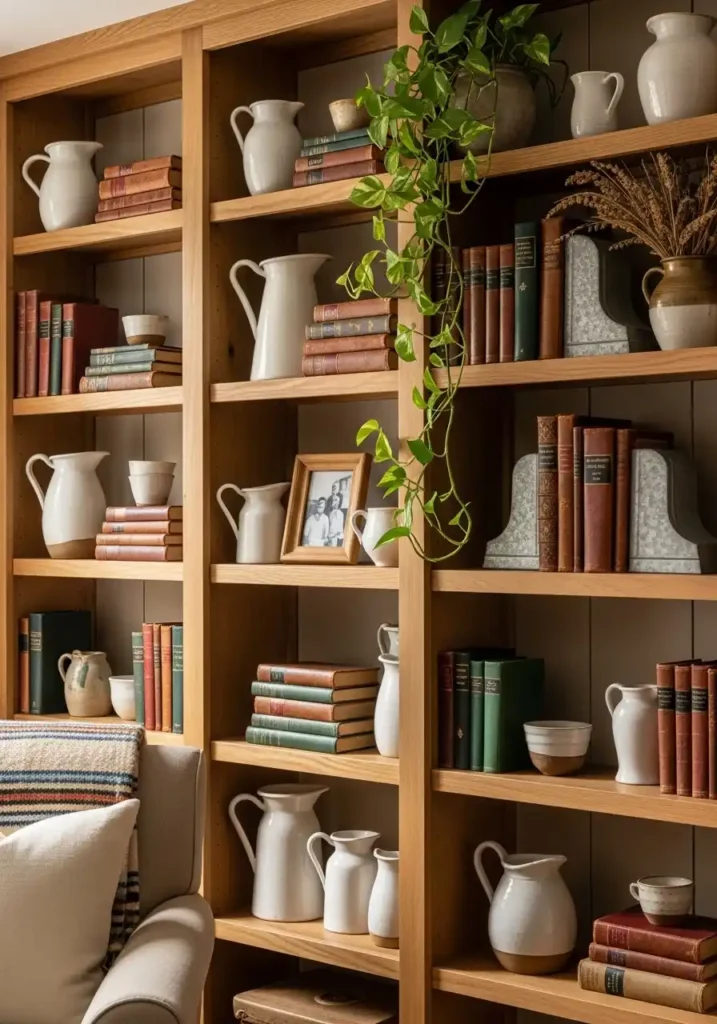
The way a farmhouse living room bookshelf is styled tells you more about the people who live in the home than almost any other single design element — and the shelves that look most beautiful on Pinterest are inevitably those that have been filled with genuine personal collections rather than styled with generic décor objects purchased specifically for the purpose of shelf decoration. Real books with worn spines and beloved covers, inherited ceramics with history and family meaning, found objects from walks and travels, small framed photographs of faces you love — these are the things that make farmhouse shelves sing with authentic warmth and deeply personal character.
The art of styling farmhouse bookshelves is about finding the beautiful balance between collected abundance and organized clarity — between the warm, overflowing feeling of a shelf that is genuinely used and loved, and the visual calm of a shelf where everything has been thoughtfully placed and considered. Stack your books both vertically and horizontally, using horizontal stacks as display surfaces for small objects — a candle, a small ceramic vessel, a framed photograph. Group your decorative objects in odd numbers, varying their heights deliberately and placing them in front of, beside, and occasionally on top of book stacks. Tuck a small trailing plant into the arrangement so its leaves spill naturally across the books below it. The result should look lived-in, loved, and absolutely beautiful.
19. Repurposed Vintage Crates as Farmhouse Side Tables
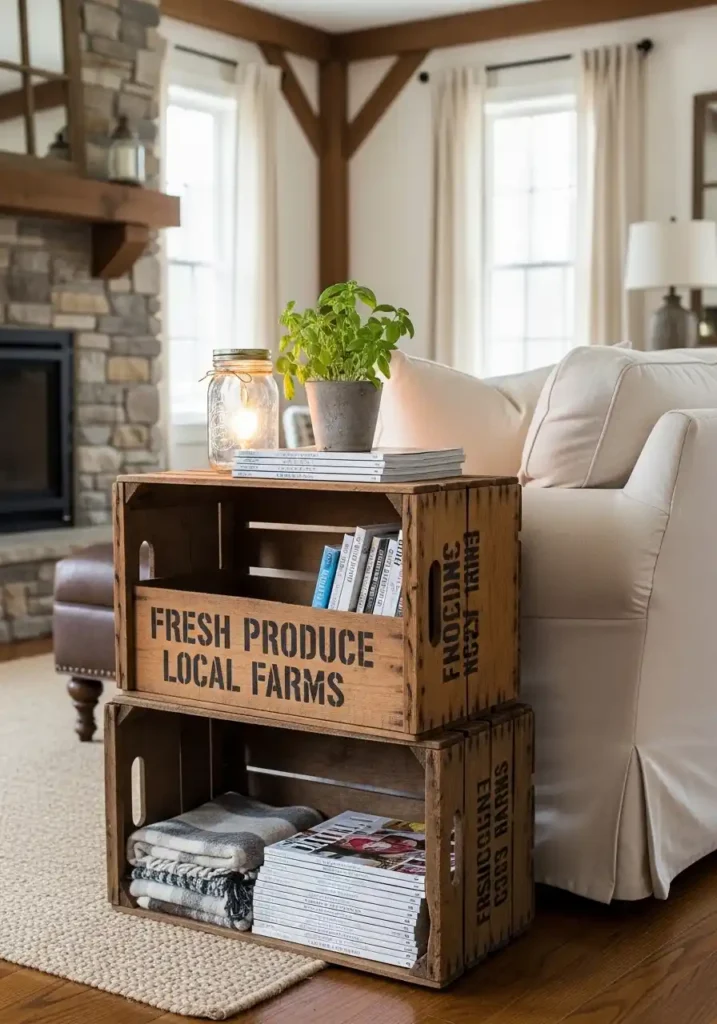
Repurposing vintage wooden crates as side tables, storage units, and display surfaces is the farmhouse living room design move that perfectly encapsulates everything this aesthetic stands for: resourcefulness, creativity, appreciation for honest materials and humble origins, and the ability to see beauty and potential in objects that the world has finished with. A genuine vintage wooden produce crate — the kind used to transport apples, peaches, or vegetables from farm to market through much of the twentieth century — is one of the most beautiful, most useful, and most characterful pieces you can bring into a farmhouse living room. And it costs almost nothing.
Finding genuine vintage wooden crates has become slightly more challenging as they’ve grown in popularity and desirability, but they remain widely available through antique markets, estate sales, vintage shops, and online marketplaces for prices that make them one of decorating’s great bargains. Look for crates with original stenciling and branding still visible — the typography and graphics of vintage produce branding are genuinely beautiful design artifacts in their own right, and they add an authentic historical dimension to the farmhouse story your room is telling. Stack two or three crates of the same size to create a side table of comfortable height. Use the interior of the lower crates for practical storage — extra books, spare candles, folded blankets — keeping the top surface clear for styling with a simple lamp, a plant, and a small collection of meaningful objects.
20. Cowhide or Grain Sack Textiles for Authentic Farmhouse Texture
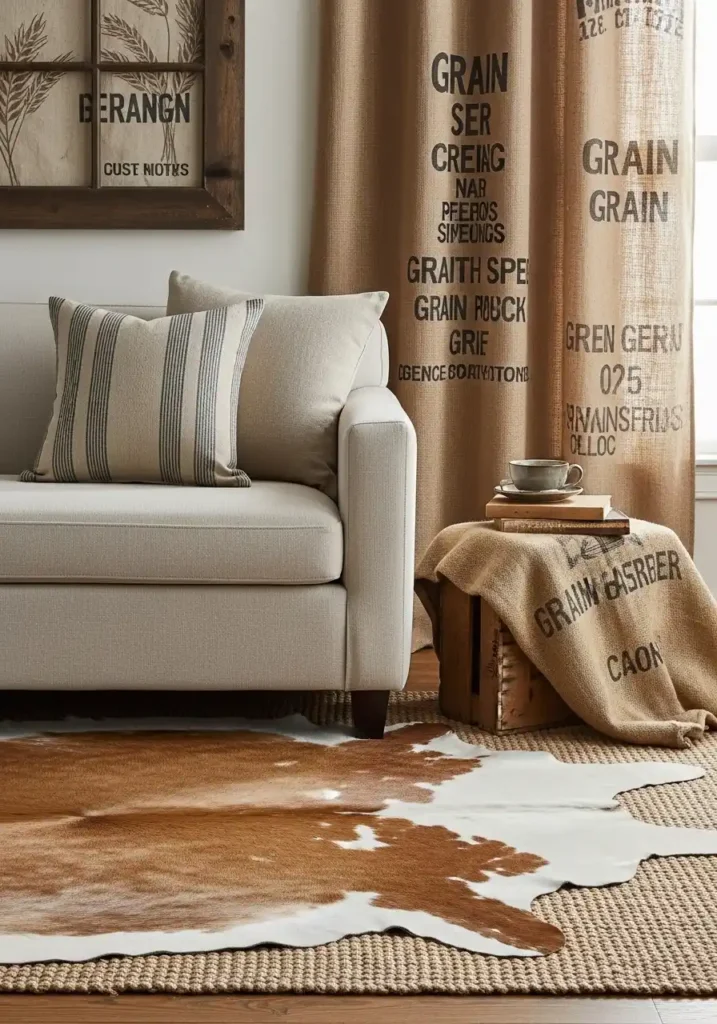
Cowhide rugs and grain sack textiles are the farmhouse living room materials that connect your interior most directly to the agricultural working life that farmhouse design has always been rooted in and inspired by — and they bring a quality of authentic, irreplaceable character that no manufactured reproduction, however skilled, can truly replicate. A genuine cowhide rug, with its natural variation in color and pattern and its luxurious tactile quality, grounds a farmhouse living room with a warmth and earthiness that is unlike anything else. Grain sack textiles, with their simple woven cloth and bold stenciled stripes, carry centuries of agricultural history in every thread.
Incorporating these materials into your farmhouse living room doesn’t require a large budget or a dramatic commitment to either — a single genuine cowhide rug layered over your existing jute or natural fiber base rug adds extraordinary warmth and visual interest to the floor plane without requiring any other changes to the room. Antique grain sack fabric — genuine pieces sourced from European flea markets and vintage textile dealers — makes the most beautiful, most characterful cushion covers imaginable, and a stack of two or three grain sack pillows on a linen sofa instantly transforms the room’s farmhouse authenticity level dramatically upward. Look for grain sack fabric with original stenciled markings still visible — the imperfect, hand-applied letters and numerals are a beautiful reminder of the human hands that created and used these textiles in their original agricultural life.
21. Farmhouse Lighting — Wrought Iron and Edison Bulbs
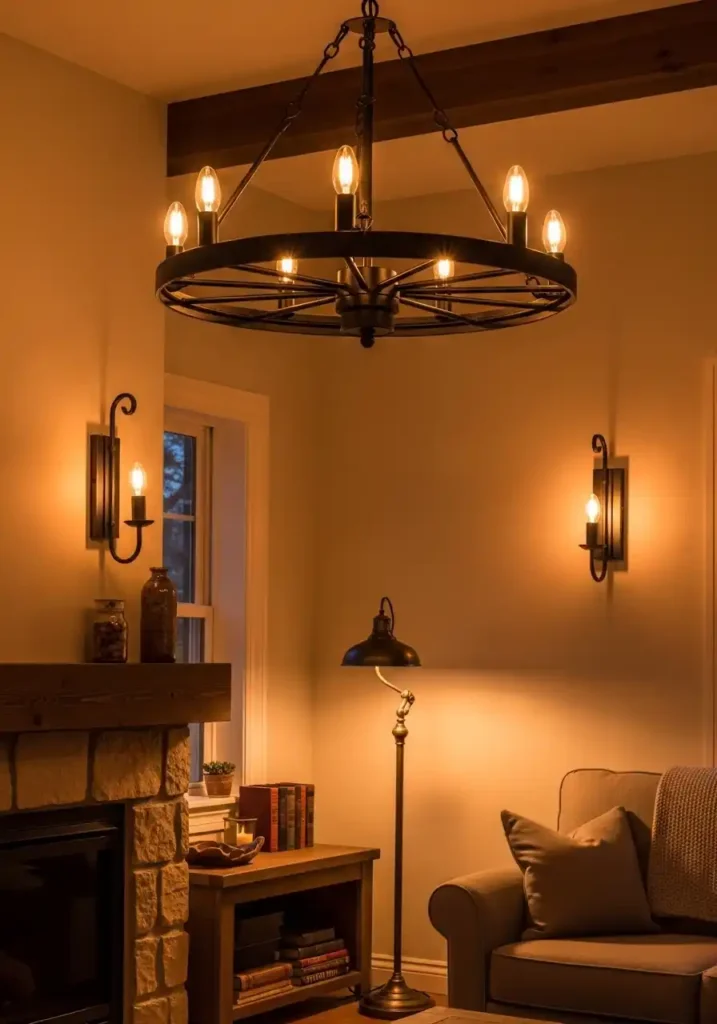
Lighting is the element that separates a farmhouse living room that looks beautiful during the day from one that is absolutely magical at every hour — and getting the fixtures and the bulb choice right is one of the most impactful investments you can make in the overall atmosphere and character of the space. The farmhouse lighting palette is defined by two non-negotiable elements: warm-toned Edison filament bulbs that cast that gorgeous amber glow, and dark metal fixtures — wrought iron, aged bronze, blackened steel — that provide the appropriate rustic weight and character for the farmhouse aesthetic. Together, these two elements create an evening atmosphere that makes every moment spent in the room feel like a scene from the most beautiful, most comforting life imaginable.
Building a layered farmhouse lighting scheme requires thinking in terms of at least three distinct sources: an overhead fixture for ambient light, wall or table lamps for warm secondary light, and candles for the most intimate, most beautiful tertiary light that no electric bulb can fully replicate. A wrought iron chandelier or pendant — whether a wagon wheel style, a simple cage design, or a cluster of exposed Edison bulbs on black twisted cords — handles the overhead layer with farmhouse authority. Wrought iron wall sconces flanking the fireplace provide beautiful directional light and strong architectural character. Table lamps with linen shades on side tables and a floor lamp in the reading corner complete the warm, layered scheme that makes a farmhouse living room feel like the coziest, most welcoming room on earth after dark.
22. Cotton Throw Blankets in Every Farmhouse Corner
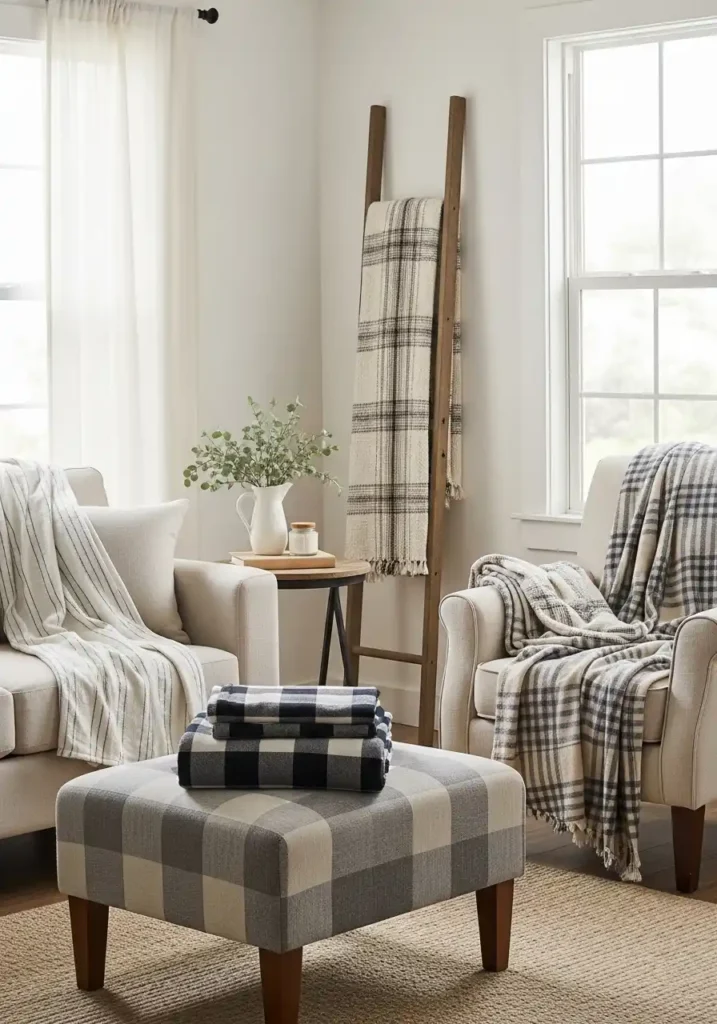
If there is one decorating habit that transforms a farmhouse living room from simply beautiful to genuinely, irresistibly, stop-your-scroll-on-Pinterest cozy, it is the generous, abundant, unapologetic use of cotton throw blankets placed in every corner, on every seating surface, and across every available rung and arm and back within reach. Throw blankets are the farmhouse living room’s most democratic luxury — they cost almost nothing, require no installation, no commitment, and no design expertise to use beautifully — and yet they contribute more warmth, more texture, more visual softness, and more genuine invitation to sit down and stay awhile than almost any other single decorating element available.
The key to using throw blankets in a farmhouse living room with genuine style rather than looking like a linen closet has exploded is choosing a palette and a collection of patterns that work harmoniously together while covering enough variety of color and texture to create interesting visual layers. Build your throw blanket collection around the core farmhouse textile patterns: a ticking stripe in navy and cream, a buffalo check in black and white, a soft plaid in muted reds and tans, and a simple ribbed cotton knit in natural undyed cream. Drape each one differently — one casually tossed over a sofa arm, one folded in thirds and laid across the back of an armchair, one loosely rolled in a basket on the floor. The resulting room says one thing louder and more clearly than anything else: you are always welcome here. Please sit down and stay.
23. Farmhouse Reading Nook with Vintage Armchair and Floor Lamp
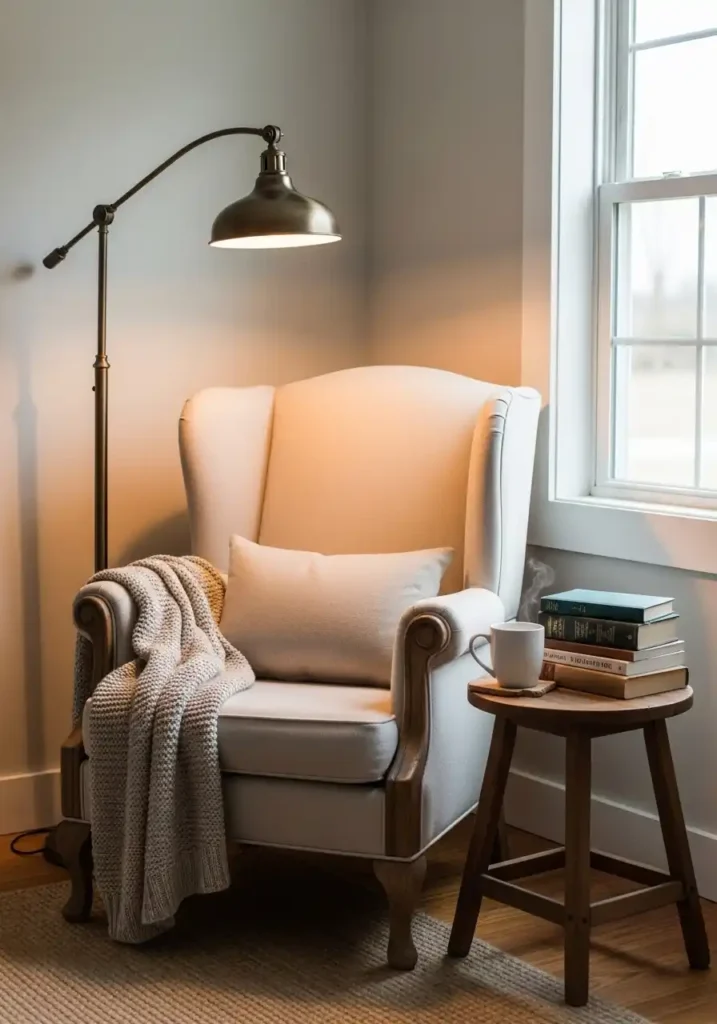
Every farmhouse living room deserves at least one dedicated reading corner — a specific spot in the room that has been intentionally designed for nothing more demanding or more complex than sitting quietly with a good book, a warm drink, and the complete and uncomplicated luxury of a slow, unhurried hour to yourself. This is the farmhouse philosophy in its purest domestic expression: the idea that a home should support the best, most nourishing, most genuinely human activities of daily life — and that reading in a comfortable chair by good light is one of the most nourishing of all. A well-designed farmhouse reading nook makes that activity as beautiful and as inviting as possible.
Creating a farmhouse reading nook begins with the chair — and the chair must be genuinely comfortable above all other aesthetic considerations, because a beautiful chair that is uncomfortable to sit in for more than twenty minutes defeats the entire purpose of the corner it occupies. A vintage linen wingback in worn, characterful fabric combines the farmhouse aesthetic perfectly with the deep, enveloping comfort of a classic reading chair form. Position it in the corner with best natural light during your preferred reading hours, and add an antique-style arc floor lamp for evening reading that casts warm, focused light from the perfect angle without requiring you to reach for a switch every time you look up. A small wooden side table within arm’s reach holds your current book, your reading glasses, and your mug. This corner will become the room’s most loved and most lived-in spot within the first week.
24. Farmhouse Entryway Connection — Hooks, Baskets, and Welcome Signs
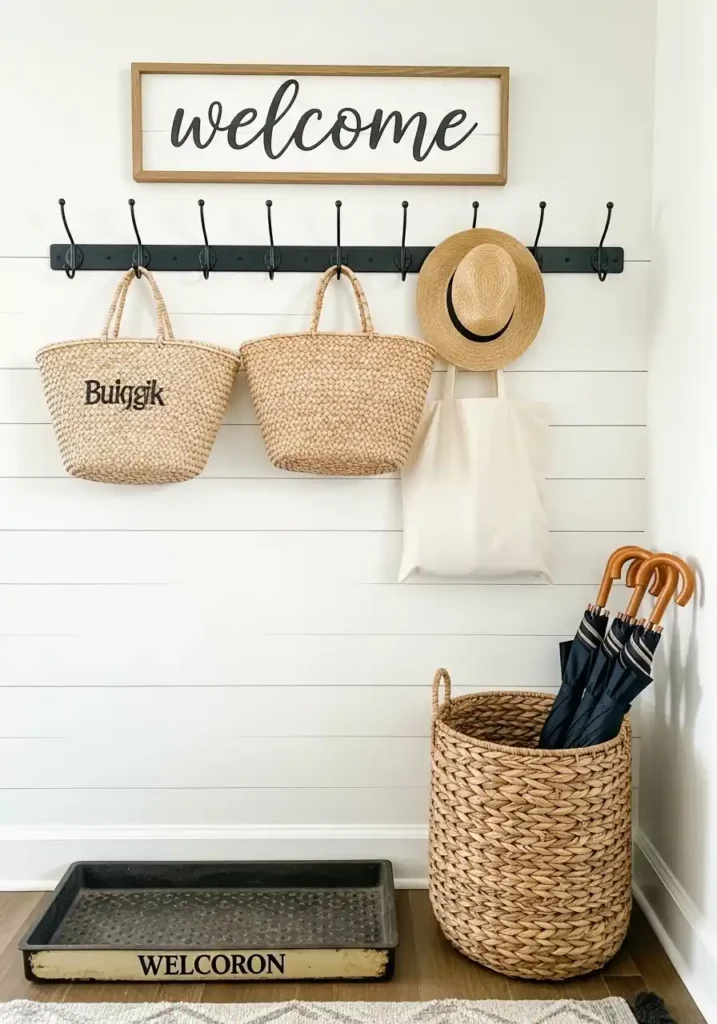
The transition from the outside world into a farmhouse living room sets the entire tone for how the space feels to arrive in — and a well-designed farmhouse entry zone within or adjacent to the living room creates an immediate sense of warmth, organization, and genuine welcome that makes every homecoming feel like a small, satisfying ceremony of returning to where you most belong. The farmhouse approach to this transitional space is characteristically practical and beautiful simultaneously: hooks for hanging things that need hanging, baskets for corralling things that need corralling, and enough genuine character in the materials and objects present to immediately tell every arriving guest that this is a home with real personality and genuine warmth.
The essential elements of a farmhouse entry zone are few and simple, which is exactly what makes designing one so satisfying. A row of black wrought iron hooks mounted on a shiplap wall panel provides the functional hanging storage that every household entry point requires — for coats, bags, hats, keys, and the thousand small items that need a home at the threshold between outside and inside. A large woven basket on the floor below the hooks corrals boots, umbrellas, and anything else that needs to live near the door. A hand-painted welcome sign above the hooks communicates the home’s essential character in the most direct and warm way possible. A simple vintage boot tray on the floor protects the floors while adding an authentic farmhouse utilitarian beauty. This small zone costs almost nothing to create and returns warmth and welcome tenfold.
25. The Perfect Farmhouse Living Room — Bringing It All Together
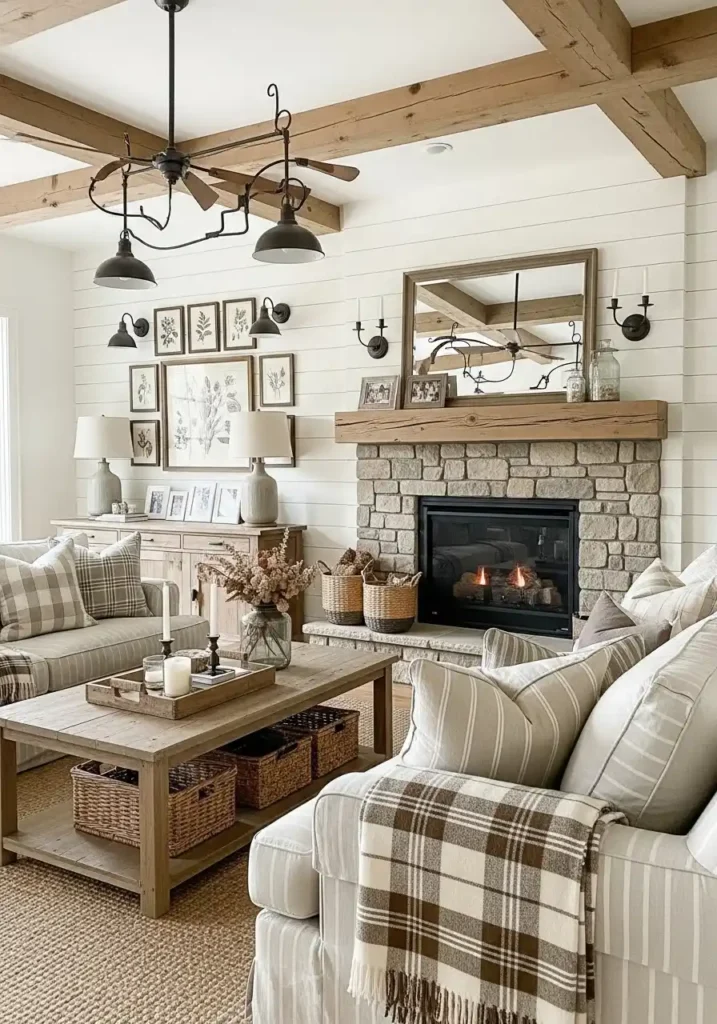
Here is the truth about the perfect farmhouse living room: it doesn’t happen all at once, and it doesn’t happen by following a checklist or purchasing a curated collection from a single source. It happens gradually, organically, and beautifully over time as you collect pieces that genuinely speak to you, as you make decisions rooted in authentic love for honest materials and genuine warmth rather than trend-chasing or social media performance. Every truly beautiful farmhouse living room you’ve ever seen on Pinterest that made your heart respond with a genuine, visceral “I want to be in that room” feeling is the result of exactly that kind of slow, patient, deeply personal accumulation of real things chosen for real reasons.
The invitation, then, is this: start where you are, with what you have and what you love, and build your farmhouse living room outward from there one beautiful decision at a time. Let the shiplap wall happen when the moment is right. Find your reclaimed wood coffee table at the estate sale you almost didn’t go to. Collect your mason jars and your dried botanicals and your plaid throws over weekends and seasons rather than in a single shopping sprint. Allow your gallery wall to develop over years as photographs are printed and botanical prints are found and meaningful objects accumulate slowly and naturally. The farmhouse living room that results from that kind of intentional, unhurried, genuinely personal process will be more beautiful, more warm, and more authentically yours than anything that could ever be assembled quickly or designed by anyone other than you.
Conclusion:
Designing a farmhouse living room is all about creating a space that feels warm, welcoming, and timeless. The 25 farmhouse living room inspirations shared above highlight how rustic textures, natural materials, neutral color palettes, and vintage-inspired décor can come together to create a cozy and charming environment. From reclaimed wood accents and shiplap walls to comfortable linen sofas and antique décor pieces, every element helps capture the true essence of rustic farmhouse style.
Whether you prefer a modern farmhouse living room, a classic country aesthetic, or a mix of rustic and contemporary elements, these ideas offer endless inspiration to transform your space. By incorporating natural light, layered textures, and handcrafted décor, you can easily achieve a living room that reflects both comfort and character.
Use these farmhouse living room decorating ideas as a guide to design a space that feels authentic, stylish, and inviting. With the right balance of rustic charm and modern comfort, your farmhouse living room can become the heart of your home where family and friends gather, relax, and create lasting memories.