1. The Warm Terracotta Cabinet Kitchen That Radiates Pure Earthy Joy
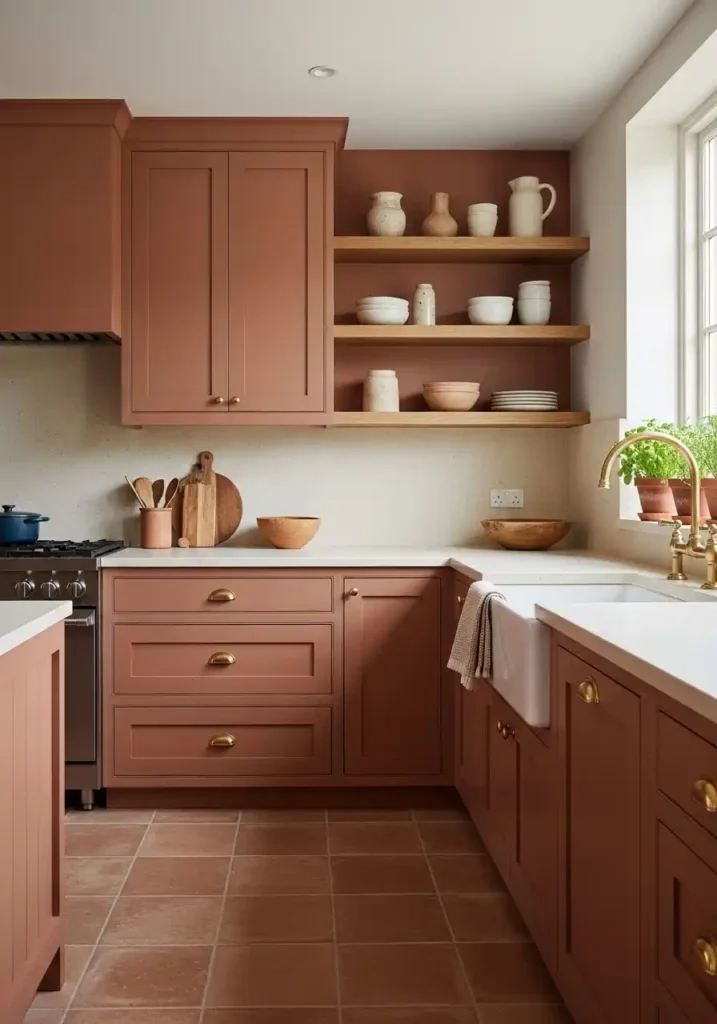
A terracotta cabinet kitchen is the Earthy Kitchen Ideas design that most completely and most joyfully recreates the specific warmth, the specific color richness, and the specific quality of sun-baked, clay-fired, Mediterranean domestic beauty that makes certain kitchens feel like they have been gathering warmth and character for generations rather than simply being installed last year. Terracotta is not merely a color — it is a material reference, a geological memory, and a cultural inheritance from the ancient tradition of fired clay architecture that has been creating warm, beautiful, enduring domestic spaces in warm climates for thousands of years. A terracotta kitchen carries all of that warmth and all of that history in its color.
The specific terracotta tone that creates the most beautiful and the most genuinely earthy cabinet color is not the bright, saturated orange of commercial terracotta paint but the deeper, slightly muted, slightly clay-gray-inflected tone of genuine fired clay — the color of an old Tuscan roof tile, a worn Mexican floor tile, or a hand-thrown terracotta pot that has been sitting in the garden for a decade developing depth and character. This specific quality of slightly aged, slightly complex terracotta creates a cabinet color of extraordinary richness and extraordinary warmth that makes white quartz countertops appear more luminous by contrast, makes unlacquered brass hardware appear more golden, and makes the kitchen’s overall atmosphere feel genuinely, deeply, organically warm in a way that no brighter or more saturated version of the color could achieve.
2. The Raw Linen and Warm Wood Kitchen for Quiet Organic Beauty
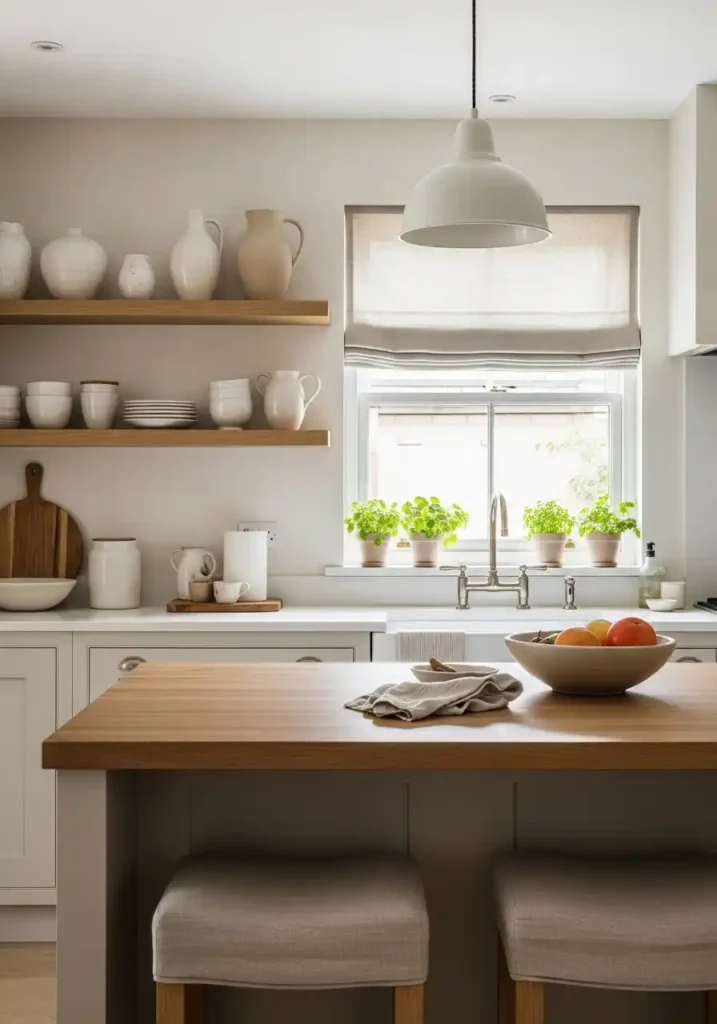
A raw linen and warm wood earthy kitchen is the natural interior design that most completely and most gently embodies the specific quality of organic, undyed, genuinely natural beauty that the natural interior movement most deeply values — because linen and wood are two of the most honest, the most materially authentic, and the most naturally beautiful materials available in domestic design, and their combination in a kitchen creates an atmosphere of such complete, sustained organic warmth that the space feels less like a designed kitchen and more like a place that the natural world itself created and furnished with its own most beautiful materials. This kitchen is calm in the way that forests and fields are calm.
The specific challenge and the specific reward of a linen-toned kitchen palette is the way it makes material quality and material texture the room’s entire expressive vocabulary — because when the color palette is so deliberately restrained, every surface must communicate its beauty through the quality of its material alone. The warmth of the butcher blocks the countertop’s honey-toned grain. The subtle texture of the linen roman blind’s woven surface catches the light. The slight variation of the handmade ceramic vessels’ glazed surfaces. The organic irregularity of the open oak shelf’s natural edge. Each material speaks quietly but with complete conviction about its specific natural beauty, creating a kitchen of extraordinary, accumulated material richness.
3. The Exposed Stone Wall Kitchen with Ancient Material Beauty
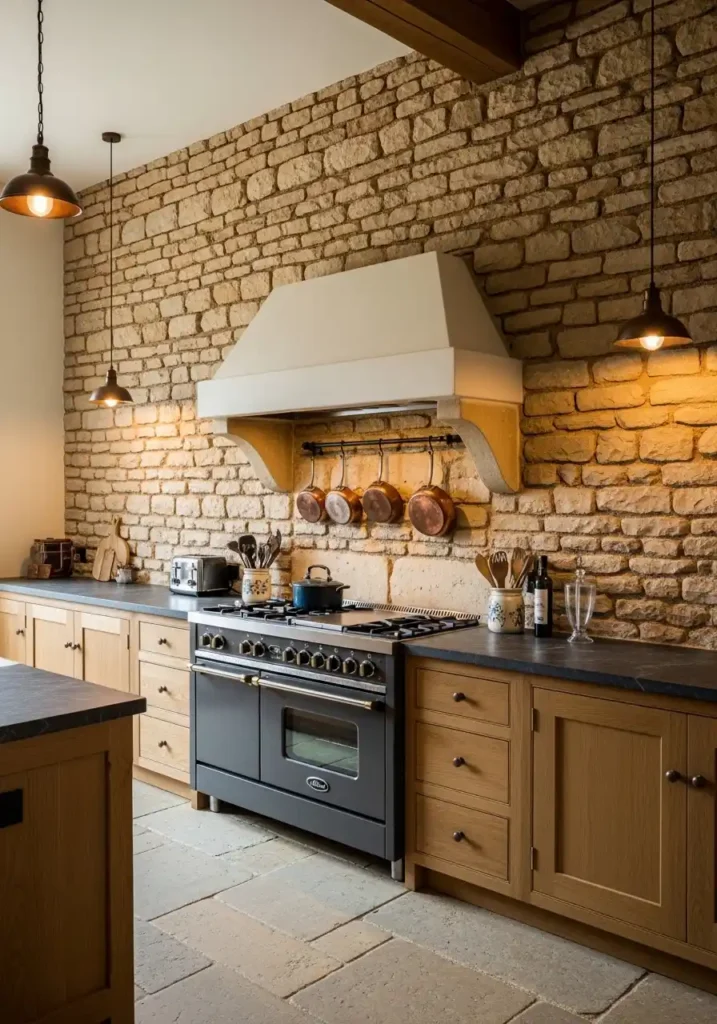
An exposed stone wall in an earthy kitchen is the architectural feature that most powerfully and most permanently connects the kitchen to the geological depth of the natural world — because genuine stone, whether limestone, sandstone, or fieldstone, brings the specific weight, the specific texture, and the specific quality of ancient, formed-over-millennia material presence into the domestic kitchen that no manufactured surface can approach with the same geological authority and the same physical depth. A stone wall in a kitchen is a wall that was forming under geological pressure while everything we have ever known was still in the future — and that quality of ancient, solid, enduring presence is precisely what makes it so extraordinarily beautiful.
The design intelligence required to incorporate an exposed stone wall into a contemporary earthy kitchen is the intelligence of restraint — because the stone wall’s extraordinary character and visual richness means that every other element in the kitchen must support it without competing with it, allowing the stone to be the room’s complete and unambiguous design star. Simple, clean oak cabinets. A plain plaster range hood in warm white or natural clay. A thick slate or limestone countertop that shares the stone’s geological material family without replicating its texture. Iron pot rack and aged iron pendant lights that reference the stone’s historical period with material honesty. Every element in service of the stone wall’s magnificent, ancient, irreplaceable presence.
4. The Clay and Ochre Limewash Kitchen for Organic Wall Beauty
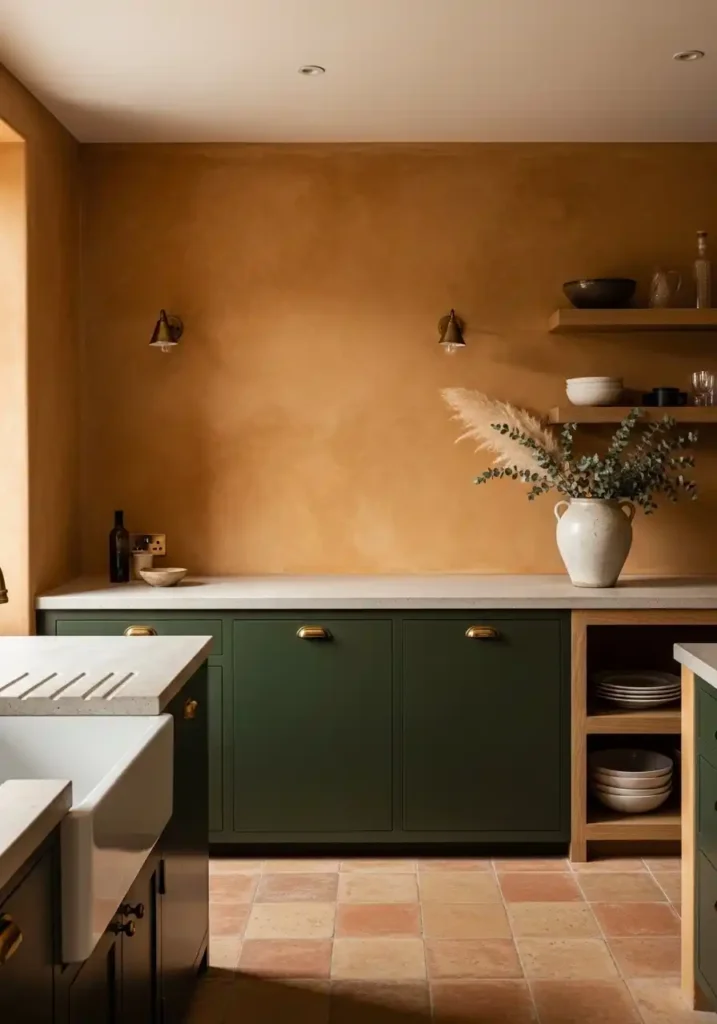
Limewash walls in a warm ochre-clay tone are the surface treatment that most authentically and most completely recreates the specific quality of ancient Mediterranean and North African domestic architecture in a contemporary earthy kitchen — because ochre is the oldest pigment used by human beings in the decoration of their living spaces, used in cave paintings and ancient plasterwork for tens of thousands of years before the first synthetic paint was manufactured, and its presence on kitchen walls in the form of limewash plaster creates a color of such genuine geological depth, such material authenticity, and such historically resonant warmth that it makes every other wall treatment appear shallow and recently invented by comparison.
The specific beauty of ochre limewash in a kitchen is the way it changes with the light throughout the day — from the pale, slightly gray quality of morning light that makes the ochre appear almost silver in its most shadowed areas, through the warm, vibrant amber of midday light that makes the color glow with its fullest, richest intensity, to the deep, almost terracotta warmth of evening artificial light that gives the ochre a quality of fired-clay richness that is genuinely extraordinary. This constant, light-driven variation in the wall’s apparent color makes the kitchen feel alive in a way that painted walls can never achieve, because limewash responds to light as a genuinely three-dimensional material surface rather than as a flat color application.
5. The Wabi-Sabi Earthy Kitchen Celebrating Beautiful Imperfection
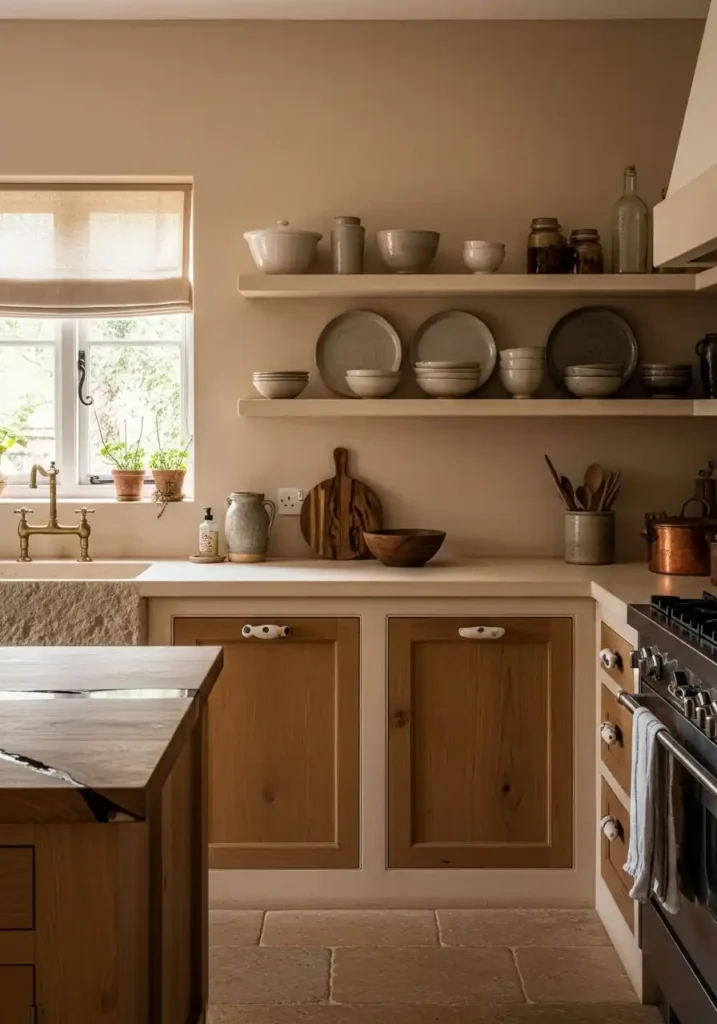
A wabi-sabi earthy kitchen is the design approach that most profoundly and most liberatingly rejects the idea that a beautiful kitchen must be perfect, precise, and immaculately finished — embracing instead the Japanese aesthetic philosophy that finds the deepest beauty not in perfection but in the natural aging, the honest imperfection, and the organic irregularity of genuinely used, genuinely handmade, genuinely natural things. The wabi-sabi kitchen is more beautiful than a perfect kitchen because it is more true — every worn surface, every irregular form, every patinated metal and every hand-thrown ceramic tells the genuine story of real materials aging honestly in the company of daily cooking and daily living.
The handmade ceramic cabinet pull is the wabi-sabi kitchen’s most immediately visible and most tactilely present expression of its design philosophy — because every time the cook opens a cabinet door and feels the specific, slightly irregular form of a genuinely hand-thrown ceramic pull beneath their fingers, the kitchen communicates its values through the most fundamental physical act of daily kitchen use. No two handmade ceramic pulls are exactly alike, and this uniqueness — the fact that the pull on the left cabinet door is subtly different in form, in glaze depth, and in surface texture from the pull on the right — creates a kitchen of genuine, irreplaceable individuality that no manufactured hardware, however expensively specified, can replicate or replace.
6. The Rammed Earth and Adobe Inspired Kitchen
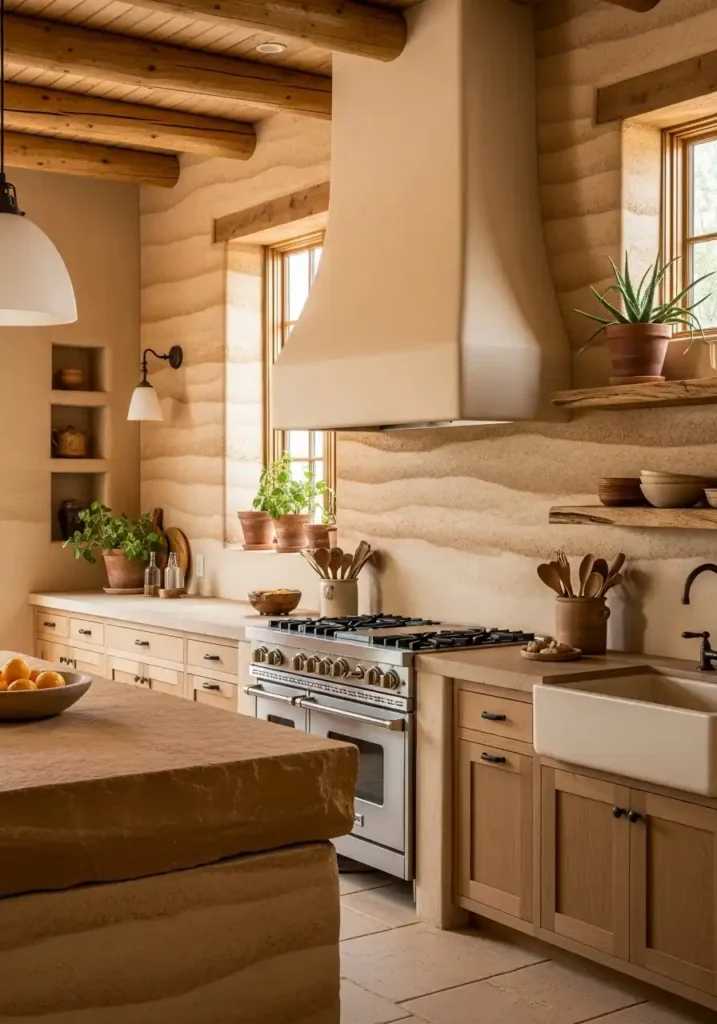
A rammed earth and adobe inspired earthy kitchen is the most geologically grounded, the most architecturally ambitious, and the most completely immersive of all natural interior kitchen aesthetics — because it recreates not just the color palette of the natural earth but the actual construction aesthetic of buildings formed from the ground itself, creating a kitchen that feels as though it was not built from manufactured components but grown from the landscape it inhabits. The clay plaster walls with their subtle horizontal layering, the sandstone island, and the broad plaster chimney hood create a kitchen of such complete material coherence and such deep, quiet, geological beauty that it generates an atmosphere of calm and groundedness unlike any other kitchen aesthetic.
The wood-burning range with its broad plaster chimney hood is the functional and architectural element that most completely realizes the rammed earth kitchen’s design vision — because it introduces a genuinely primal source of cooking heat and cooking warmth into the kitchen that connects the act of cooking to the most ancient human relationship with fire, food, and the earth simultaneously. The smell of wood smoke, the sight of a living fire through the range’s door, and the warmth radiating from the plaster chimney hood create a quality of sensory richness and primal domestic warmth that no gas or induction cooking surface, however advanced, can replicate. This is the kitchen that connects cooking to its deepest, most ancient, most fundamentally human origins.
7. The Dark Walnut and Olive Green Earthy Kitchen
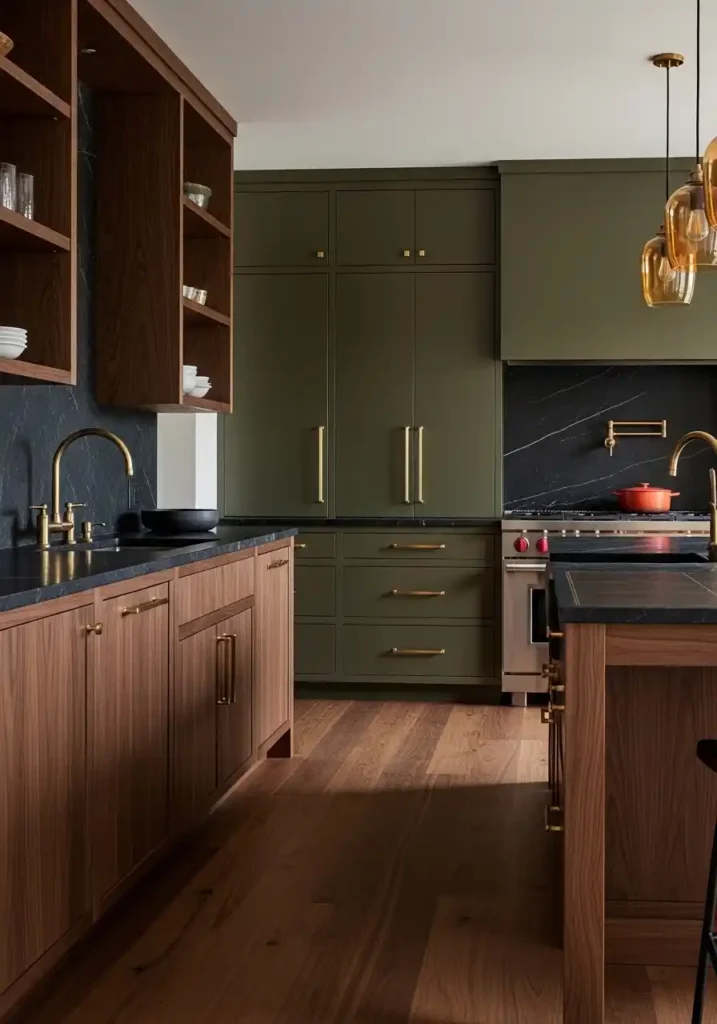
A dark walnut and olive green earthy kitchen is the natural interior design that creates the most concentrated, the most dramatically rich, and the most genuinely sophisticated expression of deep, dark natural earth tones in a contemporary kitchen — because dark walnut’s deep brown with its characteristically straight grain and its quality of warm, almost chocolatey natural depth, combined with olive green’s earthy, slightly gray-botanical tone, creates a material palette of such complete, mutually reinforcing natural richness that the kitchen feels genuinely, unmistakably grounded in the deep, organic, dark-toned world of aged wood and muted botanical color. This is not a light, bright earthy kitchen — it is the earthy kitchen of the deep forest floor.
The honed dark soapstone countertop in a walnut and olive green earthy kitchen is the material choice that most perfectly completes the dark, natural material story — because soapstone’s deep, slightly varied gray-black tone with its characteristic soft, matte surface quality creates a countertop of genuine geological beauty that appears to absorb the kitchen’s warm amber light rather than reflecting it, creating a surface of quiet, deep, concentrated visual richness that polished granite or quartz surfaces, however premium their specification, can never approach in terms of organic material warmth. Soapstone also develops a beautiful natural patina with oil and use over time, deepening and enriching with every year of cooking, making it the countertop that the earthy kitchen deserves.
8. The Kitchen with Handmade Ceramic Tile Backsplash
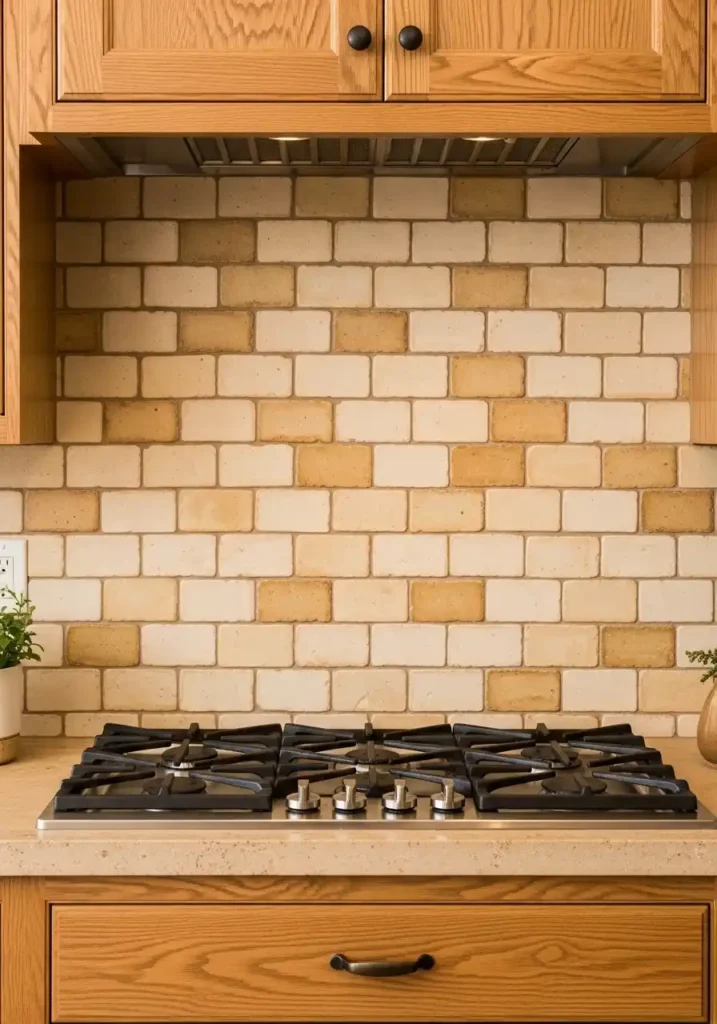
Handmade ceramic tiles in warm, earth-toned glazes are the backsplash material that most authentically and most beautifully expresses the earthy kitchen’s fundamental commitment to genuine craft, genuine natural material beauty, and the specific quality of organic warmth that only things made by human hands from natural materials can provide. Each handmade ceramic tile is a small, individual act of making — formed, glazed, and fired by a person whose specific touch, specific skill, and specific aesthetic judgment influenced every aspect of its final form and color — and a backsplash composed of dozens or hundreds of these individual acts of making creates a wall of accumulated craft richness that is genuinely irreplaceable by any machine-made alternative.
The specific quality that makes handmade ceramic tiles most spectacularly beautiful in an earthy kitchen backsplash is the organic variation in their glaze surface — the way that adjacent tiles in the same glaze color are never quite identical, with one showing a slightly deeper amber in its center, another showing a slightly more honey-toned edge, and a third showing a subtle variation in surface texture that creates a different quality of light reflection. This variation is not a manufacturing imperfection — it is the handmade tile’s most precious and most irreplaceable quality, creating a wall surface of endlessly rewarding visual complexity that rewards close examination with new variations in color and texture that machine-made tiles, with their perfect, unvarying uniformity, can never provide.
9. The Earthy Kitchen with Natural Stone Sink
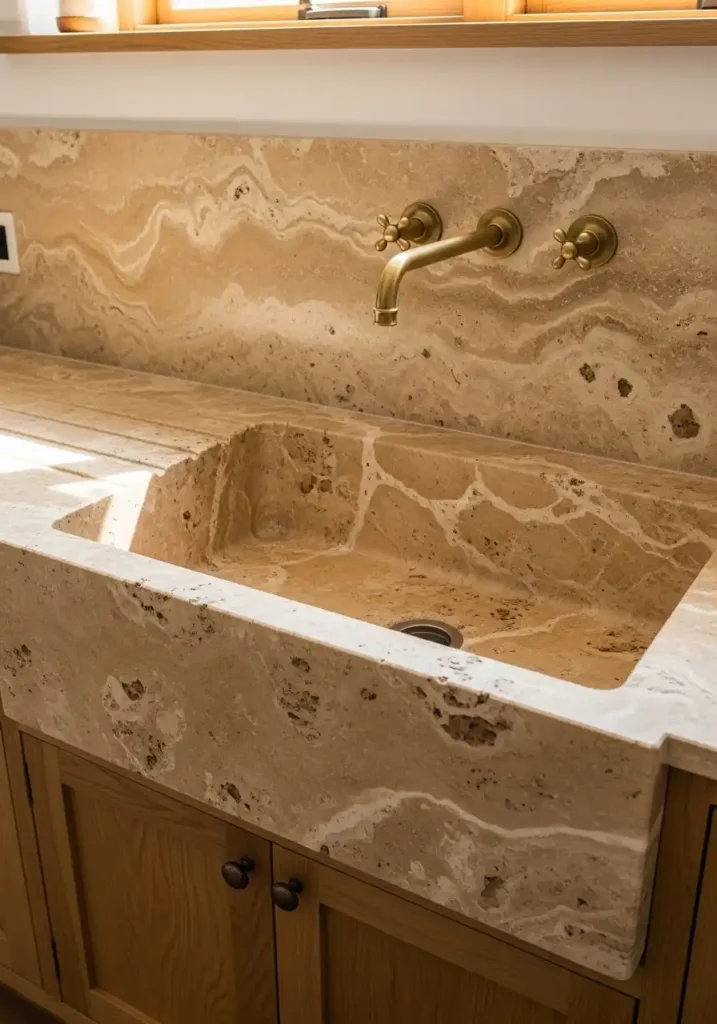
A natural stone sink carved from a single block of travertine, limestone, or sandstone is the kitchen fixture that most completely and most powerfully centers the earthy kitchen’s material philosophy — because a stone sink is not manufactured, assembled, or formed from processed materials but literally carved from a piece of the earth’s geological history, bringing a quality of material authenticity and natural presence into the kitchen that no ceramic, stainless steel, or composite sink can approach with the same directness and the same geological weight. Every travertine sink is different, unique, and genuinely irreplaceable — shaped by the specific geological history of the exact piece of stone from which it was carved.
The travertine sink’s characteristic natural voids — the small fossils, shell impressions, and mineral inclusions that are sealed with grout or left open as part of the stone’s natural surface — are the specific quality that makes travertine the most characterful and the most naturally beautiful stone for an earthy kitchen sink. These natural inclusions are not imperfections to be hidden or corrected — they are the stone’s geological autobiography, the record of the specific organic materials that were incorporated into the limestone during its formation millions of years ago, and their presence in the kitchen sink creates a daily, intimate visual relationship with the deep natural history of the earth that is genuinely, quietly extraordinary.
10. The Forest Green and Reclaimed Wood Earthy Kitchen
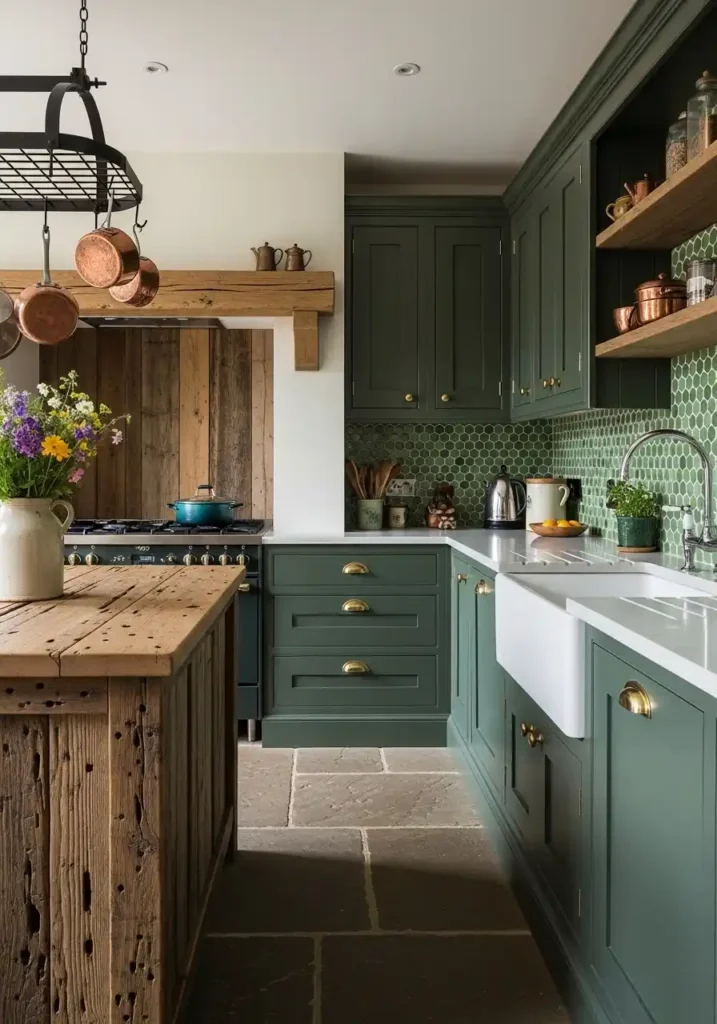
Forest green and reclaimed wood create the earthy kitchen’s most complete and most deeply atmospheric expression of the natural world brought into the domestic cooking space — because forest green is literally and directly the color of living woodland, the exact tone of deep forest shadow and dense evergreen foliage, and reclaimed wood is literally a piece of the built or natural world that has aged, weathered, and developed the specific character of genuine material history that new timber, however beautiful, has not yet had the time to acquire. Together, they create a kitchen that feels simultaneously like a beautiful contemporary design and like a space with genuine, accumulated, organic character.
The reclaimed wood island top is the single most powerful and most characterful reclaimed wood application in the forest green kitchen — because it places the aged, weathered, genuinely historical material at the kitchen’s social and functional center, where every person who cooks in the kitchen, sits at the island, or gathers around it during a party is in direct physical contact with a piece of wood whose grain, whose nail holes, whose weathered surface, and whose natural aging tell the story of a previous life in a barn, a factory floor, or an old house. That physical connection to material history creates a quality of kitchen character that no new material, however beautifully specified, can replicate.
11. The Earthy Kitchen with Jute, Rattan, and Natural Textiles
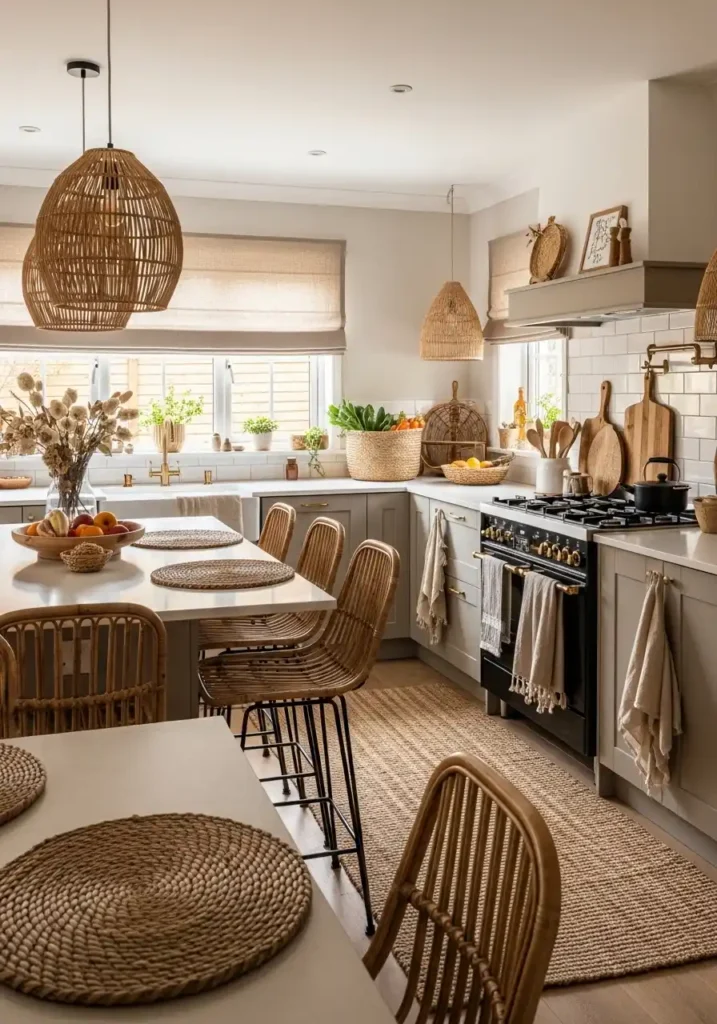
Natural textiles and woven materials in an earthy kitchen perform the single most important sensory transformation available to any kitchen design — the introduction of genuine softness, genuine warmth, and the specific quality of organic tactile richness that natural fibers provide into a room that is otherwise almost entirely composed of hard, cool, reflective surfaces. Jute, rattan, linen, and seagrass each bring not just visual warmth but a genuine quality of natural, slightly imperfect, genuinely woven texture that synthetic alternatives cannot replicate, and their combination in a single earthy kitchen creates a sensory environment of such complete, organic richness that the kitchen feels like an extension of the natural world rather than a functional room within a manufactured building.
Rattan pendant lights are the natural textile element that creates the most dramatically beautiful and the most atmospherically significant contribution to the earthy kitchen — because rattan pendants cast a specific, dappled quality of warm light through their woven structure that no other pendant material produces, creating pools of beautifully patterned light and shadow on the kitchen surfaces below that shift and move subtly as the air currents in the room cause the pendant to sway almost imperceptibly. This dappled, organic quality of light is the specific quality that distinguishes the earthy kitchen’s evening atmosphere from that of any contemporary kitchen with glass or metal pendant lighting, creating a warmth and a natural beauty that feels completely, authentically connected to the warm, organic world of natural materials.
12. The Earthy Kitchen with Organic Curved Forms
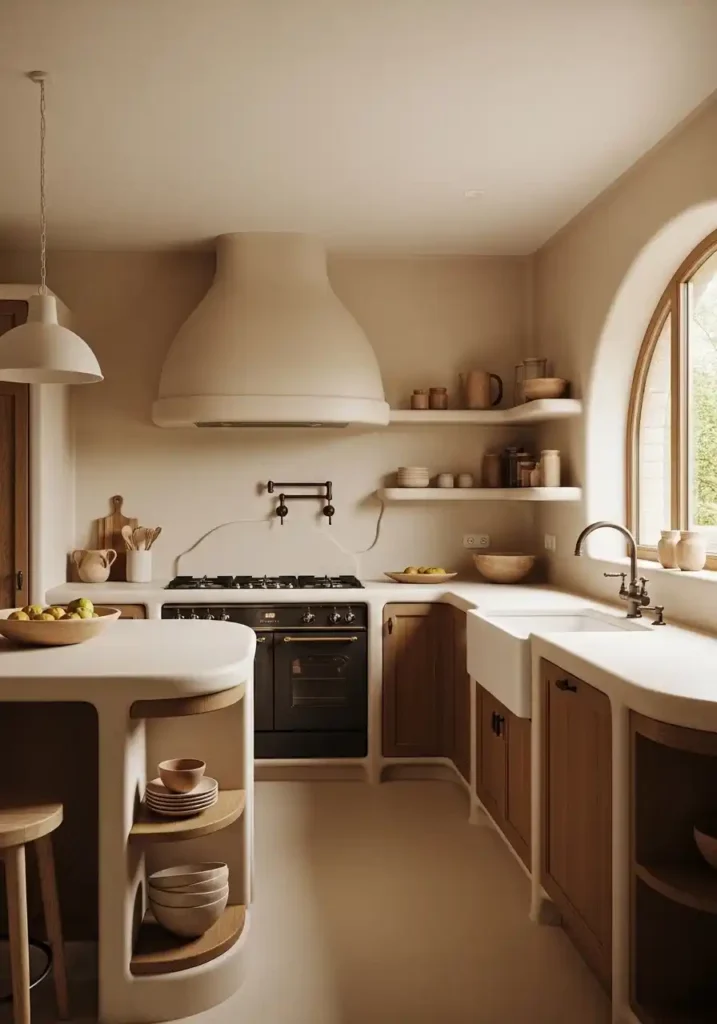
An earthy kitchen with organic curved forms is the natural interior design approach that most completely and most literally brings the shapes of the natural world — the smooth curve of a river-worn stone, the organic arc of a hillside, the gentle dome of a clay vessel — into the kitchen’s architecture and furniture, replacing the rigid geometry of manufactured, machine-made construction with the softer, more biomorphic forms that the human eye and the human nervous system find instinctively more beautiful and instinctively more calming than right angles and sharp corners. Curves in a kitchen feel genuinely natural in the same way that the natural world itself, which contains almost no true straight lines or right angles, feels genuinely natural.
The smooth plaster dome range hood is the curved earthy kitchen element that most powerfully and most architecturally establishes the space’s design philosophy — because the range hood occupies the kitchen’s most prominent architectural position, rising from the cooking surface to the ceiling at the visual center of the kitchen’s focal wall, and a hood formed in smooth, organic, dome-shaped plaster rather than in the angular, rectangular form of conventional range hoods creates a sculptural focal point of such complete, quietly confident natural beauty that it makes the entire kitchen feel resolved at a level of architectural ambition and design intelligence that goes far beyond the merely decorative. The plaster dome hood is not a piece of kitchen equipment — it is a piece of architecture.
13. The Earthy Kitchen with Dried Botanicals and Natural Abundance
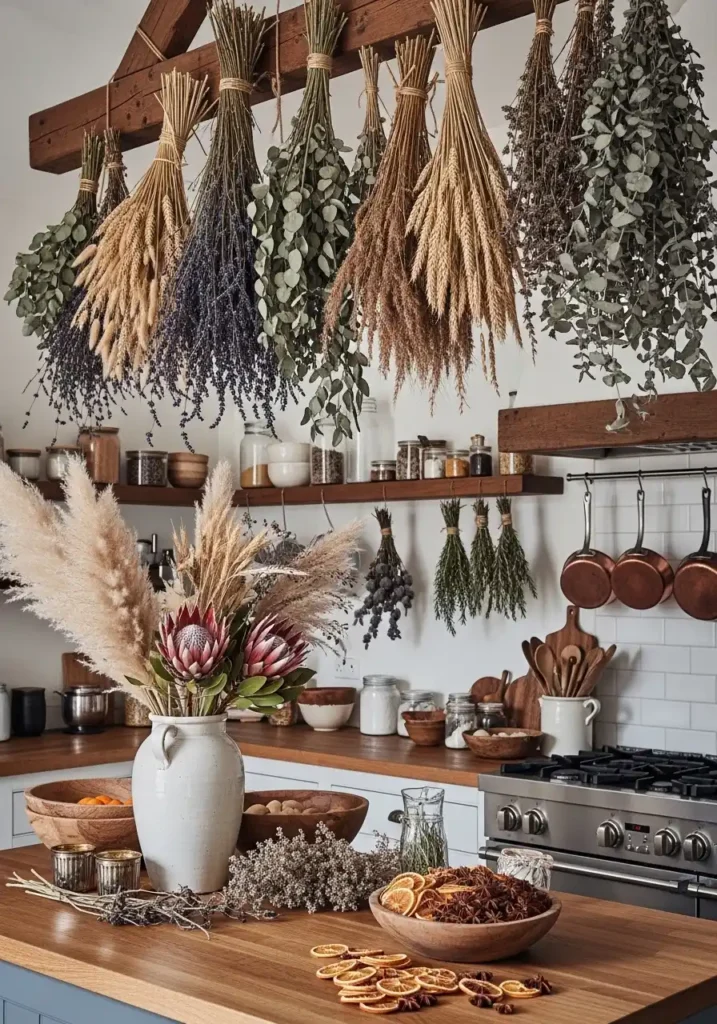
Dried botanicals in an earthy kitchen create the most complete and the most authentically natural kitchen styling available — because dried plant materials bring not just visual warmth and organic beauty but genuine, complex natural fragrance into the kitchen environment, layering the space with the aromatic richness of lavender, eucalyptus, dried herbs, and wood that makes the kitchen smell as extraordinarily beautiful and as genuinely natural as it looks. The combination of visual and olfactory natural abundance created by a kitchen generously styled with dried botanicals produces a sensory experience of such complete, deeply satisfying organic richness that every person who enters the kitchen is immediately, physically affected by its warmth and its fragrance.
The ceiling beam hung with large bunches of dried lavender, wheat, and eucalyptus is the dried botanical installation that creates the most dramatically beautiful and the most completely farmhouse-natural kitchen display available — because bunches of dried botanicals hung from above create a softly fragrant, gently moving ceiling treatment that turns an architectural structural element into a living, organic feature of extraordinary warmth and beauty. The bunches should be generous, full, and varied in botanical species to create the most visually rich and the most aromatically complex display — the visual fullness of the dried botanicals communicating the same quality of natural abundance and genuine country warmth that makes a farmers’ market stall more beautiful than any florist’s shop.
14. The Earthy Kitchen with Handcrafted Pottery Display
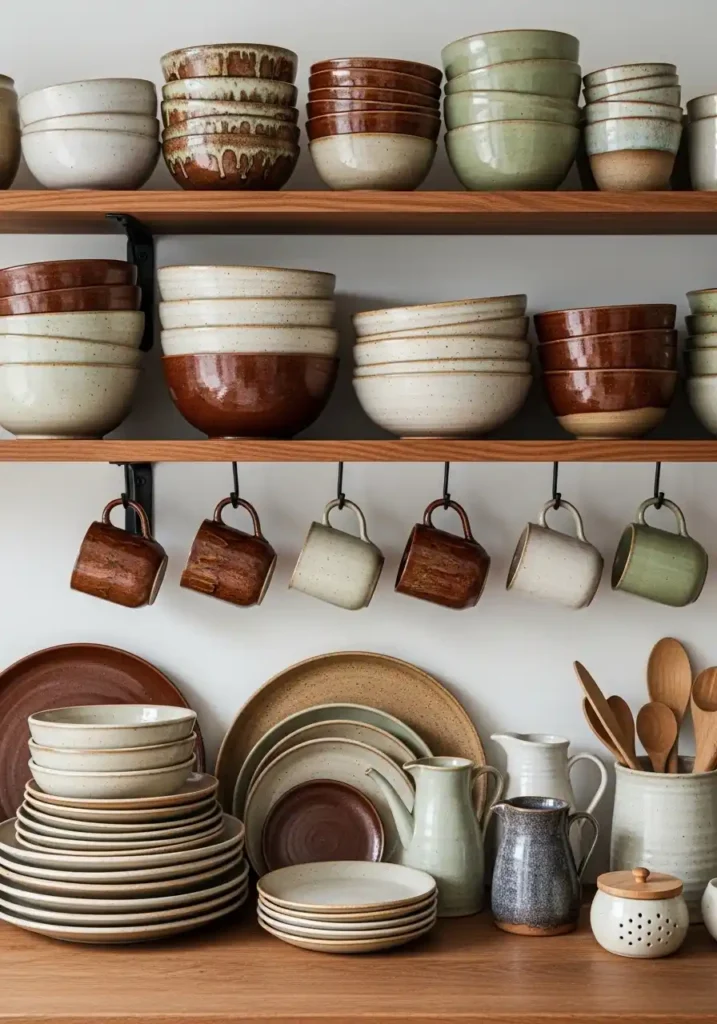
A kitchen with a genuinely curated collection of handcrafted pottery displayed on open shelving is the earthy kitchen styling that most completely and most personally expresses the natural interior aesthetic’s values — because handcrafted pottery is the physical embodiment of every principle the earthy kitchen holds most dear: the beauty of natural materials, the value of genuine making, the specific warmth of organic forms shaped by human hands from clay drawn from the earth, and the individual, irreplaceable character of objects that were made one at a time by a specific person with a specific skill and a specific aesthetic vision. A kitchen whose shelves hold a beautiful pottery collection is a kitchen that genuinely understands what beauty means.
The curation of a kitchen pottery collection is as important as its acquisition — because the most beautiful kitchen pottery display is not the most expensive collection or the largest number of pieces but the most thoughtfully selected and the most intelligently arranged group of objects, where each piece is beautiful in its own right and contributes to a composed, harmonious whole of compatible forms, complementary glaze tones, and varied but related surface textures. Stoneware in warm brown, cream, and sage glazes creates the most complete and the most naturally harmonious earthy kitchen pottery palette — the brown referencing the clay from which every piece was made, the cream providing the warm neutral that allows the other colors to be seen clearly, and the sage adding the botanical note that completes the earthy kitchen’s connection to the natural world.
15. The Earthy Kitchen with a Wood-Burning Stove
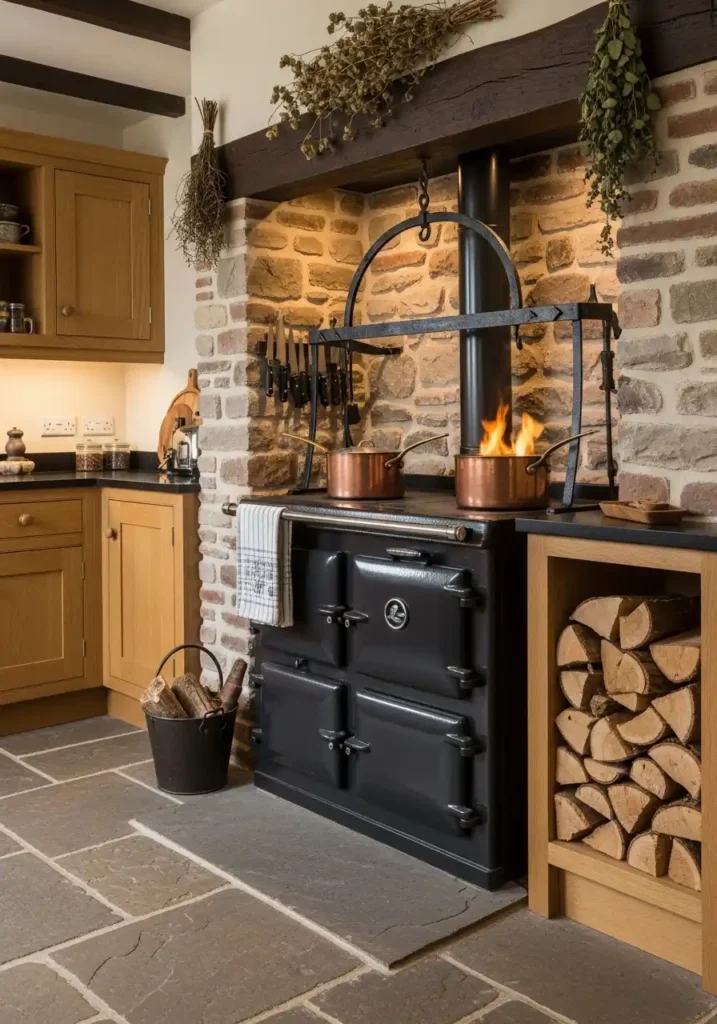
A wood-burning stove in an earthy kitchen is the cooking and heating element that most completely and most powerfully connects the act of daily cooking to its most ancient, most fundamentally human origins — because cooking over real wood fire is the oldest form of food preparation in human history, older than every kitchen technology that has followed it by hundreds of thousands of years, and its presence in a contemporary earthy kitchen creates a connection to that vast, shared human history of gathering around fire to prepare and share food that no gas burner or induction hob can approach. The wood-burning stove makes cooking a genuinely primal, genuinely elemental act.
The practical pleasures of a wood-burning kitchen stove extend far beyond its extraordinary aesthetic and atmospheric contributions — because a properly specified kitchen wood burner provides both cooking capability on its cast iron top and genuine radiant warmth throughout the kitchen and adjacent rooms during the cold months, creating a quality of whole-body physical warmth that no central heating system can replicate with the same immediacy, the same organic quality, and the same deeply satisfying sense of warmth genuinely earned through the physical act of selecting, splitting, and burning real wood. The smell of wood smoke, the sound of a crackling fire, and the sight of living flames through the stove’s glass door create a sensory richness that makes the earthy kitchen genuinely, extraordinarily beautiful during every cold evening of the year.
16. The Sage Green and Natural Linen Earthy Kitchen
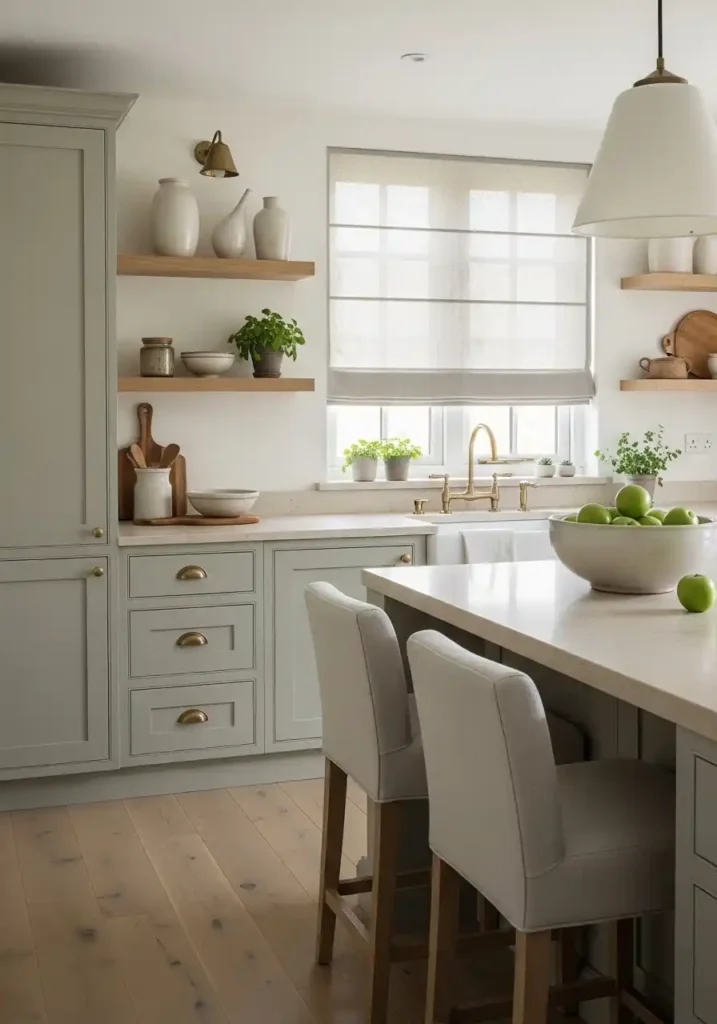
Sage green and natural linen in an earthy kitchen create the most botanically beautiful and the most quietly, completely serene natural interior kitchen palette available — because sage green is the color that most accurately and most poetically captures the specific gray-green tonal world of medicinal and culinary herbs growing in a garden, their leaves’ color exactly balanced between the warm green of living chlorophyll and the gray of dried, dusty botanical material, creating a color of such complete natural authenticity that it makes the kitchen feel genuinely, organically connected to the herb garden and the natural landscape surrounding it. Sage green is the kitchen color that smells good even before the herbs are planted.
The natural linen elements in a sage and linen earthy kitchen — the upholstered counter stools, the roman blind, the tea towels, and the napkins — create a specific quality of soft, warm, slightly imperfect textile beauty that reinforces the sage green’s botanical quietness with a material gentleness and a natural warmth that no synthetic textile alternative can provide. Natural undyed linen is warm where synthetic fabric is cool, slightly irregular where synthetic fabric is perfectly even, and genuinely natural where synthetic fabric is manufactured — and these qualities of genuine natural authenticity are precisely what the earthy kitchen needs its textile elements to provide, creating a combined palette of sage green and natural linen that is the most completely, most organically, and most genuinely botanically beautiful kitchen color story available.
17. The Earthy Kitchen with Rough-Hewn Stone Countertops
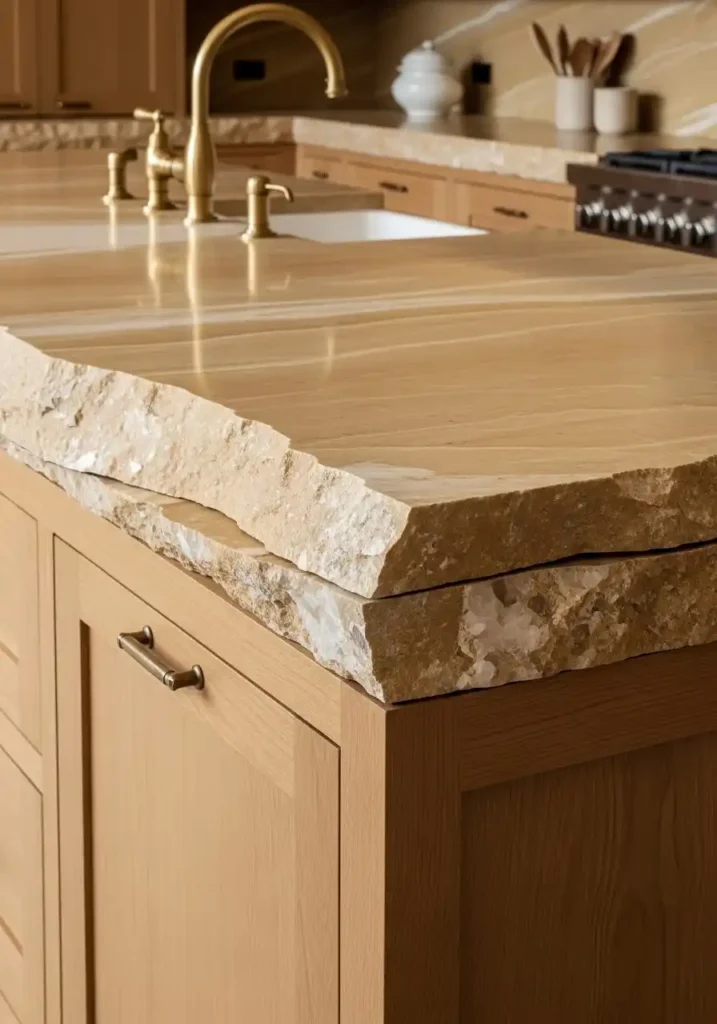
Rough-hewn stone countertops with a natural, live edge rather than a cut, polished straight edge are the kitchen countertop specification that most powerfully and most authentically brings the geological world into the kitchen with complete honesty and complete material confidence — because the live edge of a stone countertop shows exactly what stone actually is: a geological formation with specific layers, specific crystal structures, and specific natural variations in thickness and surface texture that the conventional practice of cutting stone to perfectly straight, perfectly uniform edges completely eliminates in favor of the kind of machined precision that could be achieved with any material and that makes no particular use of stone’s specific, irreplaceable natural character.
The geological detail visible in a live-edge stone countertop’s natural face — the layers of mineral deposition, the occasional crystal formation, the subtle variations in color that reveal the stone’s specific geological history — creates a counter surface of such genuine material richness and such completely individual character that no two live-edge countertops anywhere in the world are alike. This quality of genuine geological uniqueness makes the live-edge stone countertop the most honest and the most completely authentic expression of the earthy kitchen’s fundamental design philosophy: that the natural world’s materials are most beautiful when they are most honestly presented, in forms that reveal rather than conceal their specific natural origins and their specific natural character.
18. The Earthy Kitchen with Warm Copper Accents
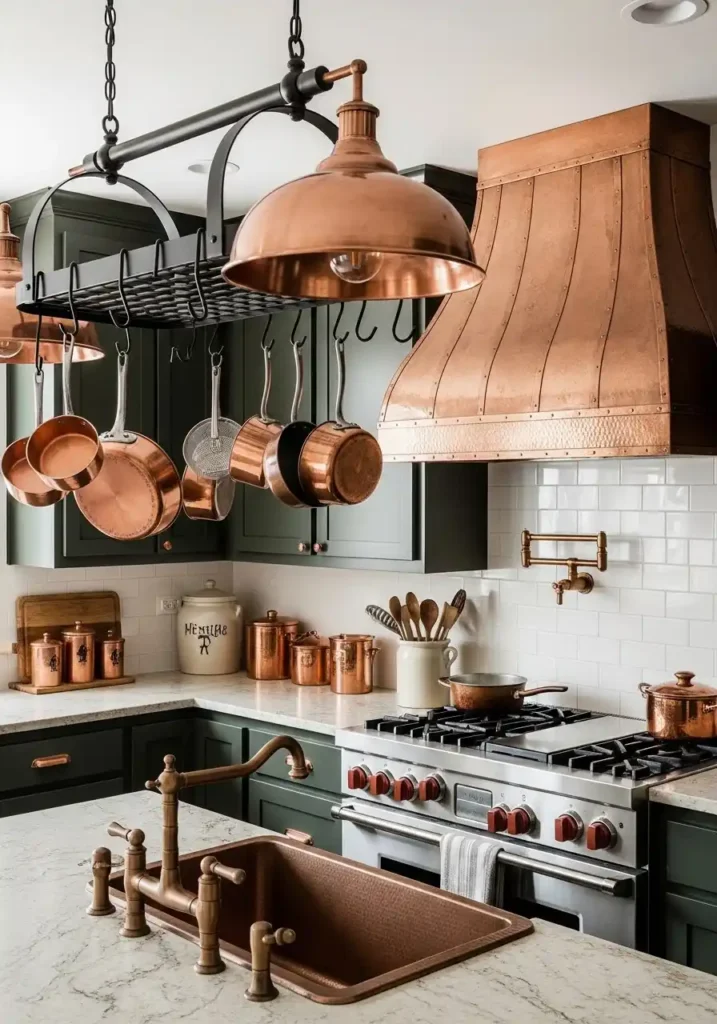
Copper as the dominant metallic accent in an earthy kitchen is the material choice that creates the most warm, the most organically rich, and the most genuinely beautiful metallic kitchen environment available — because copper is simultaneously the most visually warm metal in the domestic material vocabulary, the metal with the most complex and the most continuously evolving surface patina, and the metal with the longest and most deeply rooted connection to the history of cooking and domestic life. Copper cookware has been used in the world’s greatest kitchens for centuries for reasons of both cooking performance and beauty, and its presence in an earthy kitchen creates a material continuity with that long tradition of beautiful domestic cooking that no other metal can provide.
The hammered copper range hood is the single copper element that creates the most spectacular and the most architecturally powerful contribution to the earthy kitchen — because the range hood’s scale, its architectural position, and its complete visual dominance of the kitchen’s focal wall make it the most prominent and the most impactful canvas for copper’s specific material beauty. Hand-hammered copper, with its slightly irregular, faceted surface of thousands of individual hammer marks each reflecting light from a slightly different angle, creates a range hood surface of such extraordinary optical complexity and such warm, amber-metallic richness that it appears to glow with its own internal warmth rather than simply to reflect the light source above it.
19. The Earthy Kitchen with Vintage and Antique Finds
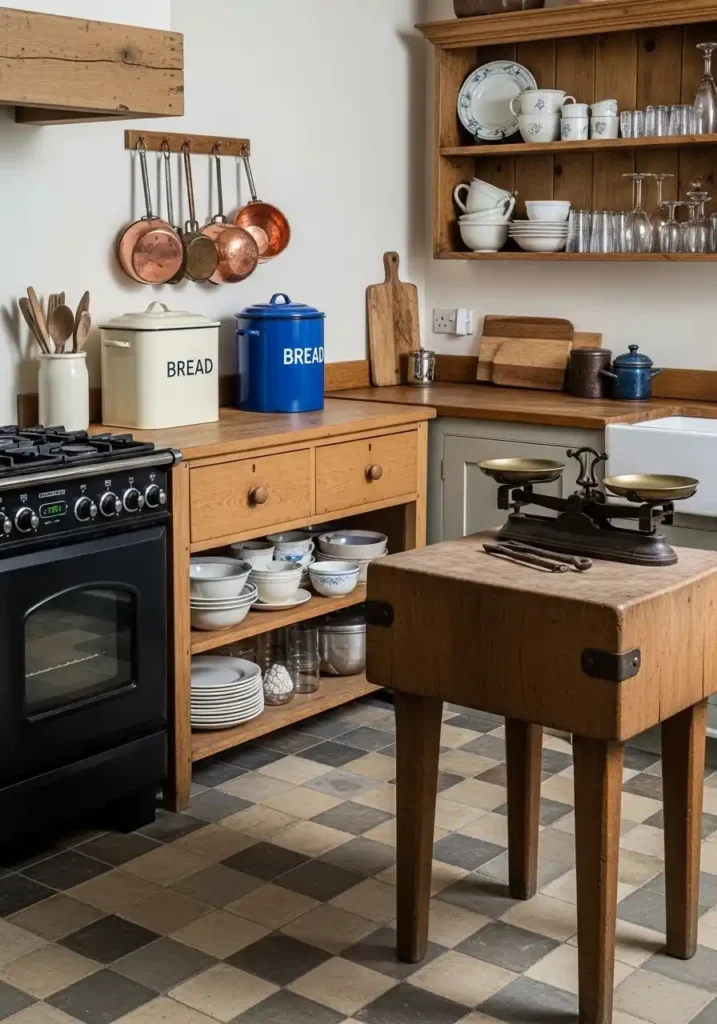
A kitchen enriched with genuine vintage and antique finds is the earthy kitchen that possesses the most complete, the most irreplaceable, and the most genuinely historically rich character of any natural interior kitchen design — because authentic vintage objects bring with them a quality of material history, genuine aging, and specific cultural provenance that no new reproduction object, however skillfully made, can replicate or approach. Every genuine antique in the kitchen is an object that was made at a specific moment in time, used by specific people for specific purposes over the years and decades of its previous life, and that carries the evidence of that use in its worn surfaces, its patinated metal, and its gently aged wood in a way that speaks immediately and authentically of genuine, accumulated domestic history.
The original Victorian pine dresser repurposed as kitchen storage is the vintage find with the most complete and the most transformative impact on the earthy kitchen’s character — because a genuine Victorian kitchen dresser, with its specific proportions, its specific patina of generations of paint and use, and its specific quality of handmade construction using techniques and tools that no longer exist in commercial furniture making, creates a focal point of such historical depth and such material authenticity that it anchors the kitchen’s entire aesthetic with an authority that no contemporary reproduction could achieve. The dresser makes the kitchen feel genuinely old in the most beautiful, most characterful, and most completely honest way.
20. The Earthy Kitchen with Natural Fiber Ceiling Panels
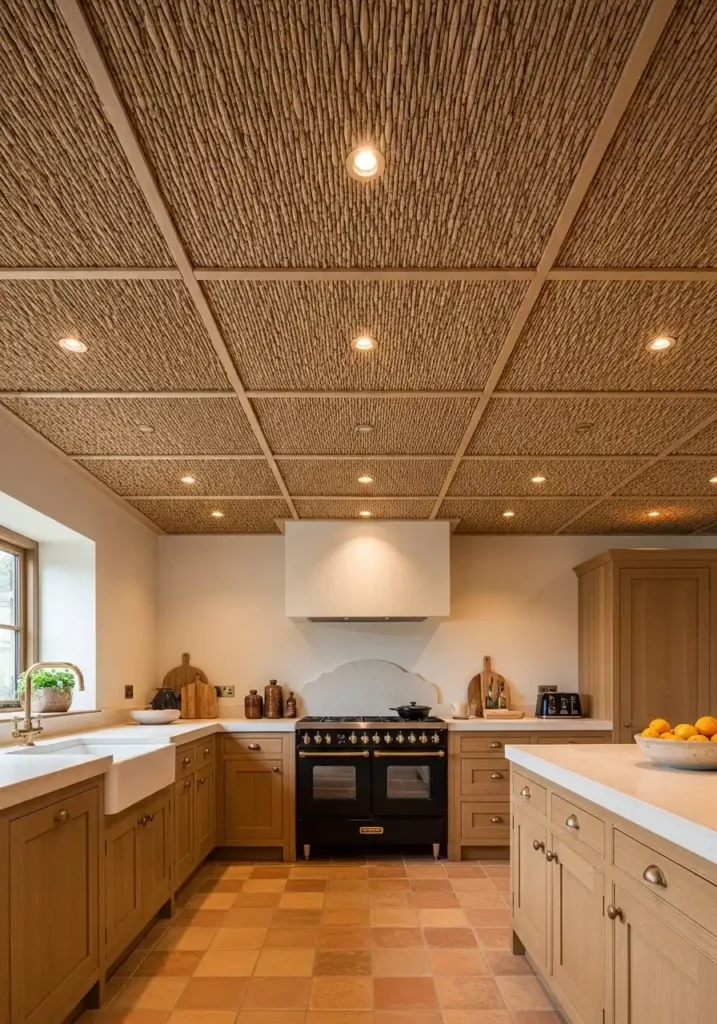
Natural fiber ceiling panels in an earthy kitchen are the design intervention that most unexpectedly and most completely transforms the kitchen’s sensory environment from above — adding the specific quality of natural textile warmth, acoustic absorption, and organic material texture to the kitchen’s ceiling that is the most consistently overlooked and the most consistently underdesigned surface in any kitchen, and that has a more significant impact on the room’s acoustic quality and atmospheric warmth than most kitchen designers and most homeowners give it credit for being able to provide. A ceiling of genuine natural fiber is simultaneously more beautiful, more acoustically comfortable, and more organically warm than any painted, plastered, or tiled alternative.
The specific acoustic benefit of natural fiber ceiling panels in an earthy kitchen is as practically significant as their visual contribution — because kitchens are typically among the most acoustically live and most reverberant rooms in any home, with their hard, parallel surfaces creating the echo and the sound amplification that makes conversation during cooking and during family meals significantly more difficult than it would be in a room with softer, more acoustically absorbent surface treatments. Natural fiber ceiling panels absorb the acoustic energy that a hard ceiling would reflect, creating a kitchen in which conversation is clearer, in which cooking sounds are more pleasantly muffled, and in which the general quality of the acoustic environment is more genuinely comfortable and more genuinely conducive to the social warmth that the earthy kitchen aspires to create.
21. The Earthy Kitchen with a Market Garden Aesthetic
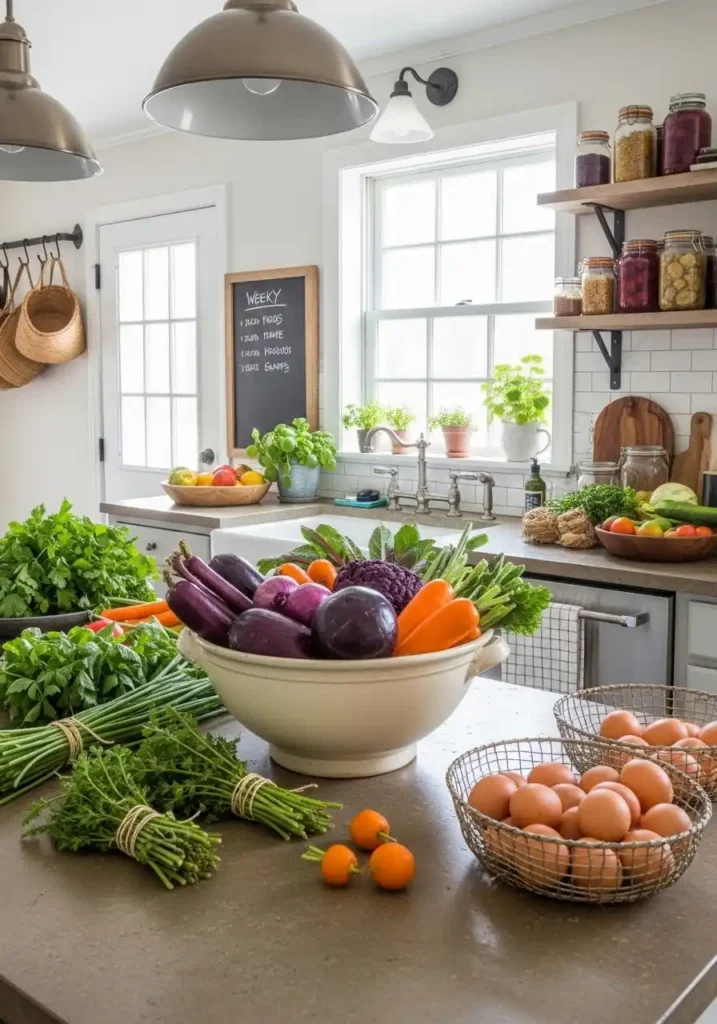
A market garden aesthetic in an earthy kitchen is the styling approach that most completely and most joyfully celebrates the kitchen’s fundamental purpose — the transformation of fresh, beautiful, genuinely seasonal ingredients into nourishing food — by making the ingredients themselves the kitchen’s primary and most beautiful decorating element. A kitchen styled with a market garden abundance of fresh vegetables, gathered herbs, seasonal fruit, and preserved produce communicates more powerfully and more honestly about the pleasures of cooking and eating than any purely decorative styling could achieve, because the ingredients are not props — they are the genuine raw material of the meals that will be cooked in this kitchen today, tomorrow, and every day of the beautiful, abundant season.
The large ceramic bowl of seasonal vegetables as a kitchen centerpiece is the market garden styling element with the most immediate and the most daily-renewed visual impact — because a wide, generous ceramic bowl filled with whatever is most beautiful and most seasonal at the current moment — deep purple aubergines in late summer, burnished orange squash in autumn, vivid green zucchini in early summer — creates a kitchen centerpiece of genuine natural beauty that changes with the seasons, never requires purchasing anything specifically for decoration, and makes the island or the counter into a still-life painting of fresh food that would have been the subject of the most celebrated Dutch and Flemish kitchen paintings of the seventeenth century. This is the most beautiful and the most honest kitchen decoration available.
22. The Earthy Kitchen with Stone Floor and Aged Patina
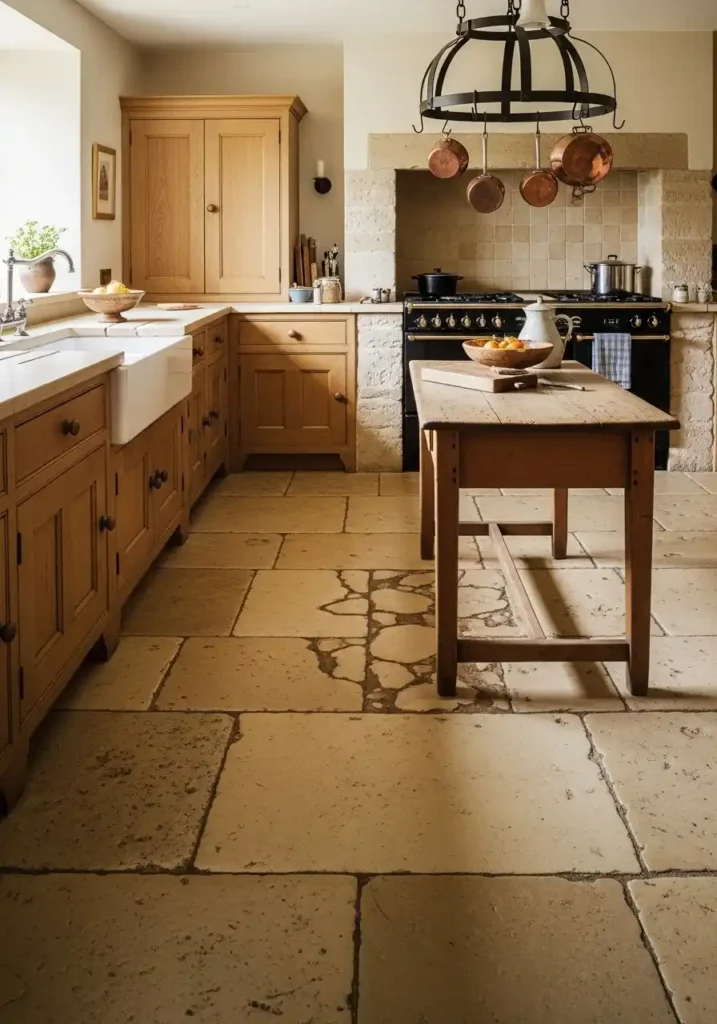
An aged stone floor in an earthy kitchen is the material element that most powerfully and most completely establishes the kitchen’s sense of genuine historical depth and genuine material character — because stone floors age in a way that is uniquely, incomparably beautiful, developing a patina of gentle wear in their most-used areas that creates a surface of such warm, polished, organically varied beauty that it tells the story of the generations of feet that have stood and walked across it with a material honesty and a physical poetry that no new floor, however beautifully specified, can replicate for decades to come. Aged stone is not worn out — it is worn in, and the difference is everything.
The specific beauty of an aged limestone or flagstone kitchen floor is the way that the natural variation between the floor’s most-worn areas — the slightly polished, slightly smoother zones directly in front of the sink, the stove, and the kitchen table where feet have stood most consistently over the years — and the less-worn areas between the flagstones creates a surface of such completely natural, completely individual topographical variation that the floor becomes a genuine record of the domestic life it has supported, a physical map of the kitchen’s daily use patterns written in the gentle geology of worn stone. This quality of material autobiography — of a floor that tells the story of the cooking and the living it has witnessed — is the most beautiful and the most completely irreplaceable quality that any kitchen floor can possess.
23. The Complete Earthy Kitchen — Every Natural Element in Perfect Harmony
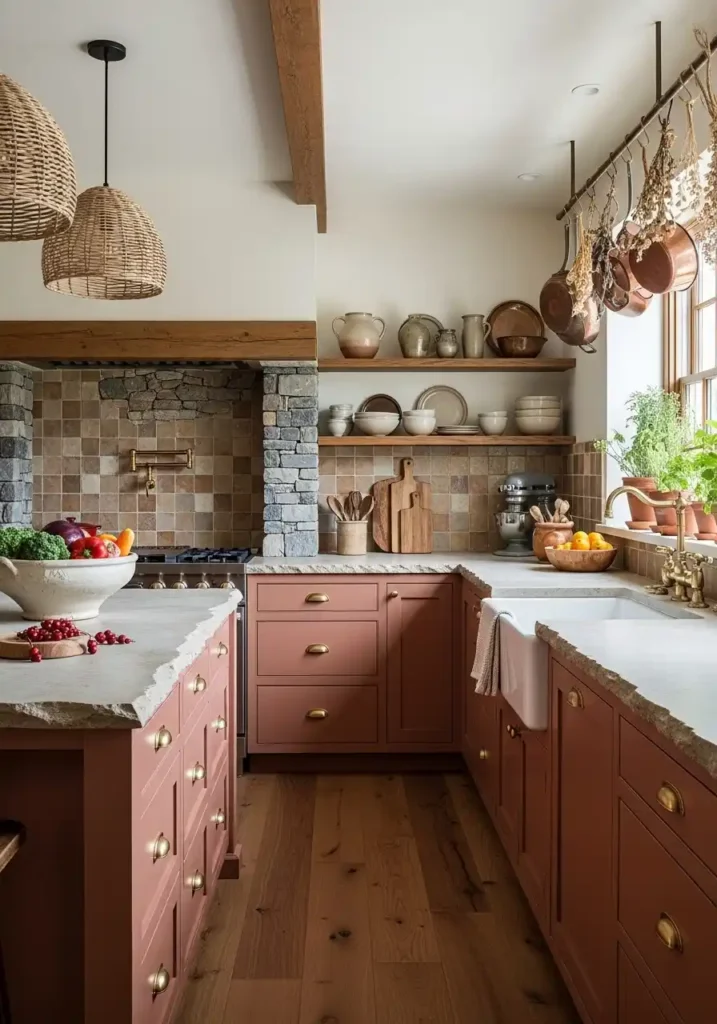
The perfect earthy kitchen — the one that makes every person who enters it feel immediately, physically calmer, warmer, and more deeply connected to the natural world; that makes cooking feel like a genuinely nourishing, genuinely grounding act rather than a rushed daily obligation; that looks more beautiful with every year of use as the unlacquered brass deepens its patina, the stone floor develops its wear, and the pottery collection grows richer and more personally expressive — is the accumulated, harmonious, completely resolved result of multiple natural material decisions working together in a state of complete, organic, mutually reinforcing harmony. The terracotta and the limestone. The copper and the rattan. The handmade pottery and the dried botanicals. Each element enriches every other.
The invitation this guide extends is perhaps the most personally meaningful of any kitchen design invitation — because an earthy kitchen is not just a design aesthetic but a declaration of values, a commitment to the specific qualities of warmth, authenticity, organic beauty, and genuine material richness that the natural world provides and that no manufactured alternative can replicate with the same depth or the same honesty. Start with the one natural material that most speaks to you — the terracotta color, the live-edge stone, the handmade ceramic, the copper pot rack — and build your perfect earthy kitchen from that single, genuinely natural starting point. Your kitchen’s most beautiful, most warm, most deeply grounding version is waiting to be discovered.
Conclusion:
Designing a kitchen with earthy elements is one of the best ways to create a space that feels warm, welcoming, and timeless. By incorporating natural materials, organic textures, soft neutral tones, and nature-inspired décor, you can transform your kitchen into a calming retreat that blends beauty with functionality. From wooden cabinetry and stone countertops to terracotta accents and indoor plants, these earthy kitchen ideas prove that nature-inspired design never goes out of style.
Whether you’re planning a full renovation or simply updating a few details, embracing earthy kitchen décor can instantly add warmth and character to your home. Use these earthy kitchen design ideas as inspiration to craft a cozy, natural interior that reflects comfort, sustainability, and effortless elegance.
Ultimately, a well-designed earthy kitchen is more than just a cooking space—it becomes the heart of the home, where natural textures, soothing colors, and inviting design come together to create a truly relaxing atmosphere.