1. The Fold-Down Counter Extension That Appears from Nowhere
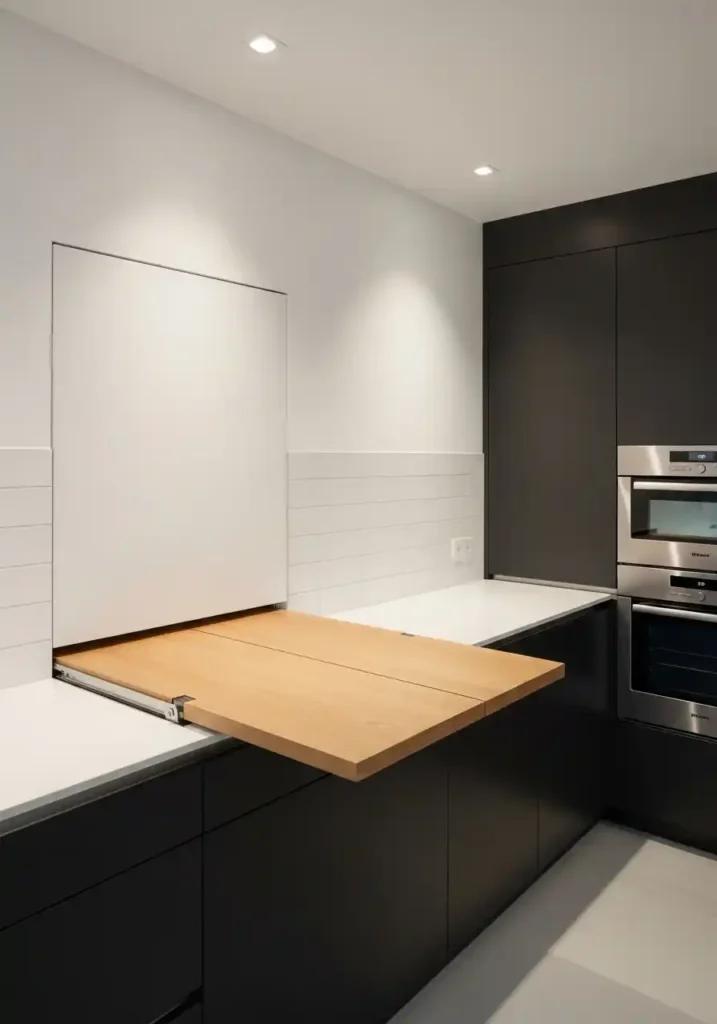
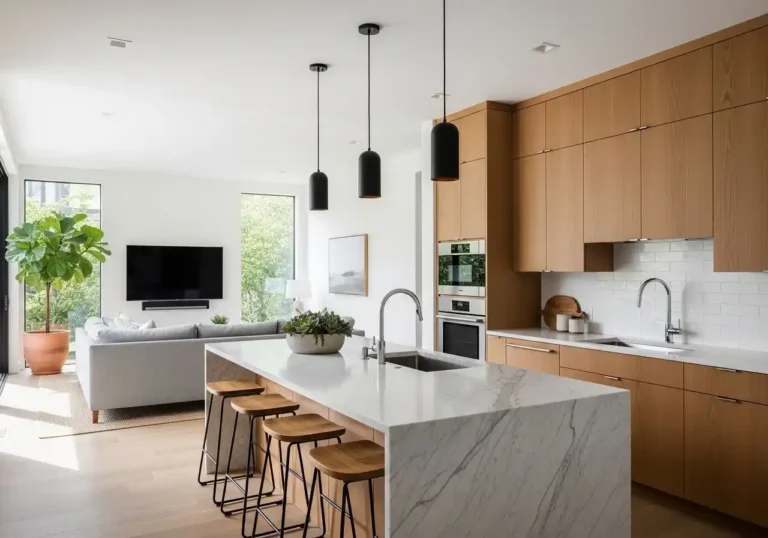
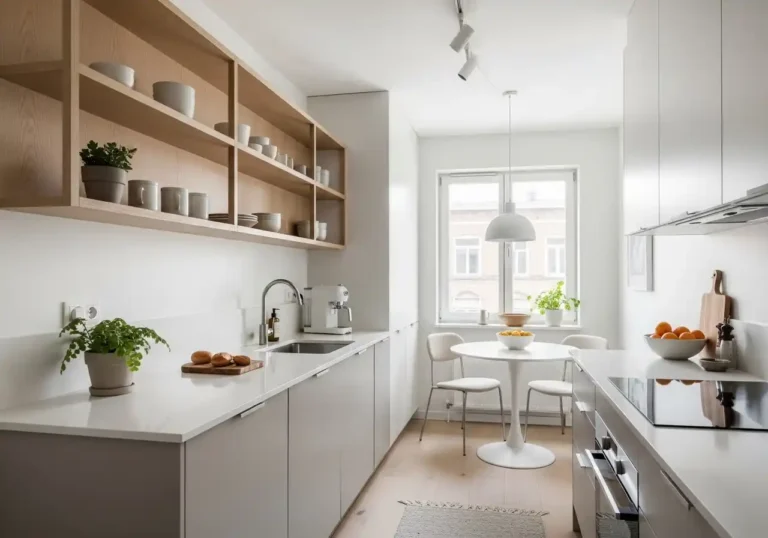
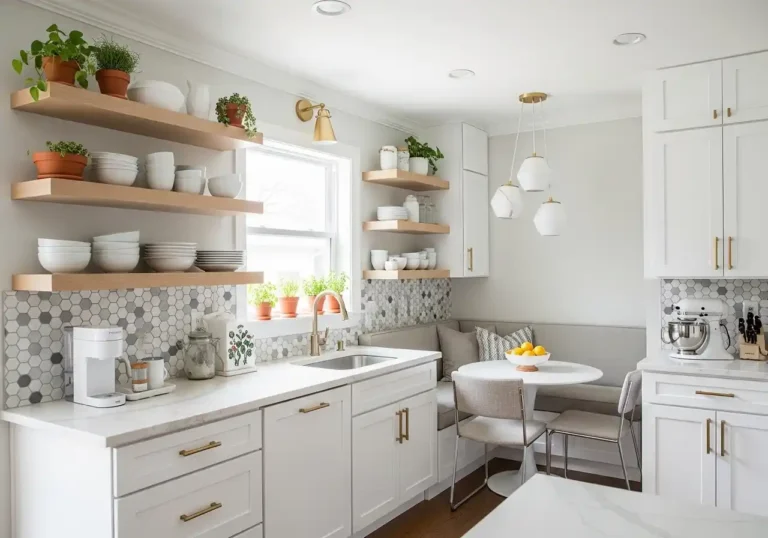
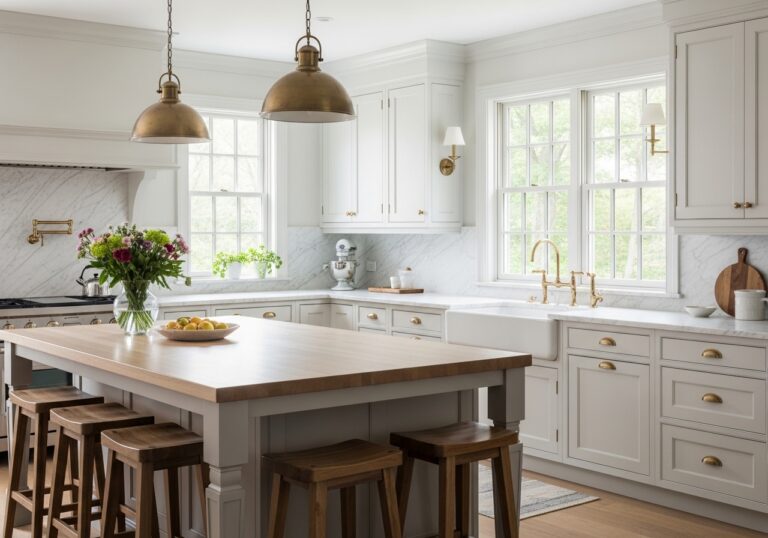
A fold-down counter extension in a Tiny Kitchen Design Tricks are the space-saving trick that delivers the most dramatic improvement in cooking practicality for the smallest permanent footprint investment — because a properly designed fold-down counter provides a full, proper, stable preparation surface of genuine size when deployed and folds completely flat against the wall when not needed, returning to the kitchen every inch of the floor space and the visual openness that the extended counter temporarily occupies. The difference between a tiny kitchen with and without this fold-down extension is the difference between a kitchen that struggles to accommodate the physical reality of meal preparation and one that handles it with generous ease.
The design and material quality of the fold-down counter extension matters enormously in a tiny kitchen where every element is always highly visible — because even in its folded, closed position, the fold-down counter is permanently a part of the kitchen’s visual environment and must be as beautiful in that closed state as it is functional in its open one. A fold-down in solid oak or walnut that matches the kitchen’s existing cabinet material reads as a deliberate, designed feature rather than a makeshift addition. The supporting bracket — a single slim brass or black steel arm that swings down from the wall to support the extended counter — should be as beautifully made as the counter itself, communicating quality and intention in every detail of its engineering and its finish.
2. Magnetic Knife Strip That Clears the Counter Completely
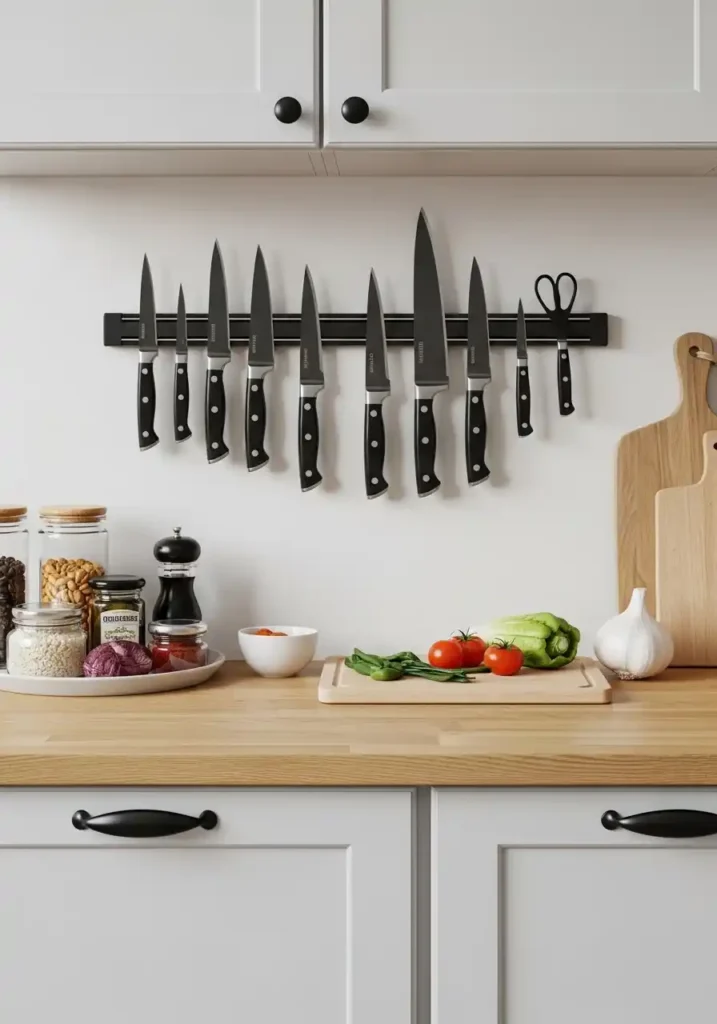
A magnetic knife strip mounted on the kitchen wall is the single most efficient knife storage solution available for a tiny kitchen — because it moves the knife collection from the counter, where a conventional knife block consumes a significant and permanently dedicated footprint of precious preparation surface, to the wall, where the knives occupy only the wall plane and contribute zero counter consumption while remaining equally accessible, equally visible, and equally safely stored with their sharp edges protected against other surfaces. In a tiny kitchen where every inch of counter space is genuinely precious and genuinely competed for by multiple simultaneous preparation tasks, this reclaimed counter space is a practical gift of real significance.
The placement of the magnetic knife strip in a tiny kitchen is the installation decision that most determines its daily convenience — and the ideal position is directly above the primary preparation area, at a height that allows knives to be lifted off and returned to the strip in a single, natural movement without reaching or stretching. Mounted at approximately eye height on the backsplash wall above the main cutting area, the knife strip is maximally convenient, maximally safe — because the knives are visible at all times and cannot be reached by children without deliberate effort — and maximally beautiful in the way that a collection of well-made kitchen knives, arranged by size on a clean magnetic strip, always manages to look genuinely impressive and genuinely professional.
3. A Tension Rod Under the Sink to Double Storage Space
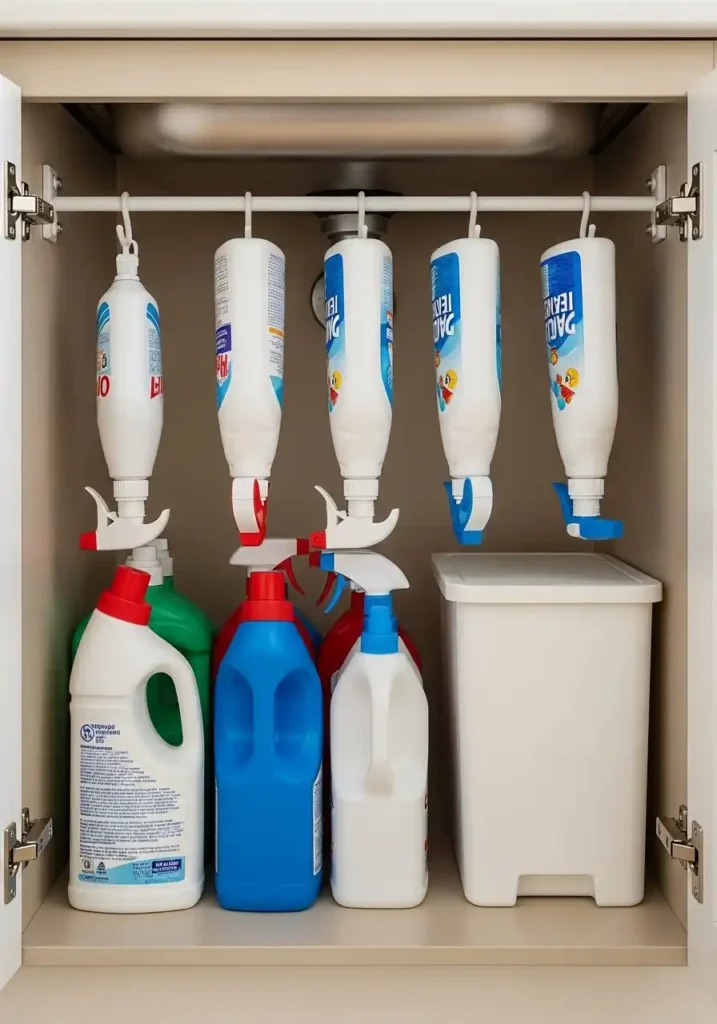
The tension rod trick for under-sink cabinet storage is the tiny kitchen space-saving idea that most people encounter for the first time and immediately wish they had discovered years earlier — because it is so simple, so inexpensive, so completely effective, and so immediately transformative of the under-sink cabinet’s storage capacity that it makes every other cabinet organization solution seem complicated by comparison. A single tension rod, the type sold in any hardware store for a few dollars, mounted horizontally across the interior of the under-sink cabinet at a height that allows cleaning spray bottles to hang from it by their trigger handles, instantly creates a second storage level within the cabinet that utilizes the full interior height rather than wasting the upper half of the cabinet on empty air above floor-level bottles.
The hanging spray bottles — suspended upside down from their trigger handles on the tension rod — free the cabinet floor completely for larger items that cannot hang, such as extra cleaning supplies, a small bin, or spare dishwasher tablets, creating a cabinet organization of such comprehensive efficiency that the under-sink storage, typically one of the kitchen’s most chaotic and most frustrating storage zones, becomes one of its most completely and most satisfyingly organized. The cost of this transformation is the price of one tension rod and five minutes of installation time — making it the highest return-on-investment storage upgrade available in any tiny kitchen and the one that every tiny kitchen should implement immediately and without hesitation.
4. Pocket Doors That Replace Swing Doors to Reclaim Floor Space
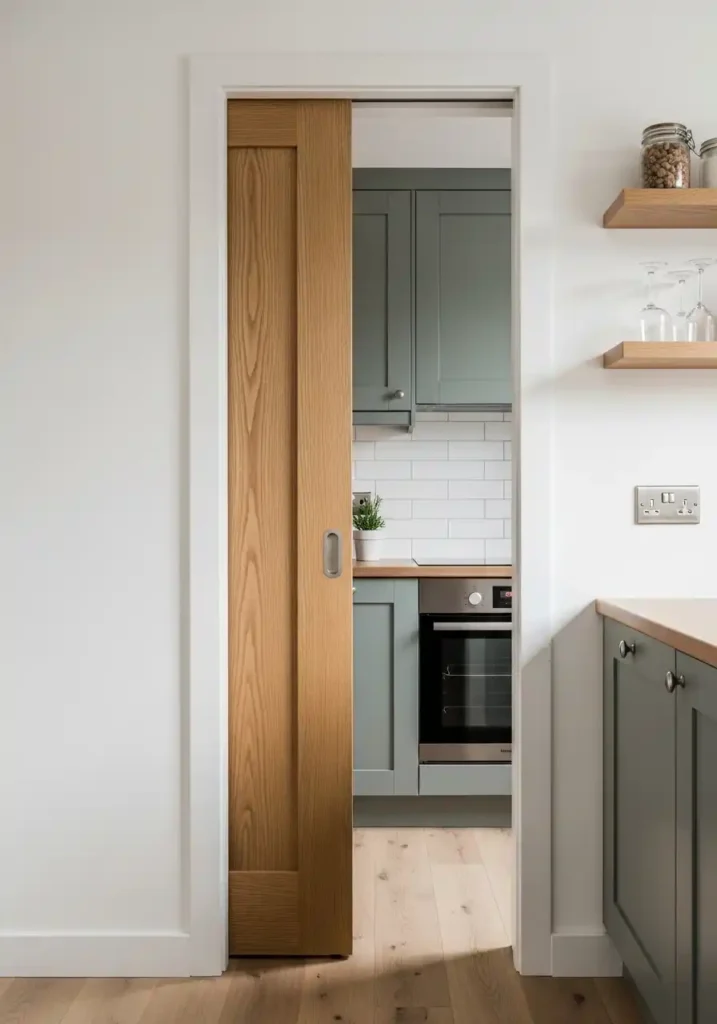
A pocket door that slides into the wall cavity rather than swinging into the kitchen or the adjacent room is the architectural intervention that most immediately and most permanently improves the tiny kitchen’s floor space — because a conventional hinged door requires a clear swing arc of approximately one square meter of floor area on at least one side of the door opening, and in a tiny kitchen where one square meter of unobstructed floor area represents a genuinely significant proportion of the total available space, eliminating the door swing arc entirely by replacing the hinged door with a pocket door returns that floor area to the kitchen’s permanent, usable, functional territory. The pocket door doesn’t just save space — it returns the kitchen’s full geometric potential.
The practical consideration that most commonly prevents tiny kitchen owners from installing pocket doors — the perception that they require significant construction work and significant cost — is less daunting in practice than it appears, because pocket door systems are available in self-contained wall-mounted versions that install onto the existing wall surface rather than within a new wall cavity, creating a sliding door system of genuine quality and genuine pocket door functionality without any demolition of existing walls. These surface-mounted pocket door systems are available in beautiful materials including solid oak and painted MDF, and a well-specified surface-mounted pocket door is visually elegant, mechanically reliable, and genuinely transformative in its daily spatial benefit for the tiny kitchen it serves.
5. A Pull-Out Pantry That Fits in Four Inches of Wall Space
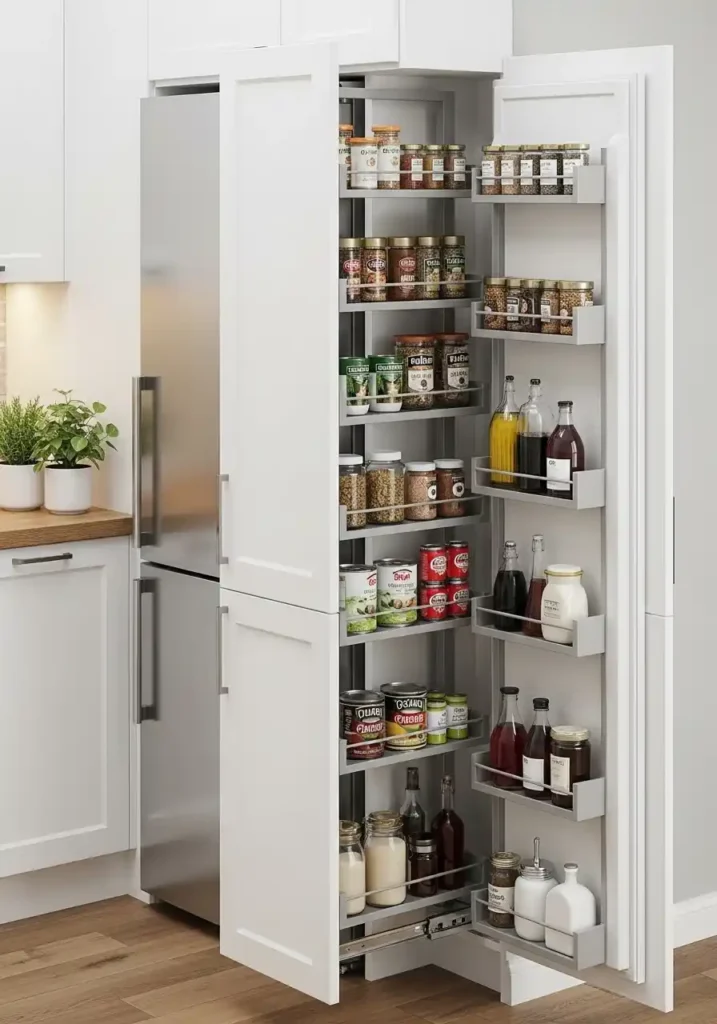
A slim pull-out pantry unit installed in the narrow gap between a kitchen appliance and a wall — or between two appliances — is the tiny kitchen storage discovery that most completely transforms the relationship between the kitchen’s apparent space and its actual storage capacity, because it creates a full, properly organized pantry of significant storage volume within a footprint so narrow that most tiny kitchen owners have looked at the gap it occupies for years without recognizing it as usable space. A pull-out unit of ten to fifteen centimeters depth in a gap of that width provides multiple full-height shelves capable of storing dozens of spice jars, canned goods, condiments, and small kitchen supplies within a floor footprint smaller than a standard sheet of paper.
The most important specification detail of a slim pull-out pantry in a tiny kitchen is the quality of the sliding mechanism — because a pull-out unit that sticks, that requires significant force to extend, or that returns unevenly is a unit that will quickly be left in the extended position permanently and will cease to deliver its space-saving benefit. A properly specified full-extension drawer slide of appropriate weight rating for the loaded shelf system provides smooth, effortless, one-handed operation of the fully loaded pull-out from its closed to its fully extended position and back, making the daily use of this pantry unit as effortless and as natural as opening any conventional kitchen drawer. The mechanism quality is worth investing in — it determines whether the space-saving trick works beautifully in practice or only in theory.
6. Stacking Appliances Vertically Instead of Side by Side
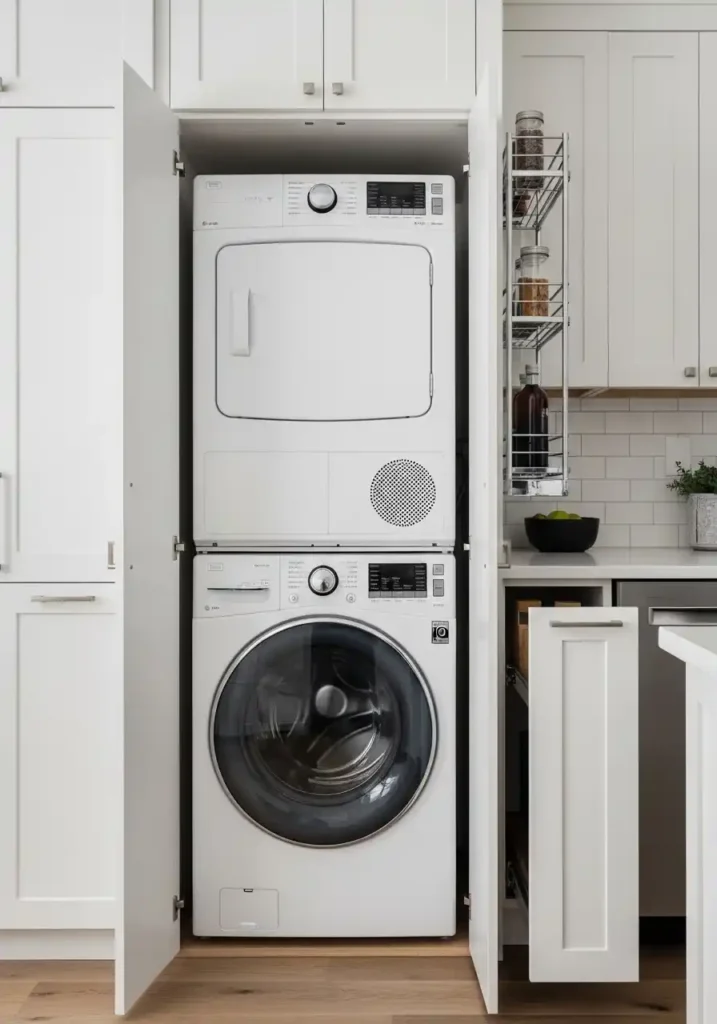
Stacking the washer and dryer vertically — dryer directly above washing machine on a proper manufacturer-approved stacking kit — is the tiny kitchen or laundry area trick that most completely and most immediately halves the floor footprint of the laundry function, freeing an entire appliance’s width of floor area for other uses without sacrificing any laundry capability whatsoever. The stacked configuration delivers identical washing and drying performance to the side-by-side arrangement using exactly the same appliances with exactly the same capacity, making the floor space saving completely free in terms of functional compromise — the only thing the stacked arrangement costs is the convenience of a counter surface above the front-loading machines, which the freed floor area beside the column more than compensates for.
The stacking kit — the manufacturer-specific hardware that connects the dryer securely to the washing machine below and prevents any movement or vibration-induced separation during operation — is the safety and stability investment that must not be skipped or substituted with improvised alternatives in any vertically stacked appliance installation. A properly specified stacking kit, designed specifically for the exact model combination being stacked, holds the dryer on the washing machine with engineered security through the full spin and tumble cycle vibrations of both appliances operating simultaneously, preventing the movement that unsecured stacking could produce. The stacking kit is the component that makes vertical appliance stacking genuinely safe, genuinely stable, and genuinely suitable for the daily domestic use that a tiny kitchen’s laundry configuration will receive for years.
7. A Hanging Pot Rack That Liberates Every Cabinet
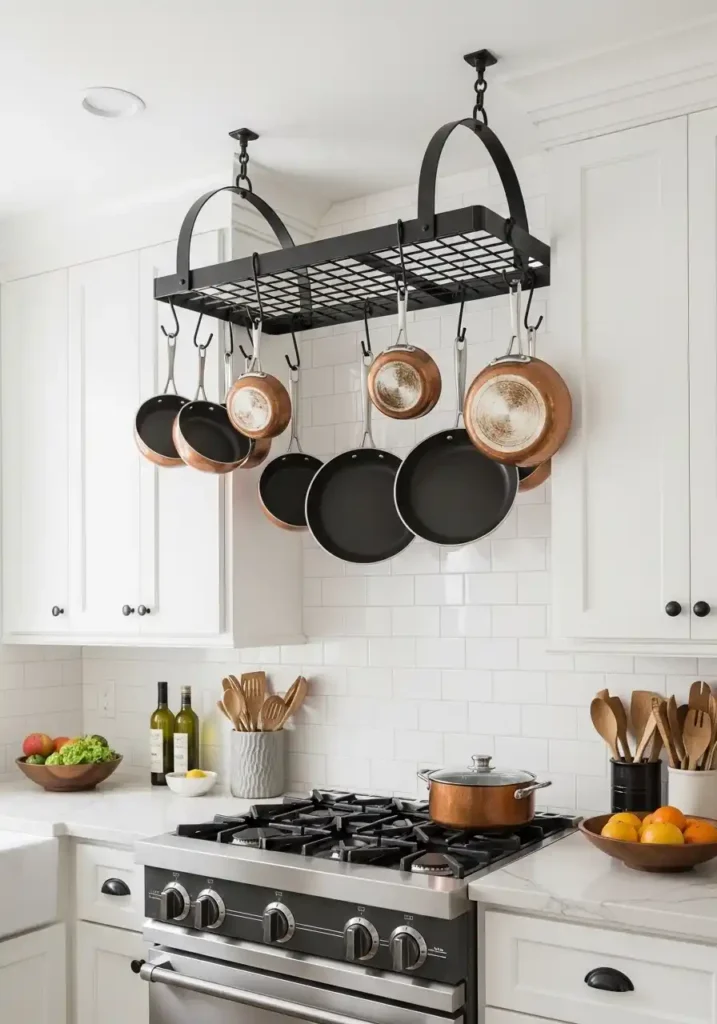
A ceiling-mounted pot rack in a tiny kitchen is the storage solution that most dramatically improves the kitchen’s daily cooking efficiency while simultaneously transforming its aesthetic character — because hanging pots and pans from the ceiling moves the kitchen’s largest and most difficult-to-organize items from the cabinets where they consume enormous storage volume into the overhead space that the tiny kitchen was previously making no use of whatsoever. The cabinet space freed by the pot rack relocation is genuinely significant — large pots and pans are among the kitchen’s most cabinet-space-consuming items, and removing them from cabinet storage can free several full cabinet shelves for food storage, small appliances, or other kitchen essentials that were previously inadequately accommodated.
The professional kitchen character that a hanging pot rack gives a tiny kitchen is an unexpected aesthetic bonus that makes the space feel genuinely more competent, more serious about cooking, and more deliberately, confidently designed than any equivalent decorating intervention could achieve at similar cost. A collection of copper-bottomed pans hanging from a black steel rack over a gas range makes the tiny kitchen look exactly like the working kitchen of someone who cooks with genuine knowledge, genuine equipment, and genuine passion — and that visual communication of cooking competence and cooking commitment transforms not just the kitchen’s appearance but the entire feeling of cooking within it. The tiny kitchen with a pot rack feels like a proper kitchen, regardless of its square footage.
8. Recessed Toe-Kick Drawers for Completely Hidden Storage
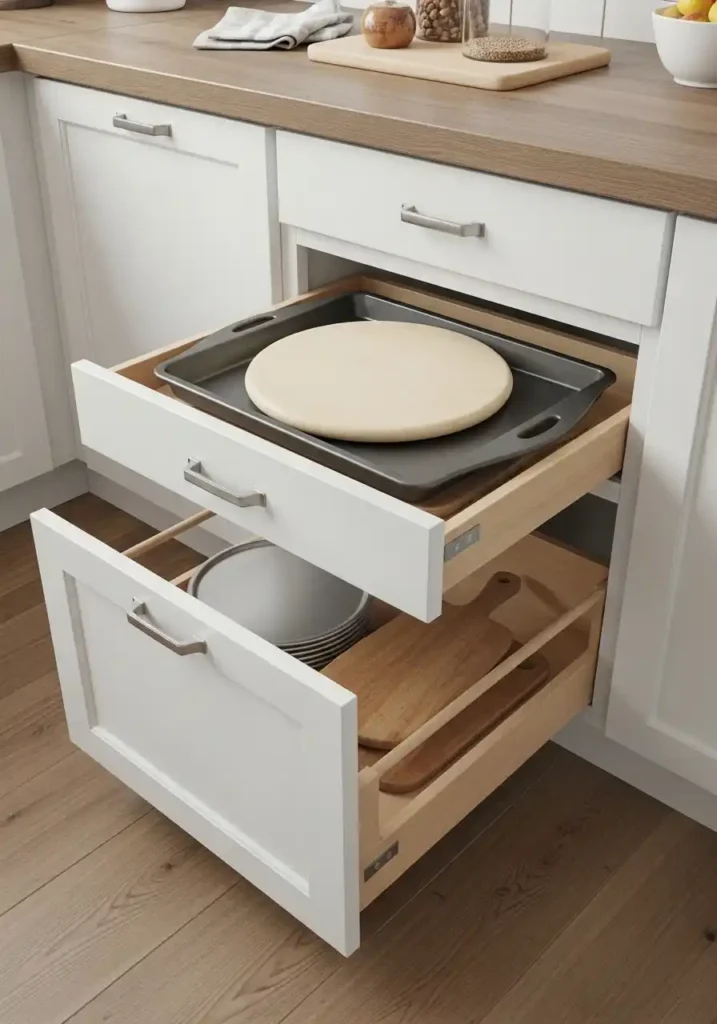
Toe-kick drawers — shallow pull-out drawers fitted into the recessed toe-kick area at the base of kitchen cabinets — are the tiny kitchen’s most brilliantly conceived hidden storage solution, because they utilize the one zone of every kitchen that is completely, universally, and entirely wasted in virtually every kitchen installation: the recessed space between the cabinet base and the floor that exists solely for the comfort of standing close to the counter. This recessed area, typically 10 to 15 centimeters high and the full depth of the cabinet run, is present beneath every base cabinet in every kitchen and is used in almost none of them for anything other than the accumulation of dust and the occasional escaped cooking utensil.
Fitted with shallow pull-out drawers of appropriate height, the toe-kick zone becomes ideal storage for flat kitchen items that are always difficult to store well in conventional cabinets — baking sheets, pizza stones, cooling racks, large cutting boards, and flat serving platters that are too large to store upright comfortably and too flat to stack efficiently with round pots and pans in the same cabinet. The toe-kick drawer front is finished in the same material and the same color as the cabinet doors above, making the entire installation virtually invisible when closed — the drawers read as part of the cabinet base rather than as a separate storage addition, maintaining the tiny kitchen’s visual cleanliness while significantly expanding its hidden storage capacity.
9. A Corner Lazy Susan That Banishes Dead Corner Space
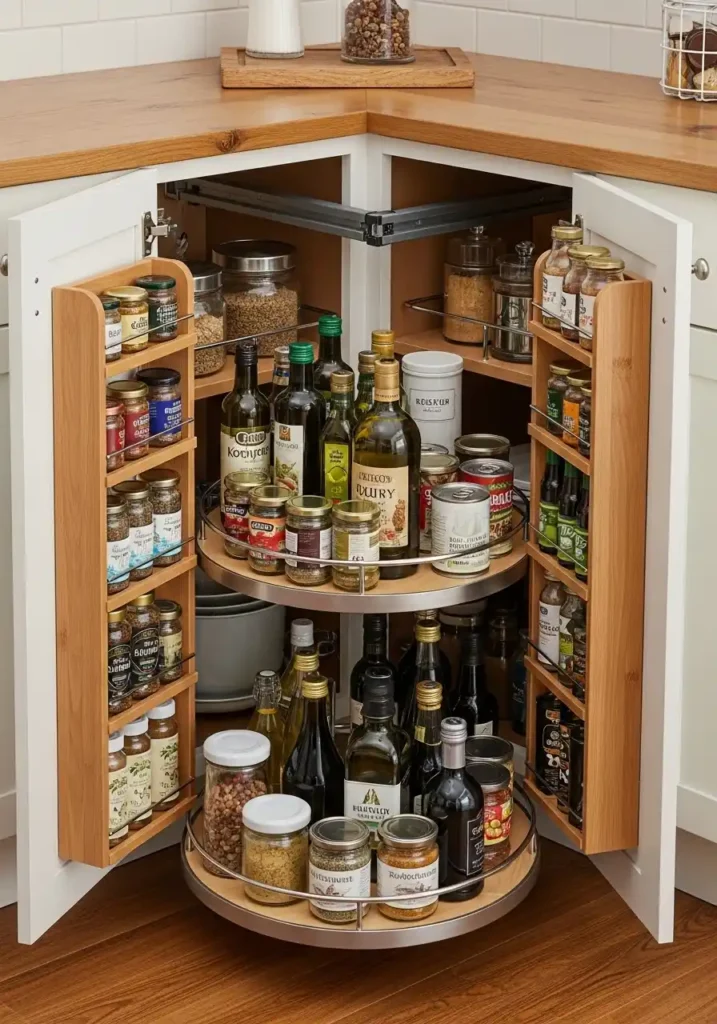
A properly specified lazy susan in the corner cabinet of a tiny kitchen is the organization solution that converts the kitchen’s single most consistently and most frustratingly wasted storage location — the deep corner cabinet whose back half is physically inaccessible to human arms of normal length when the cabinet is filled with conventional fixed shelving — into one of the most generously organized and most immediately accessible storage zones in the entire kitchen. The lazy susan’s rotating circular shelves bring everything stored in the cabinet’s full depth within reach with a single spin, eliminating the rummaging, the forgotten items at the back, and the frustrating inaccessibility that makes corner cabinets the storage zone that every tiny kitchen owner struggles with most consistently and most chronically.
The full-circle lazy susan — two large circular shelves that rotate independently within the corner cabinet, one at a higher level and one lower, each sized to the cabinet’s full interior diameter — provides the most complete and the most comprehensively accessible corner storage available, because its rotation brings every point on the full circular shelf area within arm’s reach from the cabinet opening without requiring any reaching into the cabinet’s depth. Items stored at the back of the lazy susan shelf are as accessible as those at the front — a simple rotation of the shelf brings them immediately to the opening — making the corner cabinet as genuinely useful as any conventional straight-run cabinet of equivalent volume, and in a tiny kitchen, that equivalence is a genuinely significant storage gain.
10. A Mirrored Backsplash to Double the Perceived Kitchen Size
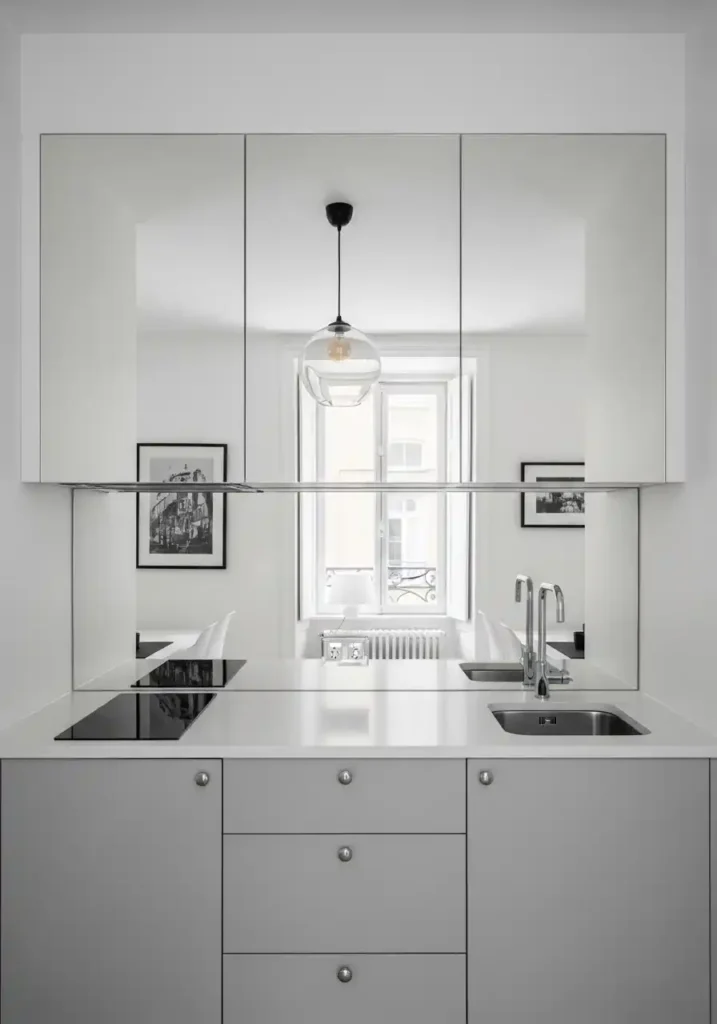
A mirrored backsplash in a tiny kitchen is the spatial trick that requires no floor space, no cabinet modification, and no structural change of any kind while delivering the most dramatic and the most immediately convincing improvement in the kitchen’s perceived size of any single intervention available. The full-length mirror panel behind the counter and backsplash area reflects the entire kitchen — the pendant light, the opposite wall, the window, the adjacent room — back into the space with such convincing clarity and such spatial depth that the kitchen appears to extend equally far in both directions from the counter, creating the impression of a kitchen of twice the actual width and twice the actual depth. The spatial illusion is immediate, complete, and genuinely convincing.
The practical requirement that differentiates a genuinely excellent mirrored backsplash from a merely adequate one is the quality and the installation precision of the mirror itself — specifically the use of a single, large, properly tempered mirror panel of the exact backsplash dimensions rather than a grid of smaller mirror tiles. A single continuous mirror panel creates one complete, uninterrupted reflected image that the eye reads as genuine spatial depth, while a grid of small mirror tiles creates a fragmented, grid-interrupted reflection of reduced spatial clarity and reduced visual elegance. The mirror should be sealed with heat-resistant silicone at all edges to prevent moisture penetration behind the panel, and professionally installed flush with the surrounding wall surface for a result that reads as genuinely architectural rather than decoratively applied.
11. Plate Racks Mounted on the Wall to Display and Store
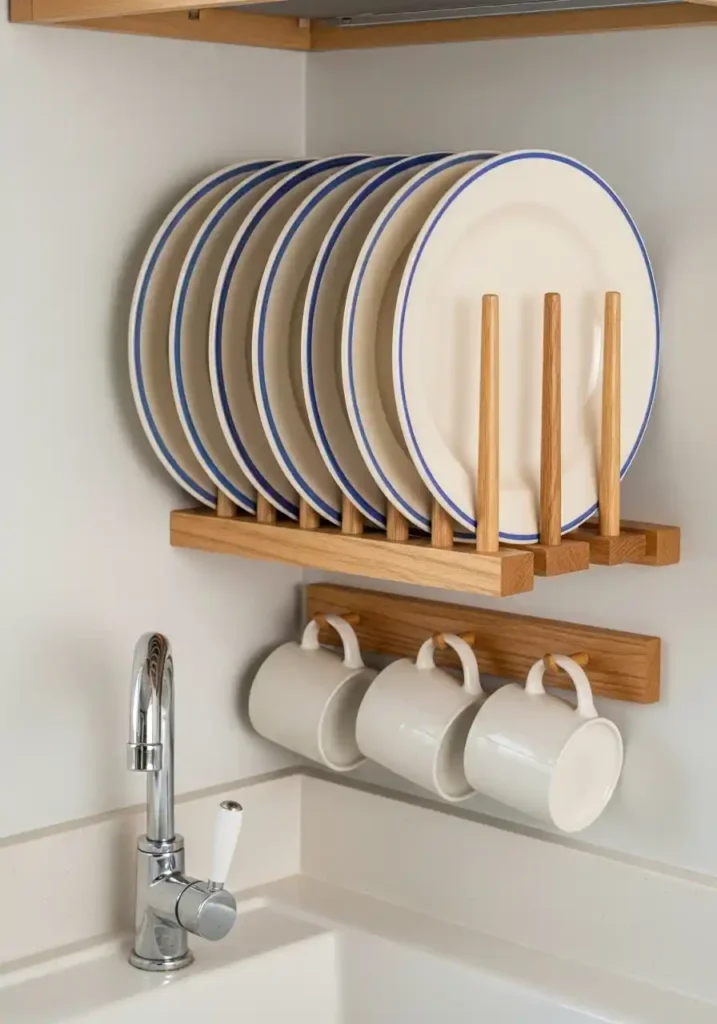
A wall-mounted plate rack in a tiny kitchen performs the most elegantly efficient of all kitchen storage tricks — drying and storing simultaneously, eliminating the separate steps of drying dishes and returning them to a closed cabinet by combining both functions into a single, beautiful wall installation that holds clean plates in their ready-to-use position permanently, always accessible, always displayed, and always air-dry without any additional drying effort required. In a tiny kitchen where the space and the time that conventional dish drying and storage requires is genuinely inconvenient to accommodate, the plate rack’s combination of functions is a genuinely significant practical improvement.
The aesthetic contribution of a beautifully chosen plate rack to a tiny kitchen is as significant as its practical benefit — because a collection of beautiful ceramic plates stored vertically on a well-made wooden rack on the kitchen wall creates one of the most warm, most domestic, most genuinely charming kitchen vignettes available in any style of kitchen decoration. The plates’ visible faces — their colors, their patterns, their surface textures — become part of the kitchen’s decorative environment in a way that the same plates hidden behind closed cabinet doors can never achieve, and the honest, unpretentious display of everyday ceramics that are used and loved daily has a quality of genuine domestic warmth that the most elaborate decorating exercise cannot replicate with the same naturalness and the same ease.
12. An Over-the-Door Organizer That Uses Forgotten Space
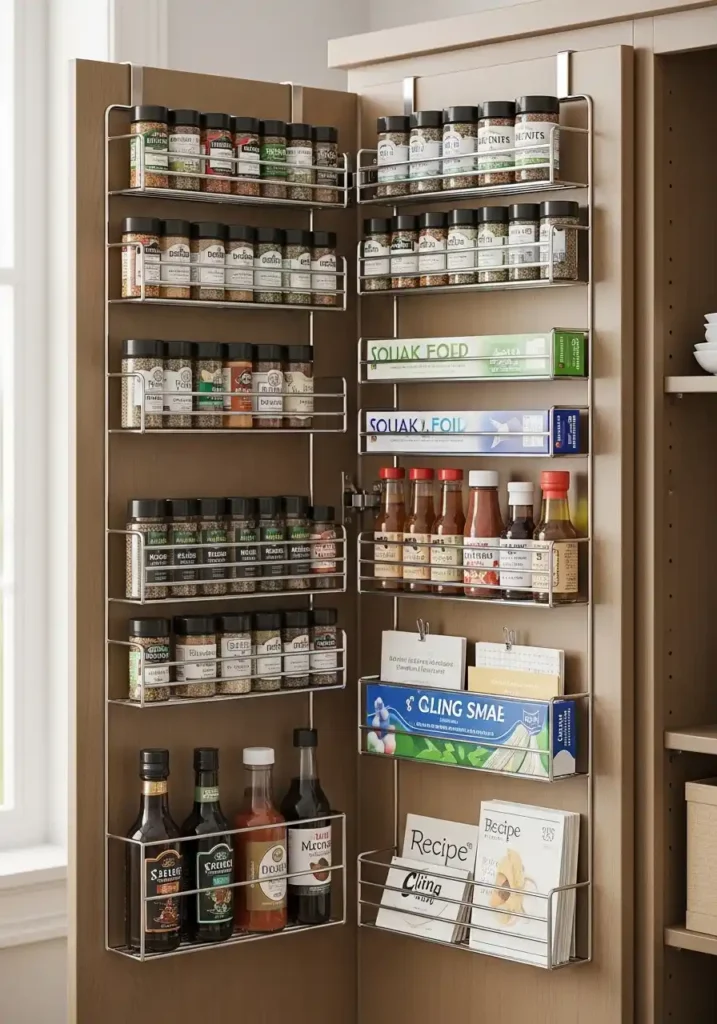
The inside surface of kitchen cabinet and pantry doors is the most completely and the most universally overlooked storage surface in any kitchen — and in a tiny kitchen where every square centimeter of storage surface is genuinely precious, the systematic fitting of over-door organizers to every applicable cabinet door can add a truly significant quantity of organized storage capacity at virtually no cost and with absolutely no impact on the kitchen’s floor area, counter area, or cabinet interior. A cabinet door fitted with a wire spice rack, a condiment bin, and a foil and wrap holder stores dozens of items that were previously competing for shelf space within the cabinet interior, freeing those shelves for items that cannot be door-mounted.
The specific over-door organizer types that deliver the most storage value per door in a tiny kitchen are those designed for the items that consume the most cabinet shelf space relative to their use frequency — spice jars, which are used in small quantities at every meal but consume significant shelf area when stored flat, are dramatically better stored on a door-mounted spice rack where they stand vertically in multiple rows and make the label of every jar simultaneously visible from the front; condiment bottles, which are too tall for efficient cabinet stacking and too frequently used for pantry exile, store perfectly in door-mounted bins at a convenient reaching height; and plastic wrap, foil, and parchment paper boxes, which are awkwardly shaped for conventional shelving, store perfectly in a door-mounted holder that holds them at the ideal angle for one-handed tear dispensing.
13. A Fold-Up Breakfast Bar That Disappears After Use
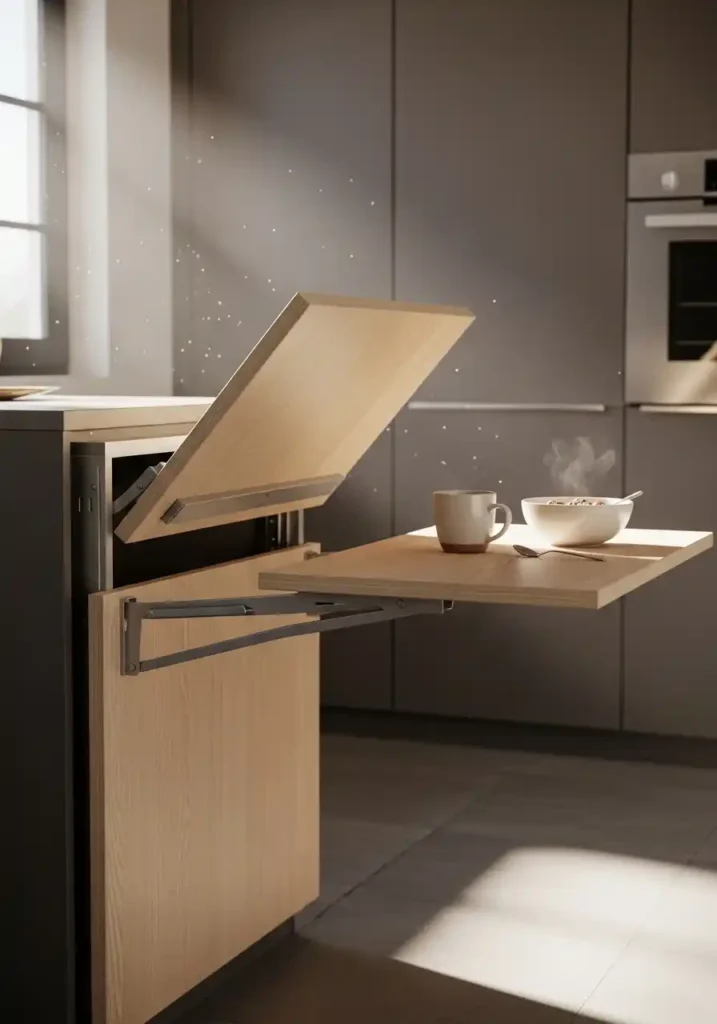
A fold-up breakfast bar in a tiny kitchen is the casual dining solution that allows the kitchen to function as a complete, properly equipped eating space for two people without permanently dedicating any floor space to the dining function — because the fold-up bar and its companion fold-flat stools store completely against the wall in their closed positions, returning every square centimeter of the kitchen floor to its full available area the moment the meal is finished. Deployed, the fold-up breakfast bar creates a proper counter-height dining surface of adequate size for two place settings, with two properly seated bar stools, in under thirty seconds. Returned to the wall, it occupies only the wall plane and reads as a designed wall feature.
The fold-flat stool design chosen to accompany a fold-up breakfast bar in a tiny kitchen is the detail that most determines the entire breakfast bar system’s practical excellence — because stools that fold completely flat and mount neatly on wall hooks beside the folded bar maintain the system’s complete storage compactness, while stools that are merely slim rather than genuinely flat add a permanent floor or wall presence that partially undermines the space-saving benefit of the fold-up bar itself. Choose stools specifically designed for wall-mounting in their folded position, with a folded profile of no more than five centimeters depth, and the entire breakfast bar and seating system becomes a genuinely invisible kitchen feature in its stored configuration — present only when needed and genuinely, completely absent at all other times.
14. Vertical Dividers in Cabinets for Tray and Board Storage
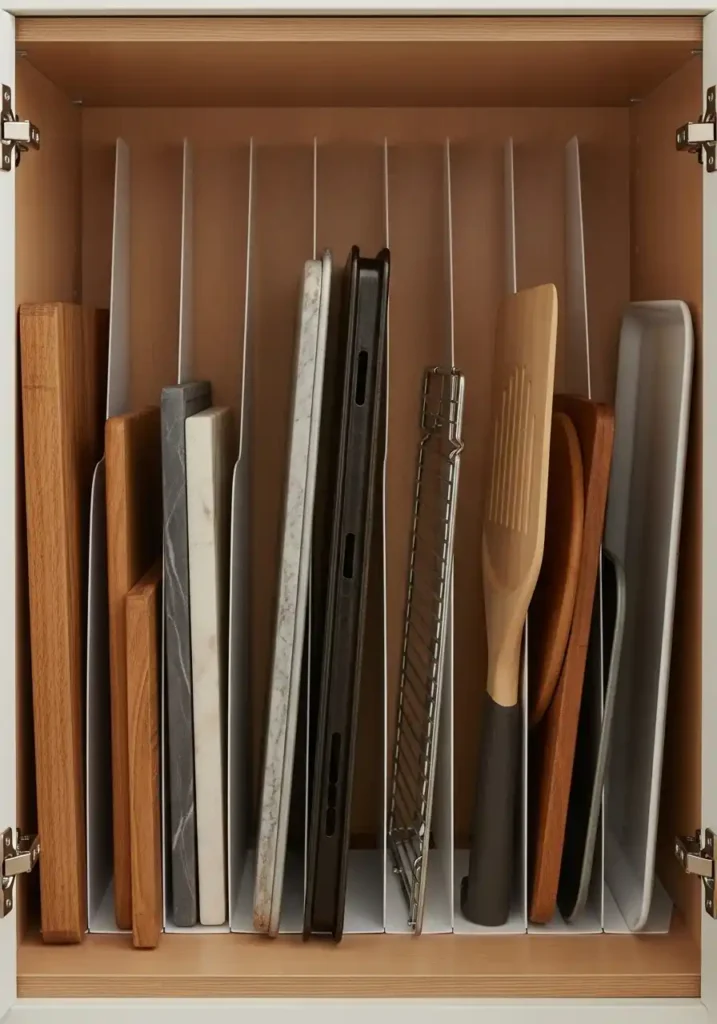
Vertical dividers installed within a kitchen cabinet to create a series of upright storage slots for flat kitchen items is the internal cabinet organization solution that most completely solves the tiny kitchen’s most persistent and most frustrating storage problem — the flat item storage challenge. Baking sheets, cutting boards, cooling racks, serving trays, and pizza paddles are among the kitchen’s most frequently used and most awkwardly stored items: too flat and too large to store efficiently with round pots and pans, too heavy and too varied in size to stack safely and accessibly in a conventional flat pile, but perfectly suited to vertical storage in individual slots where each item stands upright, occupies only its own thickness of slot width, and can be lifted out individually without disturbing any adjacent item.
The simplest and most effective vertical divider system for a kitchen cabinet consists of custom-cut plywood or MDF panels glued and screwed to the cabinet’s interior walls at regular intervals, creating slots of consistent width sized to the largest flat item being stored. A slot width of six to eight centimeters accommodates all standard cutting boards, baking sheets, and serving trays with adequate clearance for easy insertion and removal. The slots utilize the cabinet’s full interior height for genuine storage rather than the lower portion only, dramatically increasing the cabinet’s storage capacity for flat items. A small wooden strip along the cabinet floor at the slot base prevents items from slipping out the bottom during retrieval, and the entire divider system can be built and installed in an afternoon with basic woodworking tools and materials costing less than twenty dollars.
15. A Compact Dish Drying Mat That Replaces a Bulky Rack
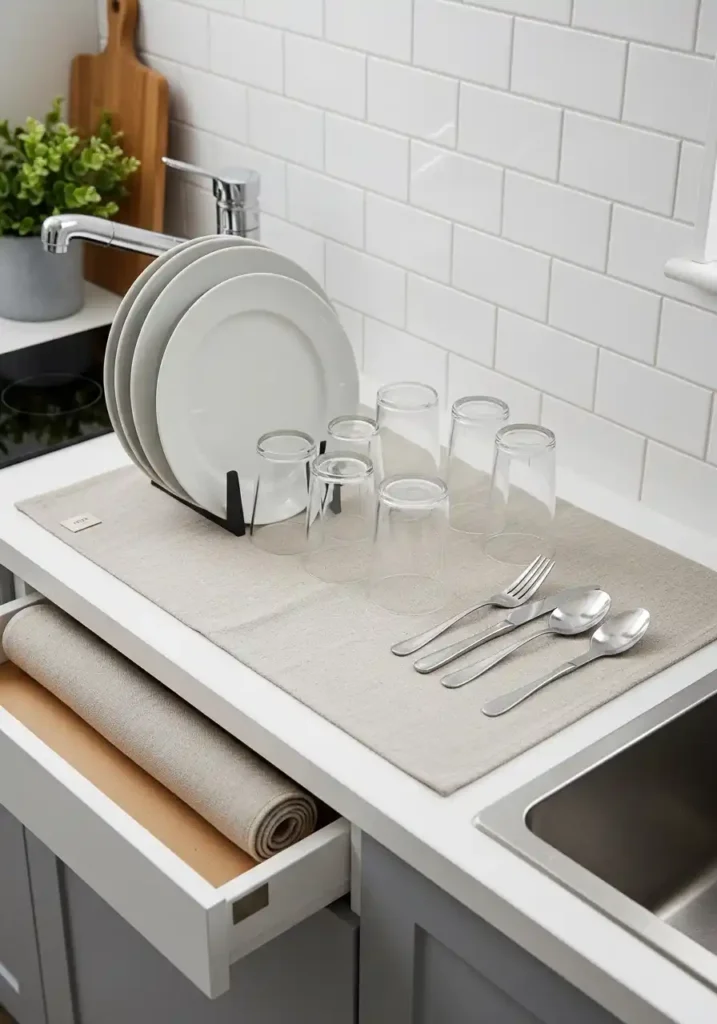
A flat dish drying mat that replaces the conventional raised dish rack on the tiny kitchen counter is the simplest and the most immediately implementable space-saving trick in this guide — because a flat mat of natural linen or microfiber lying flat on the counter surface consumes exactly the same counter area as the dishes and glasses placed upon it, while a conventional raised dish rack with its frame, its drainage tray, and its vertical cutlery basket consumes significantly more counter area than the actual dish footprint it contains and adds substantial visual bulk that makes the tiny kitchen counter appear far more crowded and far more cluttered than its actual utilization warrants. The flat mat is functionally equivalent to the dish rack and spatially vastly superior.
The specific advantage of a linen dish drying mat over a silicone or rubber flat draining mat is its ability to be rolled up and stored in a drawer when dishes are dry — a feature that returns the counter to its fully clear, fully unencumbered, fully useful state in the ten to fifteen minutes between a dish being placed to dry and that dish being completely dry and ready to be put away. A rolled linen dish mat stores in a standard kitchen drawer in a roll no larger than a hand towel, consuming effectively zero counter presence when not in use. This complete disappearance from the counter surface when not actively needed is the quality that makes the linen dish mat the most counter-space-efficient drying solution available for the tiny kitchen.
16. Stackable Storage Containers That Transform Pantry Chaos
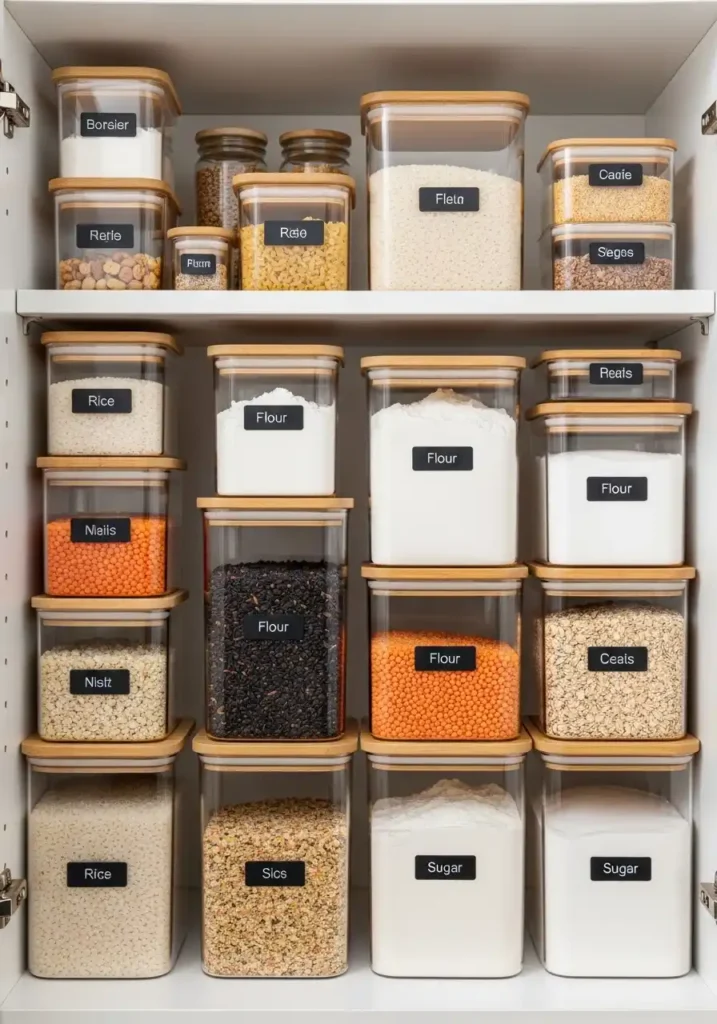
Stackable storage containers in a uniform system — all the same material, the same design language, and the same family of sizes that stack and align perfectly with each other — are the tiny kitchen pantry organization tool that most completely and most permanently transforms the relationship between the kitchen’s food storage space and its storage capacity. The chaos of mismatched food packaging — boxes of different heights, bags of different widths, jars of different shapes — wastes an enormous proportion of shelf height through the dead air spaces between items of varying dimensions, while a uniform container system that stacks precisely to the shelf above uses the full shelf height with complete efficiency and creates a pantry of such organized beauty that every item is immediately visible, immediately accessible, and immediately identifiable from the front of the shelf.
Clear borosilicate glass containers with bamboo lids are the specific stackable system that creates the most beautiful, the most functional, and the most sustainably durable tiny kitchen pantry storage — because the clear glass allows every container’s contents to be identified at a glance without lifting or moving any container, the airtight bamboo lid seal keeps dry goods fresher significantly longer than their original packaging, and the glass material never absorbs food odors, never stains, and never degrades over decades of use in the way that plastic alternatives inevitably do. A completely uniformly containerized pantry in clear glass with bamboo lids is one of the tiny kitchen’s most immediately impactful and most permanently satisfying organization improvements.
17. A Sliding Cabinet Door That Saves Swing Clearance
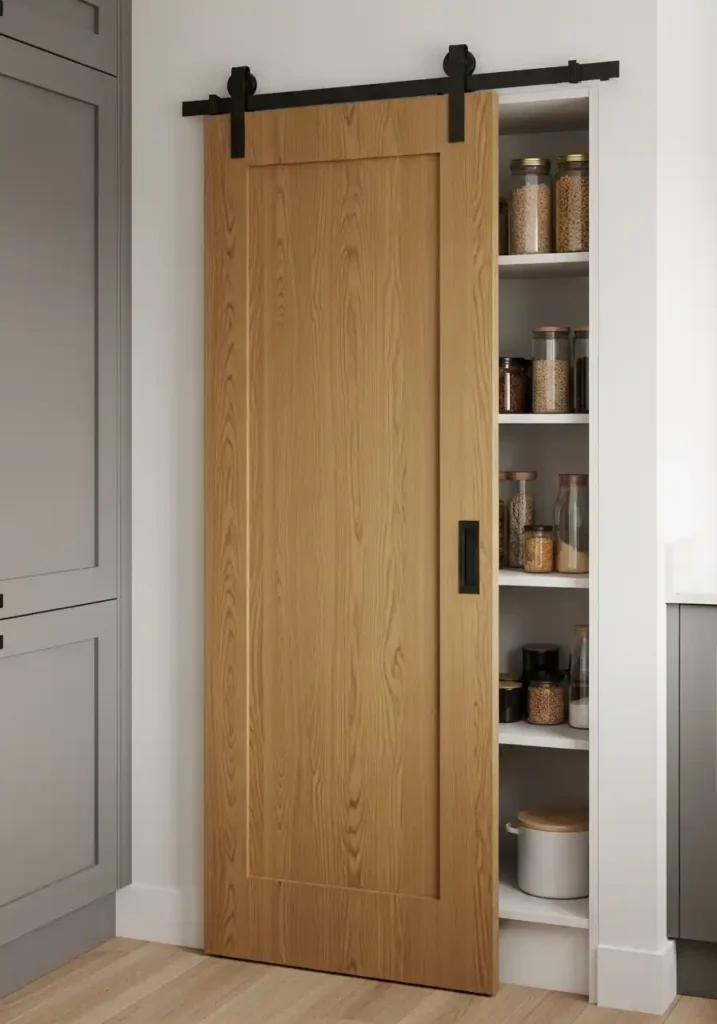
A sliding door on a kitchen pantry or larder cabinet is the hardware replacement that most significantly improves the usability of a tall kitchen storage unit in a tiny kitchen — because a conventional hinged door on a full-height pantry cabinet requires a clear swing arc of the door’s full width in front of the cabinet every time it is opened, creating a temporary obstruction of the kitchen’s working floor space that can interfere with adjacent appliances, adjacent cabinets, and the cook’s own working movement in a tiny kitchen where the distances between all working positions are already minimal. A sliding door that moves laterally along its track eliminates this swing arc requirement completely, making the pantry fully openable without occupying any floor space beyond its own footprint.
The track and hardware quality of a sliding kitchen cabinet door installation determines both its aesthetic quality and its daily functional excellence — and specifying a floor-to-ceiling track system with a proper floor guide and a soft-close damper provides the smoothest, the most stable, and the most satisfyingly tactile door operation available. A soft-close mechanism that gently decelerates the sliding door in the final few centimeters of its travel, preventing the hard stop against the track end that cheaper systems produce, communicates quality through the most fundamental and most daily of the kitchen’s physical interactions. The door material should coordinate with the existing kitchen cabinetry — the same oak, the same lacquer color, the same panel profile — for a result that reads as deliberately designed rather than retrospectively modified.
18. A Compact Compost Bin Inside the Cabinet Door
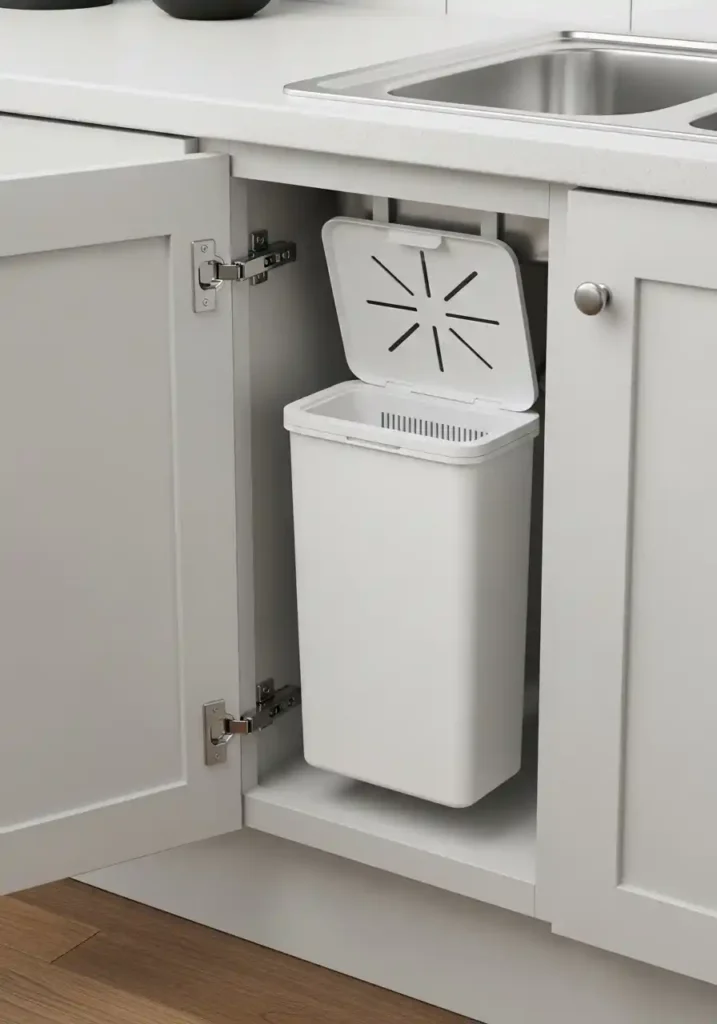
A cabinet-door-mounted compost bin in a tiny kitchen is the waste management solution that eliminates one of the most counter-space-consuming and most visually untidy objects in any kitchen — the standalone compost bin or food waste container that typically sits on or near the counter surface and occupies precious counter territory while simultaneously being one of the kitchen’s least aesthetically appealing visible elements. Mounting the compost bin directly on the inside face of the cabinet door immediately below the sink positions it at the most convenient possible point for counter scraping and food preparation waste disposal, keeps it completely invisible when the cabinet door is closed, and removes it permanently from the counter surface where it was consuming space and visual clarity that the tiny kitchen cannot afford to spare.
The mounting height of the door-mounted compost bin is the installation detail that most determines its daily convenience — because a bin positioned too low requires uncomfortable bending during the food scraping motion that is its primary use case, while a bin positioned too high is awkward to lift into the sink for emptying. The ideal mounting height positions the bin’s opening at approximately the same height as the cabinet interior’s highest shelf or the underside of the sink basin, allowing a natural, comfortable scooping motion from the cutting board to the bin without the posture adjustment that an incorrectly positioned bin requires. A ventilated lid with a carbon filter insert manages odor within the closed cabinet, keeping the bin functional and odor-free through the full emptying interval.
19. A Wall Grid System That Organizes Everything Visibly
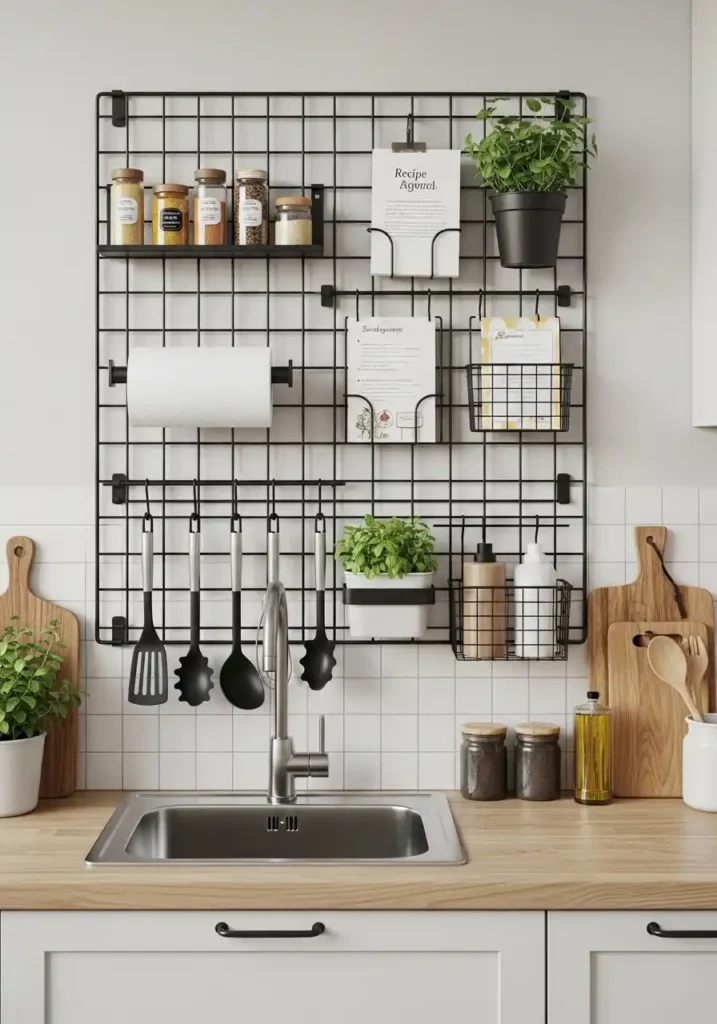
A wall grid system — a powder-coated steel grid of squares or rectangles mounted on the kitchen wall and fitted with a collection of dedicated hooks, shelves, baskets, and holders designed for the grid’s specific mounting system — is the tiny kitchen’s most versatile and most visually striking organizational installation, because it converts an entire wall section into a completely flexible, completely accessible, completely visible storage system that can hold virtually every small kitchen essential that currently clutters the counter or occupies awkward cabinet space. The grid’s modularity — every accessory can be repositioned on the grid in minutes — makes it the tiny kitchen storage solution that adapts most completely and most continuously to the kitchen’s evolving organization needs.
The visual impact of a comprehensively fitted wall grid system in a tiny kitchen is as significant as its organizational benefit — because a well-specified grid loaded with beautiful accessories creates a kitchen feature of genuine character and genuine visual interest that transforms a previously blank, uninspiring wall section into the kitchen’s most dynamic and most personally expressive surface. A matte black grid with copper-finished hooks holding good-quality kitchen utensils, a small slate shelf with labeled spice jars, a wire basket with fresh herbs, and a recipe card holder creates a kitchen wall composition of such warm, professional, genuinely characterful beauty that the tiny kitchen feels not just more organized but more genuinely designed and more genuinely loved as a result of the grid’s presence.
20. Removable Wallpaper That Transforms the Tiny Kitchen Instantly
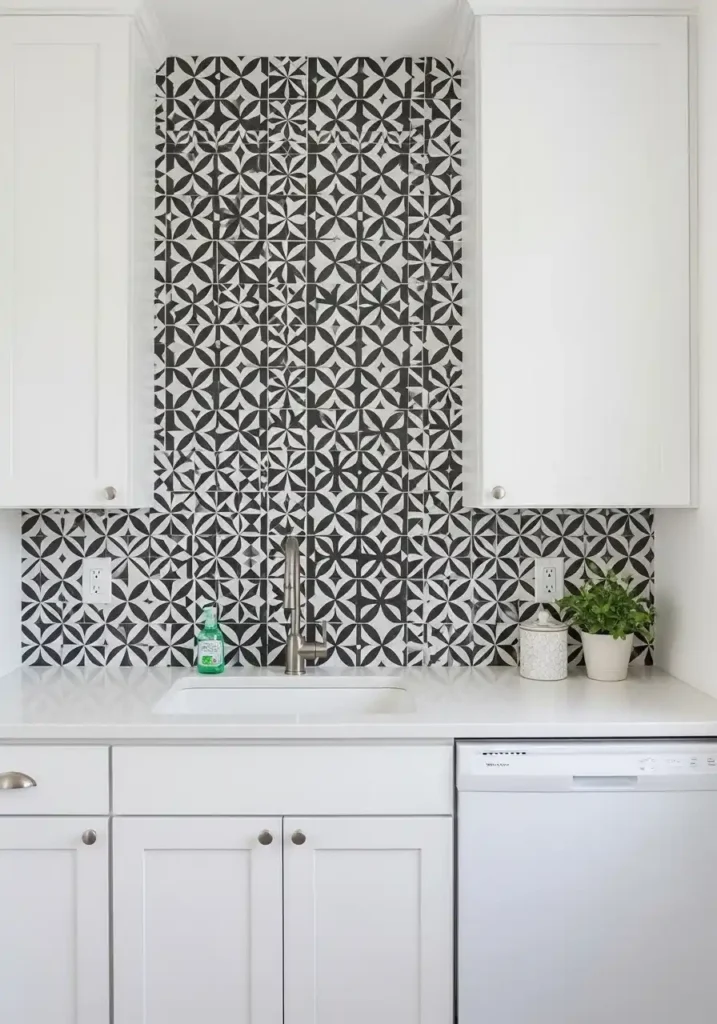
Removable wallpaper — self-adhesive, peel-and-stick wallpaper designed for easy application and damage-free removal — is the tiny kitchen transformation tool that delivers the most dramatically visible design impact for the smallest investment of time, money, and permanent commitment, making it the perfect design trick for renters who cannot make permanent modifications to their kitchen and for homeowners who want to experiment with bold design choices without the risk of a decision they cannot easily reverse. A bold removable wallpaper pattern on the kitchen’s most visible wall can transform the entire character and atmosphere of a tiny kitchen in an afternoon, at a cost of under fifty dollars, with results that photograph beautifully and impress every visitor.
The specific design application that creates the most convincingly beautiful and the most practically durable removable wallpaper installation in a tiny kitchen is the use of patterns that reference genuine hard-surface materials — encaustic cement tiles, subway tiles, marble, terrazzo — because these patterns create the convincing impression of an expensive, permanent material installation while being genuinely temporary and genuinely removable. A graphic black and white encaustic tile pattern in removable wallpaper above the kitchen counter creates an installation so convincing in its visual impact that most visitors assume they are looking at genuine tiles rather than peel-and-stick paper, and the tiny kitchen gains all the design character and visual interest of a genuine tile installation without the cost, the permanence, or the skilled installation that real tiles require.
21. A Microwave Mounted Under the Cabinet to Free Counter Space
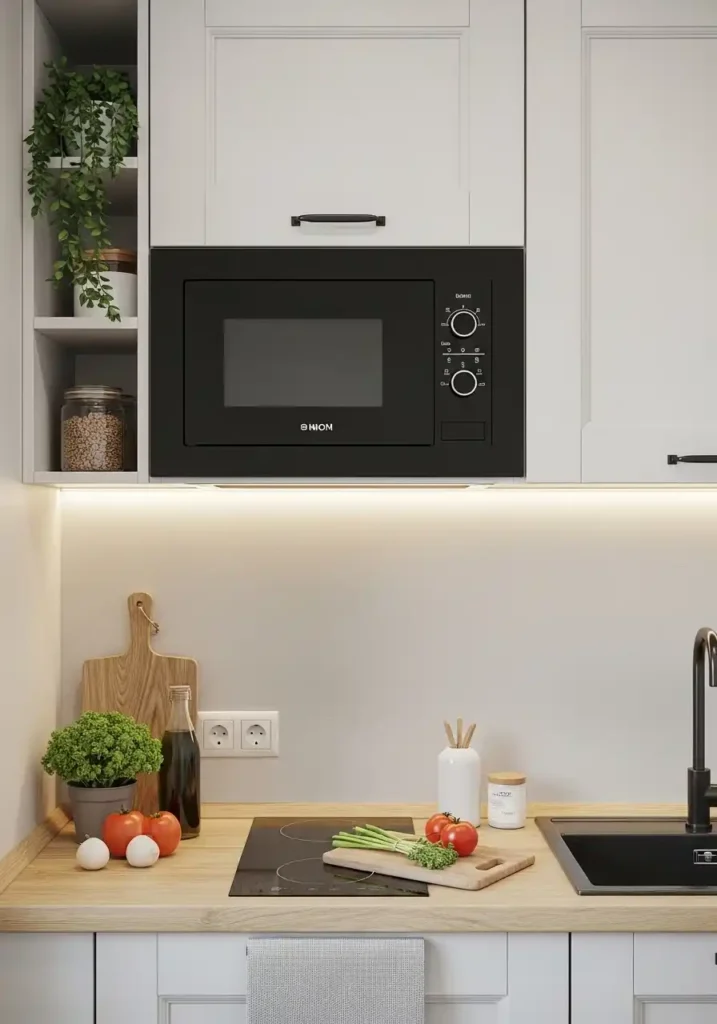
Mounting the microwave beneath the upper cabinet rather than on the counter is the tiny kitchen appliance relocation that frees the most counter space of any single appliance repositioning available — because the microwave is typically one of the largest and most permanently counter-occupying appliances in any kitchen, and its relocation to the underside of the upper cabinet returns its full footprint to the counter as immediately usable, completely unencumbered preparation surface without removing the microwave from the kitchen or compromising the convenience of its use in any way. The under-cabinet microwave is as accessible as the counter-top microwave — simply at a slightly different height — and the counter space it returns is immediately, genuinely significant.
The installation of an under-cabinet microwave in a tiny kitchen requires a cabinet of adequate depth to accommodate the microwave’s full body height when mounted beneath it, a properly positioned electrical outlet within the adjacent cabinet interior or mounted neatly within the cabinet’s underside panel, and a mounting bracket specifically designed for the exact microwave model being installed. Many major microwave manufacturers offer dedicated under-cabinet mounting kits for their counter-top models, providing all the hardware needed for a secure, properly supported installation that holds the microwave safely through thousands of daily uses. A trim kit that surrounds the mounted microwave with a panel matching the upper cabinet finish creates an installation that looks like a designed feature rather than an afterthought.
22. A Narrow Rolling Cart That Fills the Gap Between Appliances
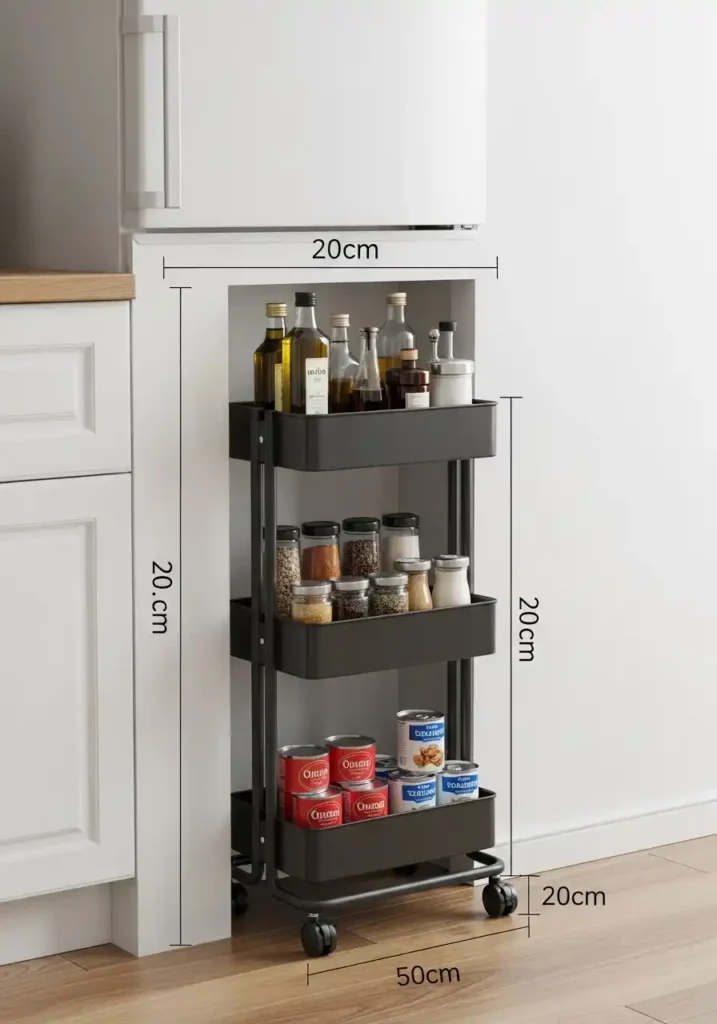
A narrow rolling cart designed specifically for the slim gaps that exist between kitchen appliances and walls — or between two appliances placed side by side — is the tiny kitchen space discovery that most delights people who encounter it for the first time, because it reveals genuinely useful storage potential in a location that is so narrow and so apparently unusable that most tiny kitchen owners have never considered it as storage space at all. A cart of twenty to twenty-five centimeters width slides perfectly into the typical gap between a refrigerator and an adjacent wall or cabinet, and its three to four shelves of full cart-width and full kitchen-standard depth provide a storage surface area of genuine significance for frequently accessed kitchen items.
The rolling casters on a slim kitchen gap cart are the feature that transforms it from a stored-in-place rack into a genuinely convenient, genuinely daily-use storage solution — because a cart that rolls freely out of its gap position on smooth-rolling casters, extends fully into the kitchen space for complete frontal access to all shelves, and rolls back into the gap with equal ease represents a storage system that can be used as readily and as naturally as any conventional open shelf. Lock the front casters when the cart is fully extended to prevent it rolling further during retrieval of items on the lower shelves, and ensure the caster height is adequate for the flooring type — whether tile, wood, or vinyl — to ensure smooth, effortless rolling in daily use.
23. The Complete Tiny Kitchen Transformation — Every Trick Working Together
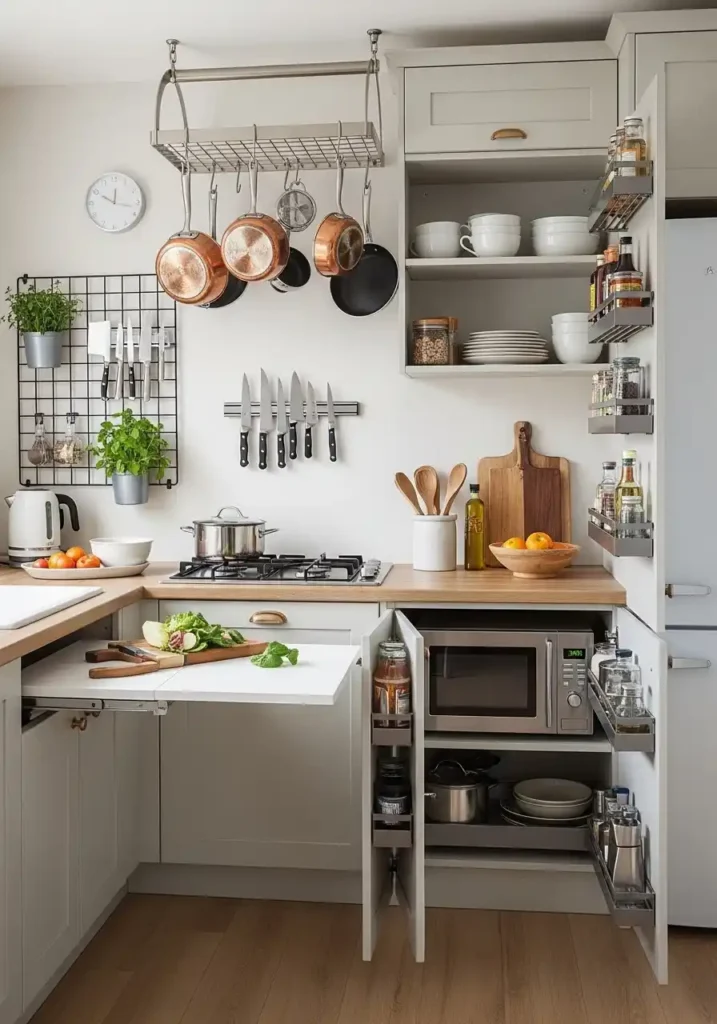
The perfectly transformed tiny kitchen — the one that makes experienced cooks stop in genuine admiration, that makes visitors ask how such a small space manages to contain everything so beautifully and so effortlessly, and that makes its owner genuinely, deeply grateful for the intelligence and the creativity invested in its organization — is the accumulated result of multiple complementary space-saving tricks working together in complete, reinforcing harmony rather than any single solution working in isolation. The fold-down counter that provides prep space. The magnetic knife strip that clears the counter. The pot rack that frees the cabinets. The toe-kick drawers that use forgotten space. The pull-out pantry that finds storage where none existed. Each trick amplifies every other.
The invitation this guide extends is both entirely practical and genuinely exciting — because every single one of these twenty-three tricks is achievable in a real tiny kitchen with a real limited budget, and most of them can be implemented without any professional help, any significant construction work, or any permanent modification that cannot be undone if circumstances change. Start with the three tricks that address your specific kitchen’s most painful and most immediate space challenges — the counter that is never clear enough, the cabinets that are never organized enough, the appliances that crowd every surface — and build your perfect tiny kitchen transformation from those three starting points. Your tiny kitchen has more potential than you currently realize, and these twenty-three tricks are the proof.
Conclusion:
Designing a small kitchen doesn’t mean sacrificing style or functionality. With these 23 tiny kitchen design tricks, you can transform even the most compact space into an efficient and beautiful cooking area. From smart storage solutions and vertical shelving to multi-purpose furniture and clever organization hacks, every small change can make a big difference in how your kitchen looks and works.
By focusing on space-saving kitchen ideas, smart layouts, and minimalist design, you can maximize every inch of your kitchen without feeling cramped. Whether you’re renovating a small apartment kitchen or simply looking for ways to improve your current setup, these tips help create a space that feels larger, more organized, and easier to use.
Start implementing these tiny kitchen design tips today and enjoy a kitchen that is not only stylish but also perfectly optimized for everyday living. Even the smallest kitchens can become highly functional with the right design strategies.