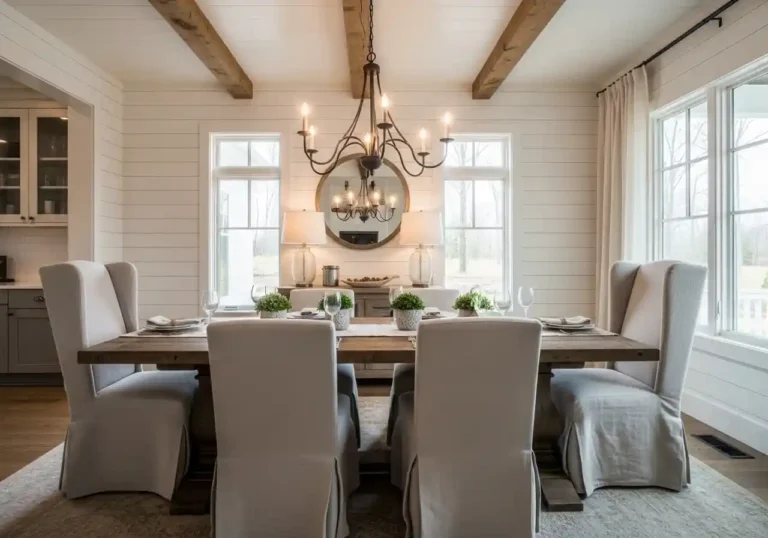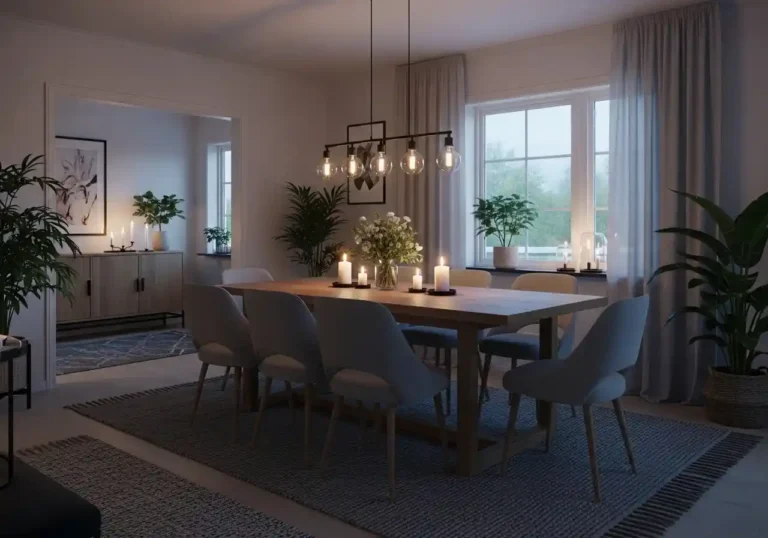
1. The Kitchen Island Dining Area — Two Functions, One Brilliant Piece
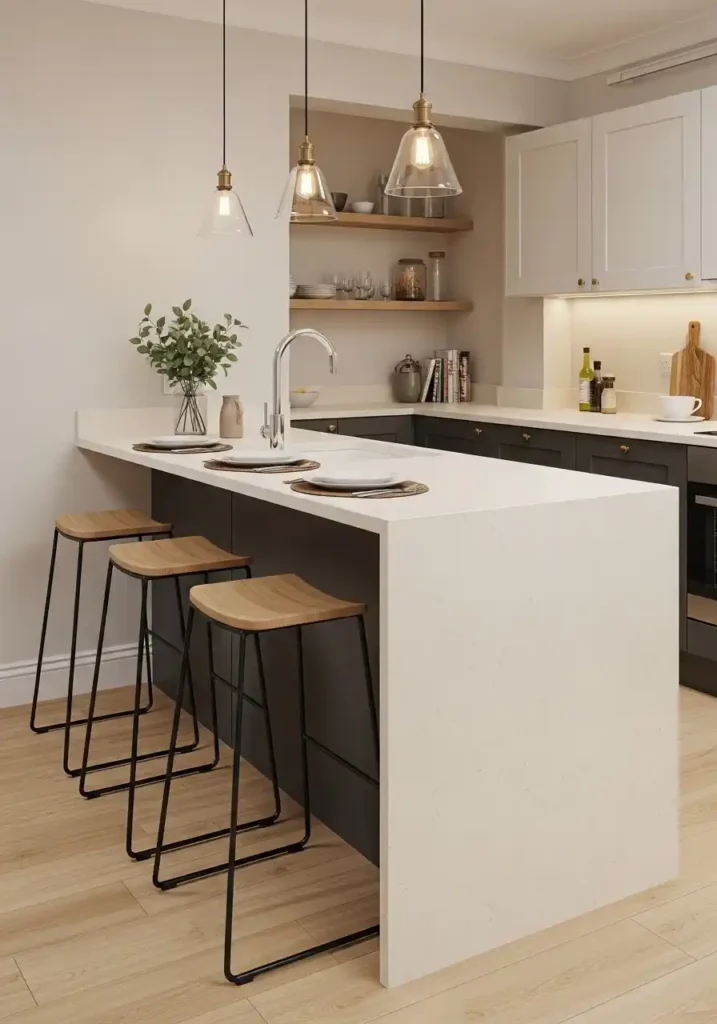
The kitchen island that doubles as a dining area is the compactSmall Dining Area Ideas solution that most completely eliminates the spatial redundancy of having two separate horizontal surfaces — a food preparation counter and a dining table — in a home that genuinely doesn’t have floor space for both. By extending one side of a kitchen island slightly beyond the standard counter depth to create a dining overhang, you gain a proper casual dining surface for three or four people that requires no additional floor footprint whatsoever beyond the island that the kitchen already needs for its primary cooking and preparation function. Three slim bar stools tucked beneath the overhang consume almost zero floor area when not in use.
The design quality of a kitchen island dining area depends enormously on the stools chosen to accompany it — because in a compact home where the island is always visible from multiple living spaces, the stools are always a prominent design element that contributes directly to the overall aesthetic of the entire open-plan area. Slim, well-proportioned stools with a footrest at the correct height for comfortable extended dining are the non-negotiable practical requirements. Beautiful materials and a design language that coordinates with the kitchen’s palette and the living area’s furniture are the equally non-negotiable aesthetic requirements. Natural oak seats on black steel frames, or white upholstered seats on brass legs, both deliver the combination of practical comfort and genuine design quality that the compact kitchen dining island deserves.
2. The Window Nook Dining Area That Steals the Best Light
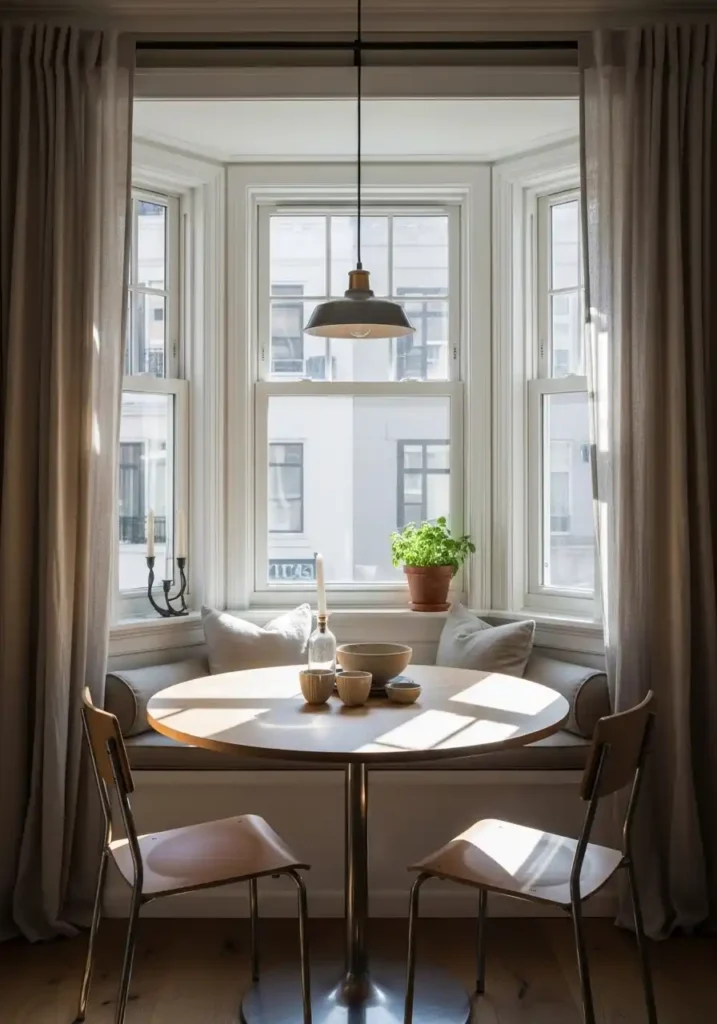
A dining area positioned directly at a window — using the window bay or the wall beneath the room’s best natural light source as the specific location for the dining table — is the compact living arrangement that prioritizes the single most important quality of any dining experience: the quality of the light during the meal. Natural light makes food look more beautiful, makes faces across the table look more warm and alive, makes the entire experience of eating feel more connected to the rhythms of the day, and makes the dining area feel more open and more generously spacious than the same arrangement positioned away from the window in a darker corner of the room. When space is limited, putting the dining table at the window is always the right choice.
The window seat bench that replaces one side of conventional chairs in a window nook dining arrangement is the dual-function element that makes this approach work most efficiently and most beautifully in a compact space — because the fixed bench against the window wall requires zero chair-pullout clearance on that side, saving the precious circulation space that two conventional chairs would demand, while simultaneously providing a built-in seating surface that can be upholstered in a beautiful fabric and styled with cushions to make it one of the most comfortable and most visually appealing seating options in the entire home. The window nook dining area with a cushioned bench seat is the spot everyone wants — the bright, warm, view-having, cushion-supported seat that makes every meal feel like a genuine pleasure.
3. Fold-Down Wall Table for the Smallest Possible Footprint
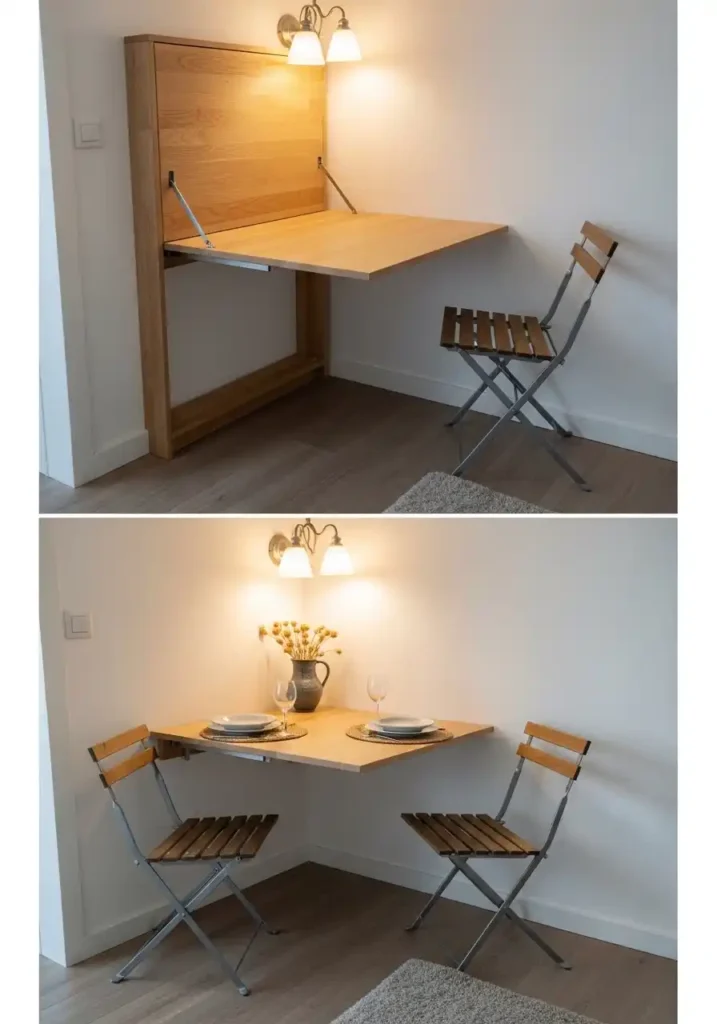
A fold-down wall table is the dining area solution for compact living situations where “small” means genuinely, seriously, structurally limited — where the floor area available for a permanent dining arrangement simply does not exist, and where the choice is between a dining area that is only present when needed or no dining area at all. In these situations, the fold-down wall table is not a compromise — it is a revelation, a piece of furniture engineering that solves an apparently impossible spatial problem with complete elegance and complete practicality, providing a proper dining surface for two to four people that folds flat against the wall in under ten seconds and returns the full floor area to whatever other use the compact space requires.
The design and material quality of a fold-down wall table matters enormously in a compact home where the table is always visible in both its deployed and its stored positions and always contributing to the room’s aesthetic character in both states. A table in solid oak with clean, beautifully proportioned lines and properly machined brass or black steel hardware looks like a deliberate, beautiful piece of furniture design in its folded position — a warm wood panel mounted on the wall with precision and care — and deploys into a proper, generous, well-proportioned dining surface that communicates the same quality and the same design intention. Mounted above the fold-down table, two matching wall sconces provide warm, appropriate dining light that serves both the deployed dining mode and the closed wall-art mode with equal beauty.
4. Corner Dining Area That Uses Every Ignored Inch
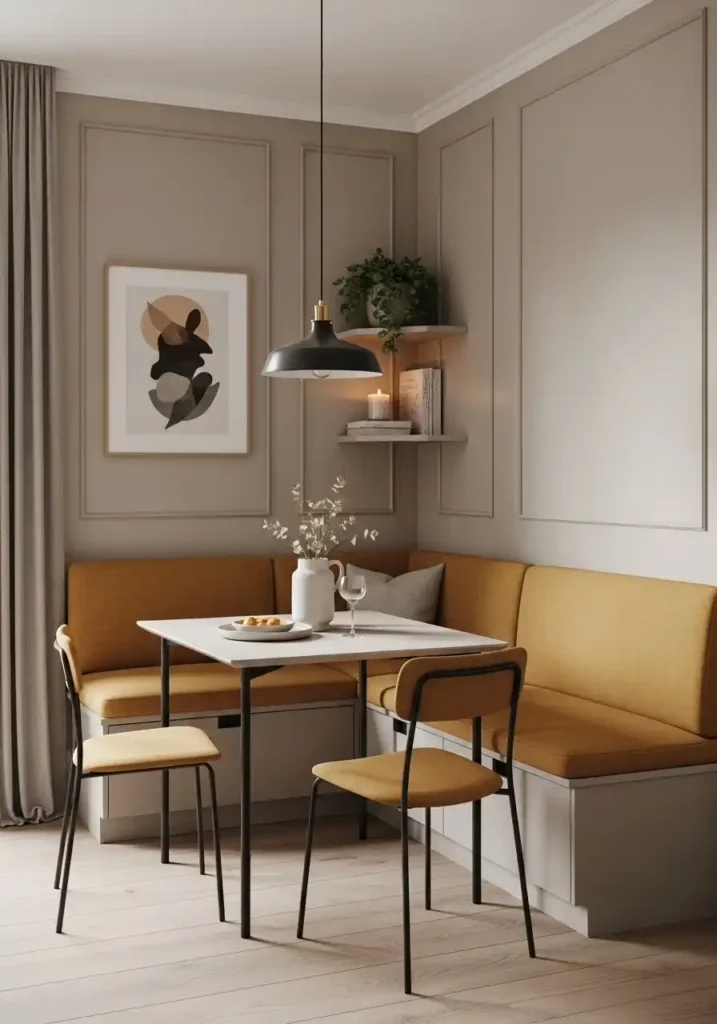
Corners are the most consistently squandered square footage in any compact home — and the compact living dining area that is fitted specifically into a corner, with a corner bench seat wrapping the two walls and a small table pushed snugly into the angle, is the furniture arrangement that reclaims this ignored space most completely and most beautifully. A corner dining arrangement eliminates chair-pullout clearance requirements on two entire sides simultaneously — the corner bench sits against both walls with no clearance needed behind it — making it possible to seat three or four people comfortably in a corner footprint that a conventional four-chair arrangement would find completely inadequate.
The corner bench seat’s hidden storage beneath the cushioned seat is the practical bonus that transforms the corner dining area from a clever spatial solution into a genuinely transformative compact living feature — because the storage compartments accessible via lift-up cushions in a corner bench can be surprisingly large, accommodating a significant quantity of items that compact homes chronically need storage for and rarely have enough dedicated space to properly accommodate. Extra table linens, seasonal tableware, children’s craft supplies, board games — all of it can disappear beneath the mustard cushions of the corner bench, keeping the compact living space clear, uncluttered, and feeling as open and as generous as its square footage can possibly allow. The corner dining area is compact living design working at its absolute best.
5. Bar Height Dining for Standing Room and Visual Drama
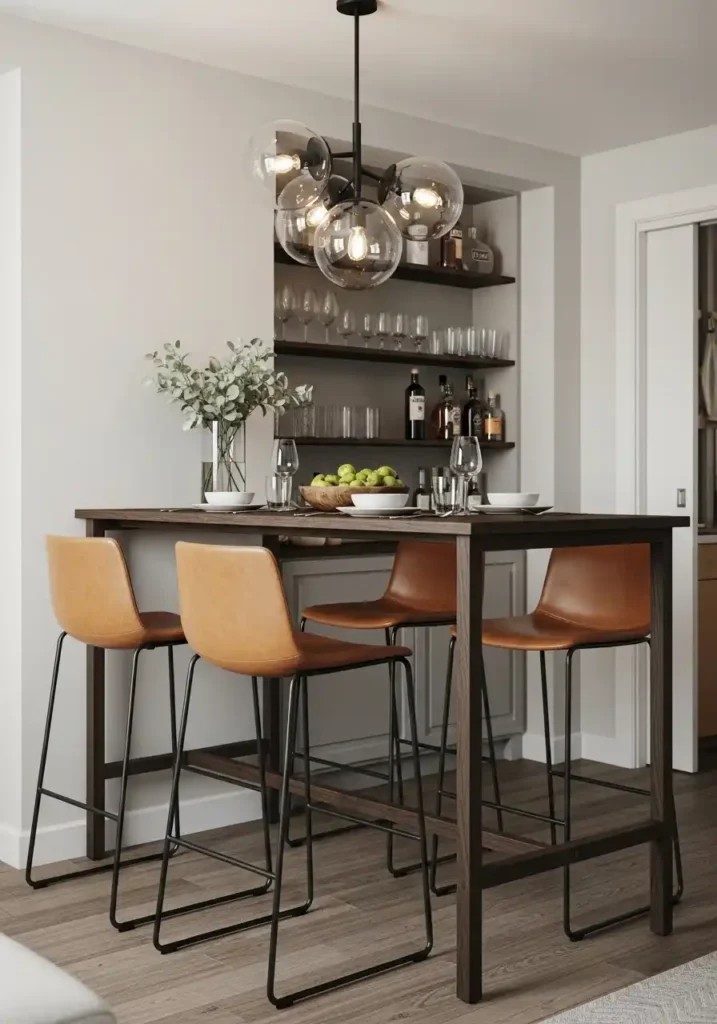
Bar height dining — a table set at counter height, approximately 90 to 105 centimeters from the floor, with bar stools rather than conventional dining chairs — is the compact living dining arrangement that delivers the most casually sophisticated, most visually dynamic, and most socially energetic dining experience of any table height option, and it achieves this while simultaneously providing a spatial advantage that standard-height dining tables cannot offer: the bar stools, when tucked completely beneath the high table surface, consume almost zero visible floor area, making the bar height dining area one of the most space-efficient permanent dining arrangements available in a compact home.
The visual drama of a bar height dining area in a compact living space comes from the contrast between the elevated table surface and the lowered eye level of diners sitting at bar stools — a contrast that creates a more dynamic, more energetic, more visually interesting dining tableau than the uniform horizontal plane of a standard-height table and chairs. This elevated perspective also means that seated diners at a bar height table have a slightly different, slightly more panoramic view of the surrounding space than they would from a conventional chair, which in a compact open-plan home creates a pleasant sense of visual connection to the kitchen and living areas that makes the dining experience feel more integrated into the life of the whole home.
6. Scandinavian-Inspired Compact Dining Area with Clean Lines
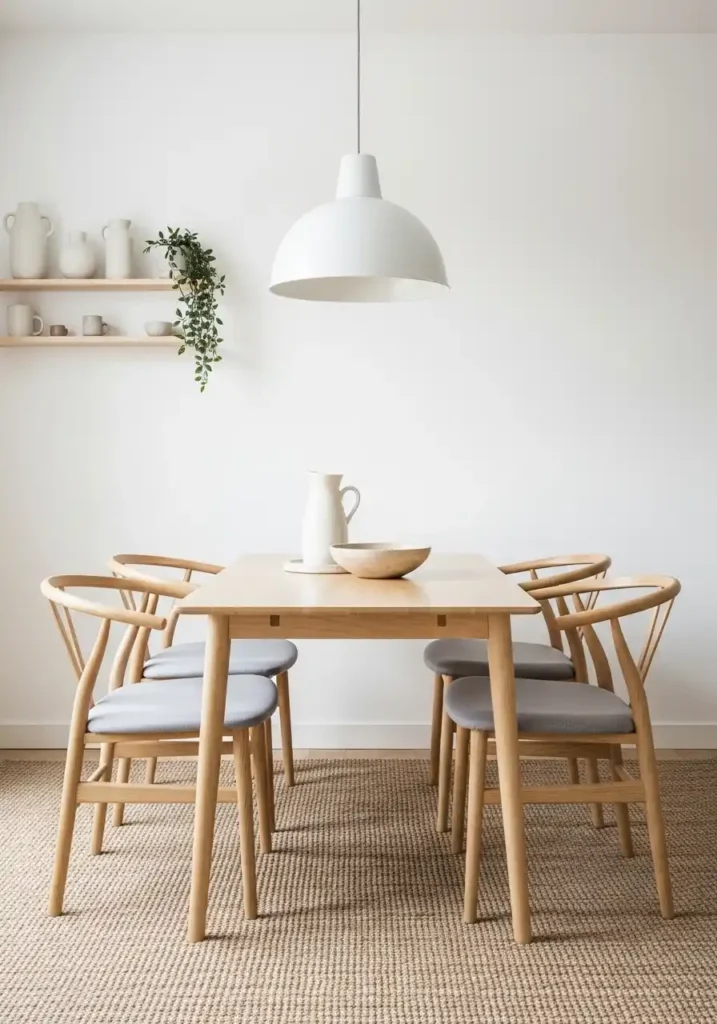
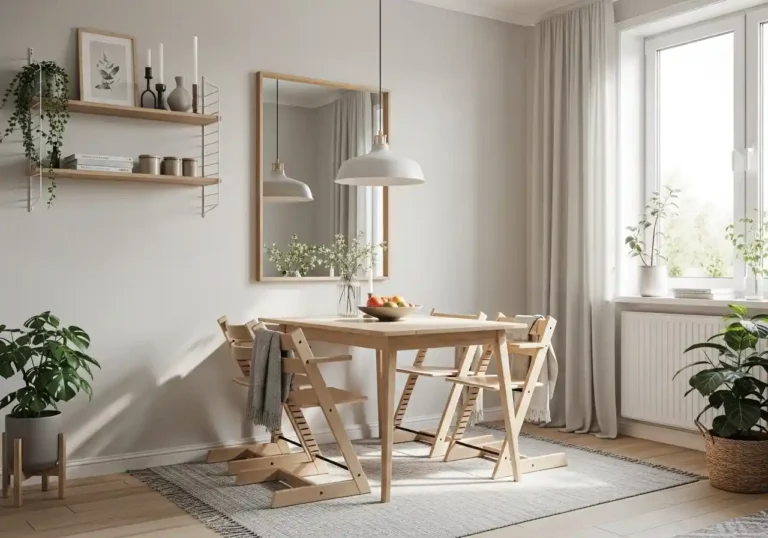
Scandinavian design principles are arguably the most naturally aligned with the specific requirements and the specific challenges of compact living dining areas of any design tradition in the world — because Scandinavian design was developed in cultures that spent centuries making small, dark domestic spaces feel warm, light, beautiful, and genuinely livable through the most thoughtful, most considered, and most honestly functional approach to furniture design and interior decoration that any design tradition has ever produced. Every Scandinavian furniture principle — the clean line, the natural material, the absence of unnecessary ornament, the priority of genuine comfort — serves the compact dining area with particular directness and particular beauty.
A small Scandinavian dining table in light birch with four slim, well-proportioned chairs around it achieves a quality of spatial generosity that furniture of the same dimensions in heavier, darker, more visually substantial materials could never replicate — because the lightness of the birch, the slimness of the chair frames, and the clean simplicity of the overall forms allow the eye to read the space around and beneath the furniture as openly and as generously as possible. The single oversized pendant above the table — the one design element where Scandinavian dining rooms consistently make their boldest and their most confident statement — fills the vertical space above the dining area with warm, focused light and a strong design presence that makes the compact dining area feel deliberately, beautifully designed.
7. Floating Dining Shelf for the Narrowest of Spaces
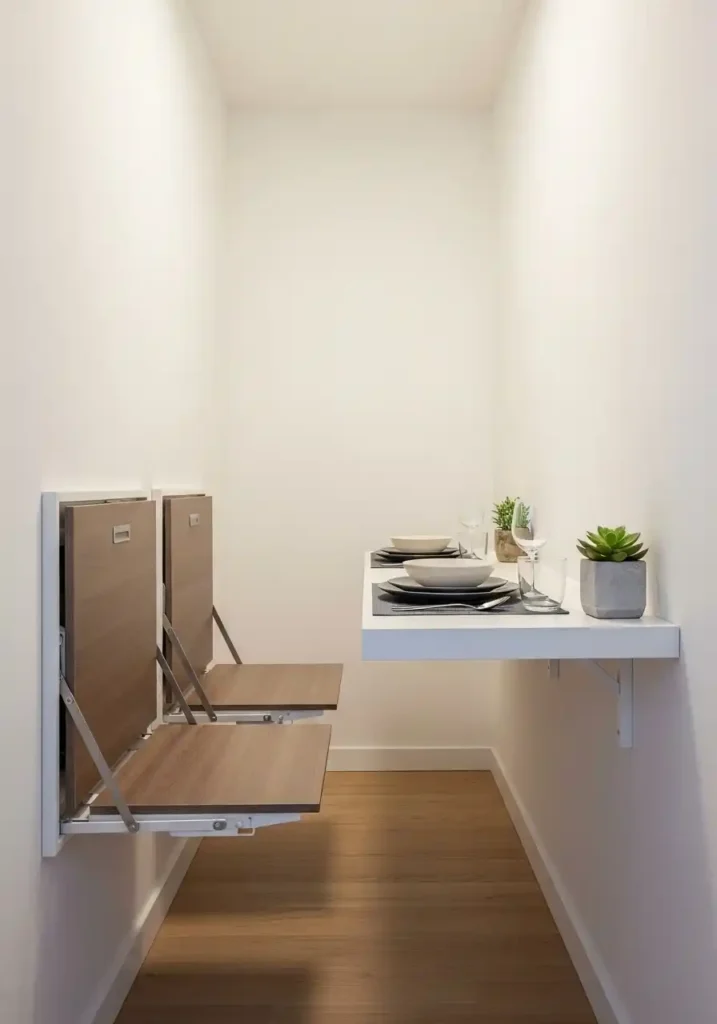
A floating dining shelf — a wide, deep shelf mounted at standard dining table height on a wall, used as a dining surface rather than as conventional shelving — is the compact living dining solution that challenges every conventional assumption about what a dining area is required to look like, and in doing so, opens up dining area possibilities in spaces that no conventional dining table, however small, could possibly occupy. A narrow corridor space, a hallway, a deep window recess, a wall beside a kitchen — any vertical surface with adequate depth can become a proper, functional, genuinely pleasant dining surface when a beautifully crafted floating shelf is mounted at the right height with the right proportions.
The practical dining quality of a floating dining shelf depends almost entirely on its dimensions — specifically its depth, which must be generous enough to accommodate a proper place setting with plates, glasses, and cutlery laid out with adequate elbow room, and its height, which must be precisely calibrated to standard dining table height of approximately 75 centimeters for comfortable seated dining. A solid oak shelf of 50 to 60 centimeters depth provides this generous place-setting space while remaining visually proportionate and practically mounted at standard wall-bracket dimensions. Paired with two wall-mounted fold-flat seats on the opposite wall that deploy when needed and fold completely flat when not, the floating dining shelf creates a complete, proper dining area in a space so narrow that it would be completely invisible to any conventional dining area approach.
8. The Open-Plan Dining Zone Defined by Pendant Light
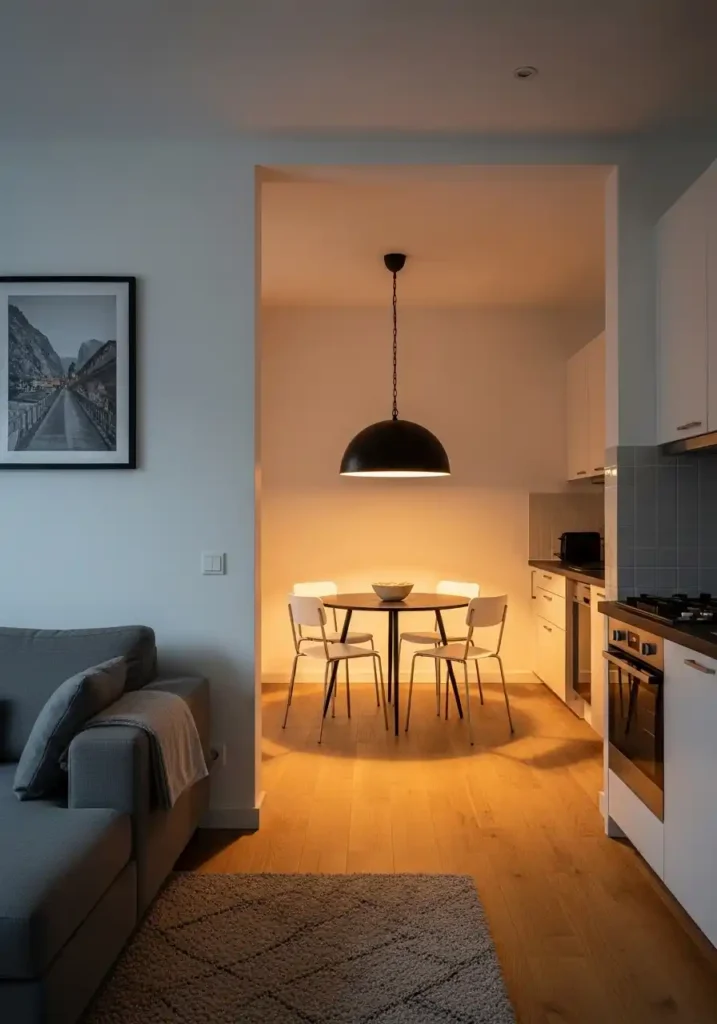
In a compact open-plan home where the dining area shares its space with the living area, the kitchen, or both, the single most important design challenge is giving the dining zone a clear, recognizable identity within the larger undivided space — and the single most effective and most beautiful way to achieve this without any physical partition, any level change, or any construction work is to hang a dramatic pendant light directly above the dining table. A pendant light of genuine presence and genuine beauty positioned above the dining table creates a zone of warm, focused, intimate light that defines the dining area’s boundaries with complete clarity and complete elegance, making the dining zone feel like its own purposeful, considered territory within the open plan.
The pendant light chosen for this zone-defining role in a compact open-plan space carries more design responsibility than any other single element in the room — because it must be visually significant enough to genuinely read as a zone-defining architectural statement from across the open-plan space, beautiful enough to be the room’s primary decorative focal point from every angle, and appropriately scaled to the dining table beneath it rather than to the larger open-plan room it occupies. An oversized woven rattan pendant, a dramatic cluster of glass globes at varying heights, or a sculptural blown-glass statement pendant all create the specific combination of warm light, strong visual presence, and genuine design beauty that the zone-defining dining pendant must deliver.
9. Extendable Table for Daily Compact Living and Weekend Entertaining
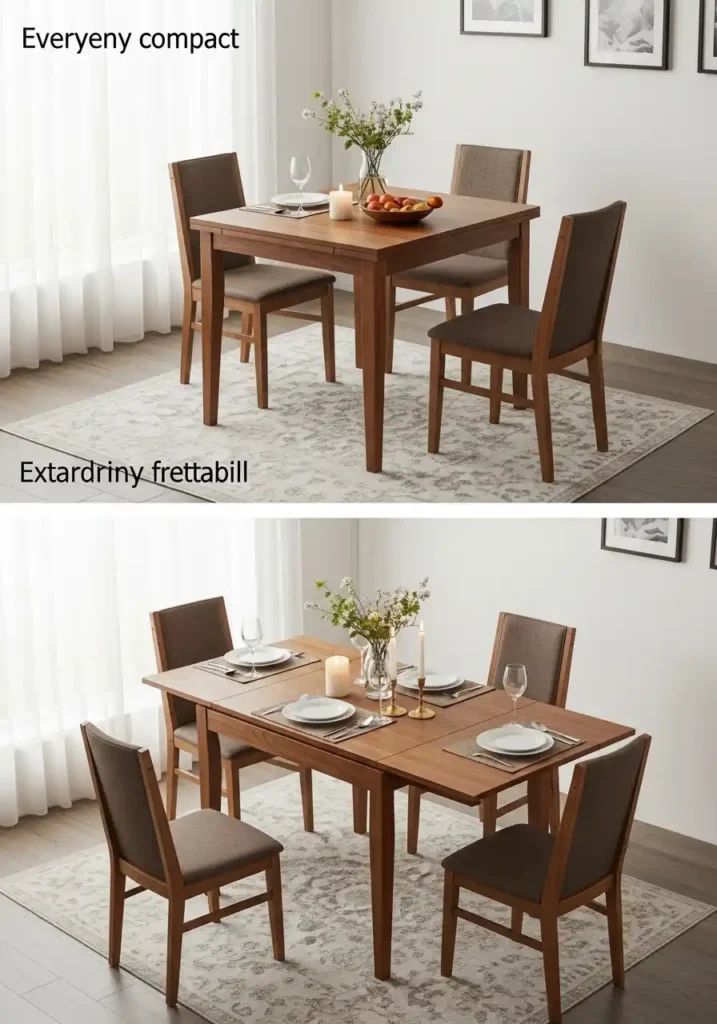
The extendable dining table is the single most liberating furniture investment available for compact living dining areas — because it resolves the fundamental contradiction at the heart of small-space dining more completely and more elegantly than any other furniture solution: the need for a table compact enough to live with graciously every single day and generous enough to seat real guests properly when entertaining requires it. In its everyday compact configuration, an extendable table sits small, leaves generous floor space around it, and allows the dining area to feel open, unconstricted, and proportionate to the compact space it inhabits. At dinner party time, it expands in under a minute into a proper, generous dining table.
The specific extension mechanism of an extendable dining table matters enormously in a compact living context — and the butterfly leaf mechanism that stores the additional table leaf within the table base and deploys without removing any separate stored section is the most compact, most elegant, and most genuinely convenient extension system available. A butterfly extension mechanism means there is no separate leaf to store in a cupboard, no awkward manoeuvring of a removed section across the dining area, and no hunting for a stored piece under a bed or behind a sofa when guests arrive unexpectedly. The table simply pulls apart at the center, the stored butterfly leaf rises and unfolds from within the base, and the table doubles in size with the smooth, satisfying ease of a well-engineered mechanism doing exactly what it was designed to do.
10. Dining Area Under the Stairs — Hidden Gem of Compact Living
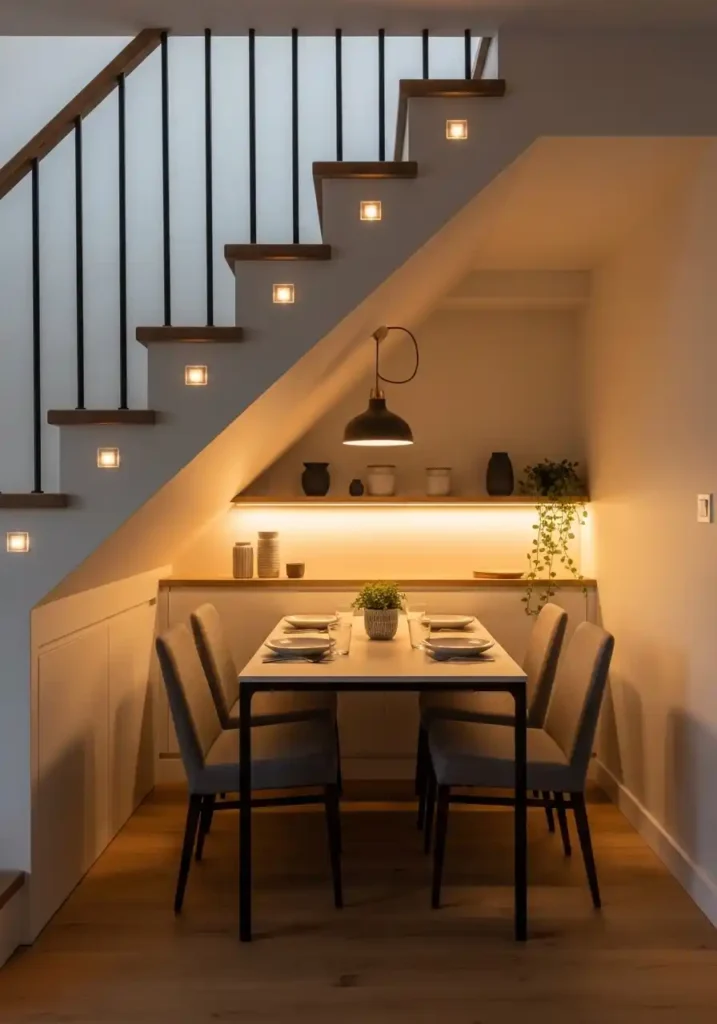
The under-stair space in a compact home is the most dramatically underused and most creatively undervalued architectural feature in domestic design — routinely used for shoe storage or cleaning equipment or simply left empty when it could, with relatively modest intervention and genuine design vision, become the most characterful, most intimate, and most genuinely beloved dining area in the entire home. The under-stair dining area has qualities that no conventionally positioned dining table can replicate: the sloping ceiling creates a natural enclosure that makes the space feel specifically and intentionally dedicated to dining, the surrounding stair structure provides three sides of physical definition, and the slight separation from the main room creates a feeling of genuine, private retreat.
The lighting of an under-stair dining area is the design decision that transforms it from a practical use of architectural dead space into a genuinely atmospheric and genuinely beautiful dining destination. Recessed LED lights fitted into the stair risers or the underside of the stair structure above the dining area create a warm, even, low-level illumination that fills the enclosed space with a quality of intimate, enveloping light that no pendant from a flat ceiling could replicate. A small pendant hung from the highest point of the sloping under-stair ceiling — even if that highest point is not very high — adds a focal decorative element. And candles on the table complete a dining atmosphere of such concentrated, warm, private beauty that this is the spot every member of the household will compete to sit in.
11. Studio Apartment Dining Area That Does Triple Duty
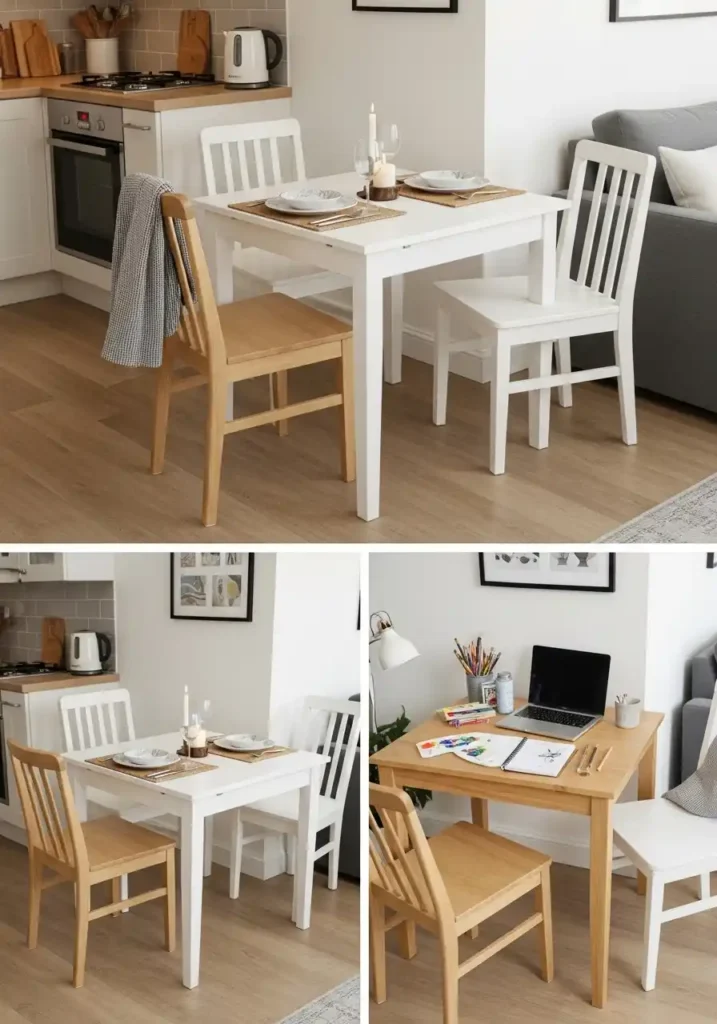
A dining table in a studio apartment is never just a dining table — it is the home’s primary horizontal work surface, its only dedicated desk space, its craft and hobby table, its gift-wrapping station, its puzzle and board game platform, and its occasional overflow surface for every domestic activity that requires a flat, clear, properly lit working area. Designing a studio apartment dining area around this multi-functional reality rather than treating the table as a dedicated dining piece that happens to be used for other things produces a space that is both more beautiful and more genuinely practical — because every design decision can be optimized for the full range of actual uses rather than for the idealized, rarely achieved state of a dedicated dining room.
The specific furniture qualities that make a studio apartment dining table genuinely excellent across its full range of functions are a smooth, cleanable surface of adequate size that works for dining, working, and crafting with equal comfort; a height precisely calibrated to standard dining and desk height so the same chairs work properly for eating and for extended computer work; and a visual simplicity that makes the table look appropriate and intentional in dining mode, working mode, and every other mode without requiring any reconfiguration or any table dressing to justify its presence. A white or natural oak table with clean lines and no fussy detail meets all of these requirements elegantly and makes the studio apartment dining area a genuinely hardworking, genuinely beautiful centerpiece of compact daily life.
12. Outdoor-Adjacent Dining Area That Borrows Garden Views
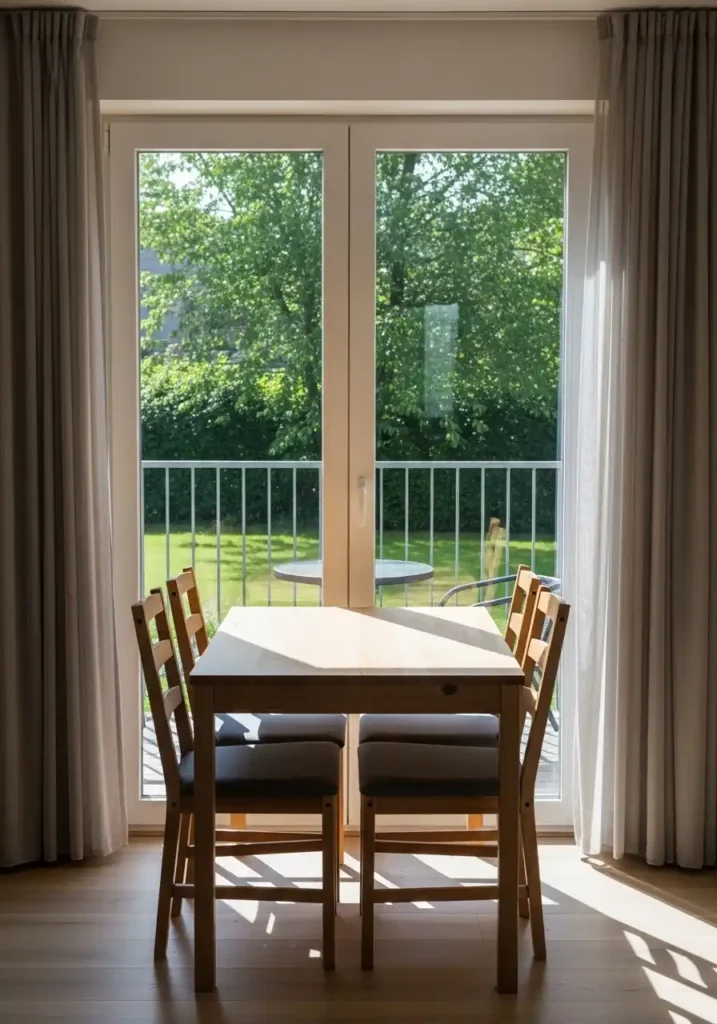
Positioning a small indoor dining area directly adjacent to glass doors or large windows that open onto a garden, a terrace, or even a modest balcony creates one of the most spatially generous and most atmospherically beautiful dining experiences available in a compact home — because the glass boundary allows the dining area to visually borrow the space of the outdoor environment beyond it, making the compact interior dining area feel connected to and continuous with a much larger natural space that extends infinitely beyond the glass. The garden view during a meal is the most effective and most beautiful spatial expansion available to any compact dining area, and it costs nothing beyond the positioning of the table.
The indoor-outdoor dining area connection works most powerfully when the visual and material relationship between the indoor dining space and the outdoor space it faces is as seamless and as continuous as possible. Using the same or very similar materials inside and outside — the same flooring material extending from inside through the glass door onto the terrace, the same color palette in both spaces, the same planting echoing the indoor plants — creates a visual continuity that makes the transition between inside and outside essentially imperceptible and makes the borrowed outdoor space feel genuinely, convincingly continuous with the indoor dining area. On warm days, opening the glass doors completely dissolves the boundary entirely, and the small indoor dining area becomes part of a combined indoor-outdoor dining space of genuine generosity and extraordinary beauty.
13. Painted Dining Zone Floor for Instant Area Definition
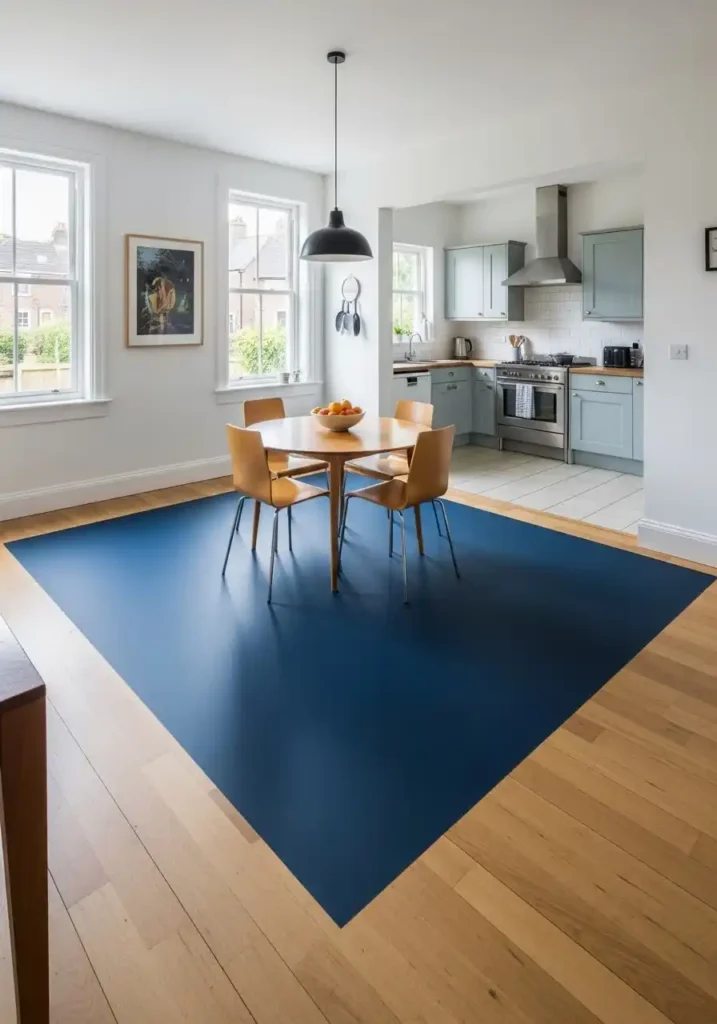
A painted floor zone in a compact open-plan home is the dining area definition technique that delivers the most design impact at the lowest cost and with the most complete integration into the existing floor surface of any zone-definition approach available — because a painted floor zone cannot be tripped over like a rug edge, does not accumulate dust beneath its edges like a rug does, does not slip or bunch like an inadequately fixed rug, and does not need to be cleaned separately from the surrounding floor. It is simply part of the floor — a specifically colored section of the floor surface that defines the dining zone with permanent, clean, graphic precision and then requires no further attention whatsoever.
The color choice for a painted dining zone floor in a compact open-plan home is the design decision with the greatest aesthetic consequence — because the painted zone is always visible from across the open-plan space and always contributing to the room’s overall color story. Deep navy on a warm wood floor creates a rich, dramatic contrast that makes the dining zone feel genuinely important and genuinely distinct from the surrounding living area. A warm terracotta on a pale gray floor creates a warm, earthy definition that suits more casual, organic dining area aesthetics. Forest green on a light floor creates a natural, botanical definition that pairs beautifully with plants and natural materials. Whatever color you choose, size the painted zone generously enough that all four chair legs land within the colored area when chairs are pulled out — this proportional correctness is what makes the painted zone read as a deliberate, beautiful design decision.
14. Dining Area with a Gallery Wall That Gives It Identity
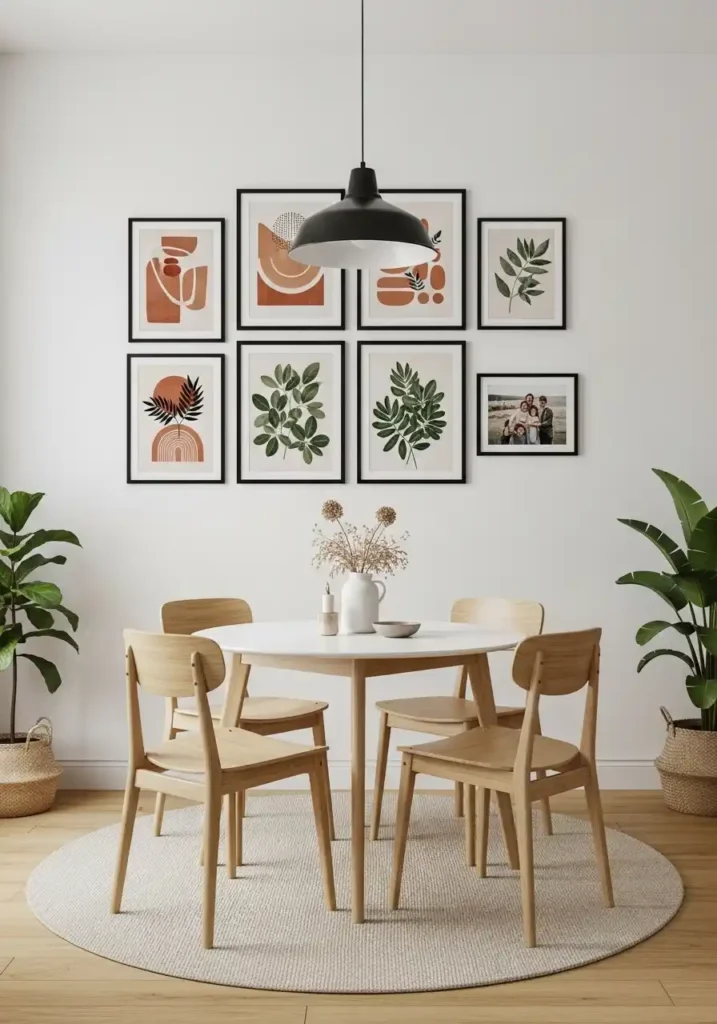
A gallery wall in a compact living dining area is the decorating decision that gives the dining zone its own clear, recognizable, deeply personal identity within a shared open-plan space — making it feel like a proper, dedicated room with its own visual character and its own sense of occasion rather than simply a table and chairs positioned in a corner of a larger space. When a compact dining area has a beautiful, carefully composed gallery wall on the wall it faces, every person who sits down to eat in that space has something genuinely worth looking at, genuinely worth noticing, and genuinely worth thinking about throughout the meal — and the quality of the dining experience is improved by that visual richness in ways that are subtle but real and cumulative.
The gallery wall composition that works most beautifully and most effectively for a compact dining area is one that is both visually rich and tonally cohesive — where the variety of images, subjects, and scales creates genuine visual interest and genuine visual complexity, and the consistency of the frame color, the mat width, and the overall palette creates the visual unity that makes the composition read as a single, considered design statement rather than a random accumulation of framed objects. Choose one frame color throughout — warm black, natural wood, or antique brass — and one coordinated color palette for the artwork within — and the gallery wall becomes a genuinely beautiful, genuinely personal backdrop that makes the compact dining area feel like the most designed, most intentional, most characterful spot in the entire home.
15. Industrial Pipe Shelving Above the Dining Area for Urban Style
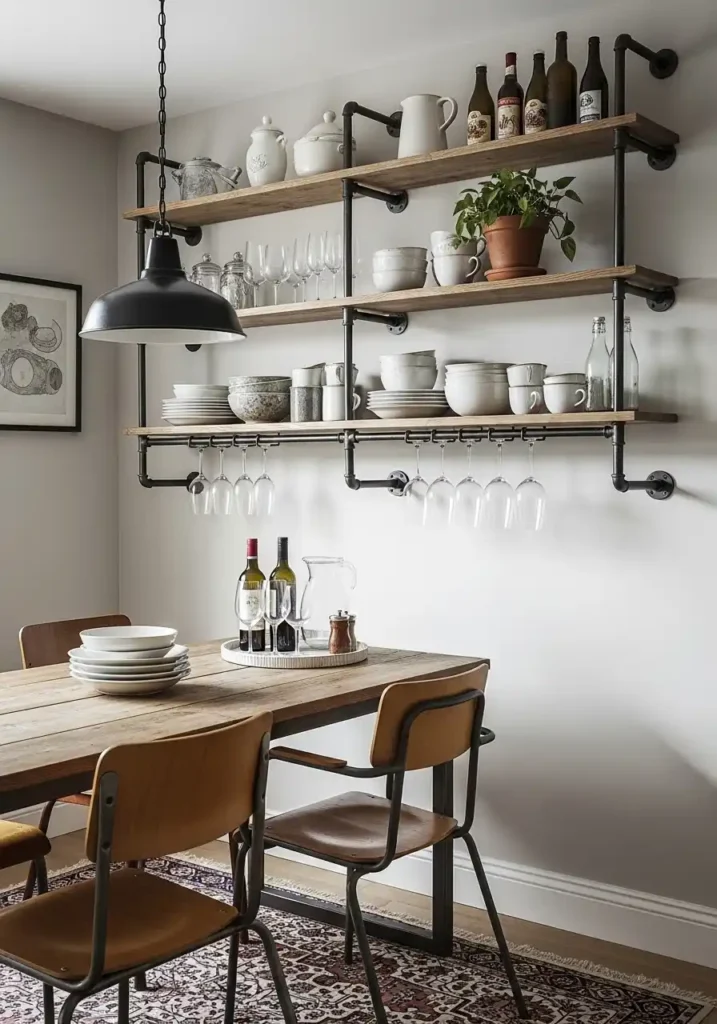
Industrial pipe shelving mounted directly above a compact dining area is the storage and styling solution that simultaneously addresses three distinct compact living needs — providing dining storage in the immediate vicinity of the dining table, adding significant visual character and design identity to the dining zone, and using the vertical wall space above the table that is otherwise completely unused territory in most compact dining arrangements. The black steel pipes and fittings of industrial shelving create a strong architectural framework of genuine visual presence that defines the dining zone’s wall with clarity and character, making the small dining area feel genuinely distinct and genuinely designed within the larger open-plan space.
The specific storage value of industrial pipe shelving positioned above a compact dining table is particularly significant because it locates dining essentials — the plates, glasses, napkins, candles, and wine bottles that are needed at the dining table — at the closest possible point to the table where they are actually used, eliminating the need to cross the room to a kitchen cupboard or a sideboard in an adjacent space every time the table is being set or cleared. This proximity of storage to use-point is a compact living principle of genuine practical intelligence that makes the daily ritual of setting the table more efficient, more convenient, and more genuinely pleasurable. Style the pipe shelves with the same care and the same editorial restraint that any beautiful open shelving deserves, and they become a display of genuine warmth and genuine personality.
16. Dining Area with a Built-In Seat and Hidden Storage
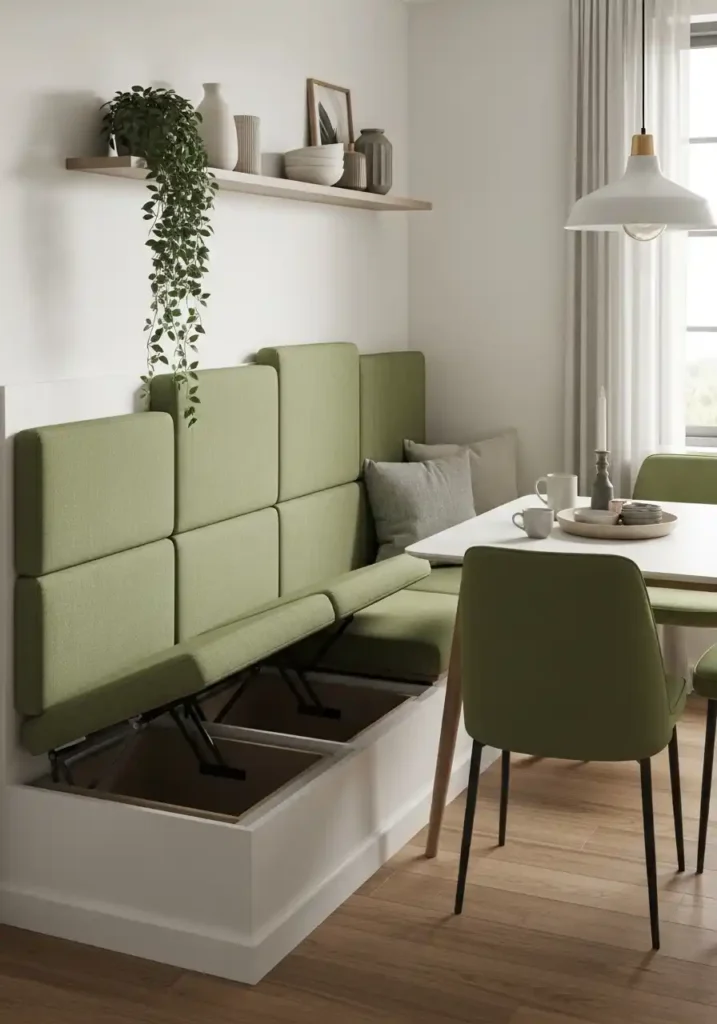
A built-in upholstered seat along one wall of a compact dining area is the custom element that most efficiently and most beautifully resolves two of compact living’s most persistent challenges — insufficient dining seating and insufficient storage — within a single piece of fixed cabinetry that adds architectural quality and genuine design character to the dining zone while consuming the absolute minimum of floor area for the maximum of function delivered. The built-in seat sits flush against the wall with no clearance required behind it, replacing the eighteen to twenty-four inches of chair-pullout clearance that freestanding chairs would need and returning that floor area to the dining zone’s functional circulation space.
The storage capacity of a built-in dining seat is one of compact living’s most genuinely useful and most genuinely liberating hidden benefits — because the compartments beneath a properly designed lift-up seat can be surprisingly deep and surprisingly generous, providing significant concealed storage for dining essentials, seasonal items, and the many household objects that compact homes need to store somewhere but rarely have a convenient, accessible, properly dedicated place for. Three separate lift-up compartments, each with a cushion section above it, provide independently accessible storage without requiring the entire seat cushion to be lifted to access any one section — a practical design detail that makes the built-in seat storage genuinely convenient for daily use rather than just theoretically useful in principle.
17. Small Dining Area Decorated with Plants for Natural Abundance
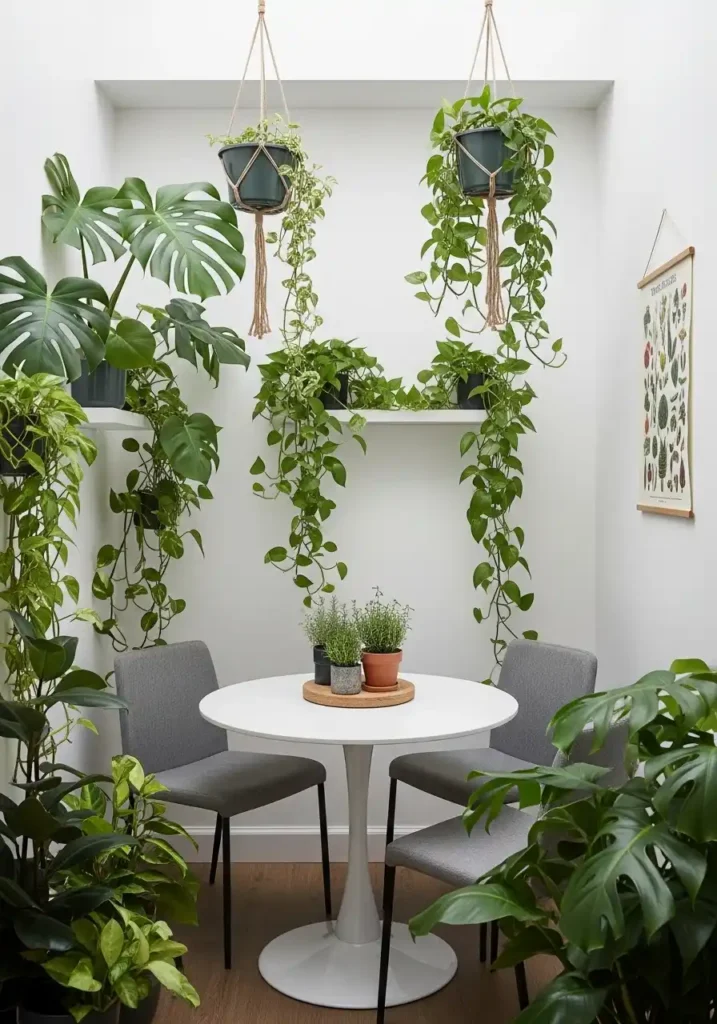
Plants in a compact dining area create the most profound and most genuine transformation of any element you can introduce to the space — not just aesthetically, through the visual richness and the organic warmth of living greenery, but atmospherically, through the specific quality of calm, natural abundance that living plants create in any room they inhabit in sufficient number and sufficient variety. A compact dining area surrounded by plants at multiple heights feels fundamentally, qualitatively different from the same space without them — more alive, more connected to the natural world, more genuinely nourishing as a context for the daily act of eating, and more generous in its apparent dimensions because the eye is drawn to the plants rather than to the walls behind them.
The plant strategy that creates the most beautiful and most spatially effective results in a compact dining area is one that specifically uses the vertical dimension — placing plants at multiple heights from floor level to ceiling rather than confining them to the table and the floor — to fill the full vertical volume of the dining zone with living greenery. A large architectural floor plant in one corner, trailing plants on a shelf at mid-height, hanging plants suspended from the ceiling at varying heights above the table, and a small centerpiece plant on the table itself create a layered, multi-level plant composition that turns the compact dining area into an immersive indoor garden experience of genuine, extraordinary beauty. The plants don’t just decorate the space — they become the space’s most defining and most memorable quality.
18. Mirrored Backsplash Behind the Dining Area
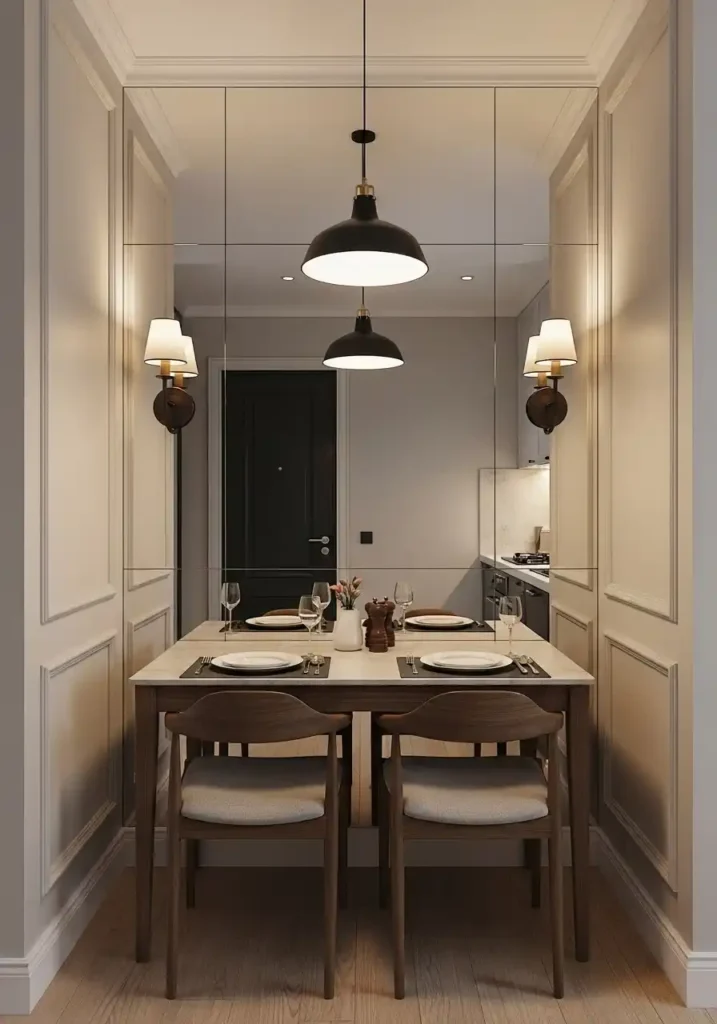
A large mirror installed on the wall directly behind the dining table in a compact dining area is the spatial transformation that produces the most immediately dramatic and the most completely convincing improvement in apparent room depth of any single intervention available — because the mirror doesn’t just add a reflective surface to one wall of the room, it creates the compelling, convincing impression that the dining area extends equally far in both directions from the table, doubling the apparent depth of the space and making the compact dining area feel genuinely, significantly more generous than its actual wall-to-wall measurement. The reflected dining table, reflected pendant, and reflected view through the room all combine to create an apparent dining space of twice the actual size.
The wall sconces mounted on the mirrored wall above and beside the dining area perform a doubly spectacular function — they cast their warm, directional light across the dining table from the mirror wall, and their reflections in the mirror create the impression of additional sconces on the opposite side of a room that is twice as deep as it actually is, filling the apparent doubled dining space with warm light from multiple apparent directions simultaneously. This combination of spatial doubling and light amplification creates a compact dining area of such apparent generosity, such warmth, and such genuine atmospheric beauty that the actual square footage of the space behind the mirror becomes genuinely irrelevant to the quality of the dining experience it creates.
19. Dining Area with Cane and Natural Material for Organic Warmth
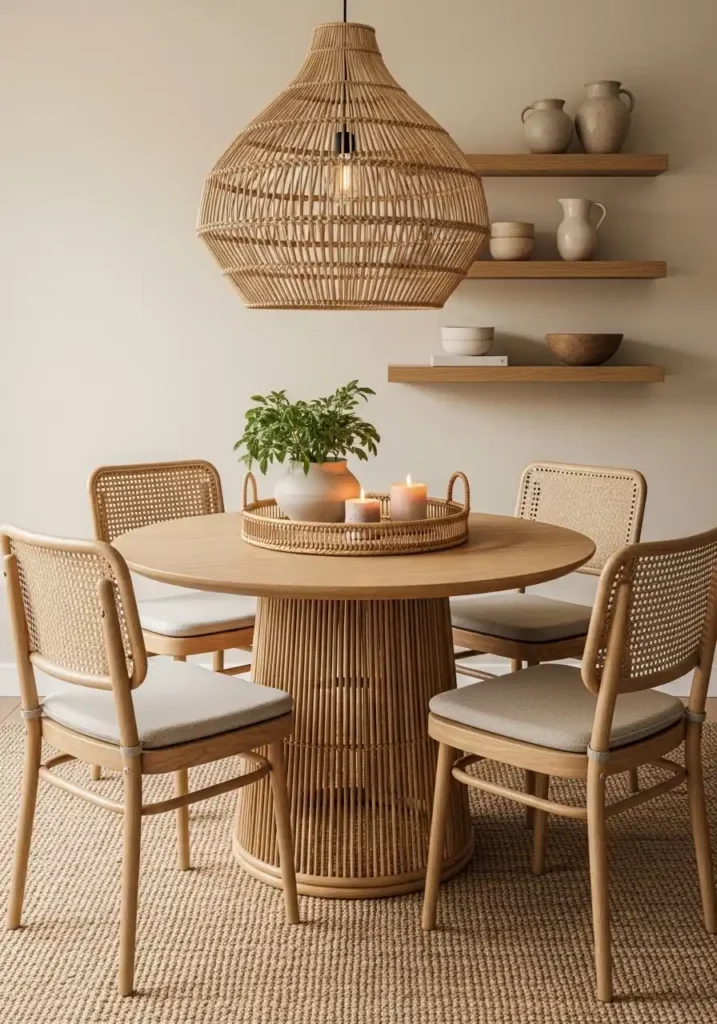
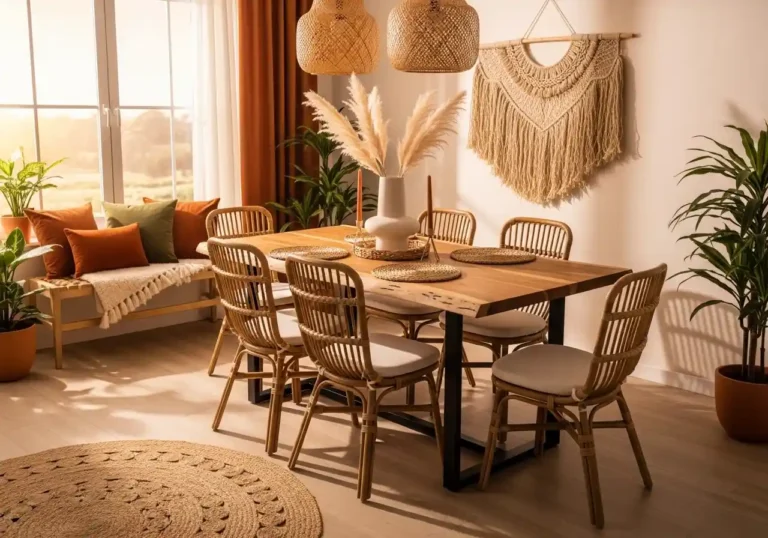
A compact dining area decorated entirely in cane, rattan, seagrass, and other natural woven materials is the design approach that creates the warmest, most organically beautiful, and most genuinely timeless atmosphere of any material palette available for small-scale dining — because natural woven materials have an inherent warmth, an inherent texture, and an inherent connection to the crafted, handmade traditions of cultures around the world that manufactured materials, however beautifully produced, can never fully replicate. The combination of cane, rattan, jute, and linen in a single compact dining area creates a room of such layered natural texture and such honest, unpretentious material beauty that it feels genuinely nourishing to spend time within.
The specific spatial benefit of cane-back chairs in a compact dining area extends beyond their obvious aesthetic warmth into the genuinely practical territory of visual transparency — because the open weave of cane creates a transparency through the chair back that allows the wall behind the chairs to be read through the furniture, contributing to the perception of openness and spaciousness in the compact dining zone that solid-back chairs of identical dimensions could not achieve. Four cane-back chairs around a round table in a compact dining area appear to consume significantly less visual space than four solid-back alternatives, making the natural cane chair choice simultaneously the most beautiful and the most spatially intelligent seating option for compact living dining areas.
20. Two-Person Dining Area for Intimate Compact Living
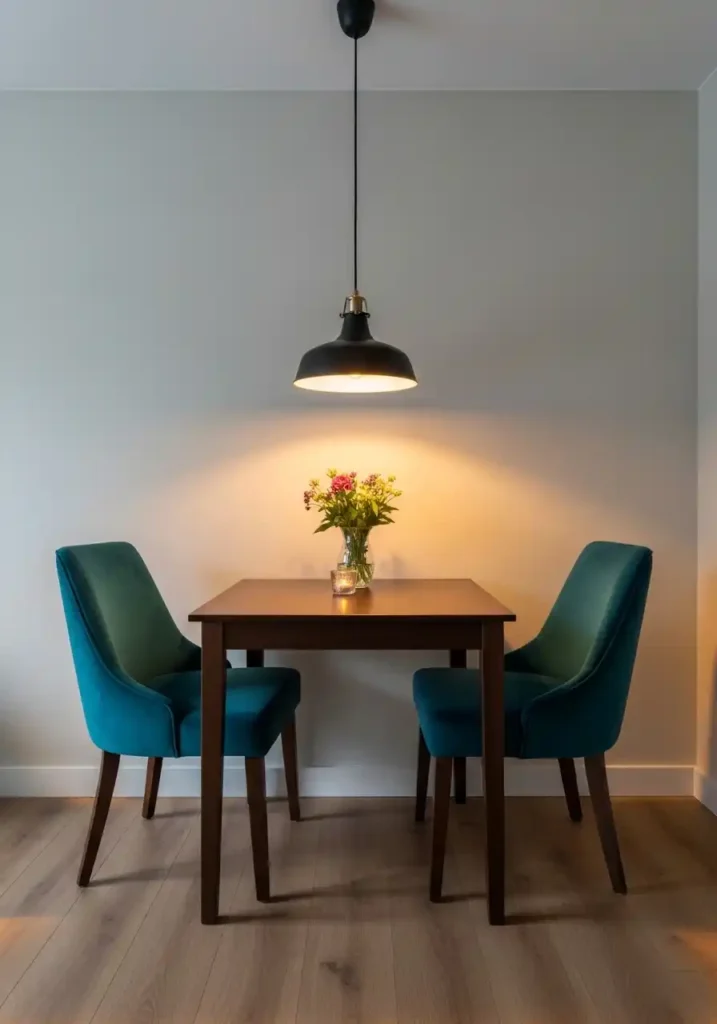
A dining area specifically and deliberately designed for two people — rather than optimized for occasional larger gatherings at the cost of everyday comfort and spatial efficiency — is the compact living dining choice that produces the most beautiful, most comfortable, and most genuinely pleasurable daily dining experience for the people who actually live in the space and eat there every day. A small table for two, properly sized for two place settings with generous elbow room, with two beautifully upholstered chairs that are comfortable enough for a long, leisurely dinner rather than merely adequate for a quick meal, creates a dining area of such intimate warmth and such genuine daily pleasure that the inability to seat six for an annual dinner party seems like a very small price to pay for the quality of every other meal of the year.
The two-person dining area achieves a specific quality of intimate beauty that larger dining arrangements, for all their practical advantages, cannot replicate — because the proximity of two people across a small table creates a face-to-face, genuinely conversational dining dynamic that larger tables with greater distances between diners cannot achieve with the same naturalness and the same ease. A single pendant light hung low between the two chairs creates a warm, focused circle of light that encloses the two diners in their own pool of warmth and privacy. Two chairs in deep velvet facing each other across a small dark table with a candle and fresh flowers — this is the compact living dining area that makes every weeknight dinner feel like the most romantic meal of the year.
21. Dining Area Defined by a Beautiful Ceiling Treatment
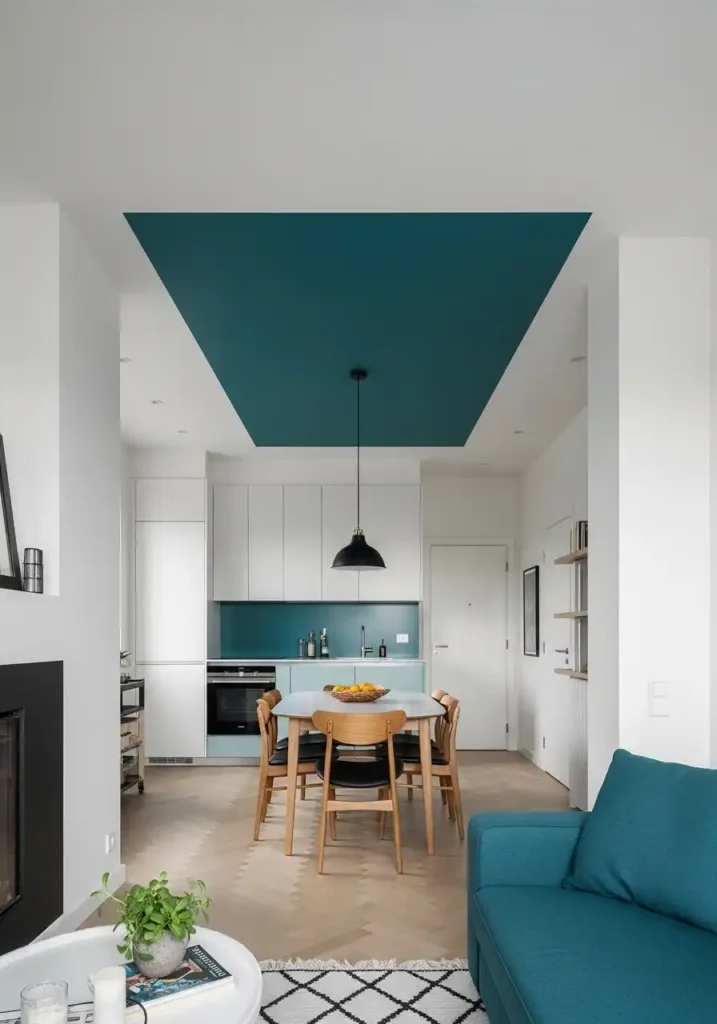
A painted ceiling panel — a rectangle of bold color applied to the ceiling directly above the dining table in a compact open-plan space — is the zone-definition technique that works from above rather than from below, creating a visual boundary for the dining area at ceiling level that is seen from across the entire open-plan space and that provides the most complete, most architecturally clear, and most genuinely original zone definition of any technique in this guide. The colored ceiling panel is visible from every position in the open-plan space, at every moment, in every light condition — it announces the dining zone unambiguously and beautifully from the moment you enter the room, and it gives the compact dining area an architectural identity and a design boldness that no rug, no pendant, and no floor treatment can quite replicate.
The color choice for the dining area ceiling panel is the design decision with the greatest consequence for the entire open-plan space’s aesthetic — because a bold ceiling panel in a compact home is always visible from every living area within it and always contributing to the room’s overall color story from above. Deep teal on a white ceiling creates a rich, jewel-like definition that makes the dining area feel intimate and special. Warm terracotta creates an earthy, organic warmth that makes every meal beneath it feel grounded and nourishing. Forest green creates a botanical, natural quality that pairs beautifully with plants and natural materials. Whatever color resonates most powerfully with your compact home’s overall aesthetic, painting the ceiling rectangle directly above your dining table is the most architecturally ambitious, most visually distinctive, and most genuinely extraordinary zone-definition technique available.
22. Compact Dining Area with Statement Tableware on Display
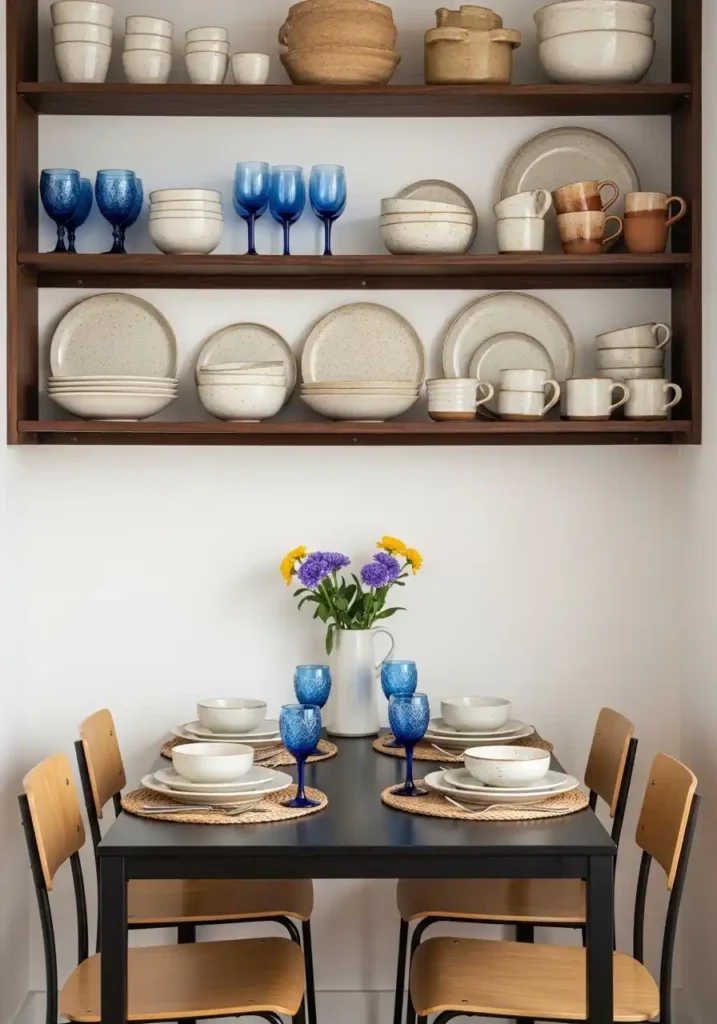
A compact dining area where beautiful tableware is displayed openly on shelves directly adjacent to the dining table is the approach that most authentically and most beautifully reflects the fundamental truth that the objects of the dining table — the plates, the glasses, the bowls, the mugs — are themselves objects of genuine beauty, genuine craft, and genuine material quality that deserve to be seen and appreciated rather than hidden behind closed doors and retrieved only at mealtimes. When handmade ceramics with their organic speckled surfaces, handblown glassware with its subtle color and irregular beauty, and carefully chosen serving pieces are displayed openly in the dining area, they become part of the room’s daily decorative environment and every meal becomes the occasion to take them down and use them.
The curation of displayed tableware in a compact dining area is a collecting practice as much as a decorating exercise — one that rewards genuine attention to the quality and the character of the individual pieces chosen rather than the purchase of matching sets from a single source. A collection of handmade ceramic plates in related but not identical tones — the warm speckled cream of one maker’s work, the slightly more matte surface of another’s, the subtle glaze variation that makes every plate fractionally different from every other — creates a display of genuine craft diversity and genuine handmade beauty that no uniform commercial set can approach. Handblown wine glasses in a soft blue or green tint catch the light on the shelf with a luminosity that makes them beautiful long before they are poured into and raised at the table.
23. The Complete Compact Dining Area — Every Principle Working Together
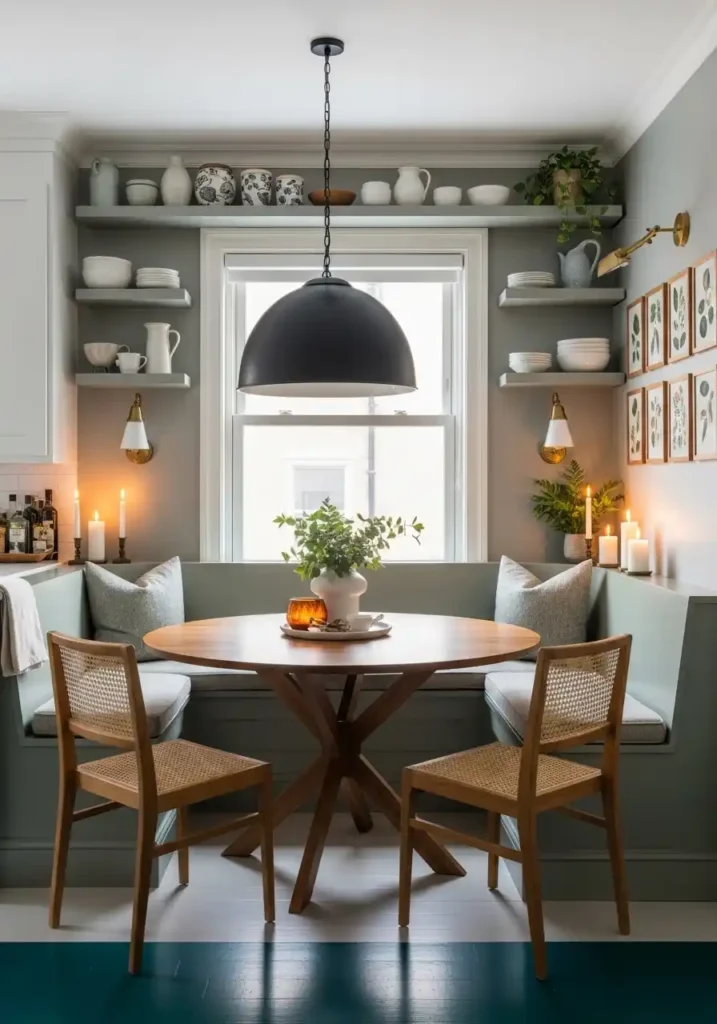
The perfect compact living dining area — the one that solves every spatial challenge with genuine intelligence, meets every practical need with genuine generosity, and creates an atmosphere of genuine beauty that makes every meal within it a pleasure worth anticipating — is always the result of multiple complementary principles working together in a state of complete, reinforcing harmony rather than any single brilliant idea working alone. The round extendable table that manages everyday compactness and entertaining generosity simultaneously. The corner banquette that reclaims ignored space and provides hidden storage. The oversized pendant that defines the zone with warm light. The displayed ceramics that turn storage into decoration. The gallery wall that gives the area its own identity. Each principle amplifies every other.
The invitation this guide offers is both entirely practical and genuinely exciting — because every one of these twenty-three ideas is achievable in a real compact home with a real compact budget, and each one can be implemented incrementally as time and resources allow, with each new element enhancing and building upon everything already in place. Start with the one idea that addresses your most immediate and most pressing compact living dining challenge — the table that doesn’t fit, the storage that doesn’t exist, the zone that doesn’t feel defined — and build your perfect compact dining area from that single confident, intelligent, beautiful starting point. Your compact living space is not a limitation. It is an invitation to design more thoughtfully, more creatively, and more beautifully than any amount of space has ever required.
Conclusion:
Creating a stylish and functional dining space in a compact home is completely possible with the right design choices. These 23 small dining area ideas show that even limited spaces can feel comfortable, practical, and visually appealing. By choosing space-saving furniture, using light colors, incorporating smart storage, and keeping the layout simple, you can make the most of every inch while maintaining a welcoming atmosphere.
Whether you prefer a modern, minimalist, or cozy aesthetic, thoughtful design can transform a small dining area into a beautiful place for everyday meals and meaningful gatherings. With a little creativity and planning, your compact dining space can become both efficient and inviting, proving that great design isn’t defined by size but by how well a space works for you.